United States · single-product record
A two percent salicylic acid toner whose label has been rebadged as BHA plus ceramides, sitting on a 4.5 star record and an eighteen dollar buy box, with a fragrance-free claim its own ingredient list does not support.
information
Identity of the item on the shelf
What the listing states about the product itself, separated from what it claims the product does.
| Product name | Anua BHA 2 Gentle Exfoliating Toner with Salicylic Acid, 5.07 fl.oz |
|---|---|
| Brand | Anua |
| ASIN | B0CDKVXBCG |
| Category path | Beauty & Personal Care > Skin Care > Face > Toners & Astringents |
| Size / format | 150 ml / 5.07 fl oz bottle |
| Marketplace | Amazon US, delivery ZIP 10001, native USD |
| Snapshot date | 2026-11-07 |
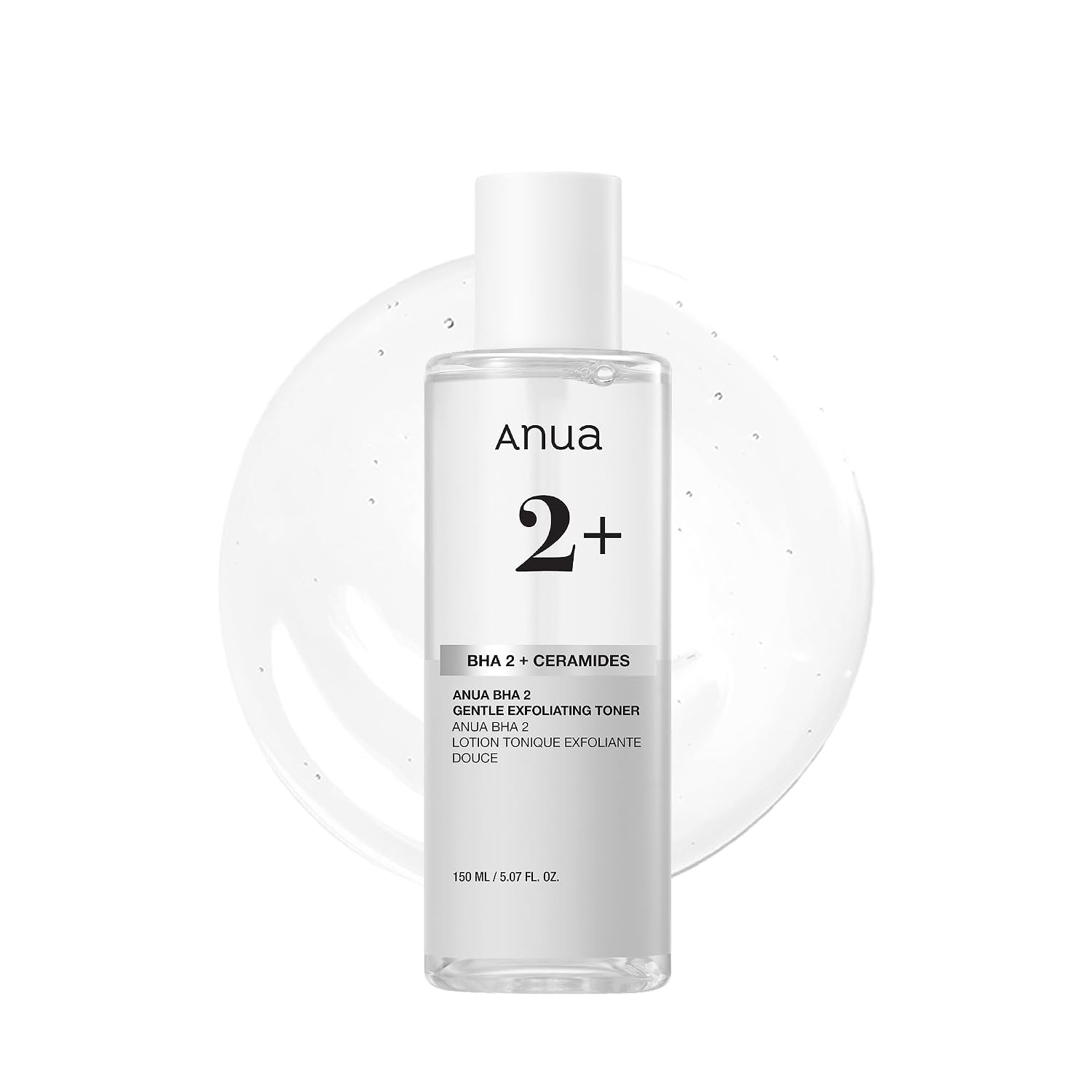
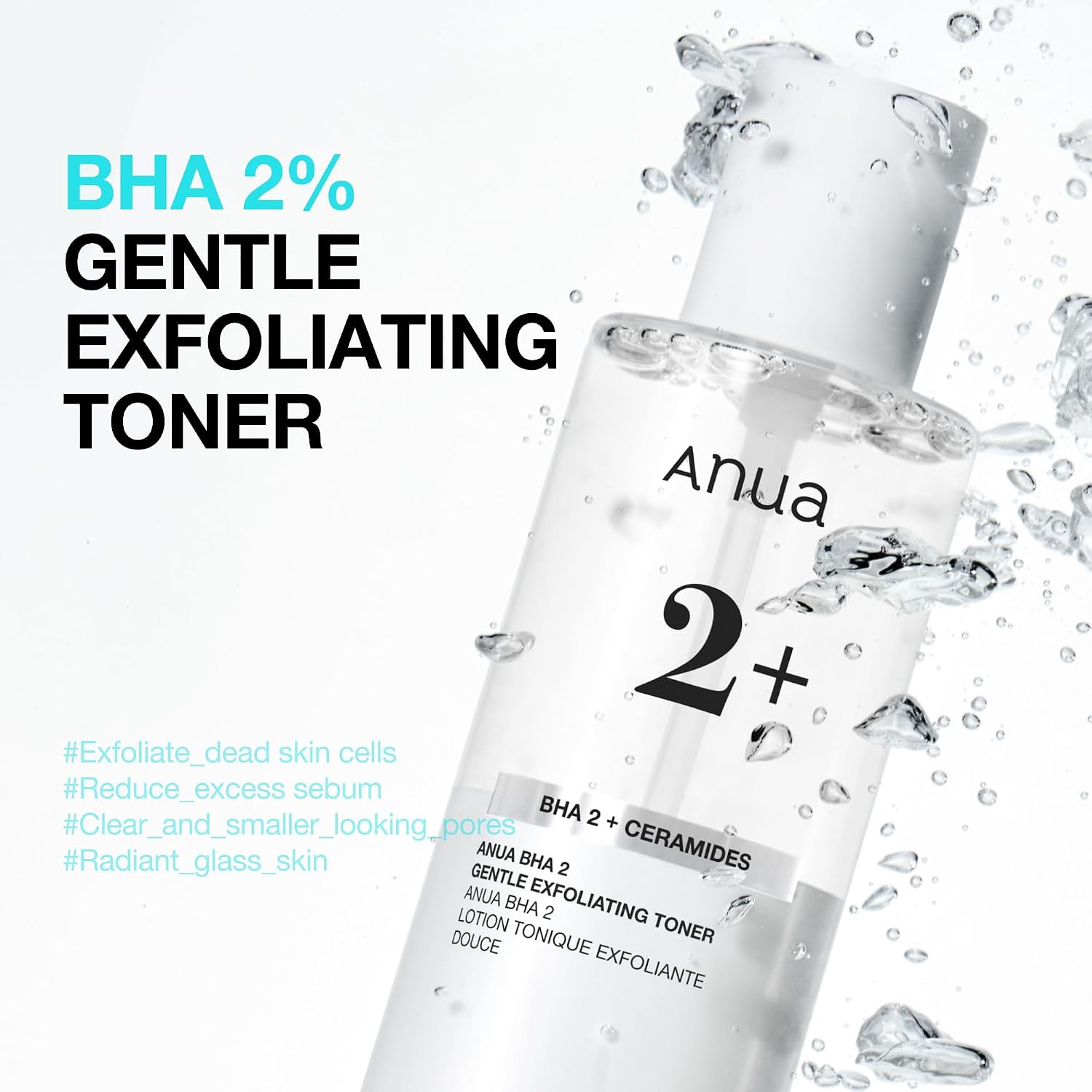
Anua BHA 2 Gentle Exfoliating Toner is a 150 ml liquid toner built around two percent salicylic acid, the beta hydroxy acid the listing credits with clearing excess sebum and dead skin cells. The bottle carries the line name BHA 2 plus Ceramides, and the bullet points back that up with tea tree extract and six ceramides on the soothing side, plus hyaluronic acid and panthenol on the hydrating side. The listing positions the whole formula as mild: fragrance-free, low-irritation, and aimed at oily and combination skin rather than at a single breakout.
The routine printed on the listing is not a daily one. Two to three applications a week after cleansing, swept over the skin and left to absorb before a moisturizer goes on top. That cadence is the listing's own, and it is the only usage instruction the page gives; nothing on the page describes a build-up schedule, a purge period or a pairing rule beyond following with moisturizer.
Promises printed on the listing
Bullet points, reproduced verbatim
- [Deep Pore Exfoliation] Formulated with 2% BHA (salicylic acid) to help remove excess sebum and dead skin cells, improving the look of blackheads and enlarged pores for clearer-looking skin.
- [Soothing & Barrier Care] Infused with tea tree extract and 6 ceramides to help soothe skin while supporting the moisture barrier, leaving skin feeling balanced without dryness.
- [Gentle Daily Formula] Designed for regular use with a mild, fragrance-free formula that helps minimize irritation, suitable for oily and combination skin types.
- [Hydrating Care] With hyaluronic acid and panthenol to help maintain hydration during exfoliation, leaving skin feeling comfortable and non-stripped after use.
- [How to Use] Apply 2-3 times per week after cleansing. Gently sweep over skin and allow to absorb before following with moisturizer.
Specification sheet
| Attribute | Value published |
|---|---|
| Brand | Anua |
| Item form | Liquid toner |
| Skin type | Oily, combination |
| Product benefits | Mild exfoliation, acne scars, improving skin texture, sebum and oil control |
| Recommended uses | Exfoliating |
| Item volume | 150 ml |
| Item weight | 150 g |
| Unit count | 5.07 fluid ounces |
| Item dimensions | 6.15 x 1.85 x 1.8 inches |
| Item model number | bhaexfoliatingtoner |
| Best sellers rank | #16,687 in Beauty & Personal Care; #112 in Facial Toners & Astringents |
| Availability | In stock, sold by Anua |
| Rendered unit price | $3.55 per fluid ounce, derived by the listing from its own unit count |
buyer reports
The score, and the buyers behind it
The average first, the distribution underneath it, then what buyers actually single out.
| Reading | Value | What it measures |
|---|---|---|
| Average score | 4.5 / 5 | Unweighted mean of every rating attached to the listing |
| Total ratings | 1,300 | Ratings, not verified purchases; the two populations differ |
| Five-star to one-star | 25.7 : 1 | A blunt polarity ratio; above ten usually marks a settled product |
Star distribution
Figure 01Share of total ratings falling in each star band.
| Band | Share | Implied ratings | What a rating here usually means |
|---|---|---|---|
| 5 star | 77% | 1,001 | delighted, likely to repurchase |
| 4 star | 11% | 143 | satisfied with a reservation |
| 3 star | 7% | 91 | mixed, the movable middle |
| 2 star | 2% | 26 | a stated promise missed |
| 1 star | 3% | 39 | failed for this buyer |
Shares are rounded as published, so the five bands can total slightly off one hundred. Implied counts are arithmetic on the published share and total, not separate figures.
The published summary
Written by the marketplace from its own review corpus
Customers find the toner effective and appreciate its hydrating properties, with one noting it helps with dry patches. The product makes skin soft and smooth, and customers consider it worth the price point. While some customers find it gentle and non-greasy, others report it irritates their skin and can be drying.
Sentiment by aspect
Figure 02Positive and negative mentions per aspect, stacked.
| Aspect | Mentions | Positive | Negative | Positive share |
|---|---|---|---|---|
| Effectiveness | 84 | 68 | 16 | 81% |
| Gentleness | 44 | 23 | 21 | 52% |
| Skin hydration | 40 | 28 | 12 | 70% |
| Skin texture | 15 | 14 | 1 | 93% |
| Value for money | 13 | 12 | 1 | 92% |
| Non-greasy | 8 | 4 | 4 | 50% |
| Duration | 6 | 5 | 1 | 83% |
Aspect counts are mentions, not buyers, and one review can touch several aspects. A strong share over a handful of mentions is an anecdote; a middling share over dozens is a pattern.
Customer voice
Verbatim review text did not render on the captured page, so nothing is quoted here and no review has been paraphrased into existence. The published summary and the aspect table above are the substitutes, and both are marketplace-generated rather than first-hand.
formula
The formula, level by level
72 declared ingredients, 68 of them carrying a published numeric grade — the split is the story of this section.
The roster below is the declaration as printed on the carton, read against the ingredient databases that answered for this product. Grading is where those sources thin out: 68 of 72 entries carry a numeric comedogenic or irritancy value. Everything here is therefore sorted by how much evidence exists, not by a risk score the data cannot support. Where a number is published, lower is the safer end; an empty cell means missing data, never a zero.
What’s inside, and what is not
- YESAlcohol-free
- YESEU-allergen-free
- YESOil-free
- YESParaben-free
- YESSilicone-free
- YESSulfate-free
- YESFungal-acne-safe
- YESPore-clogger-free
- YESReef-safe
- NONot Fragrance-free
- NONot Cruelty-free
- NONot Vegan
9 met, 3 failed. These are database tests on the declaration, not regulatory certifications.
Classification by evidence level
Figure 03Ingredient count per evidence level, with share of the declaration.
| Level | Class | Count | Share | Test applied |
|---|---|---|---|---|
| 0 | Graded, low | 64 | 88.9% | A published numeric grade below three on every graded axis. |
| 1 | Ungraded, untagged | 4 | 5.6% | No numeric grade and no adverse concern tag. |
| 3 | Graded, high | 4 | 5.6% | A published grade of three or above on some axis. |
Level 0 is the largest group at 64 ingredients. For the two ungraded levels that size is also the weakest evidence: an ungraded ingredient is not a proven-safe one, and reading a blank as a zero is the single most common error this section exists to prevent.
Adverse concern tags, counted
Figure 04How many ingredients carry each concern tag.
| Tag | Ingredients | Members |
|---|---|---|
| Rosacea | 2 | Salicylic Acid (2%), Citric Acid |
| Dryness | 1 | Salicylic Acid (2%) |
| Eczema | 1 | Salicylic Acid (2%) |
| Fragrance | 1 | Melaleuca Alternifolia Extract |
| Psoriasis | 1 | Salicylic Acid (2%) |
Functional families
Figure 05Ingredients per functional family, taken from the first function listed for each entry.
| Family | Count | Share |
|---|---|---|
| Skin conditioning | 20 | 27.8% |
| Antistatic | 17 | 23.6% |
| Moisturizer | 6 | 8.3% |
| Solvent | 5 | 6.9% |
| Antioxidant | 4 | 5.6% |
| Emulsifier | 4 | 5.6% |
| Unspecified | 4 | 5.6% |
| Viscosity Control | 3 | 4.2% |
| Astringent | 2 | 2.8% |
| Surfactant | 2 | 2.8% |
| pH Adjusters | 2 | 2.8% |
| Emollient | 1 | 1.4% |
| Exfoliator | 1 | 1.4% |
| Synthetic ester | 1 | 1.4% |
Benefit coverage
Figure 06Ingredients credited to each declared benefit.
| Benefit | Ingredients | Mechanism as stated |
|---|---|---|
| Hydrating | 13 ingredients | Boosts hydration and relieves dry, tight skin. Carried by the humectant block: the hyaluronic series, dipropylene glycol, pentylene glycol, panthenol and the kudzu and fig extracts. |
| Barrier Repair | 8 ingredients | Strengthen and restore the skin's natural barrier. Five ceramides, cholesterol, phytosphingosine and hydrogenated lecithin form the lipid side of that claim. |
| Anti-Aging | 7 ingredients | Softens lines and helps skin look youthful. In this formula the mechanism is hydration and barrier support rather than resurfacing. |
| Reduces Irritation | 5 ingredients | Eases discomfort and supports skin resilience. Centella extract, panthenol, tocopherol and the elm root extract carry it. |
| Scar Healing | 5 ingredients | Improves the look of marks and scars. Credited to the hyaluronic series, which is a hydration mechanism rather than a remodelling one. |
| Redness Reducing | 4 ingredients | Soothes visible redness and calms irritation. Centella and panthenol are the named members. |
| Brightening | 2 ingredients | Restores radiance to dull, tired skin. Salicylic acid and citric acid, both by way of surface renewal. |
| Good For Oily Skin | 2 ingredients | Balances oil and helps reduce shine. Salicylic acid and white willow bark, the second being the botanical source of salicylates. |
| Dark Spots | 2 ingredients | Fades dark spots for even skin tone. Tocopherol and white willow bark, at the weakest count on the list. |
| Skin Texture | 2 ingredients | Smooths rough patches and refines texture. Salicylic acid and centella. |
| Acne Fighting | 1 ingredient | Fights acne and helps prevent breakouts. Salicylic acid alone carries this claim, at the one ingredient that also fails the dryness and eczema screens. |
| Reduces Large Pores | 1 ingredient | Minimizes the look of enlarged pores. Salicylic acid alone, by way of sebum and keratin clearance rather than any structural change. |
Class-level concerns
| Concern | What it means here |
|---|---|
| May worsen dryness | Flagged on salicylic acid at 2 percent, position 4 of the declaration. The same entry is tagged for eczema and rosacea, and the listing's own advice is two to three uses a week rather than daily. |
| May worsen eczema | Salicylic acid carries the eczema tag. The formula offsets it with five ceramides, cholesterol and panthenol, but an eczema-prone buyer is being warned about the active rather than about the base. |
| May worsen rosacea | Two entries carry the rosacea tag: salicylic acid at position 4 and citric acid at position 19. Neither is present at a trace position, which is why the warning survives to the product level. |
Key ingredient groups
| Group | Count | What it does |
|---|---|---|
| Salicylic acid | 1 | Position 4, declared at 2 percent. The only exfoliant in the formula and the ingredient the whole product is sold on. |
| Ceramides | 5 | NP, NG, AS, AP, NS and EOP across the middle of the declaration, with cholesterol and phytosphingosine. The label line reads BHA 2 plus Ceramides for this reason. |
| Hyaluronic acid | 10 | Sodium hyaluronate and its crosspolymer, the hydrolysed forms, potassium and sodium acetylated salts, and the silanol derivatives. A humectant block rather than a single molecule. |
| Amino acid complex | 23 | Glycine through histidine, from position 47 to 69. The largest single structural feature of the formula and the reason the declaration runs to 72 names. |
| Soothing botanicals | 8 | Tea tree, white willow bark, evening primrose, elm, pine, kudzu, centella and fig. The tea tree entry is also the ingredient behind the fragrance flag. |
The full declaration, in label order
| # | Ingredient | Function | Comedo | Irrit | Safety | Level | Tags |
|---|---|---|---|---|---|---|---|
| 1 | Water | Solvent | EM | EM | 1 | 0 | — |
| 2 | Dipropylene glycol | Solvent, Moisturizer | EM | EM | 1 | 0 | — |
| 3 | 1,2-Hexanediol | Solvent | EM | EM | 1 | 0 | — |
| 4 | Salicylic Acid (2%) | Exfoliator, Whitening | EM | EM | 1 | 0 | Dryness, Eczema, Psoriasis, Rosacea |
| 5 | C12-14 pareth-12 | Emulsifier | EM | EM | 1-2 | 0 | — |
| 6 | Octyldodeceth-16 | Emulsifier | EM | EM | 1-2 | 0 | — |
| 7 | Melaleuca Alternifolia Extract | Skin conditioning, Anti-inflammatory, Plant extract | EM | EM | 2 | 0 | Fragrance |
| 8 | Pentylene Glycol | Moisturizer | EM | EM | 1 | 0 | — |
| 9 | Salix Alba Leaf Extract | Skin conditioning | EM | EM | 1 | 0 | — |
| 10 | Oenothera Biennis Flower Extract | Astringent, Plant extract | EM | EM | 1 | 0 | — |
| 11 | Ulmus Davidiana Root Extract | Skin conditioning | EM | EM | EM | – | — |
| 12 | Pinus Palustris Leaf Extract | Unspecified | EM | EM | 1-3 | 3 | — |
| 13 | Pueraria Lobata Root Extract | Moisturizer | EM | EM | 1 | 0 | — |
| 14 | Centella Asiatica Extract | Skin conditioning, Anti-inflammatory | EM | EM | 1 | 0 | — |
| 15 | Ficus Carica Fruit Extract | Moisturizer | EM | EM | 1 | 0 | — |
| 16 | Hydrogenated lecithin | Emulsifier | EM | EM | 1-2 | 0 | — |
| 17 | Sodium Hyaluronate | Skin conditioning, Moisturizer | 0 | 0 | 1 | 0 | — |
| 18 | Sodium Citrate | pH Adjusters, Antioxidant | EM | EM | 1 | 0 | — |
| 19 | Citric Acid | pH Adjusters | EM | EM | 1-2 | 0 | Rosacea |
| 20 | Xanthan Gum | Surfactant, Viscosity Control | EM | EM | 1 | 0 | — |
| 21 | Disodium EDTA | Viscosity Control | EM | EM | 2 | 0 | — |
| 22 | Panthenol | Antistatic, Skin conditioning, Moisturizer, Anti-inflammatory | 0 | 0 | 1 | 0 | — |
| 23 | Tocopherol | Antioxidant | 2-3 | 2 | 1 | 3 | — |
| 24 | Ceramide NP | Moisturizer | EM | EM | 1 | 0 | — |
| 25 | Butylene Glycol | Solvent, Fragrance, Viscosity Control, Skin conditioning, Moisturizer | 1 | 0 | 1 | 0 | — |
| 26 | Zinc Sulfate | Astringent | EM | EM | 2-5 | 3 | — |
| 27 | Triethylhexanoin | Synthetic ester, Emollient | EM | EM | 1 | 0 | — |
| 28 | Cholesterol | Viscosity Control, Skin conditioning, Emollient, Emulsifier | 0 | 0 | 1 | 0 | — |
| 29 | Hydrogenated Polydecene | Solvent, Fragrance, Skin conditioning, Emollient | EM | EM | 2 | 0 | — |
| 30 | Glyceryl Stearate | Emollient, Emulsifier | EM | EM | EM | – | — |
| 31 | Cetearyl Alcohol | Surfactant, Viscosity Control, Emulsifier | 2 | 2 | 1 | 0 | — |
| 32 | Potassium C11-15 Alkyl Phosphate | Emulsifier | EM | EM | EM | – | — |
| 33 | Ceramide NG | Skin conditioning | EM | EM | 1 | 0 | — |
| 34 | Dimethicone | Skin conditioning, Emollient | 1 | 0 | 2-5 | 3 | — |
| 35 | Ceramide AS | Skin conditioning | EM | EM | 1 | 0 | — |
| 36 | Ceramide AP | Skin conditioning | EM | EM | 1 | 0 | — |
| 37 | Ceramide NS | Skin conditioning | EM | EM | 1 | 0 | — |
| 38 | Dimethylsilanol hyaluronate | Moisturizer | EM | EM | 1 | 0 | — |
| 39 | Hydrolyzed Sodium Hyaluronate | Skin conditioning | EM | EM | 1 | 0 | — |
| 40 | Hydrolyzed Hyaluronic Acid | Skin conditioning, Moisturizer | EM | EM | 1 | 0 | — |
| 41 | Potassium hyaluronate | Unspecified | EM | EM | 1 | 0 | — |
| 42 | Hyaluronic Acid | Moisturizer | EM | EM | 1 | 0 | — |
| 43 | Sodium Hyaluronate Crosspolymer | Skin conditioning, Moisturizer | EM | EM | 1 | 0 | — |
| 44 | Hydroxypropyltrimonium Hyaluronate | Unspecified | EM | EM | 1 | 0 | — |
| 45 | Sodium hyaluronate dimethylsilanol | Skin conditioning, Moisturizer | EM | EM | 1 | 0 | — |
| 46 | Sodium Acetylated Hyaluronate | Viscosity Control, Moisturizer | EM | EM | 1 | 0 | — |
| 47 | Glycine | Skin conditioning | EM | EM | 1 | 0 | — |
| 48 | Glutamic Acid | Antioxidant | EM | EM | 1 | 0 | — |
| 49 | Glutamine | Antistatic | EM | EM | 1 | 0 | — |
| 50 | Lysine | Antistatic, Skin conditioning, Moisturizer | EM | EM | 1 | 0 | — |
| 51 | Leucine | Skin conditioning | EM | EM | 1 | 0 | — |
| 52 | Methionine | Antioxidant, Cell regeneration | EM | EM | 1 | 0 | — |
| 53 | Valine | Antistatic | EM | EM | 1 | 0 | — |
| 54 | Serine | Antistatic, Moisturizer | EM | EM | 1 | 0 | — |
| 55 | Cysteine | Antistatic, Moisturizer | EM | EM | 1 | 0 | — |
| 56 | Citrulline | Skin conditioning | EM | EM | 1 | 0 | — |
| 57 | Asparagine | Antistatic | EM | EM | 1 | 0 | — |
| 58 | Aspartic acid | Antistatic, Moisturizer | EM | EM | 1 | 0 | — |
| 59 | Isoleucine | Antistatic | EM | EM | 1 | 0 | — |
| 60 | Alanine | Antistatic, Moisturizer | EM | EM | 1 | 0 | — |
| 61 | Arginine | Antistatic, Skin conditioning, Moisturizer | EM | EM | 1 | 0 | — |
| 62 | Ornithine | Skin conditioning | EM | EM | EM | – | — |
| 63 | Taurine | Antioxidant | EM | EM | 1 | 0 | — |
| 64 | Tyrosine | Antistatic | EM | EM | 1 | 0 | — |
| 65 | Threonine | Antistatic | EM | EM | 1 | 0 | — |
| 66 | Tryptophan | Antistatic | EM | EM | 1 | 0 | — |
| 67 | Phenylalanine | Antistatic | EM | EM | 1 | 0 | — |
| 68 | Proline | Antistatic, Moisturizer | EM | EM | 1 | 0 | — |
| 69 | Histidine | Antistatic, Moisturizer | EM | EM | 1 | 0 | — |
| 70 | Ceramide EOP | Skin conditioning | EM | EM | 1 | 0 | — |
| 71 | Phytosphingosine | Skin conditioning | EM | EM | 1 | 0 | — |
| 72 | Ethylhexylglycerin | Unspecified | EM | EM | 2 | 0 | — |
EM means the field was empty or the source published no value. A dash in the level column means no numeric grade exists for that ingredient. Below roughly one percent, labels may list ingredients in any order, so the tail carries less concentration information than the head.
How to read the grades
Grades are community-database values, and the two scales read in opposite directions: acne risk and irritancy run from 0 as the safest end upward, while the safety column printed here runs from 1 as the safest end upward as well, so a 1 is the lowest risk and a 5 the highest caution. That is inverse to how the word safety usually reads. 68 of 72 rows carry a safety value, only 7 carry an acne or irritancy value, and four rows carry nothing at all; an ungraded row is unmeasured, not proven safe. Where a cell prints a range such as 1-2 or 2-5 the two source databases disagree, and this report judges on the upper bound. The roster is the full 72-entry declaration read from a packaging-sourced entry; a second database holds the same product with 34 rows, identical through position 25, and the two disagree on tocopherol alone.
monitoring
Every price point the page publishes
Native U.S. dollars against a U.S. delivery address — no conversion, no estimation, no back-fill.
Price sits last in this record because it is the most volatile field in it. Every figure is native U.S. dollars read in a U.S. delivery context. The historical block covers the whole monitoring record where one could be read, and says plainly where it could not.
| Price point | USD | Basis | Vs one-time |
|---|---|---|---|
| List price | $22.00 | published list price on the tracking record; no struck-through price renders on the listing | +22.2% |
| One-time price | $18.00 | buy box on 2026-11-07, US delivery ZIP 10001 | +0.0% |
| Subscribe & Save | $17.10 | 5 percent off on recurring delivery | -5.0% |
Price history table
| Price type | Lowest | Highest | Current | Average |
|---|---|---|---|---|
| Amazon | No record for this channel | |||
| 3rd Party New | $14.20 2024-03-20 | $18.00 2026-08-17 | $18.00 2026-08-17 | $16.76 |
| 3rd Party Used | No record for this channel | |||
Figure 07Every figure in the price history table above, drawn as bars for direct comparison.
Position and spread
| Metric | Value | Reading |
|---|---|---|
| Current vs all-time low | +26.8% | $3.80 above the floor |
| Current vs average | +7.4% | above the typical shelf price |
| Current vs all-time high | +0.0% | $0.00 below the peak |
| All-time spread | +26.8% | peak minus floor, a rough proxy for promotional depth |
Reading this price block
Every figure is native US dollars read in a US delivery context, with no conversion and no estimation. The buy box showed $18.00 with a 5 percent subscribe-and-save price of $17.10 and no struck-through list price, while the tracking record publishes a $22.00 list price and a third-party current of $18.00 dated 2026-08-17 - the same figure, eighty-two days apart, which is the closest thing to corroboration this capture has. The tracker holds no Amazon-sold record for this item at all, only third-party new, and its own last scan was two months old.
photographs
What the item looks like
Three plates to a row, each carrying its own source line beneath the frame.
notes
Scope, gaps and limits
Everything the figures above cannot tell you, stated rather than smoothed over.
- Verbatim review text did not render on the captured page for this ASIN, so no review is quoted and none has been paraphrased into existence. The published summary and the aspect table stand in for it, and both are marketplace-generated rather than first-hand.
- No buyer-uploaded photographs were rendered at capture time. The count is an observed absence, not a parse failure, and listing imagery is not substituted for user content.
- The A+ content module returned no body copy on this capture, only its carousel navigation labels, so section 01 carries the bullet points and the specification sheet without an A+ distillation. Nothing was reconstructed to fill that gap.
- The price history block carries a third-party-new record only. Amazon-sold and third-party-used rows both print as dashes on the tracking page, which is a published no-data state and not an omission here.
- The tracked current price is dated 2026-08-17, eighty-two days before collection, and the tracker flags it as over seven days old. The buy box figure read directly on the listing on 2026-11-07 matches it, so the number is corroborated even though the series is stale.
- The summary statistics on the tracking page are all-time values on every chart window, so no twelve-month or six-month low, high or average is available and none is stated.
- The listing describes the formula as fragrance-free. The ingredient databases label this product not fragrance-free, resting the call on tea tree leaf extract as a perfuming ingredient and on two entries whose database function is listed as fragrance. No declared parfum appears in either roster, so the disagreement is about fragrance-functioning ingredients rather than an obvious perfume entry.
- The listing's bullet points state six ceramides and the declared roster carries five ceramide entries plus cholesterol and phytosphingosine. The count difference is disclosed rather than smoothed.
- The silicone-free badge is reported as the database printed it, and it was computed on a 34-row roster. The fuller 72-row declaration read for this report contains dimethicone at position 34, so the badge holds on the shorter roster and does not survive the longer one. Silicone-free is therefore the one claim in the grid a reader should treat as roster-dependent.
- The same roster-length difference affects the alcohol-free and oil-free badges, which were also computed on 34 rows. Neither the fuller declaration nor the shorter one contains an alcohol, and no mineral oil appears in either.
- Two ingredient databases disagree on one grade: tocopherol prints acne 2-3 and irritant 2 in one and 0-3 on both axes in the other. Both agree the value is a range topping out at 3, and the report judges on that upper bound.
- Only 7 of 72 ingredients carry a published acne or irritancy grade, and the active ingredient is not among them. Its safety grade is 1, which is the lowest risk band, but that is one column of three.
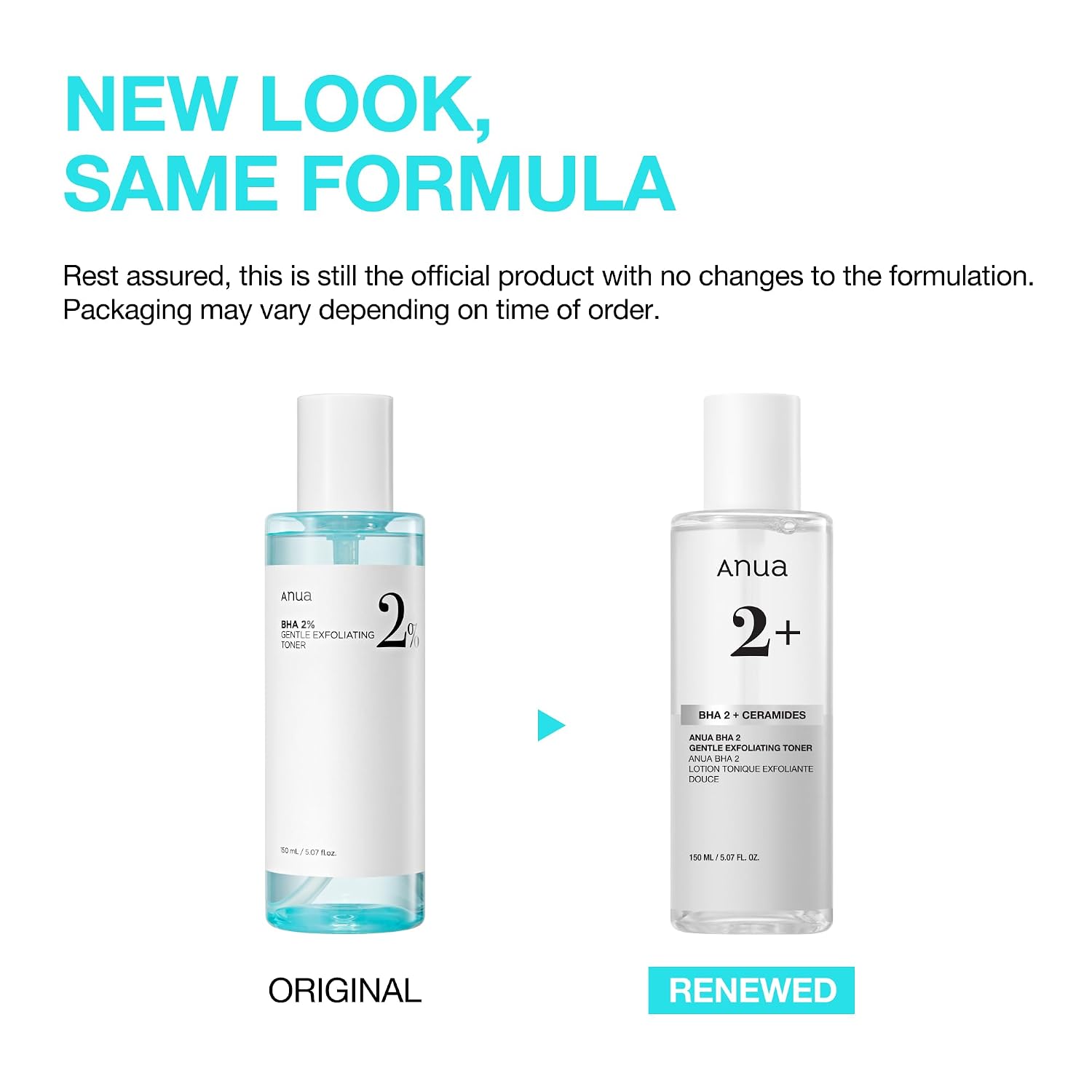
- The ingredient entry is dated 2024-10-15 and sourced from packaging. A reformulation since then, including the packaging refresh the listing itself advertises, would not appear in it.
- The community ingredient-database score for this product is 4.1 out of 5 from 42 reviews, against 4.5 from 1,300 ratings on the marketplace. The two measure different populations and neither is corrected against the other.
- Prices, ranks and rating counts move continuously. Every figure describes 2026-11-07 and nothing else.
- Ratings, prices and ranks move between captures. Every figure here describes the snapshot date on the summary panel and nothing else.
- Ingredient grades are community-database aggregates used as a reference, not a regulatory or dermatological verdict. The carton remains authoritative.
- No reviewer name, handle, identifier or profile link appears anywhere in this record.
End of record · B0CDKVXBCG