Two hundred millilitres of 7% AHA at pH 3.6 — and not one ingredient list anywhere. The pack prints more chemistry than the listing does.
Product information
Two identical 100 ml bottles with dropper-tip caps, filled with a pale amber liquid, sold as one listing. The white label carries four lines and nothing else: GLYCOLIC ACID TONER, a grey band reading Glycolic Acid 7%, the words Exfoliating Toner, and pH ~3.6. Volume is set small at the base: NET:100ml/3.38 FL.OZ.
That label is the most informative object in this entire listing, and the reason is what it leaves out as much as what it prints. There is no ingredient declaration on it — not a partial one, not a "see carton" note, nothing. The carousel shows a front label only, across all six images. So the pack declares its strength and its acidity while withholding its composition, which is the inverse of the usual problem.
The listing sells a 2-pack. The title ends "3.38 FL.OZ", which is the volume of a single bottle. The specification fields resolve the ambiguity — Number of items 2, Unit count 6.76 Fluid Ounces, Size "3.38 Fl Oz (Pack of 2)" — and the page's own unit price of $6.51 per fluid ounce is computed on the 6.76 figure, which is correct.
The problem is that a shopper scanning three listings compares the numbers in the titles. One says 250 ml, one says 5.07 fl oz, and this one says 3.38 fl oz — the smallest figure of the three — while actually containing 6.76 fl oz. The headline volume understates the product by a factor of two and the price per ounce is the highest in the batch. Both facts are true at once, and only one of them is visible without arithmetic.
| Field | Value | Note |
|---|---|---|
| Item volume | 100 ml | Per bottle, not per listing |
| Number of items | 2 | Two bottles |
| Unit count | 6.76 Fluid Ounces | The figure the unit price uses |
| Size | 3.38 Fl Oz (Pack of 2) | Contradicts the title's unqualified 3.38 |
| Skin type | Dry, Oily, Combination | Sensitive skin is absent — and the pack warns against it |
| Material feature | Alcohol Free | Unverifiable without an ingredient list |
| Date first available | not stated | The field is missing entirely |
Rating and reception
This is the lowest-rated product in the batch and it has an unusual distribution: 68% five-star against a 10% one-star tail, with only 22% anywhere in between. A distribution with a solid block at each end and a hollow middle is the shape of a product that people either get on with or do not, with little mild indifference in between — and for a strong acid at low pH that is exactly the expected shape.
On 35 ratings the tail is three or four buyers, so the exact percentage is unstable. What is stable is the pattern: a strong majority satisfied, a meaningful minority who reacted. Combine that with the fifth bullet's own warning to avoid sensitive, flaky or broken skin and the 10% one-star share stops looking like a quality problem and starts looking like a predicted outcome.
The aspect layer contributes almost nothing: two aspects, thirteen mentions, both unanimous. The aspect extractor captured eight mentions of effectiveness and five of skin feel, all positive, and found no negative bucket at all — against a histogram that contains a 10% one-star block. The two layers disagree, and where they do, the histogram is the better evidence because it counts every rating while the aspect layer only reads sentences.
No review text is quoted anywhere in this report and no reviewer is identified. The zero in the negative-aspect row is a limit of the extraction, not evidence that nobody complained.
The formula
This product has no published ingredient list in any reachable channel, and the section is built around that fact rather than around a substitute for it. Four channels were queried: the listing's text, the listing's six images, the ingredient database under both the product name and the brand, and the consumer database under both the product name and the brand. All four returned nothing.
What survives is more than it sounds. The pack prints a concentration and a pH, and those two numbers are enough to reason quantitatively about how strong this product actually is. That analysis is section 3.2, and it is the only substantive chemistry in this report.
| No | Channel queried | What it returned | Materials |
|---|---|---|---|
| 1 | Listing text — the “Ingredients” block | No block present on the page | 0 |
| 2 | Listing images — all six carousel plates | Front label only; no back label, no carton reverse | 0 |
| 3 | COSDNA — product name search | 18 records returned, all other brands | 0 |
| 4 | COSDNA — brand search “Gihen” | No results found | 0 |
| 5 | Skinsort — product search | 20 records returned, all other brands | 0 |
| 6 | Skinsort — brand page | No page exists for this brand | 0 |
Six queries, four channels, zero materials. Two of those results are worth separating from the rest: the brand-level searches returned nothing at all on either database. On the ingredient database that is a stronger statement than a missing product — the brand has no footprint there of any kind, so this is not a product awaiting upload. And on the consumer database the site's coverage of the category is demonstrably broad — twenty glycolic toners came back from one query — so the absence sits inside a well-populated space rather than at its edge.
Glycolic acid is a weak acid with a pKa of 3.83. Whether it exfoliates depends less on how much is in the bottle than on how much of it is *un-neutralised* at the formula's pH, because only the protonated form crosses the stratum corneum. The Henderson-Hasselbalch relationship gives the free fraction directly, and a declared pH of 3.6 with a pKa of 3.83 puts 63% of the acid in its free form.
The number is the point. At pH 3.6 nearly two thirds of the declared 7% is available as free acid. Move the same 7% to pH 4.5 and only about 18% would be free; at pH 5.0 it falls under 7%. So the concentration printed on the front of the bottle and the pH printed underneath it are not two independent features — together they decide the product's real strength, and this pair places it firmly at the aggressive end of the over-the-counter range.
That reading is corroborated by the listing's own warning label. The fifth bullet tells sensitive, flaky and broken skin to stay away, and the skin-type field lists only dry, oily and combination. A manufacturer who prints pH ~3.6 on the front and a sensitive-skin exclusion in the bullets is describing the same property twice, once chemically and once in plain language. It is also consistent with a 10% one-star share.
One honest limit: the tilde is the manufacturer's, not ours. “pH ~3.6” is a target, not a measured batch value, and the calculation above inherits that uncertainty. At pH 3.5 the free fraction would be about 68%; at 3.7, about 57%. The conclusion survives the whole plausible range, but the precise percentage does not.
Eight assertions appear across the listing and the pack. Two can be checked against something the manufacturer printed, five rest on the listing's word alone, and one is an instruction rather than a claim.
| No | Claim | Basis | Reading |
|---|---|---|---|
| 1 | 7% Glycolic Acid | Front label; also the title | Corroborated by the pack |
| 2 | pH ~3.6 | Front label | Corroborated by the pack |
| 3 | Tasmanian pepperberry derivative & aloe vera | Bullet only | Unverifiable — no ingredient list exists |
| 4 | Soothe and hydrate amid mild exfoliation | Bullet only | Unverifiable, and in tension with the pH |
| 5 | Improves the look of fine lines and roughness | Bullet only | Unverifiable |
| 6 | “8 weeks” before-and-after | Image 2 | Not a controlled claim: no sample, no baseline, no product in frame |
| 7 | Suitable for dry, oily, combination skin | Specification field | Consistent with the pack's own sensitive-skin warning |
| 8 | Alcohol free | Specification field | Unverifiable without an ingredient list |
Two of eight is a low evidence ratio and it is worth being blunt about why. The two claims that survive are the two the manufacturer printed on the bottle, and they are also the two that matter most for a product like this. The claims that do not survive are the ones that would sell it: the soothing botanicals, the fine-line improvement, the eight-week photographs. A buyer who wants the exfoliation has what they need; a buyer who wants the soothing story is taking it on trust.
There is no ingredient table, no class donut, no declaration-depth ladder and no tier count for this product, because all four would require materials that no source contains. Nor is the gap filled by borrowing: seven 7% glycolic toners from other brands were returned by the searches, two of them carrying a product name identical to this one, and every one of them was rejected on brand. A plausible ingredient list lifted from a competitor would have been the single easiest way to make this report look complete and be wrong.
The practical consequence for a reader is simple: treat the 7% and the pH as facts, treat the pepperberry and aloe as unconfirmed, and do not assume the formula resembles any other 7% glycolic toner. Different brands use different buffers, humectants and preservatives at the same declared concentration, and none of that is knowable from this listing.
Price
Forty-three dollars and ninety-nine cents for 200 ml, with no list price, no coupon and no Subscribe & Save option. The only number the buyer ever sees is the one on the page.
The tracker's summary table has exactly one value in it — third-party new at $43.99, dated 2026-10-18 — with no low, no high, no average and no Amazon row. One observation cannot produce a range, so the record was read from the chart, which covers about 81 days and looks like this:
Zero price changes in 81 days. This is the only product in the batch whose price record contains no movement at all — the other two each show a real pricing event. A perfectly flat line over that window on a product five weeks old is a launch price being held: no introductory discount, no promotional test, no coupon. Whether the brand can sustain that is not knowable from an 81-day record, but the intent is legible.
Two absences compound the position. There is no list price, so there is no reference against which the $43.99 could be called a saving or a premium. And there is no Subscribe & Save, which is the one discount mechanism available continuously on both other products in this batch. A buyer has no lever here at all.
Comparing headline prices across this batch is misleading, because the pack sizes differ by a factor of three. Normalising to 100 ml makes the position unambiguous.
$22.00 per 100 ml is 90% above the 250 ml product and 48% above the 150 ml one. Per fluid ounce it is $6.51 against $3.43 and $4.40. Whichever unit is used, this is the most expensive product per millilitre in the batch by a wide margin — and it is a 2-pack, which means the total outlay of $43.99 is also the largest of the three.
Value for money was not scored in the review aspects, because the extractor returned no value aspect for this product at all. So the judgement rest entirely on the arithmetic, and the arithmetic is not ambiguous: a 7% glycolic toner at $22 per 100 ml is paying for concentration and acidity rather than for volume.
Images
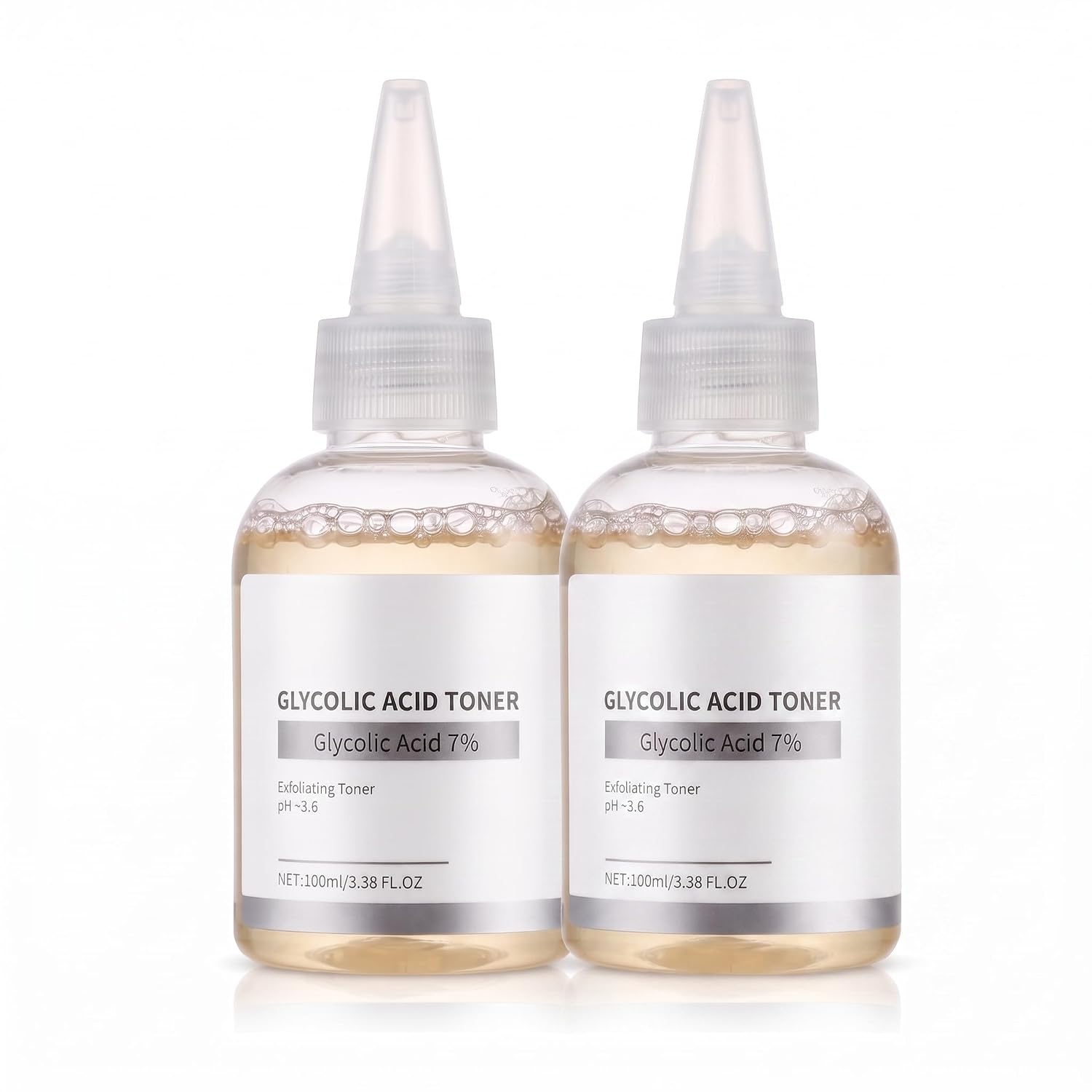
Fig. 1 · both bottles, front label
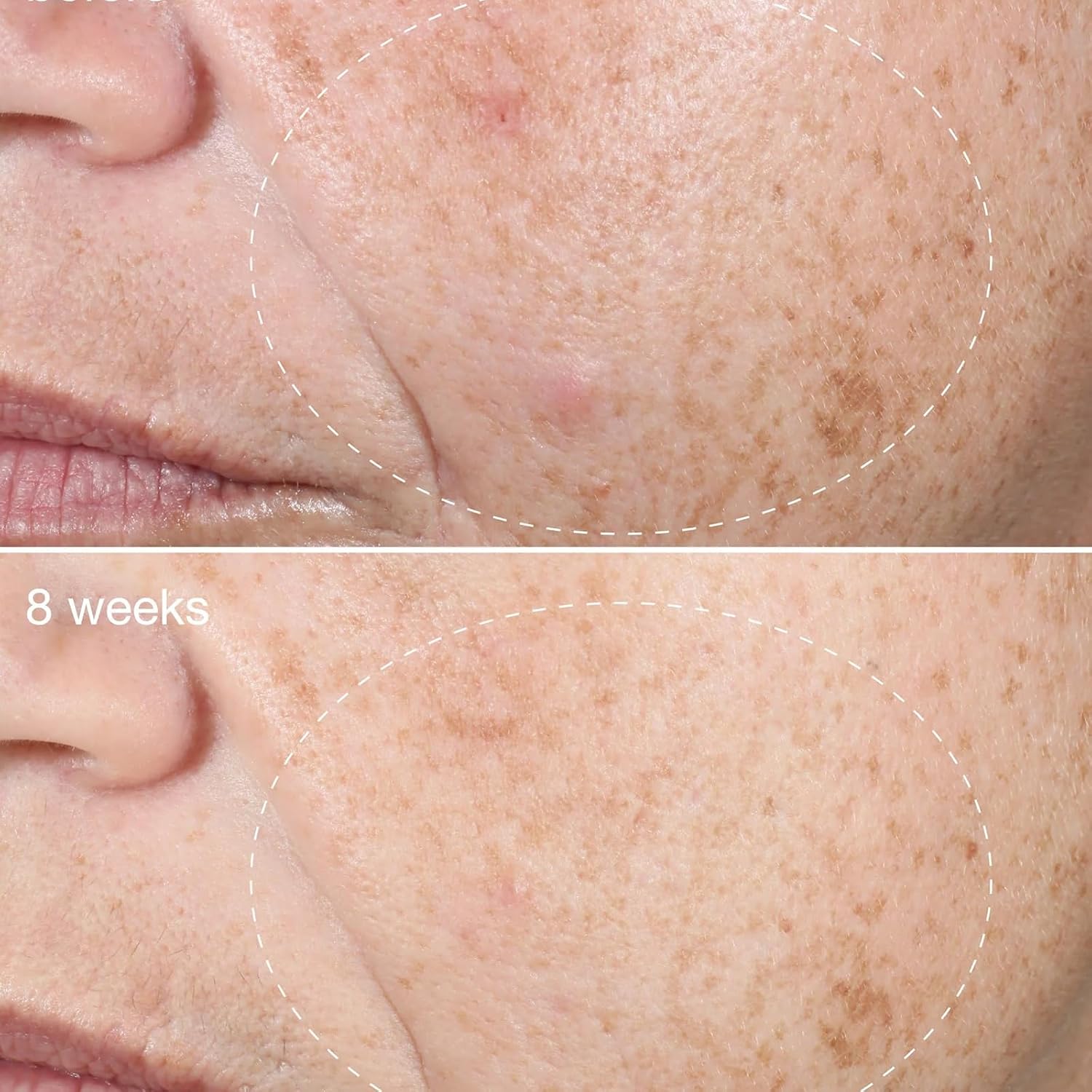
Fig. 2 · 8-week comparison
Fig. 3 · texture macro
Plate one is the most useful image in any of the three reports in this batch. Two bottles, dropper-tip caps, pale amber liquid, and a label that prints `GLYCOLIC ACID TONER`, `Glycolic Acid 7%`, `Exfoliating Toner`, `pH ~3.6`, `NET:100ml/3.38 FL.OZ`. Two of those lines are chemical specifications and they are the only manufacturer-printed data this product offers — more, in fact, than most listings provide in text. It is a front label only, with no reverse shown.
Plate two is a split before-and-after of the same cheek, joined by the words 8 weeks and a dashed circle over the cheek area. There is no product in the frame, no sample size, no statement of what was applied, and no baseline photograph taken under controlled conditions. It reads as evidence and carries none.
Plate three is macro texture art — swirling amber and clear droplets, no product, no text. It conveys that the liquid is golden and thin, which is at least true.
Method and limits
| No | Question | Answer |
|---|---|---|
| 1 | Scope | One ASIN on amazon.com, delivery set to a US ZIP so prices are native USD. No conversion. |
| 2 | Capture date | 2026-11-08, Beijing time. Rank, price and rating are a snapshot. |
| 3 | Ingredient channels | Six queries across four channels: listing text, all six listing images, COSDNA (product and brand), Skinsort (product and brand). All returned zero materials. |
| 4 | What is claimed about composition | Only what the pack prints (7% glycolic acid, pH ~3.6) and what the seller states (alcohol-free, pepperberry derivative, aloe vera). The first two are treated as declarations, the rest as unverified. |
| 5 | Missing data | No review bodies, no buyer photos, no ingredient list, no list price, no date first available. |
| 6 | Arithmetic | Price per fluid ounce and per 100 ml are computed from printed figures. The free-acid fraction is computed from the printed pH and the standard pKa of glycolic acid, 3.83. |
| 7 | Excluded | No reconstructed formula, no borrowed formula, no efficacy claim, no clinical percentage. |
Three limits are worth stating flatly. The free-acid calculation inherits the tilde in the printed pH and would shift by about ten points across the plausible range — the conclusion holds, the percentage is approximate. The rating histogram rests on 35 ratings, so the 10% one-star share is three or four people. And the absence of an ingredient list is a property of the listing, not necessarily of the pack: a physical bottle almost certainly carries a declaration on its reverse that the seller never photographed.
Reviewer names, handles, profile links, avatars and identifiers are dropped at parse time; nothing here identifies an individual buyer. The report names no collection URLs and no source-file descriptions.
Prepared as an independent product analysis. Not affiliated with the brand, the manufacturer or Amazon. Where no ingredient data exists, none is presented — the gap is the finding. Consumer database flags are class-level warnings, not dermatological predictions.