A 250 ml anti-ageing toner that is technically a light emulsion: niacinamide at position six, sixty-three declared materials, and an olive oil that makes it fail four consumer screens.
Product information
The bottle is a tall frosted-white cylinder with a white screw cap and a thin red vertical rule running the length of the label. Printed along that rule: Madeca · Time Reverse Boosting Toner · TECA / Panax Ginseng Root Extract / Ceramide, with 250 ml / 8.45 fl oz set vertically at the left and the Centellian24 wordmark at the base. That label hierarchy is worth noting before anything else, because it is not the hierarchy of the formula: the pack leads with centella, ginseng and ceramide, while the ingredient panel puts niacinamide ahead of every other functional material and the ginseng extract down at position forty-three.
The product is sold as a hydrating toner that also treats. The brand's own one-line definition, as published on the consumer database record, is “an anti-aging toner formulated around Niacinamide and Adenosine to soften the look of wrinkles and strengthen the skin barrier” — a sentence far closer to the actual declaration than the Amazon bullets are. Dongkook Pharmaceutical manufactures it, first listed it on 2026-06-19, and files it under Facial Toners & Astringents at rank #180 in that subcategory.
Five bullets, and they are not written in the same register: two are count claims that a shopper could in principle verify, two are technology claims that no ingredient list can confirm, and one is a brand history. They are set out in full because the audit in section 3.5 turns on exactly which type each one is.
| Claim type | The assertion as printed | Verifiable? |
|---|---|---|
| Count | “8 Hyaluronic Acid Complex” plus Glyceryl Glucoside | Partly — 6 named |
| Count | “9 Peptide Complex” | Yes — exactly 9 |
| Count | “five skin-identical ceramides” | Yes — exactly 5 |
| Technology | “Liposome TECA” | No — delivery form |
| Technology | “Korean Red Ginseng Exosomes” | No — fraction not nameable |
| Clinical | “Clinically proven 6-in-1” | No — zero data published |
| Brand | Dongkook, five decades of centella expertise | Not a formula claim |
The split is the story of this listing. The three claims that can be checked against an INCI list — peptide count, ceramide count, hyaluronic count — are two hits and one miss. The four claims that carry the marketing weight cannot be checked at all.
Rating and reception
A 4.6 average over 67 ratings, on a product first sold on 2026-06-19, is a five-month record with a small and early audience behind it. The distribution matters more than the mean here: 86% of raters gave five stars and the remaining 14% is spread thinly across the other four buckets rather than concentrated in a single complaint cluster. That is the profile of a product that works for the people who bought it, with a small tail of dissenters who did not leave enough of a trail to characterise.
The aspect layer is thin. Amazon's extractor returned two aspects and thirteen mentions in total, against a normal yield of four to eight aspects on a listing of this size; both came back unanimous. “Skin benefits” drew seven mentions, all positive, and “effectiveness” drew six, all positive. Thirteen mentions across 67 ratings cannot support a claim about how the product performs — it can only say that nobody who wrote an aspect-tagged sentence complained.
No review text is quoted anywhere in this report, and no reviewer is identified. The zero in the review-body row is a property of the collection path rather than of this listing: listings with tens of thousands of ratings also returned no bodies on the same capture. The consequence is that every qualitative statement below rests on the formula and on the brand's own copy, never on a buyer's sentence.
Ingredients
This is the section the product lives or dies on, because the formula contradicts the marketing in a specific and identifiable way. The declaration was captured from a single record — the consumer ingredient database that carries this exact brand and product name — because the Amazon listing publishes no INCI block at all and the second database has no entry for the toner. That is a one-channel ingredient table, and section 3.6 says what that costs.
Twelve consumer-facing tags. Eight are positive and six of those are formula-verifiable; four are negations, and all four of the negations are true. The product is genuinely alcohol-free, fragrance-free, silicone-free, sulfate-free, paraben-free and free of EU-declarable allergens — and it genuinely is not oil-free, not pore-clogger-free, not fungal-acne-safe and not vegan.
The bottom-right quadrant is where the argument is. A bottle that markets itself as hydrating, barrier-strengthening and irritation-tested is simultaneously screened out by every “acne-safe” and “oil-free” filter on the market. All four failures trace to one decision — the formula is built as an emulsion, not a solution — and that same decision is what makes the ceramide and lecithin barrier story possible. The trade is real, not a labelling slip.
| No | Concern | Materials | Detail |
|---|---|---|---|
| 1 | May trigger acne | 2 | Olive oil (10) and glyceryl stearate SE (28). The second is the highest-scored material in the table. |
| 2 | May worsen oily skin | 1 | Glyceryl stearate SE alone. |
| 3 | Fungal-acne potential triggers | 4 | Olive oil, babobab seed oil, glyceryl stearate SE, methyl glucose sesquistearate. |
| 4 | Fungal-acne unlikely triggers | 2 | Polyglyceryl-3 methylglucose distearate, polyglyceryl-10 laurate. |
The database prints its own disclaimer and it should travel with any consumer advice: a flag is a class-level warning about a material, not a prediction that this bottle will clog this face. The citation behind it is Draelos and DiNardo, J Am Acad Dermatol 2006. But the count still matters. Six flagged materials, four of them potential triggers, is a lot for a toner, and for anyone managing Malassezia folliculitis — a population that treats fungal-acne safety as a hard filter rather than a preference — this product is excluded on four separate materials. That is not a technicality; it is a real exclusion.
Twelve benefit categories are supported by the 63 materials, and their breadth is wildly uneven. Hydrating rests on 29 materials, anti-ageing on 22, barrier repair on 20. Then the curve falls off a cliff: every one of the last five benefits — brightening, dark spots, acne fighting, good for oily skin, reduced pores — is supported by niacinamide alone.
That is not a criticism of the formula; niacinamide at position six is a genuinely aggressive placement for a toner and it is doing real work. It is a criticism of the “6-in-1” framing. What the data describes is a hydrating, barrier-supporting toner with one well-placed multi-benefit active, plus a peptide tail that adds breadth far more than demonstrated effect.
| No | Material class | Count | Members |
|---|---|---|---|
| 01 | Water and solvents | 5 | Water, 1,2-Hexanediol, Propanediol, Ethoxydiglycol, Benzyl Glycol |
| 02 | Humectants and HA forms | 14 | Fourteen humectants, six of them hyaluronates |
| 03 | Barrier ceramides | 5 | NP, NS, AS, EOP, AP |
| 04 | Emollients and oils | 7 | Two plant oils plus three emollient esters and ginseng |
| 05 | Emulsifiers and rheology | 8 | Lecithin, alketh, three polyglyceryls, carbomer, polyacrylate |
| 06 | Peptides | 9 | Nine peptides at the tail of the declaration |
| 07 | Centella actives and antioxidants | 5 | TECA trio plus tocopherol and cysteine |
| 08 | Amino acids and NMF | 4 | Lysine, arginine, aspartic acid, methionine |
| 09 | Lead actives | 3 | Niacinamide, adenosine, caffeine |
| 10 | Preservative and buffer | 3 | Ethylhexylglycerin, tromethamine, disodium EDTA |
Fourteen humectants is the largest block in the formula and it is why the product reads as hydrating rather than astringent: four glycols and diols open the declaration, and the hyaluronate family closes it. Eight emulsifiers and rheology modifiers is the second surprise for a product sold as a toner, and it is the mechanical cause of the milky appearance.
Position in an INCI list is not a concentration, but it is the only ordering signal the industry publishes, and the gaps between the functional groups here are unusually wide.
Niacinamide opens at six. The centella trio — asiaticoside, madecassic acid, asiatic acid — is distributed across nineteen to twenty-five. Ceramide NP appears at thirty-one with the remaining four ceramides at thirty-nine to forty-two. The nine peptides do not begin until position fifty-one. Thirteen of the last thirteen rows of the declaration are the peptides and hyaluronates the marketing leads with: the standard inversion, where the ingredient a brand prints on the front of the bottle is the one at the back of the list.
| No | Claim | What the panel shows | Verdict |
|---|---|---|---|
| 1 | 8 Hyaluronic Acid Complex | 6 named hyaluronates, 7 counting a glycosaminoglycan | Does not reconcile |
| 2 | 9 Peptide Complex | Tripeptide-1 through palmitoyl tripeptide-5, nine entries, 51-61 | Holds exactly |
| 3 | Five skin-identical ceramides | NP 31, NS 39, AS 40, EOP 41, AP 42 | Holds exactly |
| 4 | Liposome TECA | Asiaticoside 19, madecassic acid 20, asiatic acid 25 | Actives present, carrier unverifiable |
| 5 | Korean Red Ginseng Exosomes | Panax ginseng root extract at 43 | Extract present, exosome fraction unverifiable |
| 6 | Clinically proven 6-in-1 | Hexagon chart with six “+” marks, no scale, no numbers | Unverifiable as printed |
| 7 | Without a sticky finish | Olive oil 10, octyldodecanol 17, babobab oil 23, two glyceryl emulsifiers | Texture claim, not formula claim |
All 63 rows in declared order. Materials in rose are the ones that drive the negative claims; materials in the tinted style carry a comedogenic or irritancy flag.
| Pos | Material | Function | Com | Irr |
|---|---|---|---|---|
| 01 | Water | Skin conditioning, solvent | – | – |
| 02 | Butylene Glycol | Humectant, masking | 1 | 0 |
| 03 | Glycerin | Humectant, skin protecting | 0 | 0 |
| 04 | 1,2-Hexanediol | Skin conditioning, solvent | – | – |
| 05 | Propanediol | Solvent | – | – |
| 06 | Niacinamide | Smoothing, masking | – | – |
| 07 | Betaine | Humectant | – | – |
| 08 | Ethoxydiglycol | Humectant, solvent | 0 | 0 |
| 09 | Panthenol | Skin conditioning | 0 | 0 |
| 10 | Olea Europaea Fruit Oil | Masking, perfuming, skin conditioning | 0–2 | 0 |
| 11 | Ethylhexylglycerin | Skin conditioning | – | – |
| 12 | Carbomer | Emulsion stabilising, gel forming | 1 | 0 |
| 13 | Sodium Polyacrylate | Absorbent, emulsion stabilising | – | – |
| 14 | Adenosine | Skin conditioning | – | – |
| 15 | Tromethamine | Buffering, masking | – | – |
| 16 | Hydrogenated Lecithin | Emulsifying | – | – |
| 17 | Octyldodecanol | Emollient | – | – |
| 18 | Caprylic/Capric Triglyceride | Masking, emollient | – | – |
| 19 | Asiaticoside | Antioxidant | – | – |
| 20 | Madecassic Acid | Skin conditioning | – | – |
| 21 | Disodium EDTA | Chelating | – | – |
| 22 | Glycolipids | Skin conditioning | – | – |
| 23 | Adansonia Digitata Seed Oil | Emollient | – | – |
| 24 | C12-13 Alketh-9 | Emulsifying | – | – |
| 25 | Asiatic Acid | Skin conditioning | – | – |
| 26 | Polyglyceryl-3 Methylglucose Distearate | Emulsifying | – | – |
| 27 | Sodium Hyaluronate | Humectant | 0 | 0 |
| 28 | Glyceryl Stearate SE | Emulsifying | 3 | 2 |
| 29 | Pantolactone | Humectant | – | – |
| 30 | Tocopherol | Antioxidant | 0–3 | 0–3 |
| 31 | Ceramide NP | Skin conditioning | – | – |
| 32 | Methyl Glucose Sesquistearate | Emollient | – | – |
| 33 | Lysine | Skin conditioning | – | – |
| 34 | Arginine | Masking | – | – |
| 35 | Aspartic Acid | Masking | – | – |
| 36 | Glutamic Acid | Humectant | – | – |
| 37 | Methionine | Skin conditioning | – | – |
| 38 | Cysteine | Antioxidant | – | – |
| 39 | Ceramide NS | Skin conditioning | – | – |
| 40 | Ceramide AS | Skin conditioning | – | – |
| 41 | Ceramide EOP | Skin conditioning | – | – |
| 42 | Ceramide AP | Skin conditioning | – | – |
| 43 | Panax Ginseng Root Extract | Emollient | – | – |
| 44 | Phytosterols | Skin conditioning | – | – |
| 45 | Caffeine | Skin conditioning | – | – |
| 46 | Glyceryl Glucoside | Humectant | – | – |
| 47 | Polyglyceryl-10 Laurate | Skin conditioning | – | – |
| 48 | Benzyl Glycol | Solvent | – | – |
| 49 | Hydrolyzed Glycosaminoglycans | Humectant | – | – |
| 50 | Sodium Hyaluronate Crosspolymer | Humectant | – | – |
| 51 | Tripeptide-1 | Skin conditioning | – | – |
| 52 | Hydrolyzed Hyaluronic Acid | Humectant | – | – |
| 53 | Hydroxypropyltrimonium Hyaluronate | Hydrating | – | – |
| 54 | Acetyl Tetrapeptide-2 | Skin conditioning | – | – |
| 55 | Palmitoyl Pentapeptide-4 | Skin conditioning | – | – |
| 56 | Palmitoyl Tripeptide-1 | Skin conditioning | – | – |
| 57 | Hexapeptide-9 | Skin conditioning | – | – |
| 58 | Hexapeptide-11 | Skin conditioning | – | – |
| 59 | Acetyl Tetrapeptide-5 | Humectant | – | – |
| 60 | Copper Tripeptide-1 | Skin conditioning | – | – |
| 61 | Palmitoyl Tripeptide-5 | Skin conditioning | – | – |
| 62 | Hyaluronic Acid | Humectant | – | – |
| 63 | Sodium Acetylated Hyaluronate | Humectant | – | – |
Fifty-four of the sixty-three rows carry no numeric rating on the source record, so this table is a spot check and not a risk profile. Only nine materials have a comedogenic value and only nine an irritancy value. Any statement of the form “this formula scores seven out of ten” would be an average over nine data points masquerading as an average over sixty-three.
Price
There is no list price on this listing and none on the tracker. That single fact shapes everything else about the price position: with no reference price, there is no discount to display, no “was” figure to strike through, and no promotional anchor. The $29.00 is a standalone number, and the only structural alternative is the 10% subscription rate.
At 250 ml the format is deliberately double the 150 ml norm for Korean toners, so the per-ounce figure rather than the headline is what makes it comparable: $3.43 per fluid ounce against a category that clusters around $4.50 for 150 ml bottles. The headline looks expensive; the unit price is not.
The tracker's summary table collapses to a single row — third-party new at $29.00, dated 2026-09-08, with no lowest, no highest and no average, and no Amazon row at all. One observation cannot produce a range, so the record was read from the chart instead, across 103 days from 2026-07-14 to 2026-10-25.
Ninety-seven of 103 days sold at $29.00. The only movement in the entire record is a single step down to roughly $23.20 for about six days in mid-August, from the eleventh to the sixteenth, that reverted without a second attempt. That is a 20% dip, and it is the only one.
A chart of this shape is characteristic of a launch price being held: the August episode reads as a promotional test rather than price discovery, and no second test followed in the eleven weeks to the end of the record.
Waiting has historically saved nothing. The current price is exactly at the mode of its own distribution — every day of the record except six was $29.00 — and the one window when it was not closed in August. The only continuously available discount is Subscribe and Save at $26.10, which is a subscription rate rather than a price event. Two caveats apply before any transaction: the tracker's last observation is 2026-10-25 and its scan is dated early September, so the figure is stale by forty-four days and should be re-verified; and the independent listing capture on 2026-11-08 returned the same $29.00 with a qualified buy box, which supports the number without replacing a live check.
Images
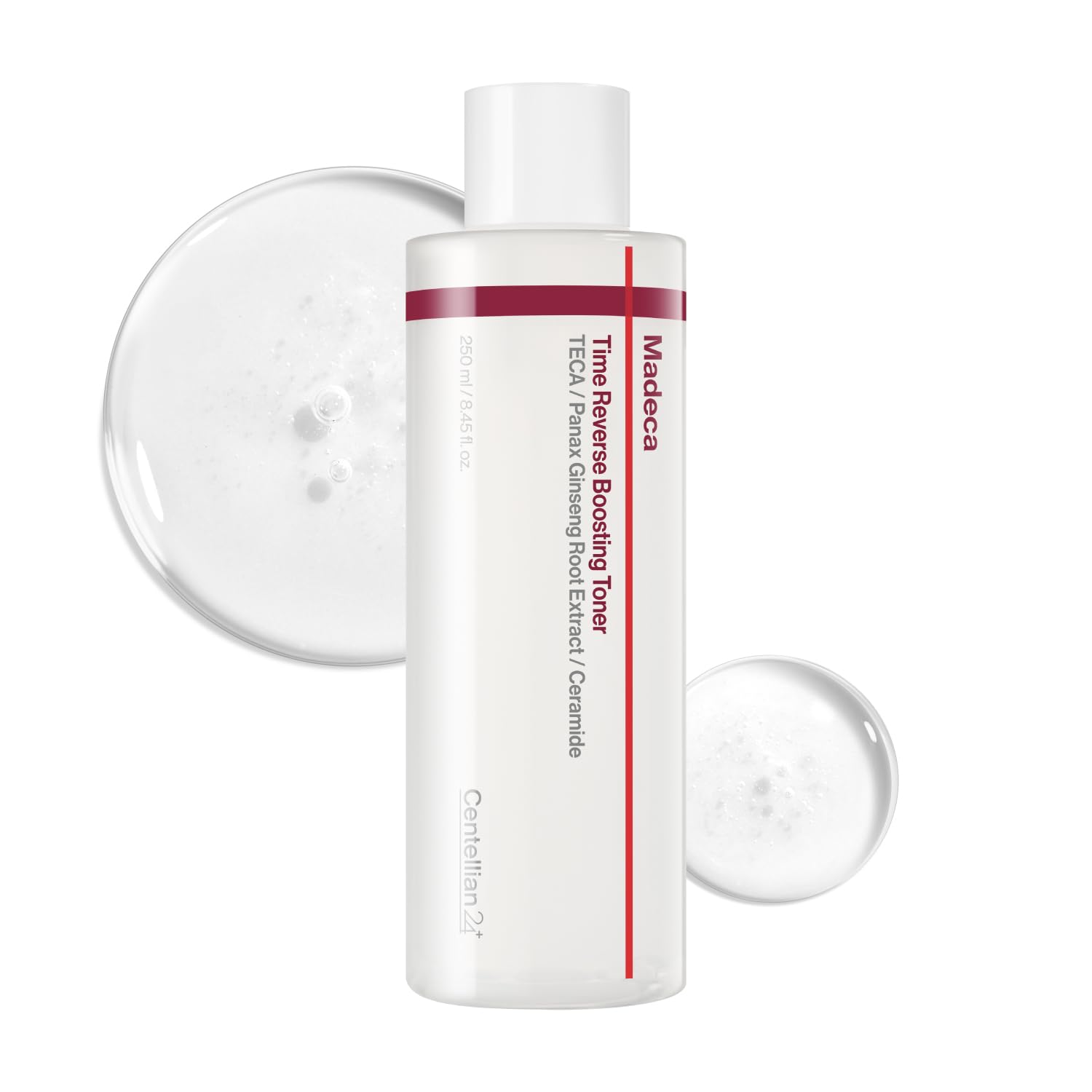
Fig. 1 · pack shot with two swatch discs
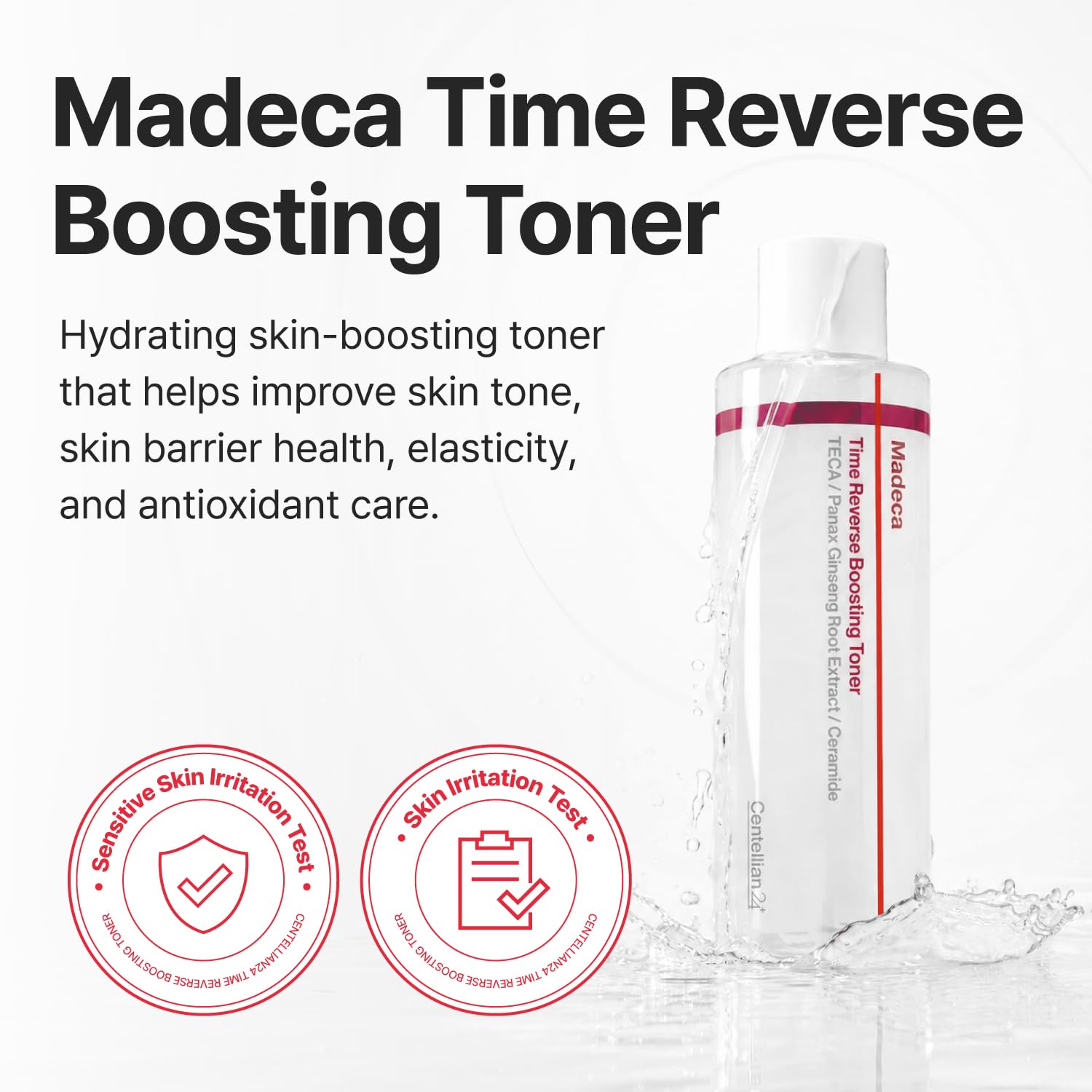
Fig. 2 · benefit panel, two test seals
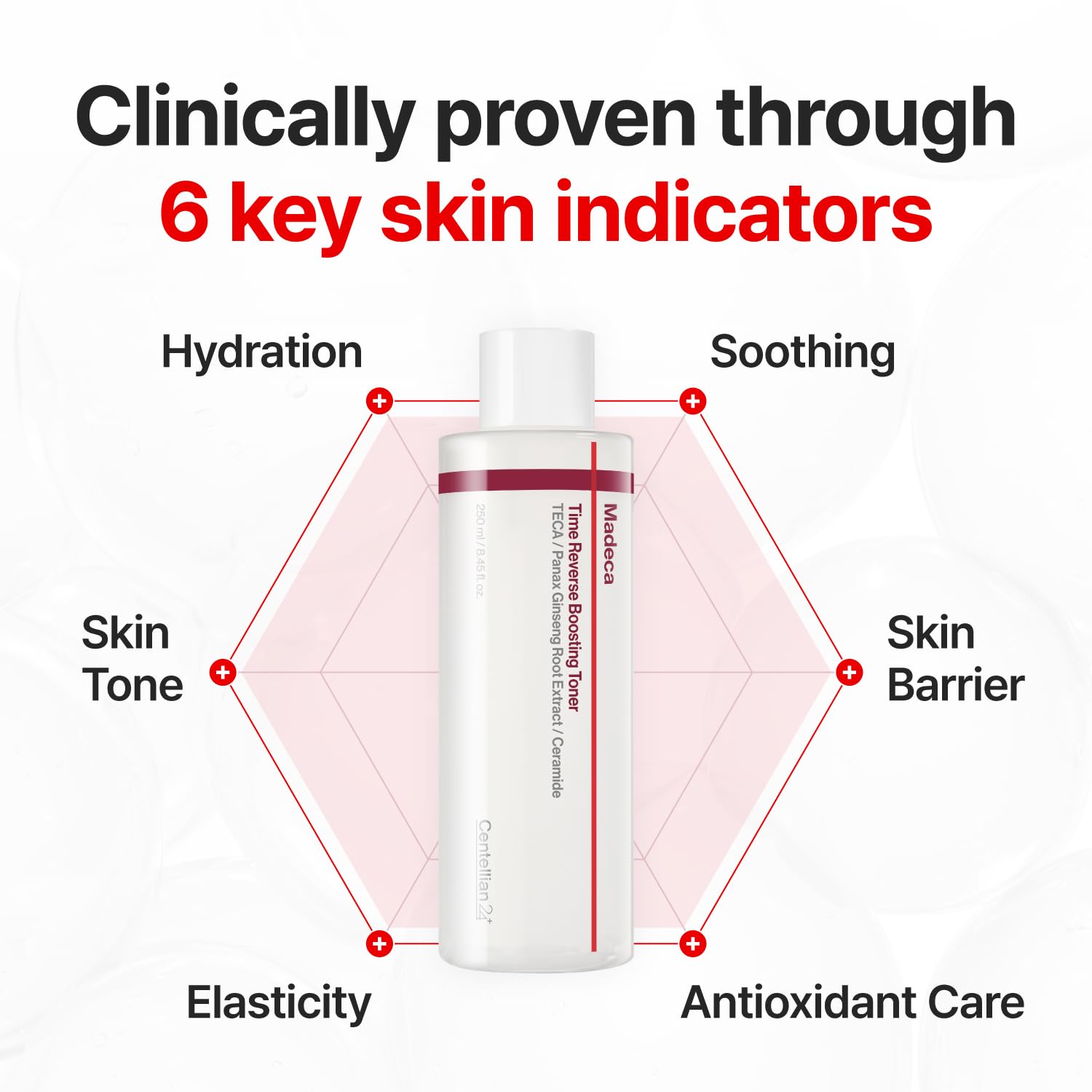
Fig. 3 · six-indicator hexagon
Read together the three plates tell a story the copy does not. Plate one is the only honest photograph: the bottle on white, with two swatch discs that show the fluid is milky and opaque, with visible suspended droplets, not clear water. That single visual detail corroborates the emulsion reading of the formula and contradicts the word “toner” as most buyers use it.
Plate two adds two red seals, Sensitive Skin Irritation Test and Skin Irritation Test, stamped with the product name around the rim and no laboratory, sample size, duration or result. Plate three is the one to look at closely: a hexagon titled “Clinically proven through 6 key skin indicators”, axes labelled Hydration, Soothing, Skin Barrier, Antioxidant Care, Elasticity and Skin Tone, each carrying a “+”, with the polygon filled to the outer edge on all six.
A radar chart with no scale, no numbers and a maximum on every axis is not evidence; it is a diagram of a claim. The listing asserts clinical proof in its first bullet and in its third image, and publishes not one percentage, sample size or test duration anywhere in its extractable copy. Buyers are being asked to accept the shape of the hexagon as the result.
Method and limits
| Question | Answer |
|---|---|
| Scope | One ASIN on amazon.com, delivery set to a US ZIP so prices are native USD. No currency conversion anywhere. |
| Capture date | 2026-11-08, Beijing time. Rank, price and rating are a snapshot. |
| Ingredient channel | One record only. The listing publishes no INCI block; the second database has no toner entry. Identity corroborated by four independent count matches (9 peptides, 5 ceramides, 3 TECA actives, glyceryl glucoside) rather than by a second panel. |
| Missing data | No US review bodies, no buyer photos, no rating on the ingredient record. Each gap is stated where it occurs rather than filled. |
| Arithmetic | Per-ounce, per-ml and percentage figures are derivations and are labelled as such. The $23.20 price level is chart-derived. |
| Excluded | No concentration, pH, clinical percentage or efficacy claim is asserted, because none is published. |
Two limits deserve a sentence each. The formula table is a single-channel record: strong on internal consistency, unconfirmed against a second transcription, and therefore vulnerable to a generation mismatch if the brand has reformulated since the record was created. And the price series is read from a raster chart, not from a data feed: the $29.00 level reproduces the chart legend exactly, but the single dip is only a few pixels deep and should be read as “roughly twenty-three dollars” rather than to the cent.
Reviewer names, handles, profile links, avatars and identifiers are dropped at parse time; nothing in this document identifies an individual buyer. The report names no collection URLs and no source file descriptions.
Prepared as an independent product analysis. Not affiliated with the brand, the manufacturer or Amazon. Ingredient positions are declaration order, not concentrations. Consumer database flags are class-level warnings, not dermatological predictions.