US Beauty & Cosmetics Product Analysis
19 fl oz pump · normal to dry skin · fragrance-free · 60-ingredient formula · snapshot 30 October 2026
01. Product Information
A 19-fluid-ounce pump bottle of cream-to-foam facial cleanser from CeraVe, positioned for normal to dry skin. The listing sells it as a single step that removes long-wear makeup and sunscreen while leaving the skin barrier intact — a format decision that puts it in direct competition with the double cleanse routine rather than alongside it. The formula carries the brand's standard ceramide trio (NP, AP, EOP) with hyaluronic acid, a full amino-acid block, and a surfactant system built on taurate and isethionate rather than sulfates.
1.1 Specification sheet
| Attribute | Value as published |
|---|---|
| Brand | CeraVe |
| Product name | Hydrating Cream To Foam Cleanser, Gentle Face Cleanser, 19oz |
| Category path | Beauty & Personal Care › Skin Care › Face › Cleansers › Washes |
| Best Sellers Rank | #417 in Beauty & Personal Care; #16 in Facial Cleansing Washes |
| Size / unit count | 19 fluid ounces (562 mL) |
| Item form | Cream that lathers to foam; pump dispenser |
| Scent | Unscented |
| Age range | Adult |
| Skin type (claimed) | Normal to dry |
| Item dimensions | 1.5 × 3.63 × 8.48 inches |
| Item weight | 1.3 pounds |
| Package quantity | 1 |
| Manufacturer | CeraVe |
| Model number | 1 |
| Availability | In stock; sold and shipped by Amazon.com |
1.2 What the brand claims
- All-in-one daily cleanser. One-step wash for face and eye makeup removal with long-lasting hydration; removes dirt, excess oil, long-wear makeup and sunscreen residue.
- Cream-to-foam mechanic. Dispenses as a rich cream, converts to foam on lathering; the brand's non-drying claim rests on this texture change rather than on a low-foam format.
- Humectant load. Hyaluronic acid plus amino acids, described as supporting the skin's Natural Moisturizing Factors so moisture is retained after rinsing.
- Three essential ceramides. Ceramides 1, 3 and 6-II, with the claim that ceramides make up 50% of the lipids in the skin barrier.
- Dermatologist-developed. Brand-level claim covering dry, sensitive, oily and acne-prone variants.
- Fragrance-free and non-comedogenic. Also paraben-free and soap-free, framed as gentle enough for sensitive skin without clogging pores.
1.3 Product imagery
Three listing images, shown at source resolution. Each is a studio asset rather than a buyer photo, which matters for how much evidential weight it can carry: they document packaging and marketing claims, not the product in use.
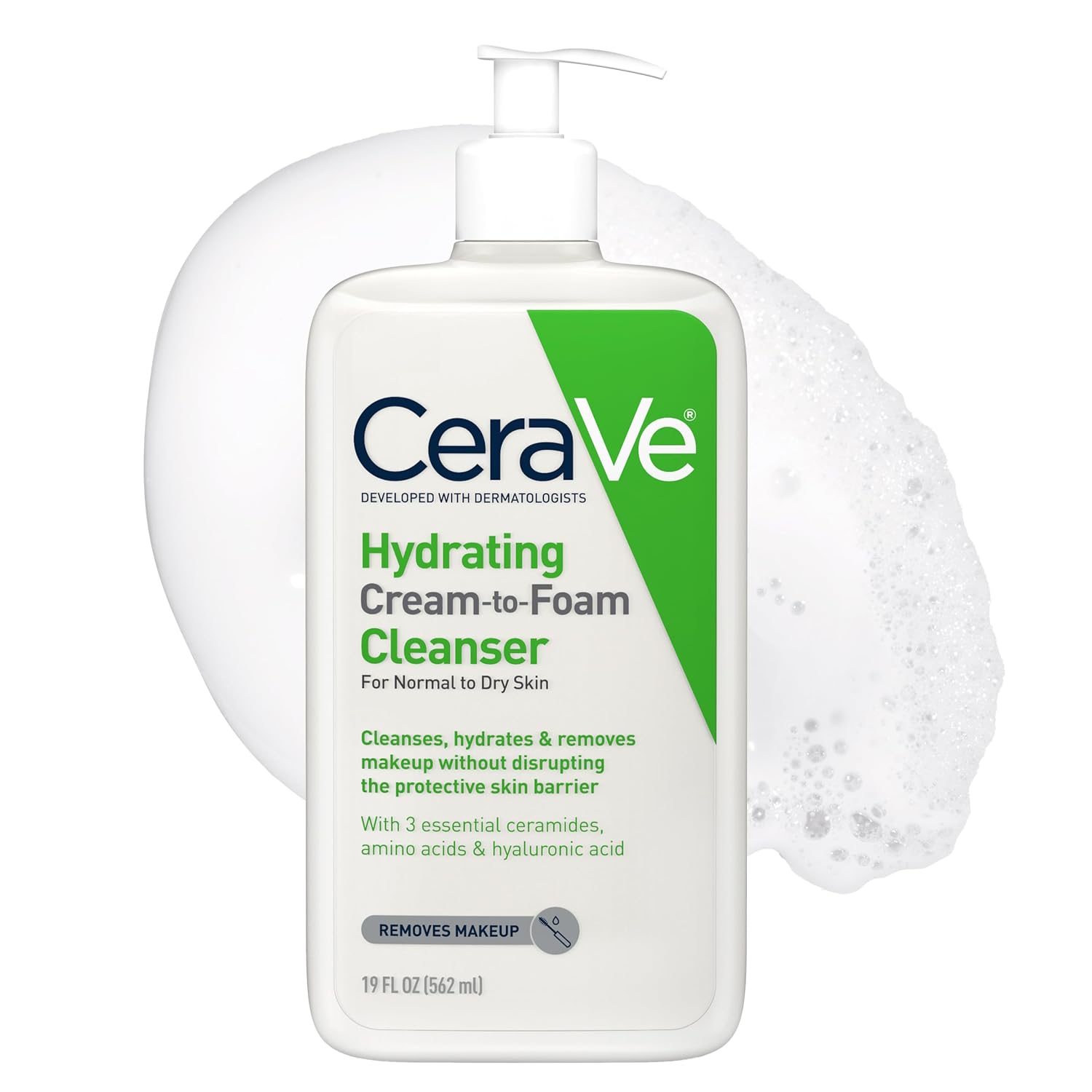
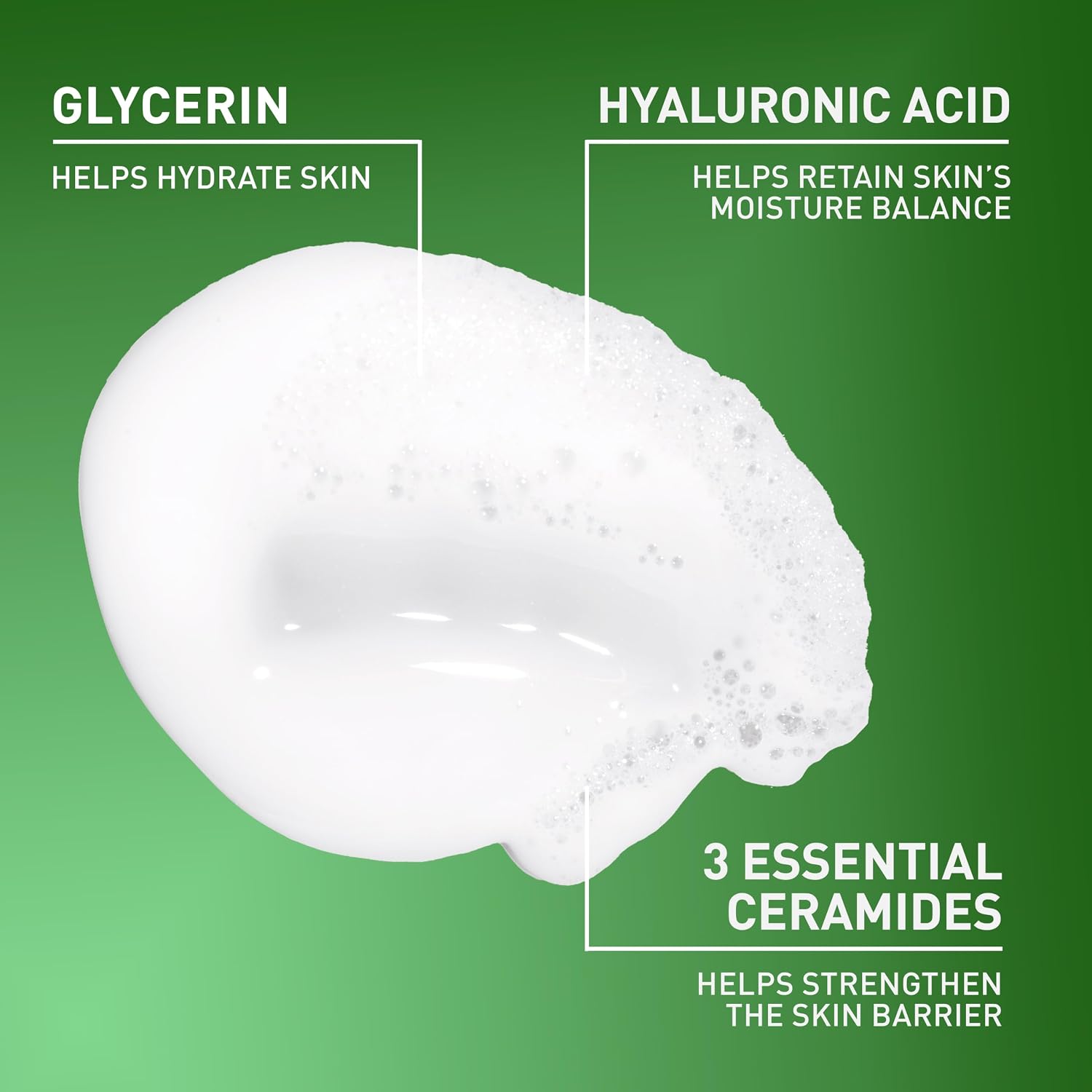
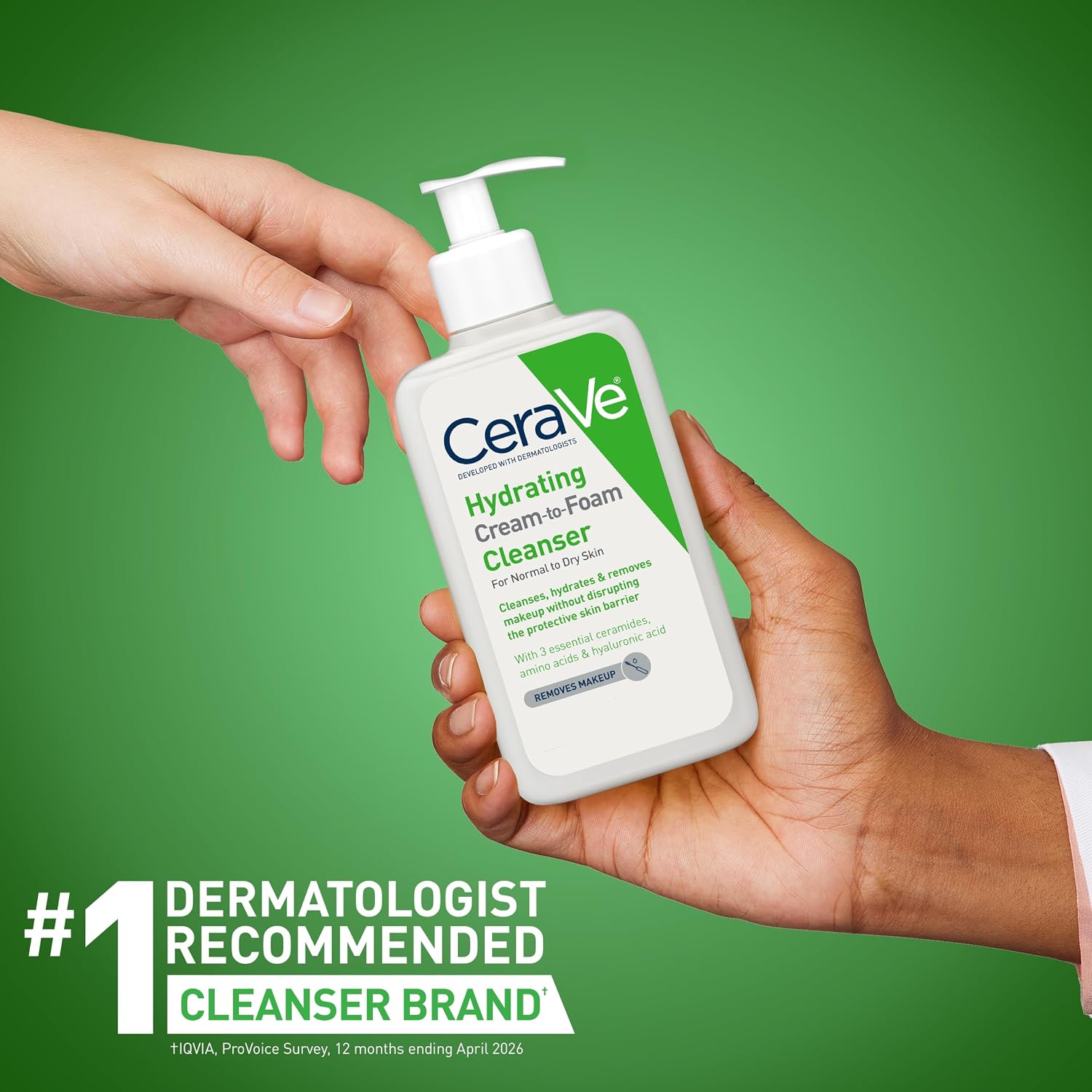
No buyer-uploaded photos were rendered for this listing at capture time, so the gallery holds listing imagery only. Listing assets are not a substitute for user content and are not presented as such.
02. Rating and Buyer Sentiment
A 4.8 average across 26,860 ratings is the kind of number that stops a shopper from reading further, which is exactly why it needs unpacking: the average is high because the base is enormous and the distribution is a single spike, not because the product is uncontested. The interesting signal sits in the aspect table further down, where two themes fall well below the 90% line.
2.1 Rating volume and distribution
Share of ratings by star level. Percentages are Amazon's rendered buckets, rounded to whole numbers.
| Stars | Share | Approx. ratings | Reading |
|---|---|---|---|
| 5 star | 86% | ~23,100 | The base of the average; nothing else moves the score |
| 4 star | 9% | ~2,417 | Mild reservations, still recommending |
| 3 star | 3% | ~806 | Split experience, likely texture or scent related |
| 2 star | 1% | ~269 | Rounded bucket; small absolute count |
| 1 star | 1% | ~269 | Rounded bucket; irritation reports concentrate here |
How to read a 4.8
With a base of 26,860 ratings, a single new rating cannot shift the average by a measurable amount. The score therefore describes a stable, settled consensus rather than a live contest — and it tells you nothing about the 5% who did not agree. That 5% is roughly 1,340 ratings, which is a large enough group to be worth reading, and small enough to disappear inside the average.2.2 Aspect-level sentiment
Amazon's own review summariser decomposes the corpus into aspects with positive and negative mention counts. This is the most useful table in the report, because it is the only place where the dissenting minority becomes visible by topic.
Positive versus negative mentions per aspect. Aspect mentions overlap, so rows are not additive; the share is positive mentions divided by total mentions for that aspect.
| Aspect | Mentions | Positive | Negative | Positive share | Signal |
|---|---|---|---|---|---|
| Effectiveness | 930 | 848 | 82 | 91% | The dominant theme, and strongly positive |
| Moisturizing | 726 | 573 | 153 | 79% | High volume, but one in five mentions is a complaint |
| Texture | 299 | 274 | 25 | 92% | The cream-to-foam mechanic reads as intended |
| Value for money | 290 | 249 | 41 | 86% | Price per ounce is judged fair at 19 oz |
| Skin sensitivity | 223 | 143 | 80 | 64% | The weakest aspect: 36% of mentions are negative |
| Fragrance | 220 | 153 | 67 | 70% | Split, despite the fragrance-free declaration |
| Gentle | 208 | 190 | 18 | 91% | Practically no dissent |
| Foaming | 200 | 166 | 34 | 83% | Lather volume is a genuine satisfaction driver |
The two soft spots
Skin sensitivity at 64% positive is the only aspect below two-thirds, and it is not a rounding artefact: 80 separate negative mentions sit against 143 positive ones. For a product marketed on gentleness for dry and sensitive skin, that is the number to interrogate. Fragrance at 70% positive is the stranger result, because the formula is declared fragrance-free and the ingredient table contains no fragrance-function ingredient. The likely reading is that some buyers are describing a perceived scent or the smell of the raw materials, while others expected a scented wash — a labelling-expectation gap rather than a formulation error. Neither reading can be confirmed without verbatim review text, which this capture did not return.2.3 What buyers say, in Amazon's summary
Customers find this facial cleanser effective at removing makeup without stripping the skin, and appreciate its moisturizing properties, particularly for dry and sensitive skin. The product receives positive feedback for its texture, with one customer noting its creamy consistency, and its gentle formula, with one mentioning it's suitable for use with tretinoin. The foaming action is well-received, with customers noting it makes a lot of suds, and they consider it worth the price. Regarding skin sensitivity and fragrance, opinions are mixed — while some say it doesn't irritate sensitive skin and has a light scent, others report burning sensations and a strong smell.
Amazon's AI-generated review summary, quoted as rendered. It is a second-hand synthesis, not a sample of buyer language, and it is the only narrative account of buyer experience available in this capture.
2.4 Review text availability
Disclosure
No individual review text was rendered on the product page at capture time, across three separate attempts including a mobile render and a retry loop. The aggregate rating, the star distribution and the aspect table all came through intact, so the quantitative picture is complete; what is missing is the verbatim layer. No review has been reconstructed, paraphrased or invented to fill the gap, and no reviewer identity of any kind appears in this report.03. Ingredient Analysis
The formula is a 60-row INCI list built around three functional blocks: a mild surfactant system, an emulsifier and emollient backbone that gives the cream its body, and a humectant plus amino-acid block that carries the hydration story. Read as a whole it is a cream cleanser that foams, not a foaming cleanser with cream added — which is why it can remove makeup without a dedicated oil step.
3.1 What's inside: the claim audit
Each claim below is a formulation-level check, not a marketing restatement. A claim marked does not hold is a property the formula fails, not a defect in the product — a cleanser can be excellent and still not be fungal-acne safe.
The non-comedogenic contradiction
The listing says "non-comedogenic"; the formulation audit says the formula is not pore-clogger free. Both can be true in the narrow sense: no single rated ingredient exceeds comedogenic grade 2, and the two that reach 2 are a fatty alcohol and a sorbitan ester at positions 25 and 18 — neither is a pore-clogging heavyweight. But a shopper with a strict acne protocol should read the claim as "unlikely to clog most pores" rather than "guaranteed clear". The fungal-acne flag follows the same logic: it is driven by ester and fatty-acid content, not by a single culprit ingredient.3.2 Declared concerns
Five class-level warnings are attached to the formula. They are conditional by construction — each one describes what an ingredient class can do, and all five fire on most foaming cleansers.
| Concern | What it means |
|---|---|
| May worsen eczema | Surfactant contact can aggravate a compromised barrier during a flare. |
| May trigger acne | Emollient esters and fatty alcohols can be comedogenic for some skin. |
| May worsen dryness | Cleansing surfactants remove lipids along with soil; the humectants offset but do not eliminate this. |
| May worsen oily skin | Emollient load can read as heavy on already-oily skin. |
| May worsen rosacea | Any foaming surfactant system can trigger flushing in rosacea-prone skin. |
3.3 Benefits the formula supports
| Benefit | Mechanism as described | Ingredients delivering it |
|---|---|---|
| Hydrating | Boosts hydration and relieves dry, tight skin | 20 |
| Barrier repair | Strengthens and restores the natural barrier | 9 |
| Anti-aging | Softens lines and supports a more youthful look | 6 |
| Reduces irritation | Eases discomfort and supports resilience | 5 |
Four benefit rows carried both a name and an ingredient count in this capture; the platform lists eleven benefits in total, and the remaining seven are omitted rather than guessed at.
3.4 Key actives
| Group | Role | Rows | Where it sits in the list |
|---|---|---|---|
| Ceramides | Locks in moisture, supports the barrier | 3 | Positions 15–17 (NP, AP, EOP) |
| Hyaluronic acid | Attracts and holds water | 1 | Position 37 (sodium hyaluronate) |
| BHA (salicylic acid) | Unclogs pores, reduces excess oil | 1 | Position 29 — preservative range, not an exfoliating dose |
3.5 Risk grading by level
Every rated ingredient was mapped onto a single risk level, taking the higher of its comedogenic and irritancy grades and using the upper bound wherever the database prints a range. Unrated is kept as its own category: it means no data, never a clean bill of health.
Ingredient count by risk level. The unrated block is the largest single category and should not be read as low risk.
| Level | Definition | Rows | Share | Ingredients |
|---|---|---|---|---|
| Level 0 | No known comedogenic or irritant risk | 5 | 8.3% | Glycerin, PEG-100 Stearate, Sodium PCA, Sodium Hyaluronate, Cholesterol |
| Level 1 | Low risk on one axis | 2 | 3.3% | Carbomer, Glyceryl Stearate |
| Level 2 | Moderate risk on one axis | 2 | 3.3% | Sorbitan Isostearate (1-2 / 0), Cetearyl Alcohol (2 / 1) |
| Unrated | No published grade — not a zero | 51 | 85.0% | The remaining rows, including all five surfactants |
Reading the grades honestly
Nine rated rows out of sixty is a 15% coverage rate, and no average across nine rows is a formula risk score. What the coverage does support is one narrow, defensible statement: no rated ingredient in this formula exceeds comedogenic grade 2, the ceiling is held by a fatty alcohol rather than a surfactant, and the five surfactants that do the actual cleansing are all in the mild taurate, betaine, isethionate and glucoside families. On a cleanser, the surfactant system matters more than any single emollient — and that system is the formula's strongest argument.3.6 Functional composition
Sixty rows grouped by published function. The emulsifier and emollient blocks together make up 30% of the formula — that is the cream in cream-to-foam.
| Function class | Rows | Share | What it contributes |
|---|---|---|---|
| Emulsifier / stabiliser | 12 | 20.0% | The cream body and the rinse-off feel |
| Masking / amino acid | 10 | 16.7% | pH balance plus the amino-acid hydration story |
| Skin conditioning | 8 | 13.3% | Ceramides, phytosphingosine, emollient esters |
| Humectant | 6 | 10.0% | Glycerin, PCA, sodium PCA, sodium hyaluronate |
| Emollient | 6 | 10.0% | Fatty alcohols and glyceryl esters |
| Cleansing (surfactant) | 5 | 8.3% | The entire cleansing system, all mild |
| Buffering | 4 | 6.7% | Citric acid and sodium hydroxide for pH |
| Other | 4 | 6.7% | Colorant, chelating agent, cationic polymers |
| Preservative / antimicrobial | 2 | 3.3% | Phenoxyethanol, chlorphenesin, plus benzoate and ethylhexylglycerin boosters |
| Function not published | 3 | 5.0% | Threonine, polyquaternium-53, polyquaternium-39 |
3.7 Rating coverage
Rated versus unrated rows in the 60-ingredient list.
The coverage figure is the single most important caveat in this section. A database that has graded 9 of 60 rows has not audited the formula; it has sampled it. The absence of a grade on phenoxyethanol, chlorphenesin or salicylic acid is a gap in the database, not evidence that those ingredients are unproblematic.
What can be said with confidence is positional: the five surfactants sit at positions 3 to 5, 44 and 45, and all five belong to mild families. The strongest single piece of formulation evidence is not a grade at all — it is that the list contains no SLS, no SLES, no fragrance, no drying alcohol and no essential oils.
3.8 Complete ingredient list
All 60 rows in INCI order. Comedogenic and irritancy are community-database aggregates where both columns read low is safer; a dash means unrated, and a range such as 1-2 is judged at its upper bound.
| # | Ingredient | Function | Comedogenic | Irritancy |
|---|---|---|---|---|
| 1 | Water | Skin conditioning | — | — |
| 2 | Glycerin | Humectant | 0 | 0 |
| 3 | Sodium Methyl Cocoyl Taurate | Cleansing | — | — |
| 4 | Coco-Betaine | Cleansing | — | — |
| 5 | Sodium Cocoyl Isethionate | Cleansing | — | — |
| 6 | Sodium Chloride | Masking | — | — |
| 7 | PCA | Humectant | — | — |
| 8 | PPG-5-Ceteth-20 | Emulsifying | — | — |
| 9 | PEG-100 Stearate | Surfactant | 0 | 0 |
| 10 | PEG-150 Pentaerythrityl Tetrastearate | Emulsifying | — | — |
| 11 | PEG-6 Caprylic/Capric Glycerides | Emulsifying | — | — |
| 12 | PEG-30 Dipolyhydroxystearate | Emulsifying | — | — |
| 13 | CI 77891 | Cosmetic colorant | — | — |
| 14 | Aspartic Acid | Masking | — | — |
| 15 | Ceramide NP | Skin conditioning | — | — |
| 16 | Ceramide AP | Skin conditioning | — | — |
| 17 | Ceramide EOP | Skin conditioning | — | — |
| 18 | Sorbitan Isostearate | Emulsifying | 1-2 | 0 |
| 19 | Carbomer | Emulsion stabilising | 1 | 0 |
| 20 | Glycol Distearate | Emollient | — | — |
| 21 | Glyceryl Stearate | Emollient | 1 | 0 |
| 22 | Glyceryl Oleate | Emollient | — | — |
| 23 | Glycine | Buffering | — | — |
| 24 | Trideceth-6 | Emulsifying | — | — |
| 25 | Cetearyl Alcohol | Emollient | 2 | 1 |
| 26 | Behentrimonium Methosulfate | Surfactant | — | — |
| 27 | Threonine | — | — | — |
| 28 | Sodium Hydroxide | Buffering | — | — |
| 29 | Salicylic Acid | Masking | — | — |
| 30 | Sodium PCA | Humectant | 0 | 0 |
| 31 | Sodium Lactate | Buffering | — | — |
| 32 | Arginine | Masking | — | — |
| 33 | Sodium Lauroyl Lactylate | Emulsifying | — | — |
| 34 | Serine | Masking | — | — |
| 35 | Sodium Benzoate | Masking | — | — |
| 36 | Valine | Masking | — | — |
| 37 | Sodium Hyaluronate | Humectant | 0 | 0 |
| 38 | Proline | Skin conditioning | — | — |
| 39 | Isoleucine | Skin conditioning | — | — |
| 40 | Cholesterol | Emollient | 0 | 0 |
| 41 | Phenoxyethanol | Preservative | — | — |
| 42 | Alanine | Masking | — | — |
| 43 | Phenylalanine | Masking | — | — |
| 44 | Coconut Acid | Cleansing | — | — |
| 45 | Coco-Glucoside | Cleansing | — | — |
| 46 | Chlorphenesin | Antimicrobial | — | — |
| 47 | Disodium EDTA | Chelating | — | — |
| 48 | Hydroxyethyl Urea | Humectant | — | — |
| 49 | Citric Acid | Buffering | — | — |
| 50 | Hydroxyethyl Acrylate/Sodium Acryloyldimethyl Taurate Copolymer | Emulsion stabilising | — | — |
| 51 | Caprylyl Glycol | Emollient | — | — |
| 52 | Phytosphingosine | Skin conditioning | — | — |
| 53 | Xanthan Gum | Emulsifying | — | — |
| 54 | Histidine | Humectant | — | — |
| 55 | Acrylates/C10-30 Alkyl Acrylate Crosspolymer | Emulsion stabilising | — | — |
| 56 | Polyquaternium-53 | — | — | — |
| 57 | Polyquaternium-39 | — | — | — |
| 58 | Polysorbate 60 | Emulsifying | — | — |
| 59 | Ethylhexylglycerin | Skin conditioning | — | — |
| 60 | Benzoic Acid | Masking | — | — |
Formula verdict
A mild, cream-based cleanser whose strongest claim is what it leaves out: no sulfates, no fragrance, no drying alcohol, no essential oils, no parabens. Its weakest claim is what it promises on the pack: "non-comedogenic" and "removes makeup without disrupting the barrier" both oversimplify a formula that contains emollient esters at comedogenic grade 2 and five surfactants capable of stripping lipids. Judged as a cleanser for normal-to-dry skin it is well built; judged as a universal sensitive-skin product it is not, and the 64% sensitivity score in section 2.2 says the same thing in buyer language.04. Price Analysis
At $18.96 for 19 fluid ounces the product sits at $1.00 per ounce — a mass-market drugstore price for a formula that behaves like a mid-tier one. What makes the pricing interesting is not the level but the stability: over six years of tracking, the first-party price has moved inside a $13 band and is currently 5% under list.
4.1 Current offer
| Price type | Amount | Note |
|---|---|---|
| Current selling price | $18.96 | Single buy-box price in a US delivery context; no coupon or deal badge rendered |
| Unit price | $1.00 per fluid ounce | Derived from the 19 fl oz fill, not from Amazon's unit-count field |
| Subscribe & Save | $17.06 | 10% subscription tier; not confirmed at checkout |
| Original / struck-through price | Not displayed | The buy box carries no "was" or "typical" price, so no discount is claimed on-page |
| Coupon or deal | None | No clipped coupon, lightning deal or Prime exclusive rendered |
| Delivery | Free over $35 | Prime members free next-day at capture |
4.2 Price history
All-time record since tracking began in August 2020. Every figure below is a lifetime statistic — none of them is a period figure, so a "six-month low" cannot be read off this table.
| Price type | Lowest ever | Highest ever | Current | Average |
|---|---|---|---|---|
| Amazon (first-party) | $12.73 (25 Jun 2026) | $25.85 (17 Oct 2021) | $18.96 (08 Oct 2026) | $17.73 |
| Third-party new | $13.00 (10 Oct 2021) | $70.78 (02 May 2021) | $18.96 (08 Oct 2026) | $38.69 |
| Third-party used | — | — | — | — |
The current value was last observed 22 days before this snapshot, so it is a tracked figure rather than a live quote. The third-party used series carries no data at all, which is a finding in itself: there is no meaningful resale market for this product.
4.3 Price comparison by category
The four recorded price points per channel. The third-party high of $70.78 is a single 2021 observation and should be read as an artefact of the resale channel rather than a market price.
4.4 Price movement over time
The dated extremes plotted in sequence. The line connects observations, not a continuous series — the shape between points is not observable from the record.
4.5 Position against benchmarks
| Benchmark | Amazon | Third-party new | Reading |
|---|---|---|---|
| Current vs all-time low | +48.9% | +45.8% | Both channels sit mid-band, $6.23 above the first-party floor |
| Current vs all-time high | −26.7% | −73.2% | The resale high is not a comparable price point |
| Current vs all-time average | +6.9% | −51.0% | Slightly above the first-party norm; far below the resale mean |
| Current vs list price | −5.2% | −5.2% | A modest, permanent-looking discount rather than a promotion |
| Average vs list price | −11.3% | +93.5% | The first-party series has run under list for most of its life |
| Spread (high − low) | $13.12 | $57.78 | Wide in absolute terms, but spread across five years |
| Channel premium | $20.96 (resale average minus first-party average) | Carried almost entirely by one 2021 outlier | |
The practical read
Two facts decide the buying question. First, both channels quote exactly $18.96, so there is no cheaper alternative seller and no reason to hunt for one. Second, the all-time low of $12.73 was set in June 2026 — four months before this snapshot — which means a meaningful dip is a recent, not historical, event. A buyer who can wait has a demonstrated $6.23 of downside; a buyer who cannot is paying 6.9% above the six-year average, which is still 5.2% under list. For a consumable with a two-year shelf life, the rational move is to buy on Subscribe & Save at $17.06 rather than wait for a floor that may not repeat.4.6 Price freshness
The tracked price was last confirmed on 8 October 2026, 22 days before this snapshot, and cross-checks against the live product page read taken the same day. That is inside a normal tracking cadence, but it is not a live quote: verify before any transaction, and treat the whole price section as a dated observation rather than a standing offer.
05. Methodology, Confidence and Limitations
5.1 What was measured
| Block | Basis |
|---|---|
| Product information | Product detail page read in a US delivery context, all prices native USD, no conversion applied |
| Rating and distribution | Rating histogram and aspect counters as rendered by the marketplace |
| Ingredient list | Two independent formulation databases cross-checked row by row; the complete 60-row list is reconciled against the published INCI order |
| Price history | Third-party price tracker, all-time summary block, transcribed verbatim |
| Imagery | Listing images at source resolution; no buyer photos were rendered for this product at capture time |
5.2 Confidence by block
| Block | Confidence | Why |
|---|---|---|
| Title, brand, category, specifications | High | Read from labelled page nodes |
| Rating and star distribution | High | All five buckets present and summing to 100%; weighted check reproduces the displayed average |
| Aspect sentiment | Medium | A platform-generated synthesis; counts overlap and are not additive |
| Ingredient list | High for content, medium for grading | Row-for-row reconciliation across two databases; only 15% of rows carry a grade |
| Price history | High for values, medium for interpretation | Values transcribed verbatim; averages have no published weighting |
| Verbatim reviews | Not available | No review text rendered; nothing reconstructed |
| Buyer photos | Not available | No review-media gallery rendered; listing imagery not substituted |
5.3 Limitations
- Point-in-time snapshot. Price, rank, rating count and offer structure move continuously; everything here is as of 30 October 2026.
- Ratings are not reviews. The 26,860 figure counts star ratings; the written-review layer was not available.
- All-time price statistics. The history block is lifetime data from August 2020 and cannot answer period questions.
- Sparse price observations. Five values per channel, no observation-level table, so the path between extremes is unknown.
- Ingredient grading coverage. 51 of 60 rows are ungraded; a blank is missing data, not zero risk.
- Community-database ratings. Both the ingredient grades and the formulation-database score are community aggregates, not regulatory or dermatological determinations.
- Delivery-location dependency. Price and availability reflect a US address; other locations may see different offers.
- Listing imagery only. The gallery contains manufacturer assets, not customer photographs.
Snapshot date 30 October 2026. All amounts in USD as published; no currency conversion applied. Reviewer identities are withheld throughout. Ingredient grades are reference data, not a compliance or dermatological conclusion.