What this is. A 15 ml squeeze tube of 5% ascorbic acid eye cream with three ceramides, caffeine and hyaluronic acid, sold at $17.88 against a $24.99 list price.
What the data says. 4.4 stars on 2,538 ratings with 70% at five stars, an aspect table where every theme clears 60% positive, and a formula that fails the pore-clogger-free badge on the same page where the brand sells it as non-comedogenic.
The tension worth reading for. The cheapest product in this batch has the cleanest review profile and the largest gap between what a drugstore brand claims and what its own ingredient list supports.
| Product | CeraVe Skin Renewing Vitamin C Eye Cream, 5% pure vitamin C, 0.5 fl oz / 15 ml |
|---|---|
| Brand | CeraVe (United States) |
| Category | Beauty & Personal Care > Skin Care > Eyes > Creams |
| Price today | $17.88 after a 28% reduction from a $24.99 list price; $16.09 on Subscribe & Save |
| Rating | 4.4 out of 5 from 2,538 ratings |
| Sales rank | #2,677 in Beauty & Personal Care, #13 in Eye Treatment Creams |
| Snapshot date | 1 November 2026, US delivery context (New York 10001), native USD |
1. Product Information
CeraVe's pitch here is unusually specific for a drugstore eye cream: 5% pure vitamin C, three named ceramides, caffeine for puffiness, hyaluronic acid for water, and a tube rather than a jar. The percentage is the headline because it is verifiable, and it is: ascorbic acid sits at position 3 in a 39-row list, which is high enough to be doing work rather than appearing on the panel.
The rest of the claim structure is the standard barrier story the brand has built its reputation on, and it holds up better than most. Ceramide NP, AP and EOP appear as a block at positions 15 to 17, cholesterol at 27 completes the ratio that makes ceramides functional, and phytosphingosine at 37 is the precursor that ties the group together. That is a formulator's version of barrier repair, not a marketing one.
1.1 The listing at a glance
| Attribute | Value |
|---|---|
| Item Volume | 0.5 fluid ounces (15 ml) |
| Item Form | Cream |
| Age Range | Adult |
| Special Feature | Anti Aging, Antioxidant |
| Active Ingredients | Ceramide, Vitamin C |
| Item Weight | 0.03 kg |
| Package Dimensions | 5.47 x 1.93 x 1.26 inches; 1.13 ounces |
| Manufacturer | CeraVe |
| ASIN | B0CTTR375V |
| Best Sellers Rank | #2,677 in Beauty & Personal Care; #13 in Eye Treatment Creams |
1.2 What the pack looks like
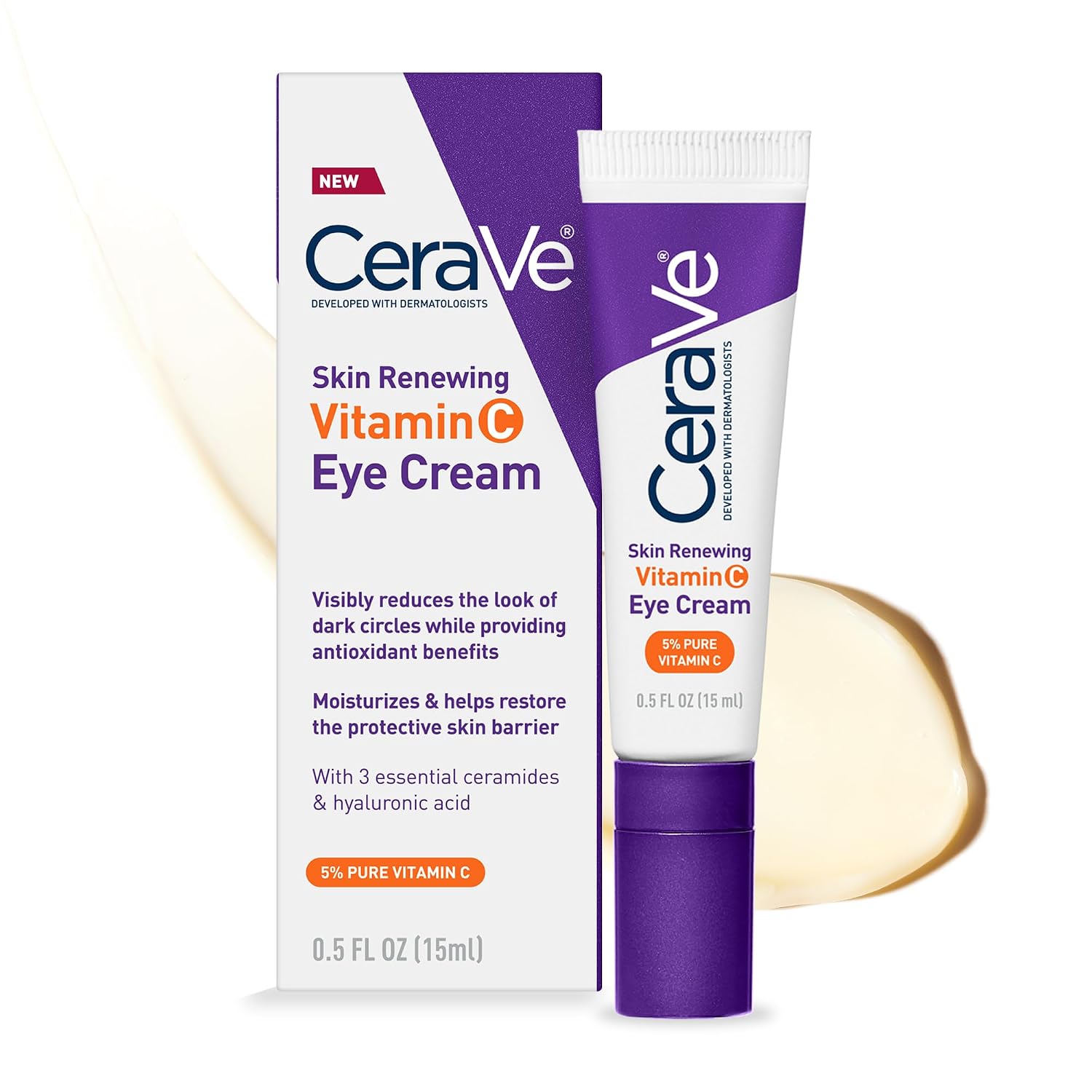
Source: Amazon
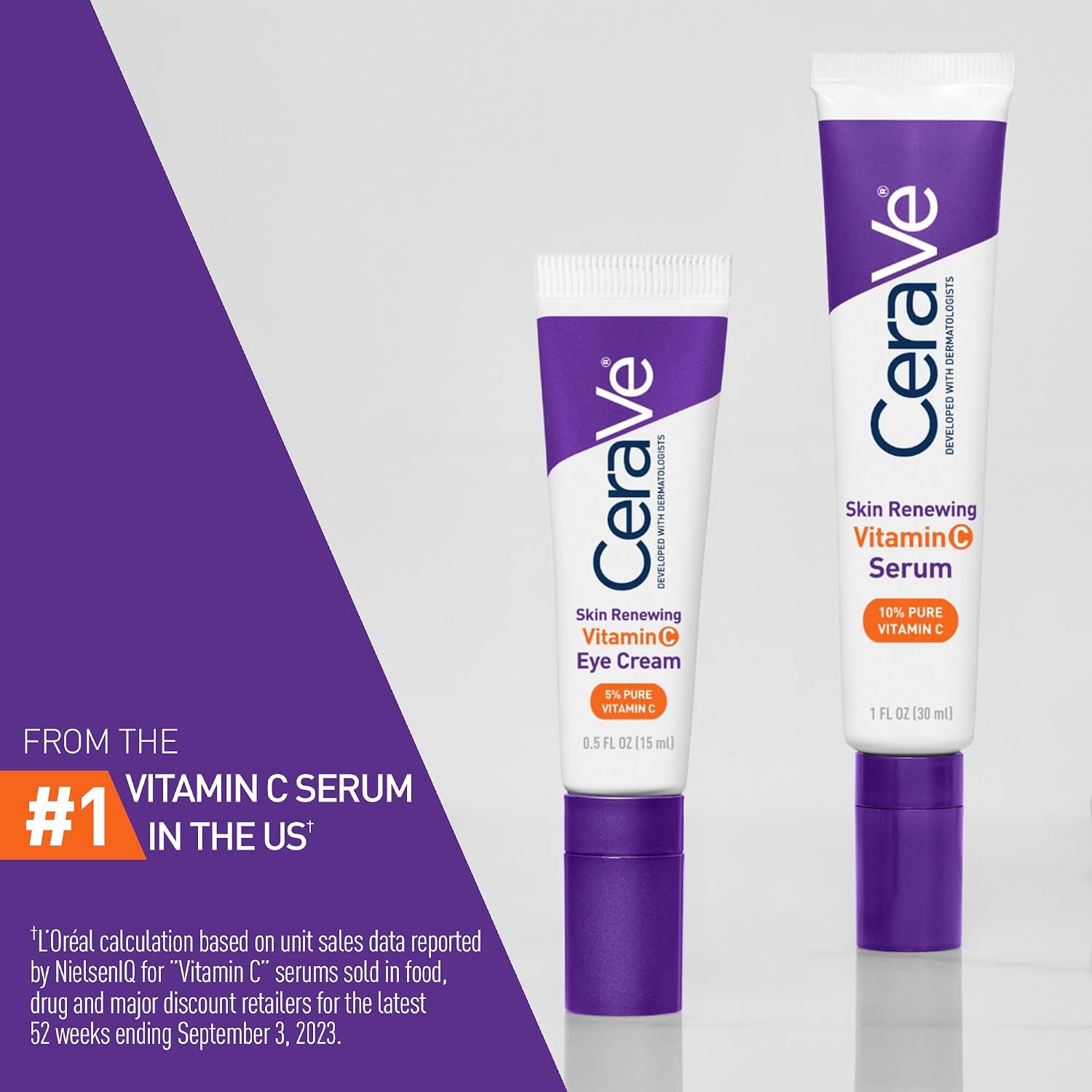
Source: Amazon
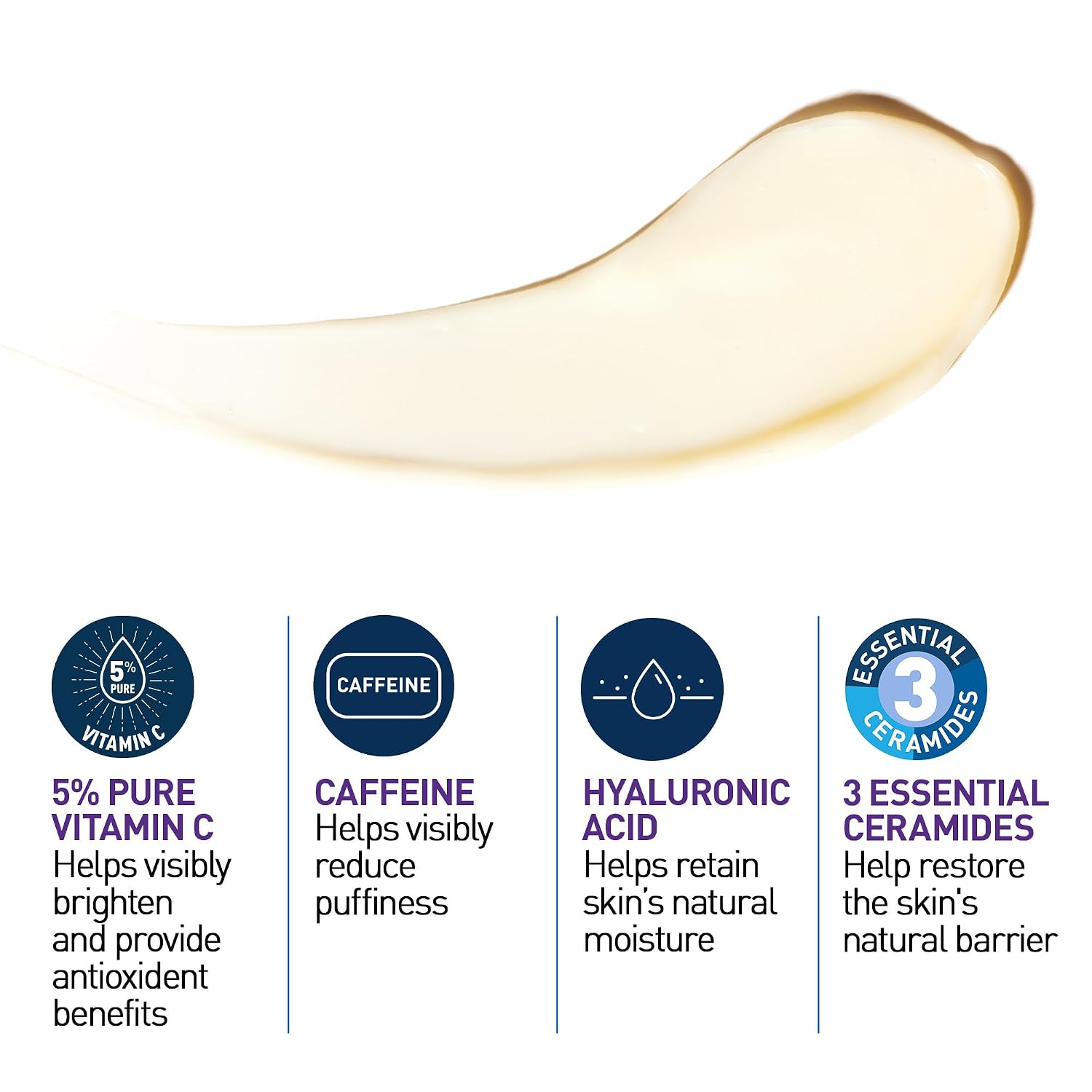
Source: Amazon
Three listing images are published for this ASIN and all three are shown: the carton and tube, a line comparison against the brand's 10% face serum, and a four-icon ingredient panel. No buyer photography exists in the gallery.
1.3 The claims on the listing
| Claim as written | What it commits to |
|---|---|
| 5% pure vitamin C | A named concentration, verifiable against ascorbic acid at position 3. This is the strongest claim on the listing because the number and the position agree. |
| Visibly reduces the look of dark circles | The claim the review base is least sure about. Brightening scores 70% positive across 82 mentions, and the platform summary records buyers who see no improvement. |
| Moisturises and helps restore the protective skin barrier | Supported by the ceramide block at positions 15 to 17 plus cholesterol at 27, and by the review base at 83% on moisturising. |
| With 3 essential ceramides and hyaluronic acid | Both present and both identifiable: ceramides NP, AP and EOP, and sodium hyaluronate at position 25. |
| Ophthalmologist tested, allergy tested, suitable for contact lens wearers | Three separate testing statements with no protocol, sample size or result published. They are consistent with a brand that formulates for sensitive skin, and they remain unverifiable from the listing. |
| Non-comedogenic | A claim printed on the pack and contradicted by the ingredient table: cetearyl alcohol at comedogenic 2, five ester rows flagged for fungal acne. This is the clearest claim-versus-formula conflict in this batch. |
2. Product Rating
The headline is 4.4 out of 5 across 2,538 ratings, and the distribution is the healthiest in this batch: 70% five-star, 16% four-star, and only 7% at two stars or below. There is no second peak anywhere in the curve.
What makes the number unusually trustworthy is the aspect table underneath it. All eight themes clear 60% positive, and the two that a cheap eye cream usually loses on, texture and absorption, score 90% and 95%.
2.1 How the ratings are distributed
| Stars | Share | Approximate ratings |
|---|---|---|
| 5 stars | 70% | 1,777 |
| 4 stars | 16% | 406 |
| 3 stars | 7% | 178 |
| 2 stars | 3% | 76 |
| 1 stars | 4% | 102 |
Read the shape: 70/16/7/3/4 is close to what a well-formulated commodity product looks like when it does what it says for most people. The four-star bucket is more than twice the three-star bucket, which is the correct ordering and a sign that the middle of the distribution is not where the product disappoints.
On 2,538 ratings the one-star block is roughly 102 ratings and the two-star block around 76. Those are small enough to be individual skin reactions and shipping damage rather than a systematic failure, and they are the opposite of the pattern on the two film-forming products reviewed in the previous batch.
2.2 What buyers say, in the platform's own summary
Customers find the eye cream effective, with one noting it works as well as expensive brands, and they appreciate its moisturizing properties that smooth wrinkles around the eyes. The product receives positive feedback for its smooth texture, non-greasy formula, and quick absorption, while being scentless and suitable for sensitive skin. Regarding brightening effects, opinions are mixed - while some report brighter under-eye areas, others don't notice improvements in dark circles.
The platform summary is almost entirely positive and unusually concrete: effective, works as well as expensive brands, moisturising, smooth texture, non-greasy, absorbs quickly, scentless, suitable for sensitive skin. That is seven separate properties confirmed by buyers, and the aspect counts back six of them.
The one honest caveat is about brightening. The summary says opinions are mixed and that some buyers notice no improvement in dark circles, which is the right thing to expect from a 5% ascorbic acid cream in a 15 ml tube: the concentration is real but the dose per application is small and the timeline is months, not weeks.
2.3 Which themes drive the score
| Aspect | Mentions | Positive | Negative | Positive share |
|---|---|---|---|---|
| effectiveness | 259 | 182 | 77 | 70% |
| brightening | 82 | 57 | 25 | 70% |
| moisturizing | 77 | 64 | 13 | 83% |
| texture | 51 | 46 | 5 | 90% |
| skin irritation | 49 | 30 | 19 | 61% |
| non-greasy | 22 | 19 | 3 | 86% |
| absorption | 21 | 20 | 1 | 95% |
| fragrance-free | 17 | 14 | 3 | 82% |
Eight aspects, and every one of them is positive. Absorption at 95% across 21 mentions and texture at 90% across 51 are the two cosmetic wins; moisturising at 83% across 77 and fragrance-free at 82% across 17 confirm the sensory story. Effectiveness at 70% across 259 mentions is the largest sample and the most meaningful number on the page.
The two weakest themes are brightening at 70% across 82 and skin irritation at 61% across 49. Neither is bad. For context, the two film-forming eye products reviewed before this one scored 12% and 40% on irritation, so 61% here is a different category of product rather than a marginal difference.
The most useful comparison inside this table is effectiveness against brightening. Both sit at exactly 70%, which means the product is as good at its headline claim as it is at everything else, and no better. That is the profile of a formula that is competent across the board rather than exceptional at one thing.
2.4 A second, much smaller reading
A second rating set exists and it is almost useless: the ingredient aggregator carries this product at 1.5 out of 5 from two ratings. Two ratings cannot arbitrate against 2,538, and the gap is a sample-size artefact rather than a disagreement. It is reported here because the honest version of a two-channel comparison has to include the case where the second channel has nothing to say.
2.5 What the rating cannot tell you
- A 4.4 average on 2,538 ratings is a strong signal, but it is a rating of a $17.88 cream against $17.88 expectations, not against a $60 one.
- No review text was captured, so every quotation-shaped statement here is the platform's aggregation, not a named reviewer.
- An eye cream is judged on a small area over months, and ratings accumulate fast on a mass-market SKU. The score reflects first-tube impressions more than long-term results.
- The 1.5 rating on two community ratings is statistically meaningless and is included only to disclose the second channel.
3. Product Ingredients
Coverage: 39 of 39 ingredients. All 39 rows published by the reachable channel are reproduced in page order. The second channel was blocked at the network edge, so coverage is 39 of 39 by one channel and no cross-check of the acne or irritancy columns was possible.
3.1 The ingredients, in order
Thirty-nine rows, and the first ten are the whole product: water, glycerin, 5% ascorbic acid at position 3, propanediol, dimethicone for slip, caprylic/capric triglyceride, cetearyl alcohol, glyceryl isostearate, sodium hydroxide to set the pH, and glyceryl stearate. Everything the tube promises is in that band, and everything the badges penalise is in it too.
| # | Ingredient | Function | Comedogenic | Irritancy |
|---|---|---|---|---|
| 1 | Water | Skin Conditioning | — | — |
| 2 | Glycerin | Humectant | 0 | 0 |
| 3 | Ascorbic Acid | Antioxidant | — | — |
| 4 | Propanediol | Solvent | — | — |
| 5 | Dimethicone | Emollient | 1 | 0 |
| 6 | Caprylic/Capric Triglyceride | Masking | — | — |
| 7 | Cetearyl Alcohol | Emollient | 2 | 1 |
| 8 | Glyceryl Isostearate | Emollient | — | — |
| 9 | Sodium Hydroxide | Buffering | — | — |
| 10 | Glyceryl Stearate | Emollient | 1 | 0 |
| 11 | PEG-100 Stearate | Surfactant | 0 | 0 |
| 12 | Panthenol | Skin Conditioning | 0 | 0 |
| 13 | Dipotassium Glycyrrhizate | Humectant | — | — |
| 14 | Hydrogenated Jojoba Oil | Abrasive | — | — |
| 15 | Ceramide NP | Skin Conditioning | — | — |
| 16 | Ceramide AP | Skin Conditioning | — | — |
| 17 | Ceramide EOP | Skin Conditioning | — | — |
| 18 | Carbomer | Emulsion Stabilising | 1 | 0 |
| 19 | Copernicia Cerifera Cera | Emollient | 1 | 0 |
| 20 | Cetearyl Glucoside | Emulsifying | — | — |
| 21 | Behentrimonium Methosulfate | Surfactant | — | — |
| 22 | Triethyl Citrate | Masking | — | — |
| 23 | Caffeine | Skin Conditioning | — | — |
| 24 | Silica | Abrasive | — | — |
| 25 | Sodium Hyaluronate | Humectant | 0 | 0 |
| 26 | Sodium Lauroyl Lactylate | Emulsifying | — | — |
| 27 | Cholesterol | Emollient | 0 | 0 |
| 28 | Phenoxyethanol | Preservative | — | — |
| 29 | Tocopherol | Antioxidant | 0-3 | 0-3 |
| 30 | Hydrogenated Lecithin | Emulsifying | — | — |
| 31 | Hydroxyacetophenone | Antioxidant | — | — |
| 32 | Citric Acid | Buffering | — | — |
| 33 | Caprylyl Glycol | Emollient | — | — |
| 34 | Trisodium Ethylenediamine Disuccinate | Chelating | — | — |
| 35 | Xanthan Gum | Emulsifying | — | — |
| 36 | Pentaerythrityl Tetra-Di-T-Butyl Hydroxyhydrocinnamate | Antioxidant | — | — |
| 37 | Phytosphingosine | Skin Conditioning | — | — |
| 38 | Polyacrylate Crosspolymer-6 | Emulsion Stabilising | — | — |
| 39 | Benzoic Acid | Masking | — | — |
Only 11 of 39 rows carry any published comedogenic or irritancy rating, and 6 of those are above zero. Judged on the upper bound, cetearyl alcohol at 2 for comedogenicity and 1 for irritancy is the heaviest flag, with dimethicone, glyceryl stearate, carbomer and carnauba wax at 1, and tocopherol printed as a 0-3 range. The 28 unrated rows are missing data rather than clean, and the three ceramides carry no rating at all.
3.2 What the formula is actually built around
Ascorbic acid at position 3 is a genuine 5%, which is unusual in a drugstore eye cream and is the reason the tube rather than a jar matters: L-ascorbic acid oxidises on contact with air, and a squeeze tube limits that. The price of the format is that the last third of the tube is harder to dose precisely.
Ceramide NP at 15, AP at 16, EOP at 17, cholesterol at 27, phytosphingosine at 37. That is the full ceramide-plus-cholesterol-plus-fatty-acid architecture the brand is known for, and it is the most defensible part of the formula.
Dimethicone at 5, caprylic/capric triglyceride at 6, cetearyl alcohol at 7 and carnauba wax at 19. These rows make the cream smooth and non-greasy in the hand, and they are also the four rows behind the pore-clogging and fungal-acne flags.
The claim matrix is the most contradictory in this batch, and the contradiction is worth stating plainly. The formula is genuinely alcohol-free, fragrance-free, paraben-free, sulfate-free and reef-safe. It is also not oil-free, not silicone-free, not cruelty-free and not vegan, and every one of those four failures is a specific row rather than a policy: jojoba oil, dimethicone, and an animal-derived ceramide and cholesterol block.
The preservative system is three rows and conventional: phenoxyethanol, caprylyl glycol and benzoic acid, with a chelator at 34 and an antioxidant at 36 to protect the oil phase. For an ascorbic acid formula the real stability question is oxidation rather than microbes, and the tube plus the BHT-type antioxidant at 36 is the answer the brand has chosen.
3.3 Function groups: where the ingredients go
| Group | Count | Ingredients |
|---|---|---|
| Humectants | 3 | Glycerin, Dipotassium Glycyrrhizate, Sodium Hyaluronate |
| Emollients | 7 | Dimethicone, Cetearyl Alcohol, Glyceryl Isostearate, Glyceryl Stearate, Copernicia Cerifera Cera, Cholesterol et al. |
| Solvents and texture | 3 | Propanediol, Carbomer, Polyacrylate Crosspolymer-6 |
| Emulsifiers | 4 | Cetearyl Glucoside, Sodium Lauroyl Lactylate, Hydrogenated Lecithin, Xanthan Gum |
| Skin conditioning and protecting | 7 | Water, Panthenol, Ceramide NP, Ceramide AP, Ceramide EOP, Caffeine et al. |
| Antioxidants | 4 | Ascorbic Acid, Tocopherol, Hydroxyacetophenone, Pentaerythrityl Tetra-Di-T-Butyl Hydroxyhydrocinnamate |
| pH, buffering and chelating | 3 | Sodium Hydroxide, Citric Acid, Trisodium Ethylenediamine Disuccinate |
| Masking and amino acids | 3 | Caprylic/Capric Triglyceride, Triethyl Citrate, Benzoic Acid |
| Preservatives | 1 | Phenoxyethanol |
| Other | 4 | PEG-100 Stearate, Hydrogenated Jojoba Oil, Behentrimonium Methosulfate, Silica |
The largest group is Humectants at 3 rows, tied with the emollients, which is the correct description of a cream: half the formula conditions and the other half occludes. The actives that carry the marketing occupy five rows between them, and that ratio is normal for the category rather than a criticism.
3.4 Classification by position: the concentration ladder
Thirty-nine rows split into three bands. In a cream the bands map onto structure more than argument, but the first band here really does contain everything the tube promises.
| Band | Positions | Count | What sits there |
|---|---|---|---|
| Lead actives | Positions 1-10, the top of the INCI order | 10 | Water, Glycerin, Ascorbic Acid, Propanediol, Dimethicone, Caprylic/Capric Triglyceride, Cetearyl Alcohol, Glyceryl Isostearate et al. |
| Core support | Positions 11-25 | 15 | PEG-100 Stearate, Panthenol, Dipotassium Glycyrrhizate, Hydrogenated Jojoba Oil, Ceramide NP, Ceramide AP, Ceramide EOP, Carbomer et al. |
| Trace and buffer | Positions 26-40 | 14 | Sodium Lauroyl Lactylate, Cholesterol, Phenoxyethanol, Tocopherol, Hydrogenated Lecithin, Hydroxyacetophenone, Citric Acid, Caprylyl Glycol et al. |
The lead band is water, glycerin, ascorbic acid, propanediol, dimethicone, caprylic/capric triglyceride, cetearyl alcohol, glyceryl isostearate, sodium hydroxide and glyceryl stearate. Two of those ten are the active and the humectant; the other eight are the emulsion.
The middle band runs from PEG-100 stearate at 11 to sodium hyaluronate at 25 and is where the ceramides, panthenol, caffeine and the second humectant sit. It is the band that justifies the price difference against a plain moisturiser.
The tail band is preservation and finishing: cholesterol, phenoxyethanol, tocopherol, lecithin, the chelator, the gums, the antioxidant and benzoic acid. Nothing in it is a claim, and the cholesterol at the top of the band is the one that matters functionally.
3.5 What the product claims, and how the claims hold up
Twelve badges, six hold and six fail. The failures split into three cosmetic-preference rows, two animal-policy rows and one that is a genuine safety question.
| Claim | Status | Note |
|---|---|---|
| Alcohol-free | Holds | No denatured alcohol; the ceraryl alcohol is a fatty alcohol and an emollient |
| EU-allergen-free | Holds | No EU-listed fragrance allergen |
| Fragrance-free | Holds | No fragrance row; the review base independently describes it as scentless at 82% positive |
| Paraben-free | Holds | Preserved with phenoxyethanol, caprylyl glycol and benzoic acid |
| Sulfate-free | Holds | The surfactants are a stearate and a methosulfate, not a sulfate |
| Reef-safe | Holds | No UV filter and no tracked restricted ingredient |
| Oil-free | Not met | Hydrogenated jojoba oil at position 14, plus caprylic/capric triglyceride and a wax |
| Silicone-free | Not met | Dimethicone at position 5, high in a 39-row list |
| Cruelty-free | Not met | The aggregator states outright that the product is not cruelty-free |
| Fungal-acne-safe | Not met | Seven flagged rows: five esters, one fatty alcohol and one other, led by cetearyl alcohol and glyceryl stearate |
| Pore-clogger-free | Not met | One flagged row and a comedogenic 2 on cetearyl alcohol, which is the badge that matters most on a product sold as non-comedogenic |
| Vegan | Not met | Cholesterol and the ceramides are animal- or fermentation-derived, and the brand publishes no vegan declaration |
Pore-clogger-free is the failure that matters, because the product is sold to acne-prone buyers on a non-comedogenic promise. Cetearyl alcohol at comedogenic 2 is the specific row, and it is the seventh ingredient in a 39-row list, which is high enough to be present at a meaningful level.
Oil-free and silicone-free fail on hydrogenated jojoba oil and dimethicone respectively, and both are deliberate: the first gives the cream its cushion, the second gives it slip without grease. A buyer who avoids either can simply choose a gel formula instead, and the failure is informative rather than damning.
3.6 Concerns worth knowing before you buy
Cetearyl alcohol at comedogenic 2 with irritancy 1, glyceryl stearate and dimethicone at 1 each, and five ester rows the aggregator groups as fungal-acne triggers.
The ester and fatty-alcohol load, in a cream that is otherwise fragrance-free and well tolerated.
Dimethicone at position 5 plus three occlusive emollients, which is what makes the texture smooth and what makes it unsuitable for very oily lids.
Three class-level concerns, and all three trace to the same four rows: the fatty alcohol, the silicone and the ester block. That is a narrow set of causes for three separate warnings, and it means a buyer who tolerates cetearyl alcohol and dimethicone will likely tolerate the whole formula. The fragrance question, which is usually the first concern on an eye product, does not arise here at all.
3.7 The benefits, ranked by how many ingredients carry them
| Benefit | Description | Ingredients | Weight |
|---|---|---|---|
| Hydrating | Boosts hydration and relieves dry, tight skin | 12 | |
| Barrier repair | Strengthens and restores the skin's natural barrier | 12 | |
| Anti-aging | Softens lines and helps skin look youthful | 8 | |
| Redness reducing | Soothes visible redness and calms irritation | 8 | |
| Reduces irritation | Eases discomfort and supports resilience | 7 | |
| Scar healing | Improves the look of marks and scars | 4 | |
| Brightening | Restores radiance to dull, tired skin | 2 | |
| Dark spots | Fades dark spots for even skin tone | 2 | |
| Good for oily skin | Balances oil and helps reduce shine | 1 | |
| Reduces large pores | Minimises the look of enlarged pores | 1 | |
| Skin texture | Smooths rough patches and refines texture | 1 |
Eleven benefits, and the top of the table is unusually balanced: hydrating and barrier repair tie at 12 ingredients each, which is exactly the two things the ceramide block and the humectants are for. The three single-ingredient rows at the bottom are the marketing tail and should be discounted, but the top six are all multi-ingredient and all consistent with the formula.
3.8 Key ingredient groups
| Group | Mechanism as published | Ingredients |
|---|---|---|
| Antioxidants | Shields skin from free radical damage | 4 ingredients: Ascorbic Acid, Tocopherol, Hydroxyacetophenone, Pentaerythrityl Tetra-Di-T-Butyl Hydroxyhydrocinnamate |
| Ceramides | Locks in moisture and supports the skin barrier | 3 ingredients: Ceramide NP, Ceramide AP, Ceramide EOP |
| Exfoliators | Removes dead cells to smooth texture | 2 ingredients: Ascorbic Acid, Citric Acid |
| Vitamin C | Brightens, evens tone and supports collagen | 1 ingredient: Ascorbic Acid |
| Vitamin E | Protects skin and soothes irritation | 1 ingredient: Tocopherol |
| Hyaluronic acid | Hydrates by attracting and holding water | 1 ingredient: Sodium Hyaluronate |
Six key groups, and four of them overlap: ascorbic acid is counted as an antioxidant, an exfoliator and the vitamin C group, and tocopherol as an antioxidant and vitamin E. The ceramide group at three ingredients is the only one that describes a mechanism rather than a molecule.
4. Product Price
This is the cheapest product in the batch and the only one with a discount that can be checked against a reference price. The buy box reads $17.88, the list price is $24.99, the listing prints a 28% saving, and Subscribe & Save takes the price to $16.09. For a 15 ml tube that is $35.76 per fluid ounce.
The pricing story is straightforward and does not need a history to read. A mass-market eye cream at $17.88 with a $24.99 list is being sold at the discount level that drugstore brands run permanently, and the subscription rate at 36% below list is the deepest cut available on the page.
4.1 Today's price
Two facts make this the easiest price in the batch to judge: there is a real list price to measure against, and the discount is printed by the retailer rather than asserted by the brand. A 28% saving on a $24.99 reference is a normal drugstore promotion rather than a launch stunt, and the $16.09 subscription rate is 10.0% below the buy box on top of it.
4.2 Every price point the listing prints
Only four prices exist on the listing and all four are printed by Amazon itself: the buy box, the manufacturer's list price, the subscription rate and the fill size that turns them into a unit price. Nothing below is a historical figure and nothing has been estimated from one.
| Price point | Value | How it is derived |
|---|---|---|
| Current buy box | $17.88 | The price a US visitor on a New York ZIP sees with no coupon applied on 1 November 2026 |
| List price | $24.99 | Amazon's own reference price for the product; the listing prints a 28% saving against it |
| Subscribe & Save | $16.09 | The subscription rate, which is 10.0% below the buy box and 35.6% below list |
| Unit price | $35.76 per fl oz | $17.88 divided by the 0.5 fl oz fill, a derivation supplied here because Amazon prints no unit price for this ASIN |
| Savings badge | 28% | The difference between list and the buy box, as printed on the page |
4.3 Position against the listing's own reference
Three differences can be computed from the four printed values. Each is a derivation, and each is stated against the value it is measured from.
| Benchmark | Difference | Reference value |
|---|---|---|
| Buy box versus list price | -28.5% | $24.99 |
| Subscribe & Save versus buy box | -10.0% | $17.88 |
| Subscribe & Save versus list price | -35.6% | $24.99 |
4.4 What this section cannot tell you
The historical record could not be read for this report. The price-tracking source that supplies the all-time low, high and average for this series was unreachable at collection time, and no archived copy of the page existed. Rather than substitute an estimate, this report publishes only the four prices the listing itself prints and states plainly that no all-time low, no all-time high and no average exist here. A reader should therefore treat $17.88 as today's price and the 28% saving as today's discount, and should not read either as evidence of where the price has been.
4.5 What this means for the purchase decision
- $17.88 is 28.5% below the $24.99 list price, which is a real and checkable discount rather than a struck-through number.
- Subscribe & Save at $16.09 is 10.0% below the buy box and 35.6% below list, and it is the cheapest standard route to this product.
- $35.76 per fluid ounce on a 15 ml fill makes this the lowest unit price of any eye cream in this batch, at roughly a quarter of the cost per ounce of the 10 ml gel reviewed alongside it.
- There is no all-time low, high or average for this ASIN in this report, because the historical source could not be read. Treat $17.88 as today's level and nothing more.
- At this price the product is a low-risk trial: 2,538 ratings, a healthy histogram, and a tube small enough to finish before an ascorbic acid formula oxidises.
5. Who It Is For
| A good fit if you… | Look elsewhere if you… |
|---|---|
| want a fragrance-free eye cream with a declared 5% ascorbic acid and a ceramide barrier story, at a drugstore price | expect a fast brightening result on established dark circles: the platform summary records buyers who notice no change, and brightening scores 70% across 82 mentions |
| have sensitive skin around the eyes and want something the review base calls scentless and non-greasy | have oily lids: the formula carries dimethicone at position 5 and three occlusive emollients |
| want a cream that absorbs quickly and sits under makeup | need the product to be non-comedogenic, which the brand claims and which the ingredient table contradicts on two rows |
| are buying a 0.5 oz tube at $17.88 and want the lowest unit price in the eye-cream category | are avoiding silicones, jojoba oil or animal-derived ceramides and cholesterol |
| value a tube format that limits vitamin C oxidation | expect a pump or an airless container; this is a squeeze tube with a screw cap |
One practical note the listing makes and the review base confirms: 5% ascorbic acid in a cream is a slow ingredient and a brightening result is a months-long question, while the moisturising and texture benefits are immediate. Buyers who judge this product on week one will rate the texture, and the reviews show exactly that: 90% and 95% on texture and absorption against 70% on brightening.
6. Method and Confidence
| Element | Confidence | Basis |
|---|---|---|
| Title, specifications, rank | High | Read from the US product page in a US delivery context |
| Price | High | Buy box and list price both rendered in USD with a New York ZIP set |
| Rating and histogram | High | Rendered by the page itself, 2,538 ratings |
| Customers say and aspects | High | Platform summary, eight aspects with mention counts |
| Individual review text | Not available | No review body rendered on desktop, mobile or the retry loop |
| Buyer photos | Not available | The listing exposes zero buyer image tiles for this ASIN |
| Ingredient table | High for names and order | Complete 39-row list from the reachable channel |
| Price history | Not available | The historical source was unreachable and no archive existed; only listing prices are reported |
6.1 Limitations, stated plainly
- No review bodies were captured. Three surfaces returned zero inline reviews across four attempts, so no review quotation appears here and none was reconstructed.
- No buyer photos exist for this ASIN, so the gallery shows the three listing images only.
- The all-time price record was not obtainable: the price-tracking source returned a security challenge on every attempt and no archived capture of the page existed. This report therefore has no all-time low, high or average, and the price section says so rather than estimating one.
- The second ingredient channel was blocked at the network edge on this run, so the ingredient analysis rests on one source and no independent acne or irritancy score exists.
- The aggregator's community rating for this product is 1.5 from two ratings. Two ratings cannot arbitrate against 2,538, and the figure is reported only to show how thin that channel's sample is.
- Tocopherol carries a printed range of 0-3 on both rating columns, which means the source's references disagree. The upper bound is used for any risk judgement.
- The brand describes the product as non-comedogenic; the ingredient table flags cetearyl alcohol at comedogenic 2 and five ester rows for fungal acne. Both statements are reported and the contradiction is named rather than resolved.
- Position in the INCI list is a proxy for concentration, not a measurement.
- Everything here is a snapshot taken on 1 November 2026.
Snapshot date 1 November 2026. All prices in US dollars as published for a US delivery address; no currency conversion applied. Reviewer identities are withheld throughout. Ingredient ratings are community-sourced and describe ingredient classes, not this finished formula.