Dr.Melaxin Calcium Volume Under Eye Patches
Cemenrete Calcium line, 60 Count hydrogel patches
The best-rated product in this batch, the only one with no ingredient declaration at all, and the only one whose price record has a single channel. Three facts that turn out to be related.
Product information
What the listing declares, and where it declares it badly
Rating and review evidence
A bimodal distribution, and why the mean describes nobody
What the reviews say, in aggregate
That paragraph is Amazon's own machine-written summary of the review corpus, reproduced as published. It is not a quotation from a reviewer and it carries no reviewer identity, because none was collected.
Colour mapping across the five buckets: five star #D81B60, four star #FF7043, three star #F2B705, two star #2D6CDF, one star #6A2C91.
| Theme | Mentions | Positive | Negative | Positive share |
|---|---|---|---|---|
| skin feel | 17 | 17 | 0 | 100% |
| appearance | 10 | 10 | 0 | 100% |
| effectiveness | 114 | 95 | 19 | 83% |
| moisturizing | 118 | 90 | 28 | 76% |
| puffy eyes | 12 | 9 | 3 | 75% |
| smoothing | 18 | 13 | 5 | 72% |
| skin irritation | 15 | 10 | 5 | 67% |
| adhesion | 23 | 15 | 8 | 65% |
Ingredients
Three channels queried, zero rows returned, and one word standing where a formula should be
This section cannot present an ingredient table, because the product has no published ingredient declaration that this session could obtain. What it can do is show the audit: which channels were queried, what each returned, and exactly how little the listing says instead. That is a less satisfying section than the one the other two products in this batch get, and it is the honest one.
Twenty documents were examined for this product and not one of them is an ingredient list. The donut is not decoration: it is the shape of the evidence base, and the missing slice is the one that matters.
Six sources, counted by how many ingredient names each one discloses. Across all six the total is eight mentions of three names, every one of them brand-owned, and zero INCI names. A buyer who wants to know what is in this product cannot find out from the listing.
| Source | Names disclosed | What it actually says |
|---|---|---|
| Amazon bullets | 2 | "Rebornic", named once, with no position, no percentage and no companion materials |
| Pack front label | 2 | "REBORNIC 10,000ppm", which states a concentration for a trademark rather than for a chemical |
| Listing Ingredients field | 1 | The single word "rebornic", with no punctuation and no list |
| A+ comparison table | 3 | "Calcium, Vitamin D, Rebornic" repeated identically in all five columns |
| Skinsort | 0 | Not indexed; brand page read in full and does not list this product |
| COSDNA | 0 | Blocked at the network edge; no query answered |
What can and cannot be concluded
The one quantitative claim on the listing is 10,000 ppm of activated calcium ions, carried in a material the brand calls Rebornic. 10,000 ppm is 1% by mass, which is a meaningful figure for a trace mineral and an implausible one for a primary structurant, so on its own it tells a buyer roughly where the calcium sits without saying what carries it.
Nothing establishes the base of the patch. A hydrogel crescent is normally water, a humectant such as glycerin, and a gelling polymer, but this listing neither states nor implies any of that, and the panel is not recoverable from the pack shots: the front label is a brand face with no declaration, and the two other creatives are before-and-after graphics. Reading a base off the format would be inference presented as data, and it is not done here.
The absence is not a property of the format. The goPure product collected in this batch is a 10 ml gel with 24 declared rows on the same marketplace, and the film-forming product collected alongside it has 32. Patches can and do carry declarations; this listing simply does not.
Because there is no declaration, the report makes no functional classification, no concentration ladder and no safety screen for this product. Those sections exist for the other two products in this batch and their absence here is the finding, not an oversight.
The clinical figures, and what they actually assert
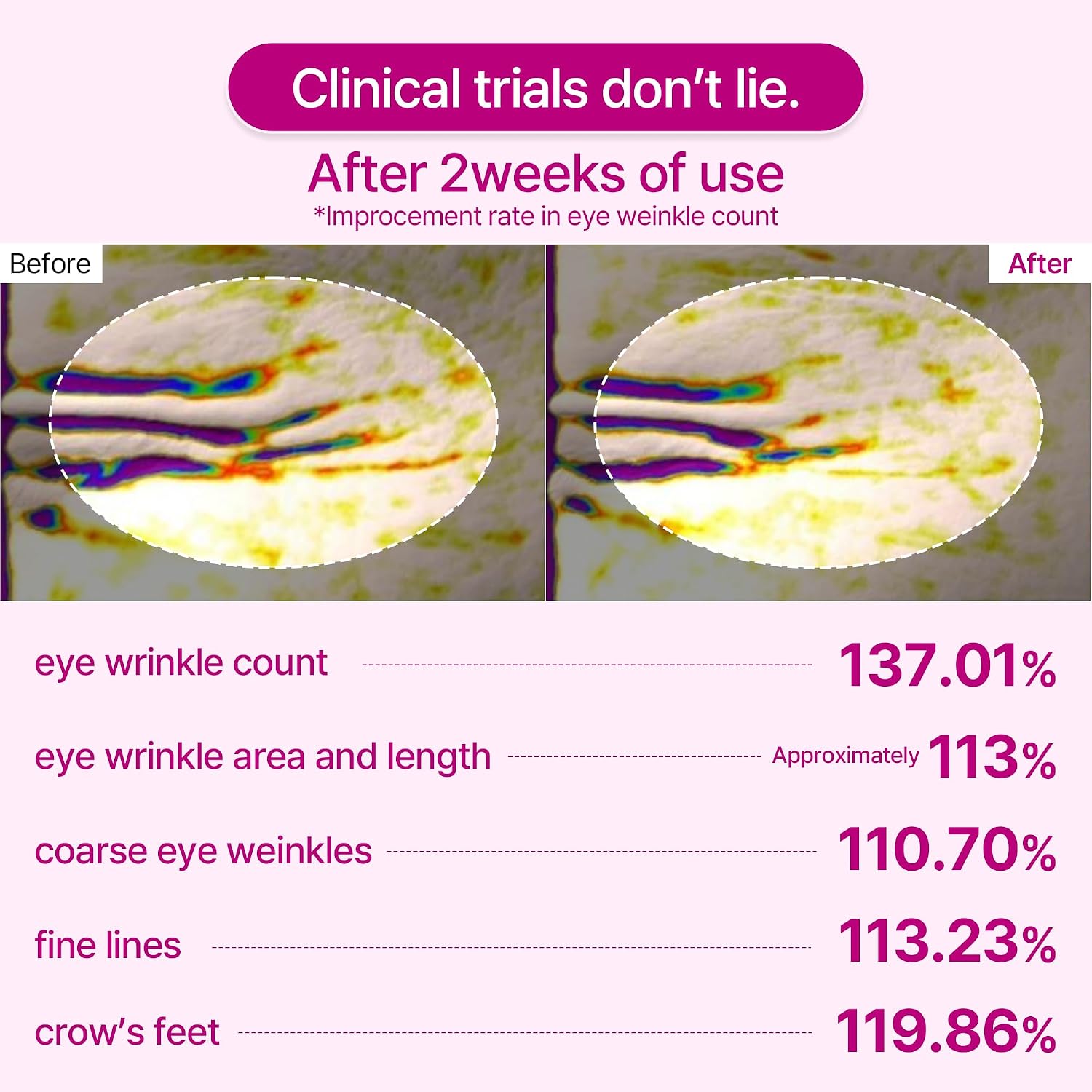
The second listing image is a claims graphic headed "Clinical trials don't lie. After 2 weeks of use", footnoted "*Improvement rate in eye wrinkle count", over instrument-scanned before-and-after panels and five dotted-leader figures: eye wrinkle count 137.01%, eye wrinkle area and length approximately 113%, coarse eye wrinkles 110.70%, fine lines 113.23%, crow's feet 119.86%.
Read as printed, four of the five figures describe a reduction of more than 100%, and one is stated to two decimal places. A percentage reduction of an instrument count cannot exceed 100% under its ordinary meaning, so either the metric is a ratio expressed against a baseline in some other way, or the figures are not reductions at all. The graphic does not say which, and a buyer reading 137.01% has no way to resolve it. This is a presentation problem before it is an evidence problem.
The precision is also unsupported in the frame. Five figures to two decimal places imply a specific instrument, a specific sample size and a specific statistical treatment, and the creative discloses none of the three.
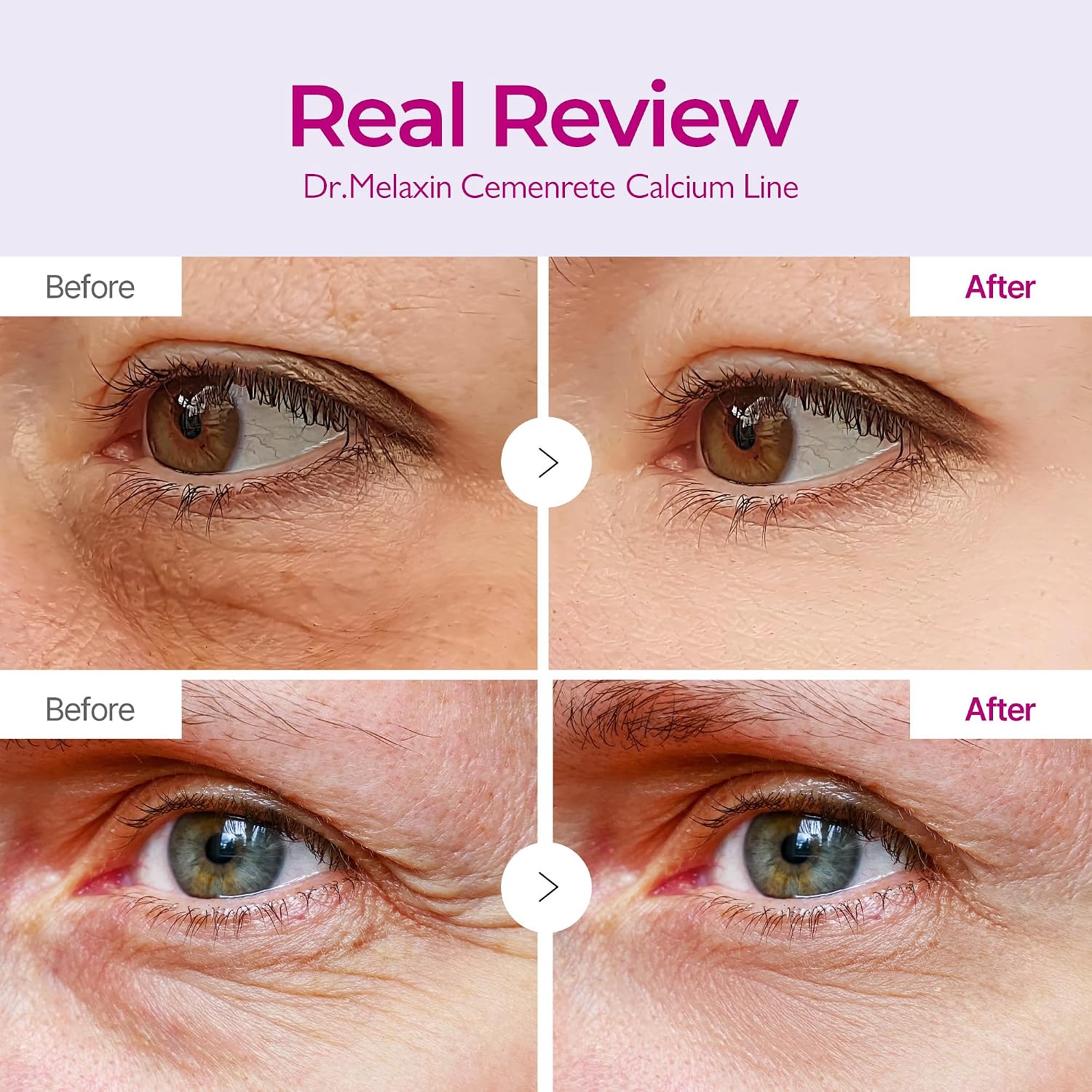
The third image is a "Real Review" before-and-after pair for the wider Cemenrete Calcium line rather than for this product specifically, and the header names the line, not the patch. That is a subtle misdirection: the faces corroborate a family of products, and the reader is left to attach them to the one in the buy box.
None of this is an accusation of bad faith. Before-and-after imaging and improvement percentages are the standard grammar of this category, and all three products in this batch use some version of it. What differs is that the two gels publish a declaration a reader can check against their claims, and this product publishes only the claims.
Price
No list price to discount from, one channel to buy from, and a price that is genuinely below this product's own history
The price history record
| Price type | Lowest ever | Highest ever | Current | Average |
|---|---|---|---|---|
| Amazon | no data | no data | no data | no data |
| 3rd Party New | $15.75 (Jul 18, 2026) | $53.01 (May 10, 2024) | $20.00 (Oct 26, 2026) | $30.27 |
| 3rd Party Used | no data | no data | no data | no data |
All-time summary as published. The table holds five values per price type and no observation-level history. Monitoring began 2024-05-10; last scan 2026-10-26; last tracked 2026-10-21.
There is no list price anywhere on this listing and no struck-through reference price beside the buy box, which means the 10% Subscribe & Save rate is the only discount the listing itself quantifies. Against its own history the current $20.00 is a real markdown — 33.9% below the all-time average — but that is a claim about the product's past, not about a manufacturer's suggested price, and the two are not interchangeable.
At $0.33 per patch this is the cheapest product in the batch by a wide margin, and the unit framing is the honest way to read it. A 60-count jar at $20.00 delivers thirty applications; the two gels in this batch deliver roughly sixty to a hundred applications per tube at $29.90 and $33.15. Per use rather than per unit, the gap narrows sharply, which is the opposite of what the headline prices suggest.
FREE delivery Friday, November 6 on orders over $35; Prime same-day window quoted at capture
Product images
Three per row, listing imagery only
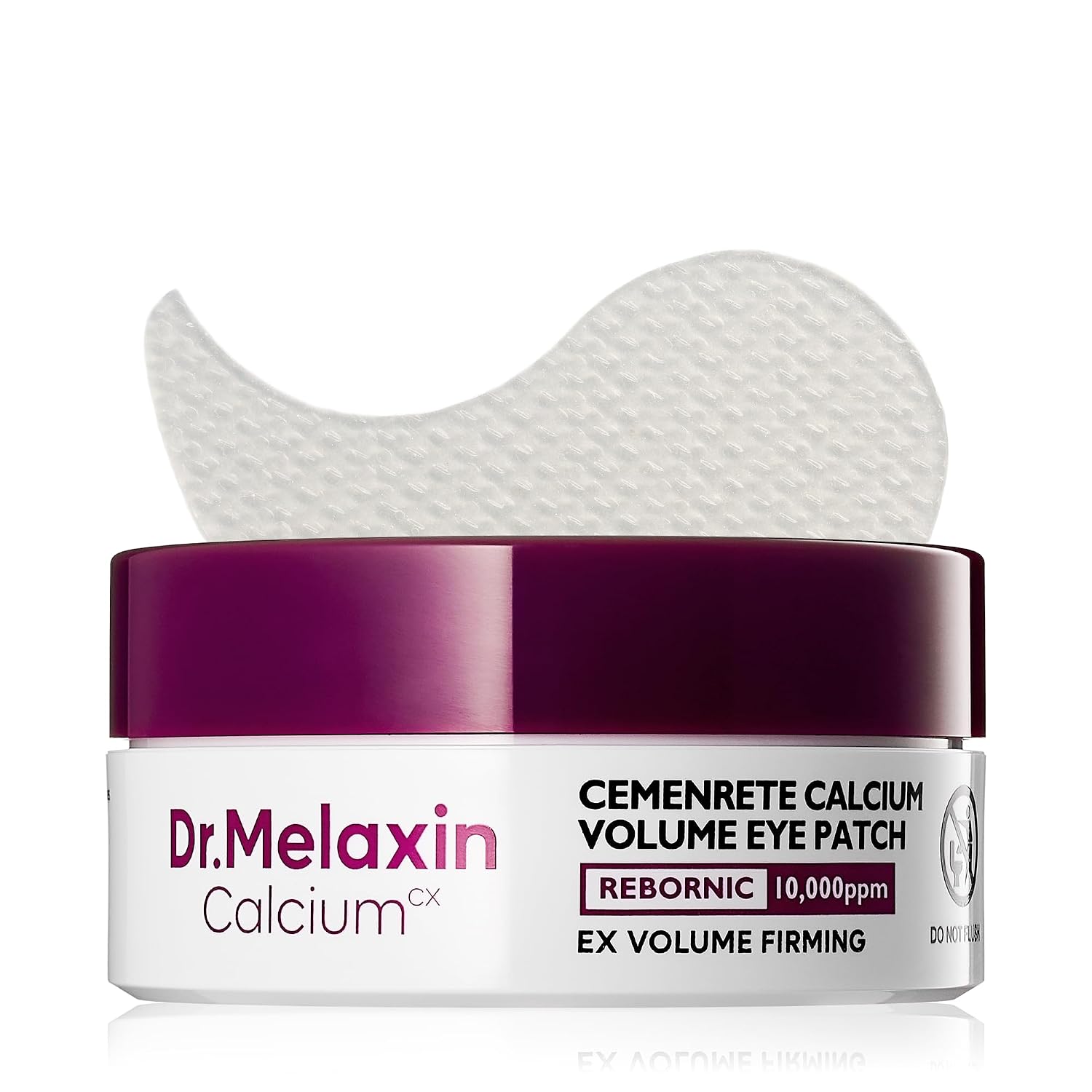
Three listing images were captured. No buyer photographs rendered for this ASIN on any page variant, so the gallery is listing imagery only and is not presented as customer evidence. Note that none of the three shows the back of the pack, which is the one place a declaration would normally be printed.
Methodology and limits
What was measured, what was not, and how far each figure can be trusted
- MarketplaceAmazon US, delivery context New York 10001, native USD only
- Capture date2026-11-01
- Product dataProduct detail page parsed into a structured record; every figure in sections 01 and 02 traces to that record
- Price recordThird-party Amazon price tracker, all-time summary; one price type only
- Ingredient channelsAmazon listing Ingredients field, Skinsort brand and product pages, COSDNA search. No channel yielded a declaration
- Ingredient absenceEstablished by reading the Skinsort brand page in full, not by a failed search
- Rating and aspectsAmazon aggregate rating, histogram and machine-extracted aspect table
- Review textNot obtained. No page variant returned review bodies or buyer photographs. Nothing is quoted and no review is paraphrased
- AnonymisationNo reviewer name, handle, profile link or identifier appears anywhere in this report, because no reviewer-level data was collected
Confidence by element
| Element | Confidence | Basis |
|---|---|---|
| Price at capture | High | Read from the buy box with a US delivery context; matches the tracker's current observation exactly |
| Absence of an Amazon price series | High | Stated by the tracker's own toggle label and corroborated by the buy box naming a third-party seller |
| All-time price extremes | High | Transcribed verbatim, each with its own date |
| Absence of an ingredient declaration | High | Every plausible channel read; the listing field contains one word |
| Rating and histogram | High | Published aggregate; percentages are rounded shares of 1,391 |
| Aspect sentiment | Medium | Machine-extracted themes, several on very small mention counts |
| Clinical figures as an efficacy claim | Low | Five percentages printed without sample, instrument or definition |
| Customer experience as described | Low | No review bodies were obtained; the qualitative layer is the aspect table and the AI summary only |
| Buyer photographs | None | Zero rendered on any page variant |
Limitations
- No ingredient declaration was obtained from any channel. This report contains no ingredient table, no functional classification and no safety screen for this product, by necessity rather than choice.
- No review bodies were obtained on this run, from three page variants including a mobile fetch and a retry loop.
- No buyer photographs rendered. The three images shown are listing imagery.
- Only one of three price types carries data, so no channel comparison, no marketplace premium and no parity test could be computed, and no list price exists to discount against.
- The all-time high of $53.01 coincides with the first day of monitoring and inflates the published average. Every average-based percentage here is disclosed as distorted rather than silently corrected.
- The five clinical percentages on the second listing image cannot be interpreted as stated: four exceed 100% and none is defined. They are reported as printed and assessed as uninterpretable, not recomputed.
- The third listing image shows the brand's Cemenrete line rather than this product specifically, and is labelled as such rather than presented as product-level evidence.