US Marketplace Product Analysis
A sandalwood-scented talc-free body powder assessed on listing facts, review sentiment, composition claims and the longest price history in this batch - including a $32.40 outlier that distorts it.
| ASIN | B09GX2C6N2 |
| Brand / Manufacturer | HAPPY NUTS |
| Marketplace and currency | Amazon US, native USD, no conversion applied |
| Delivery context used | New York 10001 - a US address, confirmed on the rendered page |
| Snapshot date | 2026-10-27 |
| Category path | Sports & Outdoors › Outdoor Recreation › Accessories › Anti-Chafing Products |
| Format and size | Loose powder, 6 oz / 170 g shaker bottle, Original Sandalwood Zest scent |
| Availability | In stock |
1. Product Information
1.1 What this product is
A talc-free powder for men, aimed at the groin, the feet and what the copy calls "any other areas that experience chafing or wetness". The positioning is narrow and problem-led rather than cosmetic: the four claims printed on the bottle are sweat protection, odour neutralising, prevents chafing and anti bat-wing, and the brand's own language is blunt rather than polished. This is a functional grooming product that has decided to be funny about its category instead of discreet, and the fifth bullet - "the rare kind of mens gifts he didn't know he needed" - makes the commercial strategy explicit.
The composition framing is built on subtraction. The specification field lists alcohol free, aluminium free, gluten free, sulfate free and talc free, adds paraben free as a special feature, and the fifth bullet extends the exclusion list to phthalates, formaldehyde, silicones and synthetic dyes, closing with cruelty-free, vegan, gluten-free and dermatologist-tested. Two ingredients are named positively - aloe and coconut oil - and both are described as soothing for chafing, itching and irritation. What the listing never publishes is an INCI list, which means the formula's actual composition, as opposed to its exclusions, is unavailable from the page.
1.2 Specification table as published
| Attribute | Value |
|---|---|
| Brand | HAPPY NUTS |
| Item Form | Powder |
| Scent | Original |
| Material Type Free | Alcohol Free, Aluminum Free, Gluten Free, Sulfate Free, Talc Free |
| Special Feature | Aluminum Free, Paraben Free |
| Manufacturer | Happy Nuts |
| Model / MPN | ORTCI |
| UPC | 860000477543 |
| Unit Count | 6 Ounce |
| Item Weight | 6 ounces |
| Product Dimensions | 4.72 x 5.91 x 0.2 inches; 6 ounces |
| Best Sellers Rank | #529 in Sports & Outdoors; #7 in Anti-Chafing Products; #81 in Deodorant |
| ASIN | B09GX2C6N2 |
The dimensions field is internally inconsistent as published - a 6-ounce bottle cannot be 0.2 inches thick - and is reproduced verbatim rather than corrected.
1.3 The six selling bullets
- Versatile multi-purpose powder - groin, feet and any chafing or wetness area; long-lasting protection against sweat and chafing.
- Fresh and soothing formula - aloe and coconut oil to soothe chafing, itching and irritation.
- Talc-free, baby-powder-style body powder - all-day comfort against sweat, chafing and odour.
- Masculine scent - a subtle original sandalwood aroma, framed as maximum odour protection.
- Clean and cruelty-free ingredients - the long exclusion list plus vegan, gluten-free and dermatologist-tested.
- The gift that keeps him comfortable all year - positioned as a gift for men who are hard to buy for.
1.4 Product imagery
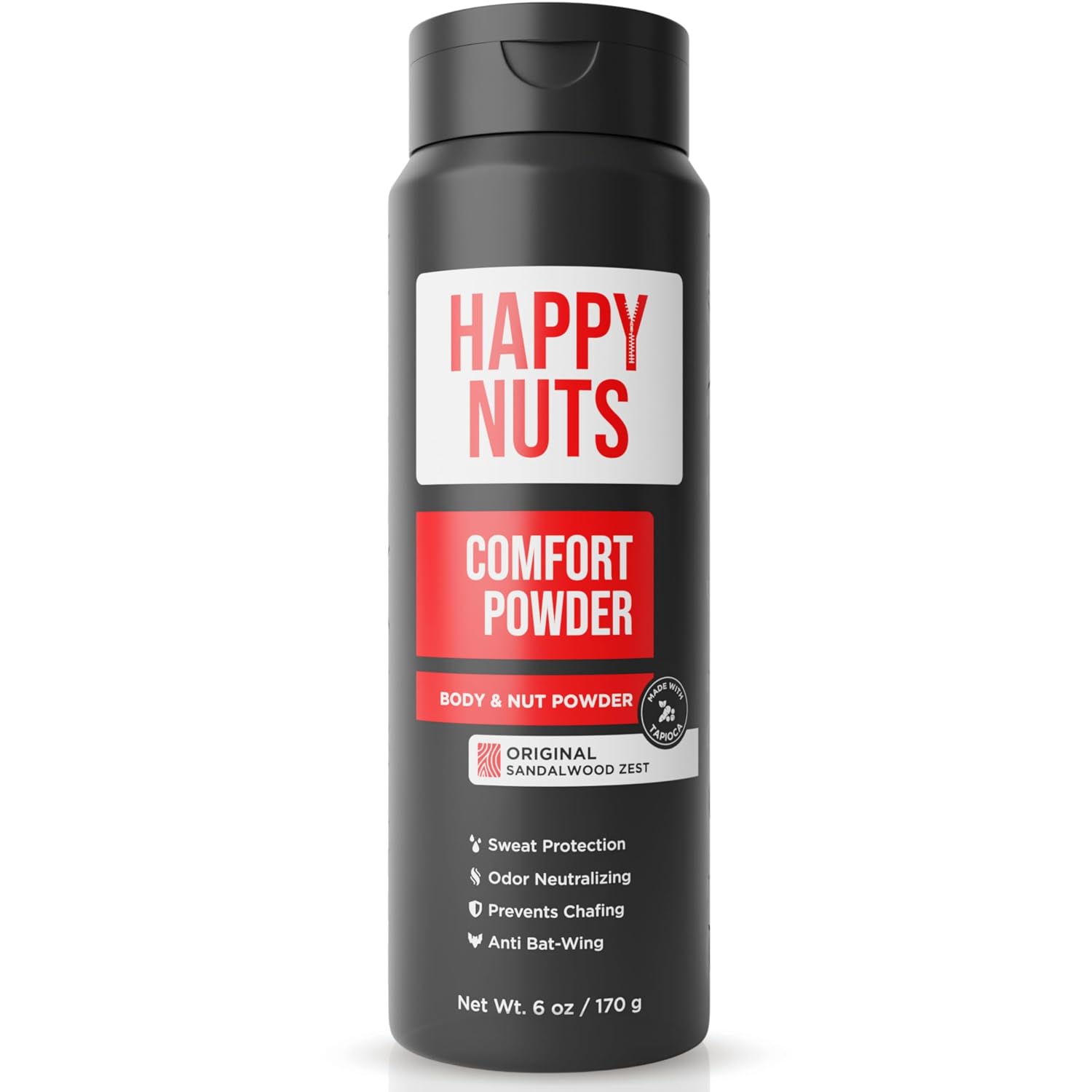
Source: Amazon
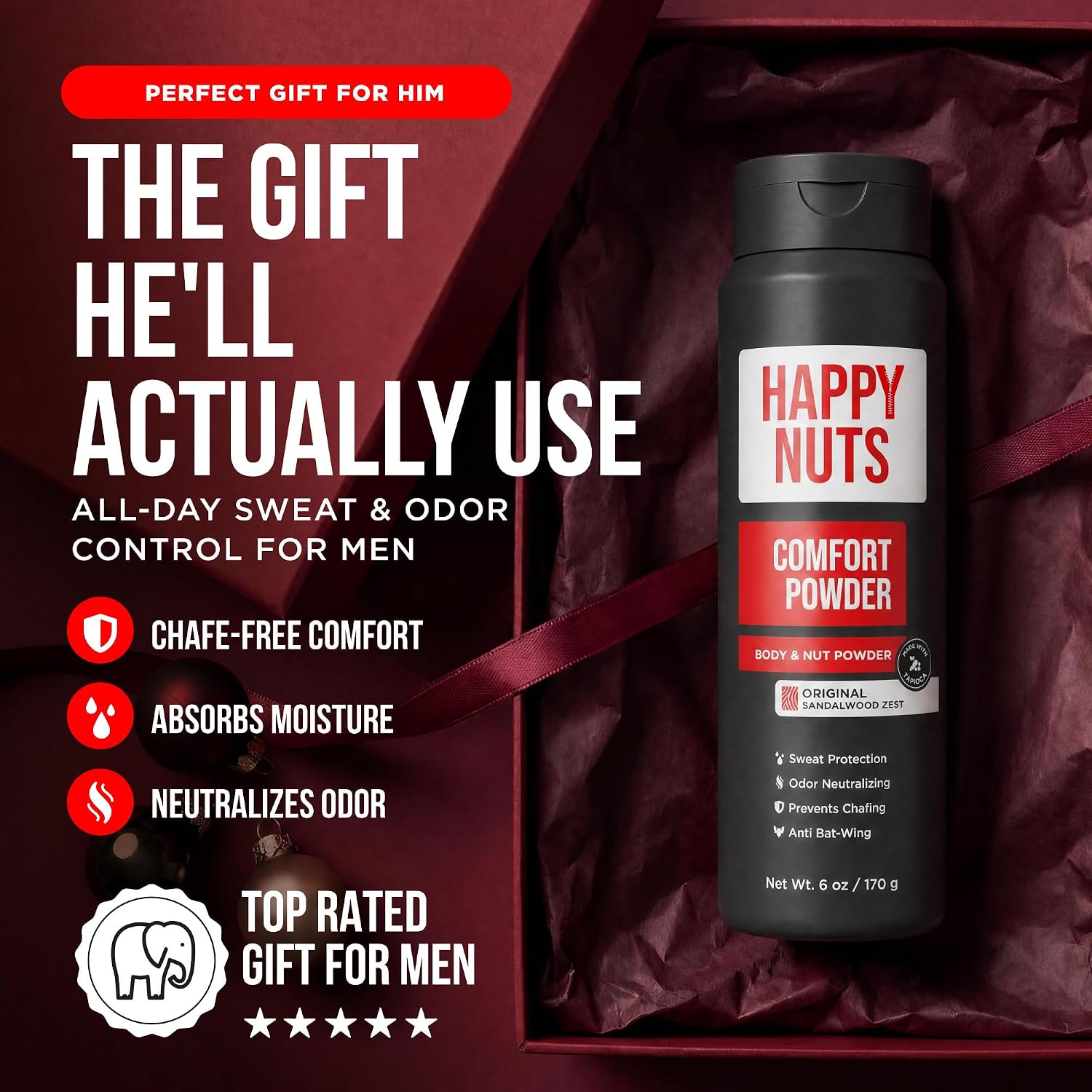
Source: Amazon
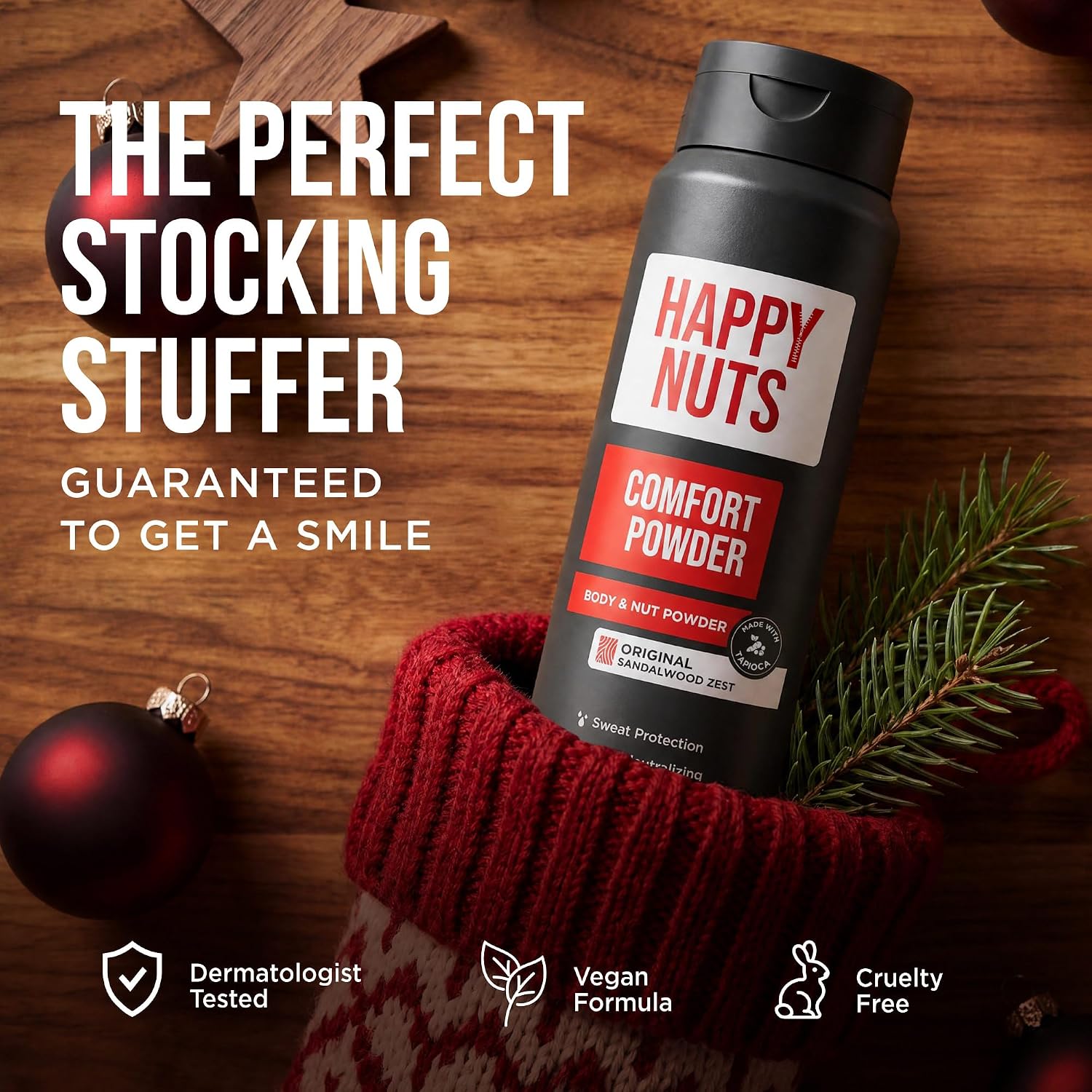
Source: Amazon
Two of the three images at capture time are holiday-gift creative rather than product-demonstration creative, in late October. That is a listing fact with commercial meaning: the brand is already spending its image slots on the gift season. No buyer-uploaded photographs were rendered for this listing, so none are reproduced.
2. Product Rating and Review Sentiment
2.1 Headline rating
| Metric | Value |
|---|---|
| Average rating | 4.6 / 5 |
| Global ratings | 6,344 |
| Weighted recomputation | 4.66 - a 0.06 gap from the displayed 4.6, which is rounding loss across five whole-percentage buckets |
| Written review text captured | None - the review block did not render on this capture |
2.2 Star distribution
| Stars | Share | Approx. ratings |
|---|---|---|
| 5 star | 80% | ~5,075 |
| 4 star | 11% | ~698 |
| 3 star | 6% | ~381 |
| 2 star | 1% | ~63 |
| 1 star | 2% | ~127 |
| Total | 100% | 6,344 |
This is the most top-heavy distribution of the three products in this batch: 91% of ratings sit at four stars or above and the 1-2 star tail is 3%. Unlike the other two, there is no inversion at the bottom - the 1-star bucket (2%) is larger than the 2-star bucket (1%), but both are so small that a handful of ratings moves either by a full point. At 3% on a 6,344 base the tail still represents roughly 190 ratings, so it is not that unhappy buyers do not exist; they are simply too few to distort the mean. The shape describes a product that lands consistently rather than one that polarises, which for a grooming product aimed at a specific discomfort is the outcome a brand would want.
2.3 Aspect-level sentiment
Amazon's AI-generated summary of the review corpus reads:
Customers find the deodorant effective, noting it works better than baby powder and eliminates moisture. The product receives positive feedback for its silky smooth texture, pleasant scent, and ability to keep areas dry and chafe-free, particularly in hot weather. Customers appreciate that it contains no talcum powder and makes them feel happy, with one customer specifically mentioning it's gentle on the skin. While some customers consider it worth the money, others find it not a great value.
| Aspect | Mentions | Positive | Negative | Positive share |
|---|---|---|---|---|
| Soothing | 59 | 57 | 2 | 97% |
| Effectiveness | 333 | 309 | 24 | 93% |
| Dryness | 187 | 170 | 17 | 91% |
| Happiness | 70 | 63 | 7 | 90% |
| Nut happiness | 69 | 62 | 7 | 90% |
| Scent | 276 | 229 | 47 | 83% |
| Texture | 39 | 30 | 9 | 77% |
| Ingredients | 67 | 51 | 16 | 76% |
| Value for money | 118 | 57 | 61 | 48% |
Effectiveness is the spine of this review corpus - 333 mentions at 93% positive, the largest functional aspect by a wide margin, and the summary's framing ("works better than baby powder") tells you what buyers are comparing it against. Dryness at 91% over 187 mentions confirms the core job is being done. Soothing tops the table at 97% but on only 59 mentions, and a small denominator is easy to over-read: it is the best number in the table and the least robust one.
Value for money is the only failing aspect, at 48% - the single aspect below half, on 118 mentions. That is the mirror image of the product's pricing position: it is the most expensive of the three products in this batch per ounce at the same $3.33, sold against a category where buyers expect a cheap commodity. Scent at 83% over 276 mentions is a strong result for a sandalwood fragrance positioned as masculine, and the 47 negative mentions are the ones a fragrance-sensitive buyer would want to read - though no review text was captured to read.
One data artefact should be flagged rather than smoothed over: the aspect table returns both happiness (70 mentions) and nut happiness (69 mentions) at identical 90% positive. These are almost certainly the same aspect captured twice under two labels rather than two themes, and they are charted as published. Adding them together, as a naive reader might, would double-count roughly 70 mentions.
3. Product Ingredients
Result: neither ingredient database holds this product, and the brand publishes no INCI list.
Five searches across two independent cosmetic-ingredient databases returned no entry for this product. One near-miss was found and rejected in each case, and both rejections are documented in 3.2. No ingredient table, safety grade, comedogenicity rating or irritancy rating can be reported, and none was reconstructed.
3.1 What the coverage audit found
| Database | Queries | Result | Near-miss found |
|---|---|---|---|
| Database A | 3 | No entry for this product | Same brand, different product: HAPPY NUTS Comfort Cream, a cream rather than a powder |
| Database B | 2 | No entry, and no brand page at all | Different brand, near-identical name: Happy Curves Comfort Powder |
3.2 The two near-misses, and why both were refused
Both rejections are worth documenting, because each would have produced a complete, plausible and wrong ingredient report.
| Near-miss | Why it is not this product | What using it would have fabricated |
|---|---|---|
| HAPPY NUTS Comfort Cream | Same brand, same anti-chafe positioning, but a cream. A cream carries emulsifiers, a water phase and a preservative system; a powder carries none of them | A formula in which every ingredient class is wrong for the product format |
| Happy Curves Comfort Powder | Different company, different target user (women), different scent (Tahitian Vanilla), different formula | A 21-ingredient table - real, detailed, and for a competitor's product |
The second near-miss is the more dangerous of the two, because it is a powder with a nearly identical name. It would have passed a casual identity check and produced a full ingredient analysis with claim badges attached. It was refused on brand, target user and scent, all three of which are unambiguous in the source records.
3.3 The composition claims that do exist, and their evidence tier
| Claim | Where it appears | Independent verification | Tier |
|---|---|---|---|
| Free from alcohol, aluminium, gluten, sulfates, talc | Specification field | None available | Brand-declared |
| Free from parabens | Specification field (special feature) | None available | Brand-declared |
| Free from phthalates, formaldehyde, silicones, synthetic dyes | Fifth bullet point | None available | Brand-declared |
| Contains aloe and coconut oil | Second bullet point | None available | Brand-declared |
| Vegan, cruelty free, gluten free, dermatologist tested | Fifth bullet; third image | None available | Brand assertion only |
| Full INCI list | Not published anywhere | Not obtainable | Not available |
Two things follow. First, the exclusion list is long enough that it functions as the product's main technical claim - this is a brand arguing by subtraction rather than by ingredient story, and the argument is unverifiable without a formula. Second, the one positive ingredient claim is the one that matters most for an acne-prone buyer: coconut oil is named in the copy, and coconut oil carries one of the higher comedogenic ratings in common cosmetic use. That rating is not asserted here as a fact about this product, because no ingredient table exists to confirm the percentage, the position in the formula, or even that the oil is present in the finished powder as opposed to a derivative.
3.4 What "clean ingredients" can and cannot mean here
The listing's central framing is cleanliness by exclusion: no parabens, no phthalates, no talc, no aluminium, no sulfates, no formaldehyde, no silicones, no synthetic dyes. That is a meaningful list, and talc-free in particular is the claim this whole category is built on now. But it answers a different question from the one an ingredient-concerned buyer is usually asking. What is in it remains unpublished, and for a leave-on powder applied to skin folds - the least ventilated, most friction-exposed surface on the body - the composition matters more than the exclusion list.
Three specific questions therefore stay open. Comedogenicity cannot be assessed, which matters at the exact site of application. Irritancy cannot be assessed, which matters for a product whose selling point is soothing chafed skin. Allergen screening cannot be performed, which matters because a sandalwood scent necessarily involves fragrance components that a "free from" list does not enumerate. Not indexed is not the same as not safe, and it is not the same as not flagged - there is no finding here at all, only an absence.
4. Product Price
4.1 Current pricing
| Price type | Amount | Notes |
|---|---|---|
| Live selling price | $19.99 | Buy box, US delivery context, captured 2026-10-27 |
| List price as rendered | $21.99 | Struck-through "List Price" on the live page; 9% saving displayed |
| Unit price | $3.33 per ounce | As rendered against the 6 oz net weight |
| Subscribe & Save | $16.99 | 23% below the one-time price - a deeper tier than the 15% seen elsewhere |
| Coupon layers | 25% on Subscribe & Save; 10% on 2 select items | Both rendered as selectable coupons, not applied prices |
This is the most layered price block of the three products. The headline $19.99 sits under a $21.99 reference price with a 9% saving already applied, and then two further discounts are offered on top: a 23% Subscribe & Save tier and a 25% subscription coupon. Stacked, the deepest obtainable price is materially below the sticker. That structure - a visible discount, then a subscription discount, then a coupon on the subscription - is what a brand does when the sticker price is doing positioning work rather than clearing inventory.
4.2 Price history
| Price type | Lowest ever | Highest ever | Current | Average |
|---|---|---|---|---|
| Amazon | $14.99 (Feb 03, 2025) | $20.00 (Jan 23, 2025) | - | $18.32 |
| 3rd Party New | $12.00 (Dec 25, 2023) | $32.40 (Jun 17, 2024) | $19.99 (Oct 24, 2026) | $19.05 |
| 3rd Party Used | - | - | - | - |
The Amazon row is populated but has no current value - a state that is more informative than an empty row. Amazon did carry this product: the record shows a low of $14.99 and a high of $20.00, both in early 2025, and an average of $18.32. But the current cell is empty, which reads as Amazon having left the buy box sometime after January 2025. The Amazon average therefore describes a period that has ended, not a channel currently in play. The used channel is empty throughout.
4.3 Price comparison across channels
The Amazon current bar is absent by design, not by error: no current Amazon observation exists, so plotting one would be invention. Every other Amazon benchmark is plotted alongside its third-party counterpart, and the two histories are close - Amazon's $14.99 to $20.00 band against a third-party band that is nominally $12.00 to $32.40 but is effectively $12.00 to $20.00 once the outlier is set aside.
4.4 Where the live price sits
| Benchmark | Value | Live price $19.99 vs benchmark |
|---|---|---|
| All-time low (3rd party) | $12.00 | +66.6% |
| All-time average (3rd party) | $19.05 | +4.9% |
| List price as rendered | $21.99 | -9.1% |
| List price on the tracking record | $19.95 | +0.2% |
| All-time high (3rd party), outlier | $32.40 | -38.3% - not a meaningful comparison |
All percentages are derived arithmetic from transcribed values, rounded to one decimal. Note that the two "list price" rows disagree, and that disagreement is real rather than an error in this report: the live page renders a struck-through reference price of $21.99, while the tracking record's list-price field carries $19.95. Two different reference prices for the same product is worth a moment's thought - the higher one is what the shopper sees, and it is what makes a 9% saving visible.
4.5 The $32.40 outlier, and why it should not drive any conclusion
The third-party high of $32.40, dated Jun 17, 2024, is 2.7 times the all-time low and 1.62 times the list price. It is so far outside every other observation in either channel that treating it as a market price would be a mistake. On records of this kind, a spike of that shape is normally a bundle, a multi-pack listing, or a reseller offer mapped onto the parent ASIN rather than a genuine market high. It is reported as published, and the interpretation is explicitly inferential.
The practical consequence is arithmetic. Remove that one observation and the third-party range collapses from $20.40 to roughly $8.00, and the "current is 38.3% below its high" figure becomes meaningless. Any volatility claim about this listing built on the published range would be a claim about one data point. The same caution applies, in weaker form, to the third-party average of $19.05, which is pulled upward by the outlier and is therefore likely to overstate the typical price.
4.6 Reading the price record
The current price is its list price. At $19.99 against a $21.99 reference, the product is a 9% discount that never really leaves the neighbourhood of its own anchor. Against the tracking record's $19.95 list, the current price is +0.2% - dead on. That combination, a permanent-looking small discount under a stable anchor, is a pricing posture rather than a promotion.
The market has historically cleared below list, and is now at it. The third-party average of $19.05 is 4.5% below the tracker's list price, and the Amazon average of $18.32 is 8.2% below it. Both averages sit under list, while the current price sits on it. Read inferentially, the historical discounts look like periodic promotions away from the target price, and the present price looks like a return to target.
Amazon's exit is the structural fact worth carrying forward. A listing that Amazon once priced between $14.99 and $20.00 and no longer quotes at all has handed pricing control to marketplace sellers. That is consistent with the buy box having consolidated and with the layered coupon structure now on the page - both are things a seller does when it, rather than Amazon, owns the price.
Value perception is where price and sentiment collide. Value for money is the only review aspect below 50% at 48% across 118 mentions, while effectiveness sits at 93% and dryness at 91%. The product is judged to work and judged expensive, in that order. At $3.33 per ounce it is priced like a premium grooming product and reviewed by people who expected a commodity powder - which is exactly the gap the 23% subscription tier and the 25% coupon are there to close.
4.7 Freshness of the price picture
- Live capture, 2026-10-27: current.
- Tracked current observation, Oct 24, 2026: 3 days stale at capture, and equal to the live price.
- Last update scan: approximately 3 days before capture; last tracked: approximately 9 days before capture.
- Amazon channel: no recent observation at all - the emptiness is a finding, not staleness.
The tracked current value and the live capture agree exactly at $19.99, which confirms the price has not moved in three days. The record overall is the oldest in this batch - 4.5 years of monitoring - and it is also the one with the clearest structural gap in it.
5. Commercial Position
5.1 Rank and category standing
| Rank | Node | Reading |
|---|---|---|
| #529 | Sports & Outdoors | A strong position in a very large node - materially better than the other two products in this batch achieve in their parent categories |
| #7 | Anti-Chafing Products | Top-ten in the most specific node, but not the leader |
| #81 | Deodorant | Present in the broader deodorant node, where competition is far denser |
The three ranks tell a coherent story. The product is a genuine volume seller - #529 in Sports & Outdoors is not a niche position - but it is #7 rather than #1 in its own sub-category, which means it competes in a node where several products sell at similar scale. Its listing sits in Sports & Outdoors rather than in Beauty, which is a categorisation choice with real consequences: it puts the product in front of an active-lifestyle shopper rather than a grooming shopper, and it is consistent with the chafing-first framing of the copy.
5.2 Demand and structural signals
| Signal | Reading | Interpretation |
|---|---|---|
| Ratings volume | 6,344 | Established seller; the largest base of the three products in this batch |
| Monitoring start | Apr 11, 2022 | 4.5 years of price history - the deepest record here |
| Amazon-direct offer | Historically present, now absent | Pricing control has moved to marketplace sellers |
| Discount layering | 9% + 23% S&S + 25% coupon | Three stacked levers - a sign of price pressure rather than confidence |
| Rating shape | 91% at 4 stars or above | Consistent delivery; no polarisation |
| Imagery | Two of three slots are gift creative | Seasonal demand is the brand's expected volume driver |
5.3 The proposition in one paragraph
This is the strongest-performing of the three products on every review measure that matters - effectiveness 93%, dryness 91%, a 4.6 average over 6,344 ratings and a 3% low tail - and the weakest on the one measure that touches money, with value for money at 48%. That split is the whole commercial story. The product works and buyers say so; what they resist is paying a premium price for a category they think of as cheap. The brand's answer is visible in the price block rather than the copy: a permanent 9% discount under a $21.99 anchor, a 23% subscription tier, and a 25% coupon on that tier. What the listing cannot answer is the ingredient question, because neither database indexes the product and the brand publishes only what it excludes.
6. Method, Confidence and Limitations
6.1 How the data was collected
| Element | Method |
|---|---|
| Listing facts, specifications, bullets | Read from the rendered product detail page |
| Price and availability | Buy box read in a US delivery context (New York 10001) with a USD currency preference; no conversion applied |
| Rating and star distribution | Rating widget and all five histogram buckets, summing to 100% |
| Sentiment aspects | The marketplace's AI-generated review summary and its nine aspect counts |
| Price history | All-time summary record per price type, read as a single snapshot |
| Ingredient channels | Five searches across two independent cosmetic-ingredient databases, plus two explicit near-miss rejections |
| Reviewer privacy | No reviewer name, handle, profile identifier or profile link appears anywhere in this report |
6.2 Confidence by element
| Element | Confidence | Basis |
|---|---|---|
| Title, brand, category path, specifications | High | Read from the page's own labelled fields |
| Live price, list price, unit price | High | Single unambiguous buy-box block with a rendered reference price |
| Rating and distribution | High | All buckets present; recomputation within rounding tolerance |
| Price history values | High | Transcribed verbatim, including the empty current cell |
| Derived percentages and spreads | High as arithmetic | Computed from transcribed values, one decimal |
| Amazon channel as active | Not available | No current Amazon observation exists |
| Sentiment aspects | Medium | An AI derivation over reviews; two near-duplicate rows suggest imperfect parsing |
| Individual buyer reviews | Not available | The review block did not render; no review text is quoted |
| Buyer photographs | Not available | No review-media gallery was rendered |
| Ingredient composition | Not available | Not published by the brand and not indexed by either database |
6.3 Limitations
- Point-in-time snapshot. Price, rank, buy-box ownership and rating counts all move. Everything here is as of 2026-10-27.
- Ratings are not reviews. The 6,344 figure counts star ratings; the written review base is a small subset.
- No review text. The review block did not render across four access paths and three timed retries.
- Sentiment is derived, not read. Section 2.3 rests on an AI summary of reviews; two aspect rows are near-duplicates and are charted as published rather than merged.
- One outlier distorts the third-party range. The $32.40 high drives the 170% spread and the -38.3% gap to the high; neither should be quoted without that caveat.
- Two different list prices exist. The live page renders $21.99; the tracking record carries $19.95. Both are reported rather than reconciled.
- Amazon channel is historical only. No current Amazon observation exists, so cross-channel comparison is between eras.
- No ingredient data at all. Five searches across two databases returned nothing; the brand publishes no INCI list.
- Dimensions field is internally inconsistent and is reproduced verbatim rather than corrected.
- Delivery-location dependency. Price and availability reflect a US address.
Snapshot date 2026-10-27. All prices in USD as rendered for a US delivery address, with no currency conversion. Reviewer identities withheld. Where a field could not be collected it is reported as unavailable together with the reason, rather than estimated or reconstructed. No near-match product was used to fill an ingredient gap.