Kiehl's has been selling this jar since at least 2010 and still holds a top-five slot in Amazon's eye-treatment-cream subcategory. The formula explains part of that: a water-in-oil emulsion built on shea butter and a run of emollient esters, with avocado oil at position eight and only two emulsifiers in twenty-six rows. The record also explains the rest - a 6% one-star tail three times the size of its two-star bucket, a claimed active the declaration does not contain, and a price that sits below its own ten-year average while the brand itself answers the texture complaint in its own FAQ.
Amazon US · captured with a New York 10001 delivery address · snapshot 1 November 2026 · all prices native USD · no reviewer identities reproduced
| Live price | Rating | Ratings | Ingredients | Claims held |
|---|---|---|---|---|
| $30.00 | 4.4 / 5 | 3,323 | 26 | 7 / 12 |
Price, rating and volume read from the listing on 1 November 2026. Of the twelve claim badges Skinsort checks, seven hold and five fail - oil-free, cruelty-free, fungal-acne-safe, pore-clogger-free and vegan.
Part one
The jar, its rank, and the name it is quietly changing
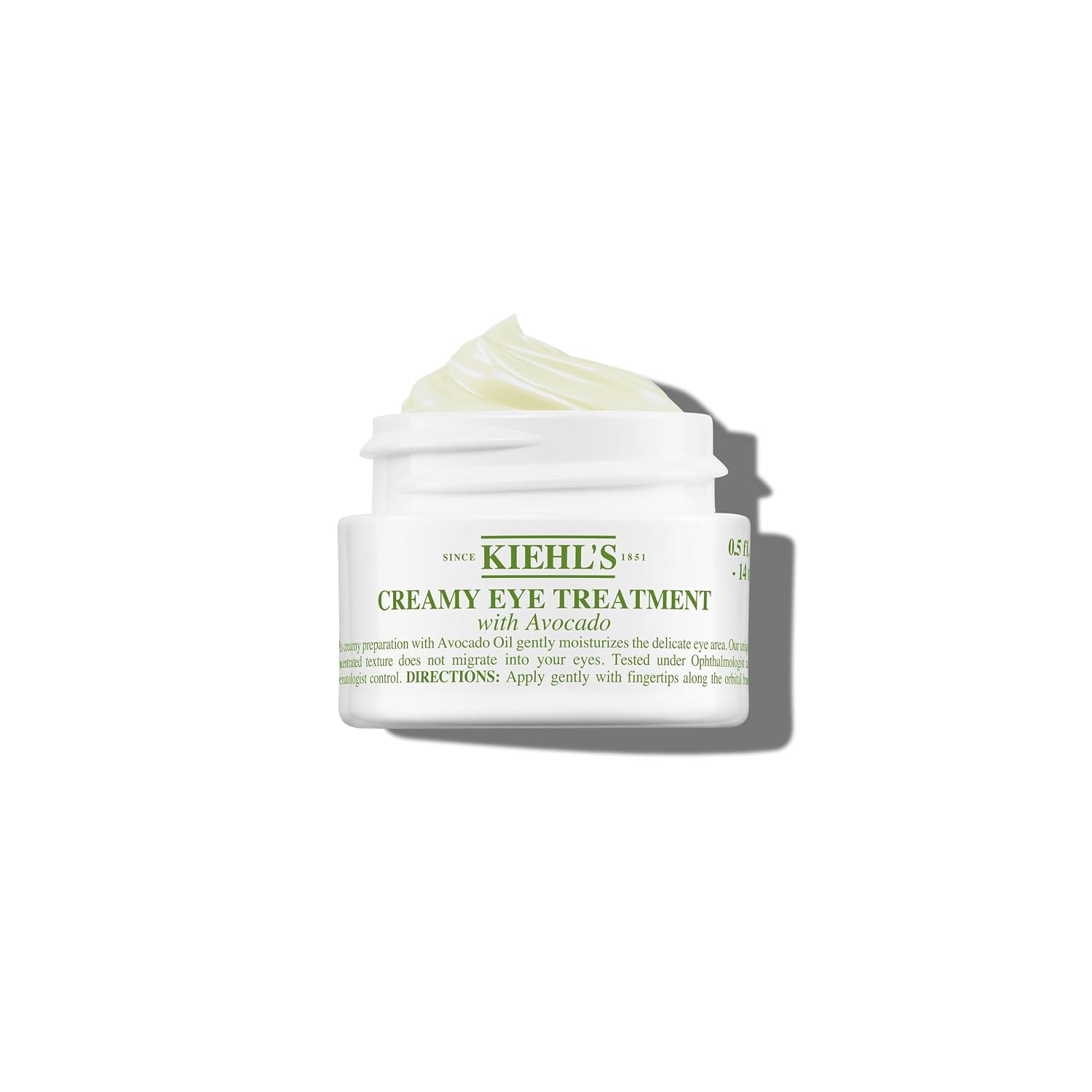
An eye cream in a small white jar, 0.5 fluid ounces, sold on Amazon by the brand itself rather than by Amazon. The breadcrumb puts it at Beauty & Personal Care > Skin Care > Eyes > Creams, and the badge puts it at #5 in Eye Treatment Creams behind an overall rank of #1,542 in Beauty & Personal Care. Both numbers carry information. The overall rank is a volume statement in a category with hundreds of thousands of ASINs; the subcategory rank says that more than a decade after the tracker started watching this listing, it is still one of the five eye creams Amazon sells most. There is a naming problem worth stating at the top: the listing title reads Avocado Eye Treatment, while the jar, the label and the ingredient record all read Creamy Eye Treatment with Avocado. The line was renamed, the ASIN was not, and the brand's own bullet copy now uses both names in the same paragraph.
Source: Amazon
Source: Amazon
Source: Amazon
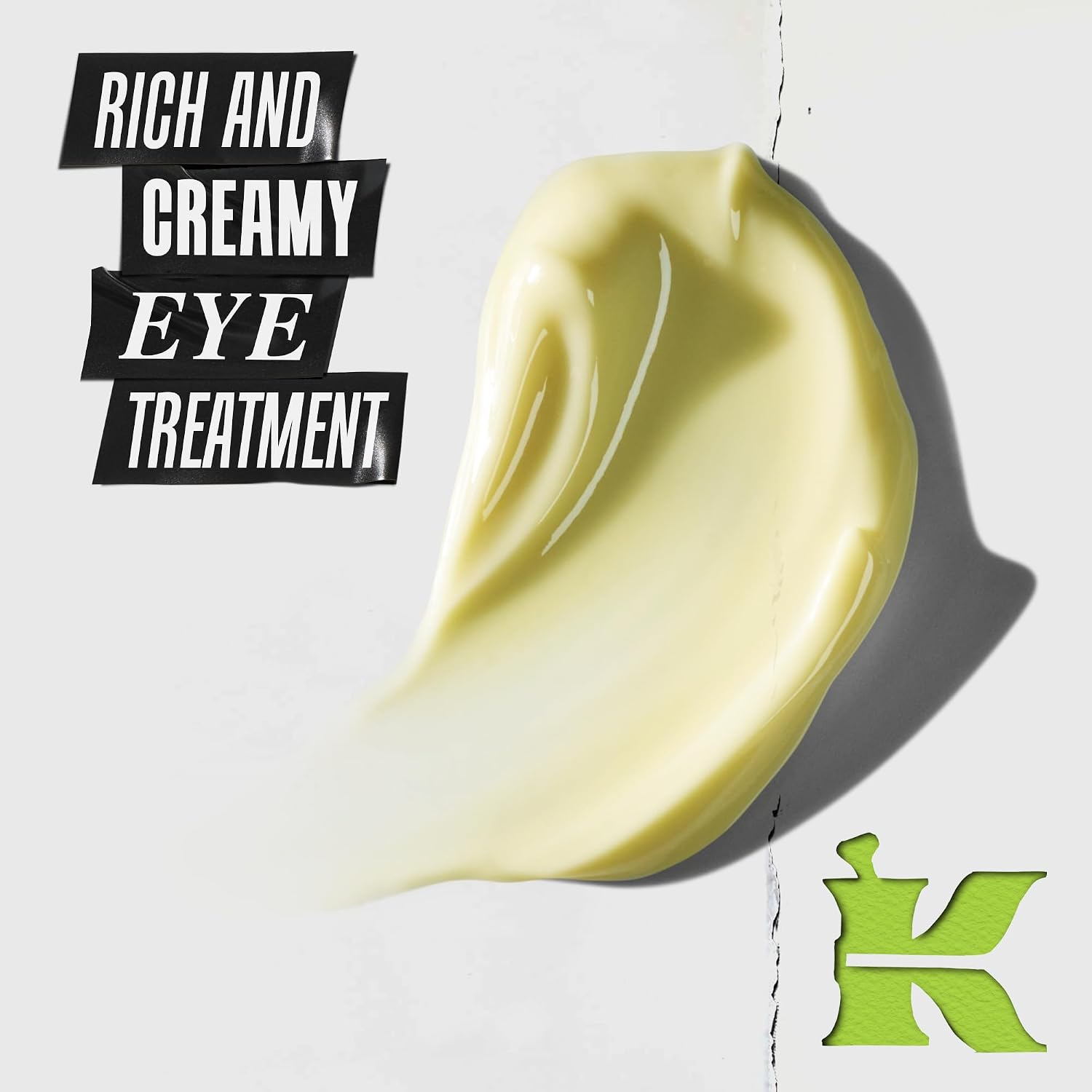
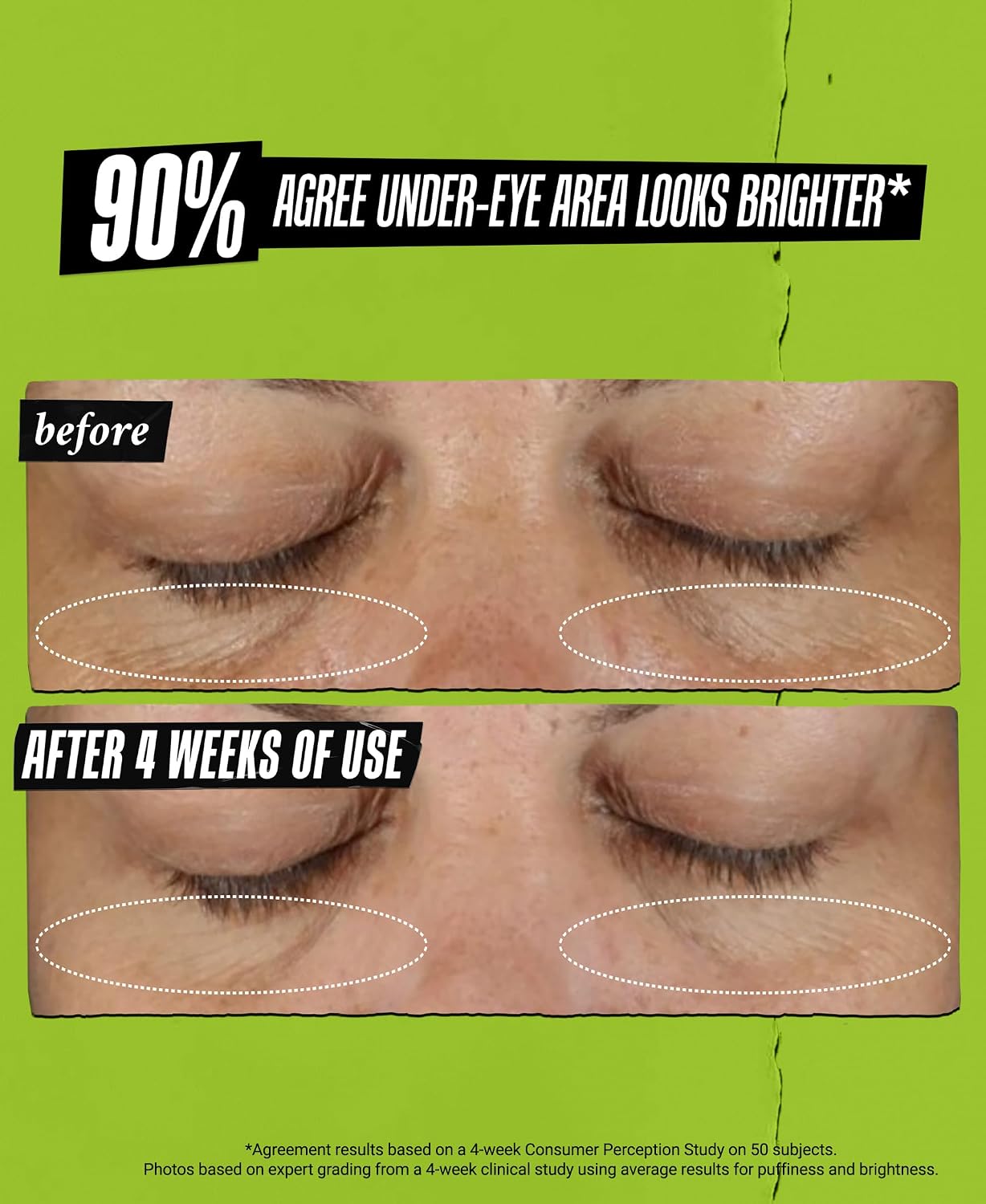
The carousel exposes eight images; the three above are the pack shot, the texture frame and the clinical frame, which between them answer the three questions a buyer actually asks. The second frame is more informative than it looks: the cream stands in a peak rather than slumping, which is what a continuous oil phase does at room temperature and is the physical reason the texture complaints in the review data are seasonal rather than constant. The third frame carries the honest footnote that most clinical graphics bury - the 90% is self-reported agreement, the photographs are expert-graded averages, and they are not the same measurement. The remaining five frames are ingredient callouts, a size comparison and a routine graphic.
Declared specifications
| Field | Value |
|---|---|
| Brand | Kiehl's |
| Item Volume | 15 ml |
| Item dimensions L x W x H | 1.64 x 1.64 x 1.42 inches |
| Age Range (Description) | Adult |
| Special Feature | Travel Size |
| Item Dimensions | 1.64 x 1.64 x 1.42 inches |
| Item Weight | 0.04 kg |
| Product Dimensions | 1.64 x 1.64 x 1.42 inches; 1.41 ounces |
| Item model number | U-SC-2790 |
| Department | Beauty |
| Manufacturer | Kiehl's Since 1851 |
| ASIN | B000S97MAY |
| Best Sellers Rank | #1,542 in Beauty & Personal Care; #5 in Eye Treatment Creams |
What the seller promises
- Hydrating eye cream for dry eyes: Kiehl's Avocado Eye Cream is a rich, fragrance-free under-eye cream that hydrates the delicate eye area and reduces the look of puffiness, dullness and dry fine lines. Reach for it after late nights, long flights or long screen days, before events, and under makeup. It can be used as a daily treatment, under-eye primer and a 10-minute eye mask, so one jar covers three steps
- Avocado Oil and Caffeine at work: Avocado Oil moisturizes, nourishes and softens the under-eye area. Caffeine helps reduce the look of under-eye puffiness. Beta-Carotene and Sodium & Copper PCA complete the brightening formula. The creamy water-in-oil texture bursts into hydration when warmed between your fingertips and seals in moisture all day. No added fragrance, so you may notice a light yellow tint and the natural scent of its oils
- Clinically tested results: In a 4-week clinical test with expert grading, the look of puffiness was reduced by 32% and under-eye brightness improved by 11%. In a 4-week consumer perception study of 50 subjects, smoothness improved by 25% and 90% agreed the eye area looked brighter. As a primer, in a 1-week consumer assessment of 50 subjects, makeup lasted longer and did not settle into fine lines
- For all skin types, including sensitive skin: Made for women and men with dry, normal, oily, combination or sensitive skin. Ophthalmologist- and dermatologist-tested for safety, and the concentrated formula is designed not to migrate into eyes. Free from parabens, fragrance, silicones, mineral oil and synthetic dyes, in recyclable packaging. Patch test on a small area before first use; stop use if irritation occurs
- How to use, morning and night: After cleansing and toning, warm a rice-grain amount between your ring fingers and tap it around the eye area until absorbed. Follow with moisturizer, plus SPF by day. Best in cold, dry or air-conditioned conditions; in humid summers, keep to a rice-grain amount and store the jar away from heat. Sizes: 0.5 fl oz / 14 ml to try or carry on, 0.95 fl oz / 28 ml for everyday use and better value per ml.
Five bullets and four numbers: a 32% reduction in the look of puffiness and an 11% improvement in brightness from a 4-week clinical test with expert grading; 25% smoother and 90% agreeing the eye area looked brighter from a 4-week consumer perception study of 50 subjects; plus a 1-week primer claim on 50 subjects. Every one of them is an appearance measure, graded or self-reported, on a panel of fifty or fewer, with no control arm stated. Two other details are worth keeping: the copy tells buyers plainly that the product is not odourless - no added fragrance, but a natural scent from the oils, plus a light yellow tint - and it names Caffeine as an active, which becomes important in part three.
From the manufacturer
The manufacturer block is more candid than most. Its comparison table prices this eye cream at $30.00 between the Ultra Facial Cleanser at $19.50 and the Ultra Facial Cream at $35.25, and lists the three at 4.4, 4.7 and 4.6 stars respectively - the brand publishing its own product as the lowest-rated of the three. The FAQ is the more useful section: asked why some reviews call the texture watery, the brand answers that this is a water-in-oil emulsion which softens in heat and firms in cooler temperatures, and advises storing the jar at room temperature away from direct sun. That is the manufacturer conceding the single most contested attribute in the review data and explaining it as physics rather than as a defect, which is both plausible and convenient.
Part two
4.4 from 3,323 buyers, and a one-star tail three times its two-star bucket
The listing carries 4.4 out of 5 across 3,323 ratings - enough volume that the average is stable, and high enough that the shape of the distribution carries more information than the mean does. The same product is scored 3.3 out of 5 from 17 reviews on Skinsort, the ingredient database. Both numbers are real, they describe different populations, and the gap between them is the first thing to understand about the way this product is received: Amazon's audience is buying an eye cream, Skinsort's is auditing an ingredient list.
Share of ratings by star bucket, as published on the listing.
77% five-star, 9% four-star, 6% three-star, 2% two-star, 6% one-star. The weighted sum of those buckets is 4.49, which the listing displays as 4.4 - truncation, not inconsistency, since the shares are rounded to whole percentages and carry about five hundredths of error. The structural fact is the tail. A 6% one-star share at this volume is roughly 199 ratings, and it is three times the two-star share while equalling the three-star share. That is not the usual prestige-skincare profile, where a small unhappy tail sits under a large satisfied majority; it is the profile of a product that either works for a buyer or does not, with very little middle. A texture that some people cannot use would produce exactly this asymmetry.
What buyers actually argue about
Eight themes are counted across 964 total mentions, and the spread from best to worst is 40 points - the widest of any product in this pipeline's recent batches. That gap is the whole story, because it separates what the cream reliably does from what it reliably costs the buyer.
Share of positive mentions per theme, with mention volume.
| Theme | Mentions | Positive | Negative | Positive share |
|---|---|---|---|---|
| effectiveness | 277 | 230 | 47 | 83% |
| moisturizing | 220 | 173 | 47 | 79% |
| value for money | 119 | 57 | 62 | 48% |
| texture | 115 | 86 | 29 | 75% |
| brightening | 75 | 59 | 16 | 79% |
| consistency | 60 | 26 | 34 | 43% |
| gentleness | 53 | 38 | 15 | 72% |
| quantity | 45 | 34 | 11 | 76% |
Effectiveness at 83% on 277 mentions and moisturizing at 79% on 220 are the pillars, and they are what the emulsion is built to deliver. Brightening at 79% on 75 mentions is the surprise: it is the smallest of the strong themes but it is stronger than the texture score, which suggests the beta-carotene tint is doing perceptual work that the ingredients alone would not predict. Then the two weak points, and they are the interesting ones. Value for money at 48% on 119 mentions is the only aspect where negatives outnumber positives - 62 against 57 - while quantity sits at 76% on 45 mentions. Read together they say the complaint is not that the jar runs out, it is that it costs too much for what it is; a little goes a long way and expensive for a moisture cream are the same observation from opposite ends. Consistency at 43% on 60 mentions, with 34 negatives, is the second fault line, and it is the one the brand has publicly answered.
Customers find this eye cream effective and appreciate its moisturizing properties, with one review noting it works instantly hydrating the eyes. The product receives positive feedback for its silky smooth texture, gentle formula that doesn't irritate sensitive skin, and ability to make eyes look refreshed and dewy. While many customers say a little goes a long way, opinions about value for money are mixed, with some finding it worth the price while others consider it expensive for a moisture cream. The consistency receives mixed reviews, with some describing it as super thick while others find it watery.
Amazon's own synthesis is unusually precise about the split: it says customers find the cream effective and moisturizing, praise the texture as silky and the formula as gentle on sensitive skin, note that a little goes a long way, then state plainly that value is mixed and that consistency draws complaints in both directions - some calling it super thick, others finding it watery. The mechanism is worth naming, and the brand names it first: a water-in-oil emulsion's viscosity is temperature-dependent, so a jar that is firm in a cold bathroom is fluid in a warm one. That reading is inferential, but it fits the two-sided consistency data better than any single-formula explanation, and it is the explanation the manufacturer itself publishes.
The review text layer
No review body rendered. The desktop page, the mobile fallback and a second unswitched session were each fetched, with three timed retries on the last, and none returned review text or buyer-uploaded photographs. The eight aspect counters above are Amazon's own aggregates, published independently of the review bodies, so they survive the failure intact. Nothing in this report quotes a buyer, and no individual review is paraphrased, because none was readable at capture time.
Part three
Twenty-six rows, nine ratings, and a claimed active that is not in the list
Two ingredient channels were queried. Skinsort returned the complete 26-row declaration with both its comedogenic and its irritancy columns intact, plus twelve claim badges. COSDNA returned nothing - the desktop search endpoint and the mobile mirror both served a Cloudflare interstitial, twice in total, and the channel was abandoned rather than retried indefinitely. So this section rests on a single database, the level column below is Skinsort's rating scale rather than a merged score, and that limitation is carried through every count on this page.
Level by level
Ingredient rows by level, after merging the two ingredient channels.
| Level | Rule | Rows | Share of formula |
|---|---|---|---|
| Level 1 | 0-1 rated | 7 | 27% |
| Level 2 | 2-3 rated | 1 | 4% |
| Level 3 | 4-5 rated | 1 | 4% |
| Unrated | no numeric rating | 17 | 65% |
| Total | 26 | 100% |
Seven rows sit at Level 1 - butylene glycol, propylene glycol, sorbitan sesquioleate, hydrogenated castor oil, sodium PCA, tocopheryl acetate and sunflower seed oil, all rated 0 or 1. Exactly one row sits at Level 2: avocado oil, rated 0-3 for comedogenicity, which is a range and is judged here on its upper bound. Exactly one row reaches Level 3: isopropyl palmitate at position 21, rated 3-4 for comedogenicity and 1 for irritancy. The number that matters most is the fourth slice - 17 of 26 rows, 65% of the formula, carry no numeric rating at all - because the database's scale is drawn from patch-test literature that covers a minority of INCI names. Shea butter, both emulsifiers, the electrolyte, both PCA salts and the whole preservation system are unrated. Read the level table as a map of where ratings exist, not as a verdict on the cream.
The same list by function
Ingredient rows grouped by the job they do in this formula.
| Function group | Rows | Share |
|---|---|---|
| Emollient ester | 5 | 19% |
| Humectant | 4 | 15% |
| Preservative | 3 | 12% |
| Botanical oil | 2 | 8% |
| Emollient wax | 2 | 8% |
| Emulsifier | 2 | 8% |
| Antioxidant | 1 | 4% |
| Chelator | 1 | 4% |
| Colorant | 1 | 4% |
| Electrolyte | 1 | 4% |
| Plant butter | 1 | 4% |
| Salicylate ester | 1 | 4% |
| Solvent | 1 | 4% |
| pH buffer | 1 | 4% |
Five rows are emollient esters - the largest group, and the reason the cream feels rich rather than watery: tridecyl stearate, tridecyl trimellitate, isocetyl stearoyl stearate, a dipentaerythrityl ester and isopropyl palmitate. Four are humectants (butylene glycol, propylene glycol, sodium PCA, copper PCA), three are preservatives, two are emulsifiers, two are botanical oils, two are emollient waxes, and the remaining eight are single rows: a solvent, a plant butter, a salicylate ester, an electrolyte, an antioxidant, a chelator, a colorant and a pH buffer. The structural point is positional and it is decisive. Water is row 1, but the next four rows are a butter and three esters, and the first emulsifier does not appear until row 5. Two emulsifiers in 26 rows, with magnesium sulfate at 13 as the internal-phase electrolyte, is the classic water-in-oil skeleton - and it explains both the burst-on-warming claim and the temperature-dependent texture complaints.
What is inside: the claim matrix
Skinsort checks twelve claim badges against the declared list. Seven hold and five fail, and the failures divide cleanly into two kinds: structural ones that no reformulation could fix without changing what the product is, and one that cannot be traced to any row at all.
| Claim | Verdict | Evidence |
|---|---|---|
| Alcohol-free | YES | No ethanol, alcohol denat. or other drying alcohol appears in the 26 declared rows |
| EU-allergen-free | YES | None of the 26 fragrance-allergen markers (limonene, linalool, citronellol, eugenol, geraniol, etc.) is declared |
| Fragrance-free | YES | Skinsort: no fragrance ingredients found. The listing separately states no added fragrance, and warns of the natural scent of the oils |
| Paraben-free | YES | No methyl-, ethyl-, propyl- or butylparaben in the declaration; phenoxyethanol and chlorphenesin carry the preservation load |
| Silicone-free | YES | No dimethicone or any other -cone / -siloxane row |
| Sulfate-free | YES | No SLS, SLES or other anionic sulfate surfactant; the two emulsifiers are a PEG-30 polyester and a sorbitan ester |
| Reef-safe | YES | Skinsort: nothing to flag. No oxybenzone, octinoxate or octocrylene, which is expected of a product with no sunscreen actives |
| Oil-free | NO | 4 oil-bearing rows: Butyrospermum Parkii Butter (2), Persea Gratissima Oil (8), Hydrogenated Castor Oil (14), Helianthus Annuus Seed Oil (24) |
| Cruelty-free | NO | A brand-level status, not a formula fact; nothing in the 26 rows can settle it either way |
| Fungal-acne-safe | NO | 10 flagged ingredients - the ester, butter and fatty-acid load of a water-in-oil emulsion |
| Pore-clogger-free | NO | 3 flagged ingredients, of which Isopropyl Palmitate at row 21 is rated 3-4 comedogenic |
| Vegan | NO | No obviously animal-derived row is named in the 26, so the flag rests on sourcing outside the declaration rather than on a visible ingredient |
Oil-free fails on four rows - shea butter, avocado oil, hydrogenated castor oil and sunflower seed oil. A cream whose second ingredient is a butter cannot be oil-free; the badge is a category mismatch, not a defect. Fungal-acne-safe fails on ten flagged ingredients and pore-clogger-free on three, of which isopropyl palmitate at 21 is the only one rated above 3. Vegan fails without a visible cause: scanning all 26 rows for an animal-derived material turns up nothing, so the flag most likely rests on a sourcing record outside the declaration and is reported unexplained rather than guessed at. Cruelty-free fails, and that is a brand-level status rather than a formula fact - nothing in an INCI list can settle it either way. On the passing side, the one worth noting is Fragrance-free, which holds on the strength of absence - no parfum, no EU-declarable allergen - and Skinsort's own note says so instead of relying on a colour badge.
The complete ingredient list
Every row below is a declared ingredient in INCI order, with the CosIng function set for each name. The two rating columns are transcribed from Skinsort as published, including its ranges; a dash means no value is carried for that row, not that the row scored zero. Level is derived from the higher of the two ratings, which is why the method section states the rule rather than assuming it.
| # | Ingredient | Function (CosIng) | Group | Comedogenic | Irritancy | Level |
|---|---|---|---|---|---|---|
| 1 | Water | Solvent, skin conditioning | Solvent | - | - | Unrated |
| 2 | Butyrospermum Parkii Butter | Skin conditioning | Plant butter | - | - | Unrated |
| 3 | Butylene Glycol | Humectant, solvent | Humectant | - | - | Level 1 |
| 4 | Tridecyl Stearate | Emollient | Emollient ester | - | - | Unrated |
| 5 | PEG-30 Dipolyhydroxystearate | Emulsifying | Emulsifier | - | - | Unrated |
| 6 | Isodecyl Salicylate | Skin conditioning, UV filter | Salicylate ester | - | - | Unrated |
| 7 | Tridecyl Trimellitate | Emollient | Emollient ester | - | - | Unrated |
| 8 | Persea Gratissima Oil | Skin conditioning | Botanical oil | - | - | Level 2 |
| 9 | Isocetyl Stearoyl Stearate | Emollient | Emollient ester | - | - | Unrated |
| 10 | Propylene Glycol | Humectant, solvent | Humectant | - | - | Level 1 |
| 11 | Dipentaerythrityl Hexacaprylate/Hexacaprate | Emulsifying, emollient | Emollient ester | - | - | Unrated |
| 12 | Sorbitan Sesquioleate | Emulsifying | Emulsifier | - | - | Level 1 |
| 13 | Magnesium Sulfate | Viscosity controlling | Electrolyte | - | - | Unrated |
| 14 | Hydrogenated Castor Oil | Emollient, viscosity controlling | Emollient wax | - | - | Level 1 |
| 15 | Sodium PCA | Humectant, skin conditioning | Humectant | - | - | Level 1 |
| 16 | Phenoxyethanol | Preservative | Preservative | - | - | Unrated |
| 17 | Chlorphenesin | Antimicrobial, preservative | Preservative | - | - | Unrated |
| 18 | Hydrogenated Jojoba Oil | Abrasive, emollient | Emollient wax | - | - | Unrated |
| 19 | P-Anisic Acid | Masking, preservative | Preservative | - | - | Unrated |
| 20 | Tocopheryl Acetate | Antioxidant | Antioxidant | - | - | Level 1 |
| 21 | Isopropyl Palmitate | Emollient | Emollient ester | - | - | Level 3 |
| 22 | Disodium EDTA | Chelating | Chelator | - | - | Unrated |
| 23 | Copper PCA | Humectant, skin conditioning | Humectant | - | - | Unrated |
| 24 | Helianthus Annuus Seed Oil | Emollient | Botanical oil | - | - | Level 1 |
| 25 | CI 40800 | Colorant | Colorant | - | - | Unrated |
| 26 | Citric Acid | Buffering | pH buffer | - | - | Unrated |
Declared order, unbroken
Water, Butyrospermum Parkii Butter, Butylene Glycol, Tridecyl Stearate, PEG-30 Dipolyhydroxystearate, Isodecyl Salicylate, Tridecyl Trimellitate, Persea Gratissima Oil, Isocetyl Stearoyl Stearate, Propylene Glycol, Dipentaerythrityl Hexacaprylate/Hexacaprate, Sorbitan Sesquioleate, Magnesium Sulfate, Hydrogenated Castor Oil, Sodium PCA, Phenoxyethanol, Chlorphenesin, Hydrogenated Jojoba Oil, P-Anisic Acid, Tocopheryl Acetate, Isopropyl Palmitate, Disodium EDTA, Copper PCA, Helianthus Annuus Seed Oil, CI 40800, Citric Acid
Readings that matter more than the list
- Caffeine is claimed and cannot be found. Bullet two names Avocado Oil and Caffeine and credits caffeine with reducing the look of under-eye puffiness. Three of the four actives named in that bullet are locatable: Sodium PCA at 15, Copper PCA at 23, and beta-carotene behind the colorant CI 40800 at 25. Caffeine is not in any of the 26 rows. Either this declaration is incomplete for the SKU or the copy overstates the formula, and a single blocked channel cannot settle which. It is the largest unresolved question in this report.
- Avocado oil is row 8, not row 2. Shea butter outranks it, and so do three synthetic esters. The ingredient on the jar is the fourth oil-family row in the list. Position 8 in a 26-row formula is a real presence rather than a token - but the name leads by marketing arithmetic, not by weight.
- The one Level 3 row is where the hydration is not. Isopropyl palmitate, rated 3-4 comedogenic, sits at 21 - behind every humectant and both PCA salts. The parts of the formula doing the moisturizing work are not the parts carrying the flag, which is a more useful reading than the flag count alone.
- The formula's honest structure is occlusion, not repair. Seven rows hydrate, three address the barrier, and brightening and irritation relief each rest on a single row - tocopheryl acetate carries both. That matches where the listing puts its clinical evidence: appearance measures on puffiness and brightness, which an occlusive film genuinely improves, rather than barrier function, which two oils and a butter only nominally support.
- Fragrance-free is earned by absence, not by deodorising. No parfum row exists and no EU allergen is declared, so the badge holds - and the listing then tells buyers they may notice the natural scent of the oils. A fragrance-free badge and an odourless product are different claims, and this jar only makes the first.
- Twenty-six rows is a short list for a prestige cream, and that is a finding. Kiehl's could have listed a botanical cocktail; it listed five esters, four humectants, two oils and a preservation system. The formula is closer to a pharmacy emulsion than to the botanical story the name promises, which is not a criticism of its performance but is a correction to what the name implies.
Part four
Thirty dollars against a forty-dollar list, and a ten-year average above it
The buy box reads $30.00, down from a $40.00 list - a 25% saving, and $60.00 per fluid ounce because the jar holds half an ounce. That is the headline. The record behind it is more interesting than the discount: the product's current price sits below both of the channel averages the tracker has built since 2010, and the subscription tier undersells every one-time price ever recorded on the primary channel.
| Field | Value |
|---|---|
| Live buy-box price | $30.00 |
| List price | $40.00 |
| Discount vs list | 25% |
| Unit price | $60.00 per fluid ounce |
| Subscribe & Save | $25.50 (36% off) |
| Monitoring start | Apr 30, 2010 |
| Last tracked | Oct 23, 2026 (9 days before collection) |
The price history table, as published
| Price type | Lowest ever | Highest ever | Current | Average |
|---|---|---|---|---|
| Amazon | $27.05 (May 22, 2023) | $37.00 (Feb 25, 2024) | - | $32.11 |
| 3rd Party New | $16.10 (Jul 06, 2013) | $59.99 (Mar 10, 2016) | $30.00 (Oct 19, 2026) | $35.00 |
| 3rd Party Used | - | - | - | - |
The four numbers, side by side
Lowest ever, highest ever, current and average for each channel that carries data.
Dated observations
The tracker has been watching this ASIN since 30 April 2010, which makes it one of the longest records in the file. It also shows something structural: the Amazon-sold channel carries no current value at all, because the listing is sold by Kiehl's Since 1851 rather than by Amazon. Five dated observations survive across the two live channels, and they are spread over thirteen years rather than over a season.
Every dated observation the free record exposes, plotted in order.
$16.10 on 6 July 2013, $59.99 on 10 March 2016, $27.05 on 22 May 2023, $37.00 on 25 February 2024, $30.00 on 19 October 2026. Read in date order, that is not a trend, it is a set of five snapshots taken at the extremes of two different channels: the two oldest points are third-party marketplace artefacts, the two middle ones are the Amazon-sold range, and the last is the live brand-direct buy box. Connecting them into a line would invent a shape the record does not contain, which is why the chart plots them as observations rather than as a series.
The current price is genuinely cheap against its own history, which is rarer than it sounds. $30.00 sits 14.3% below the third-party average of $35.00 and 6.6% below the Amazon-channel average of $32.11. Both averages were built over more than a decade. A live price under both of them is a different finding from the usual 'discounted against a list nobody pays', and it is the single most defensible commercial statement in this report.
The 25% is arithmetic against list, and it is also the standing state of the listing. The $40.00 list has not moved in the tracked window and no sustained period at list appears on the primary channel. The saving is real money; it is not a promotion, and calling it one would misread a permanently discounted listing as a temporary event.
Both all-time extremes are artefacts, and they are thirteen and ten years old. The $16.10 low of 2013 is 60% below list and predates the current packaging era; the $59.99 high of 2016 is 50% above list. A third-party marketplace on a prestige cream produces both without any change in what the brand charges. Between them they generate a 272.6% spread that says nothing about the product's actual trading band, which the two Amazon-channel figures place at roughly $27 to $37.
Subscribe and Save is the true floor of the entire record. At $25.50, 36% below the buy box, the subscription price is $1.55 below the lowest price ever recorded on the Amazon channel and $4.50 below today's third-party price. For a product the brand instructs buyers to use twice daily, the subscription is not a marginal saving - it is cheaper than any one-time price this listing has ever offered.
A dormant channel is itself a finding. Half the price table describes a window that has closed. Because the brand now sells directly, the tracker's Amazon column stopped updating and the live signal moved to the third-party column. That is why the current value is thirteen days old and still exact: the offer has not moved, and the buy box read on 1 November matches the recorded $30.00 from 19 October precisely.
The unit price is a size artefact, and the brand says so. At $60.00 per fluid ounce the 0.5 oz jar looks expensive for a moisturizer, and it is - but the listing's own copy steers buyers to the 0.95 oz size 'for better value per ml'. The small jar is the trial and travel format; judging the line's pricing on this fill would overstate it by roughly a factor of two.
Part five
Method, confidence, and the four things this report cannot settle
Every figure here is a single reading taken on 1 November 2026 from three sources: the Amazon listing in a New York delivery context, the Skinsort ingredient page, and the camelcamelcamel price record for the same ASIN. Nothing is estimated, nothing is converted, and every derived percentage is labelled as a derivation. Where a channel failed, the failure is stated in the section it affects rather than smoothed over.
| Element | Confidence | Basis |
|---|---|---|
| Live price, list price, discount | High | Read from the rendered buy box with a US ZIP applied and the Deliver to line verified as New York 10001 |
| Rating, histogram, aspect counters | High | Amazon's own aggregates, published independently of the review bodies |
| Review text and buyer photos | None | No review body rendered on any of three fetches with three timed retries |
| Ingredient list, 26 rows | High | Skinsort returns the complete declaration in INCI order |
| Comedogenic and irritancy ratings | Medium | Skinsort's scale, patch-test derived, covering 9 of 26 rows |
| Level classification | Medium | Derived: higher of the two ratings, bucketed 0-1 / 2-3 / 4-5, with ranges read on the upper bound |
| Claim matrix, 12 badges | High | Complete on Skinsort with its own parentheticals, and consistent with the listing's own free-from copy |
| Price history extremes | High | Transcribed verbatim with dates, including two cells that are genuinely empty |
| Current price recency | High | Thirteen days old and identical to the live buy box |
| Skinsort's 3.3 / 5 | Low as a market signal | Seventeen community reviews from an ingredient-literate audience |
What this report cannot settle
- No review text was readable, so nothing here reflects what an individual buyer wrote. The aspect counters are Amazon's counts of mentions, not quotations, and the 6% one-star tail is described rather than explained.
- One ingredient channel was blocked. COSDNA served a Cloudflare interstitial on both hostnames, twice each, so there is no second opinion on any rating and no independent check on the 26-row count - which is exactly the check that would have settled whether caffeine is really missing.
- The all-time table is all-time only. The tracker's free page does not expose period-specific lows or highs, and changing the chart window does not change the summary. A six-month low cannot be derived from this record and is not claimed.
- The clinical claims are unaudited. Four appearance measures on panels of fifty or fewer, one of them self-reported and all of them graded rather than instrumented, are reported as the brand publishes them and not as established effect sizes.
Snapshot, 1 November 2026. A thirteen-year-old jar that still holds a top-five subcategory rank on a formula of five esters, four humectants and two oils; a review profile whose one-star tail is three times its two-star bucket; a claim matrix that holds seven of twelve badges, with the five failures mostly structural; and a $30.00 price that sits below its own decade-long average while the brand itself answers the texture complaint in its own FAQ.