Amazon US product dossier · captured 30 October 2026 · delivery context New York 10001 · prices in USD as displayed
La Roche-Posay Toleriane Purifying Foaming Cleanser, 400 ml. A fragrance-free, sulfate-free foaming wash with a genuinely mild surfactant system — in which the two ingredients named on the front of the bottle sit at positions 14 and 15 of nineteen.
01 · Product information
A 400 ml pump bottle of foaming gel cleanser for normal to oily sensitive skin. The listing is unusually explicit about what the product is not: soap-free, sulfate-free, oil-free, fragrance-free and non-comedogenic are all asserted in the bullets, and the pack repeats three of those lines in a strip near its base. What is being sold is a balance rather than a benefit — that it removes makeup, oil and impurities without stripping skin or disturbing its pH.
| Brand | La Roche-Posay | Item form | Gel |
|---|---|---|---|
| Scent | Unscented | Age range | Adult |
| Unit count | 13.52 fluid ounces | Net content volume | 200 ml |
| Item weight | 15.36 ounces | Package quantity | 1 |
| Dimensions | 2.4 × 2.4 × 8.25 in; 15.4 oz | Unit price | $1.48 per fluid ounce |
| Manufacturer | La Roche-Posay | Model number | 3337875545822 |
| Special ingredients stated | Ceramide-3, Glycerin, La Roche-Posay Prebiotic Thermal Water, Niacinamide | ||
| Category path | Beauty & Personal Care › Skin Care › Face › Cleansers › Washes | ||
| Best sellers rank | #41 in Beauty & Personal Care · #3 in Facial Cleansing Washes | ||
One field in that table does not survive contact with the photographs. The specification gives a net content of 200 ml; the bottle in the listing image is printed 400 ml / 13.52 FL.OZ. The fluid-ounce figure matches the pack in both places, which means the millilitre figure in the specification is the error — 400 ml is 13.53 fl oz, and 200 ml would be half the stated size. A buyer reading only the specification would think they were buying a 200 ml bottle.
What the listing claims
- Cleanses without stripping. Removes impurities, excess oil and makeup, for normal to oily sensitive skin.
- Protects the barrier. Maintains the skin's natural protective barrier and optimal pH, with no pore-clogging residue.
- Clinically tested claims. After four weeks of daily use, 94% reported cleaner, healthier skin and 92% found it effectively cleansed impurities, dirt and oil.
- Soap-free and nourishing. Prebiotic thermal water, ceramide-3 and niacinamide.
- Dermatologist-tested. Tested on sensitive skin, allergy tested, soap-free, sulfate-free, oil-free, fragrance-free and non-comedogenic.
Note what is absent from that list: no exfoliation, no acne treatment, no brightening claim, no timeline beyond four weeks of use. The marketing is disciplined about this being a cleanser.
Product images
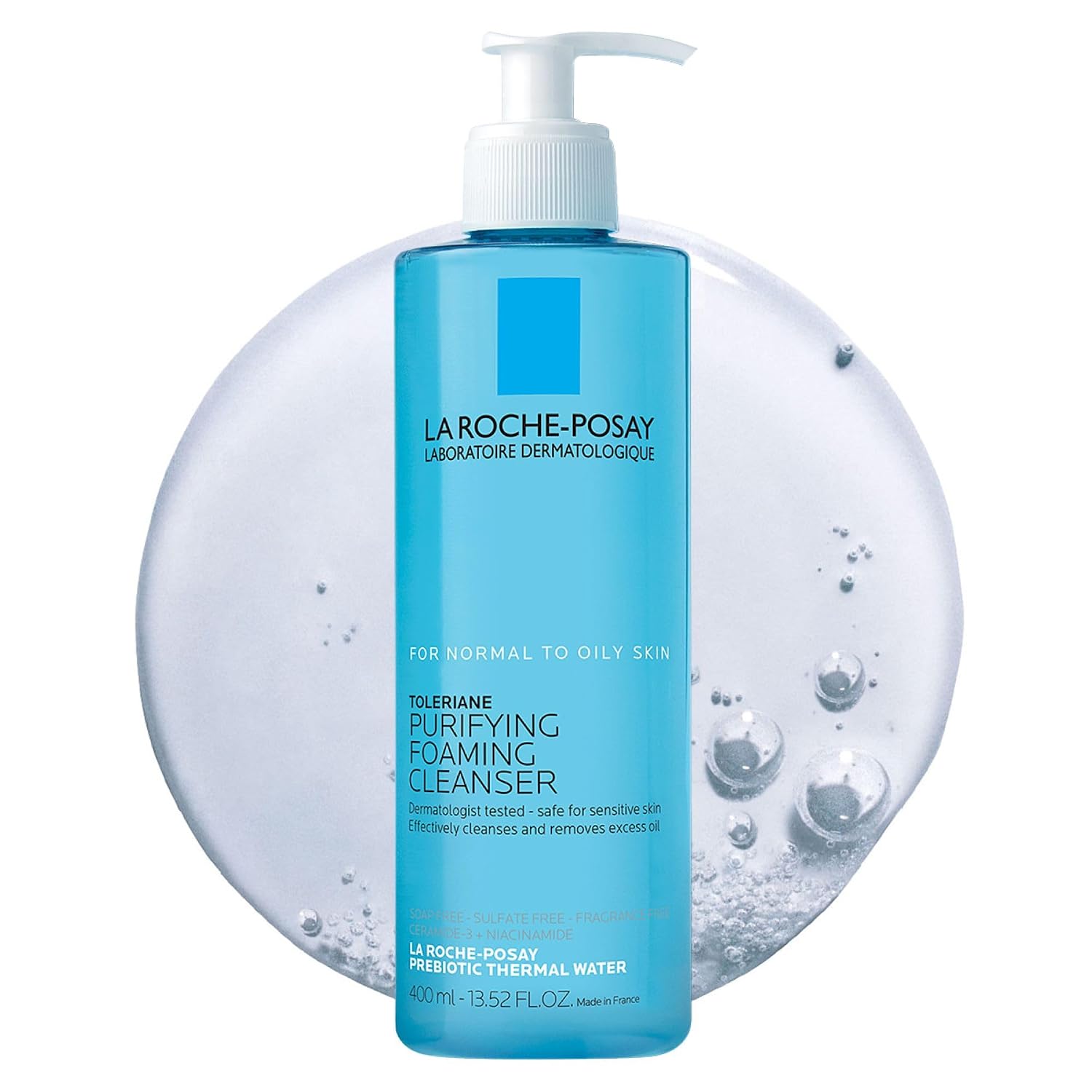
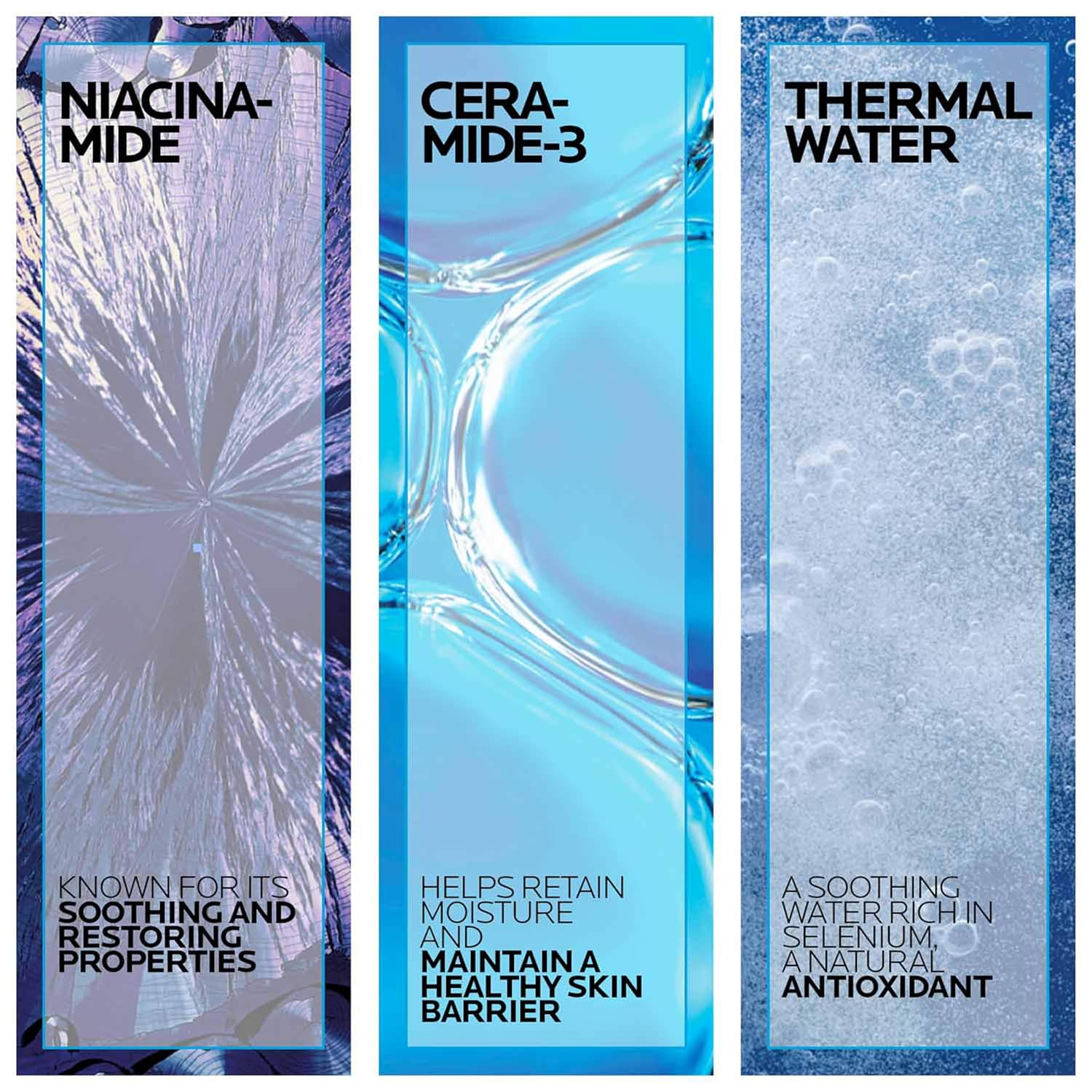
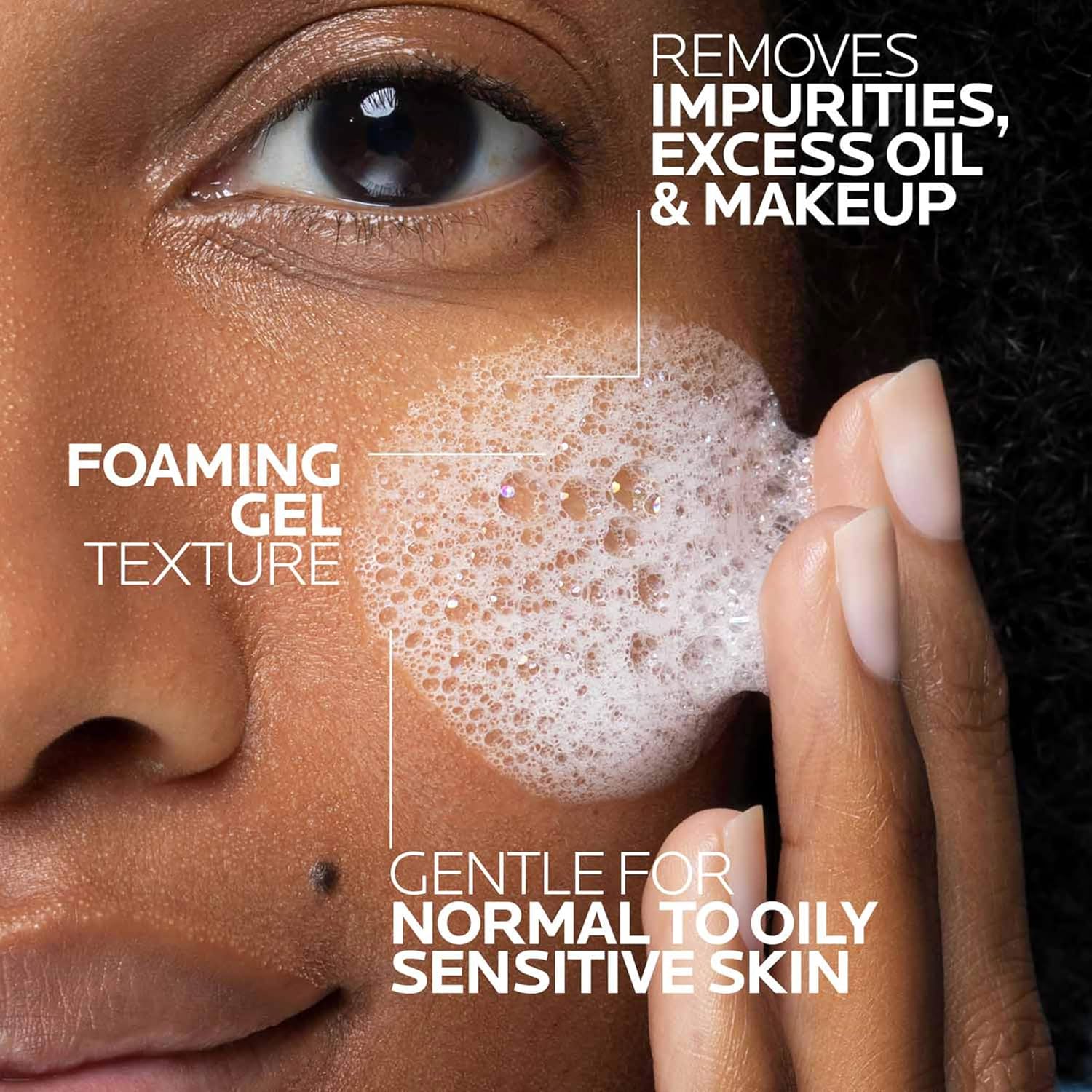
Three listing images captured, each of them marketing art rather than pack photography of the back label. The formula in section 03 comes from the listing's own INCI block, not from a photograph. The listing exposes no buyer-uploaded photographs, and none has been substituted.
02 · Product rating
4.7 out of 5 across 46,708 ratings — by far the largest rating base in this series, and large enough that the mean is a description of the market rather than of a sample.
4.7
of 5
46,708
listing-reported
85%
of all ratings
#3
Facial Cleansing Washes
| Stars | Share | Approximate ratings | Reading |
|---|---|---|---|
| 5 | 85% | ~39,702 | Consensus position |
| 4 | 9% | ~4,204 | Satisfied with a reservation |
| 3 | 3% | ~1,401 | Genuinely split |
| 2 | 1% | ~467 | Dissatisfied |
| 1 | 2% | ~934 | Dissatisfied |
One detail in that distribution is worth more than the average. One-star ratings outnumber two-star ratings roughly two to one. On a smooth gradient of mild disappointment the two-star bucket would be the larger of the pair; here it is the smaller, which is the signature of a product that either works for a buyer or provokes a reaction. That shape is consistent with the one theme that underperforms in the next section.
Because the shares are the rounded percentages the listing publishes, the 1% and 2% buckets are rounded shares and cannot be read as exact counts. With a base this large, though, 2% of 46,708 is a substantial absolute group — roughly nine hundred one-star ratings.
The two channels disagree, and both are right
A second database rates this product 3.6 from 59 reviews. That is 1.1 points below Amazon and it should not be averaged with it, because the two measure different populations: 59 self-selected votes from people motivated to register an opinion on an ingredient site, against 46,708 purchase-linked ratings from ordinary buyers. The gap is informative precisely because it is not an error — the most engaged readers were the least impressed.
03 · What buyers say
The listing's aggregated summary over 46,708 ratings describes a product that does its job gently and is valued for it.
Buyers find the cleanser effective and gentle enough for twice-daily use, and single out how well it removes makeup and clears the skin. It suits sensitive and oily skin, leaving skin soft and moisturized rather than dry, and buyers appreciate that it has no strong scent. It is considered good value for money.
| Theme | Mentions | Positive | Negative | Positive share |
|---|---|---|---|---|
| Effectiveness | 2,511 | 2,305 | 206 | 92% |
| Cleansing | 1,770 | 1,670 | 100 | 94% |
| Skin compatibility | 1,200 | 907 | 293 | 76% |
| Moisturizing | 739 | 610 | 129 | 83% |
| Value for money | 646 | 538 | 108 | 83% |
| Gentleness | 568 | 553 | 15 | 97% |
| Fragrance-free | 418 | 353 | 65 | 84% |
| Skin feel | 397 | 375 | 22 | 94% |
Four readings. The product does what it says: effectiveness and cleansing are discussed four thousand times between them at 92% and 94% positive, and gentleness — the claim a foaming wash is most likely to fail — sits at 97%. Skin compatibility is the single weak theme at 76%, and its 293 negative mentions are more than every other negative mention in the table combined. For a cleanser positioned at oily and sensitive skin, that is the expected fault line: oily skin wants more cleansing, sensitive skin tolerates less, and no formula satisfies both extremes. Fragrance draws 418 mentions, which is a lot for a product with no fragrance in it — buyers notice the absence and treat it as a feature, which is exactly what a fragrance-free positioning is for. And value at 83% is respectable for a $19.99 pharmacy cleanser, though 108 negative mentions on price suggest the subscription discount is doing real work.
A structural note: mentions are not reviews. One review can raise several themes, so these columns do not sum to 46,708 and should not be read as a partition of the buyer base.
04 · Product ingredients
This is the section where the product's marketing and its formula part company, and the evidence is positional rather than chemical.
The listing publishes the full INCI declaration. A second database was also reachable for this product and lists eighteen rows against the pack's nineteen — the two are merged below, with the pack's declaration preferred for composition and the database used for claim verdicts and benefit mapping, which nothing else can supply. A third source, which would have added per-ingredient acne and irritancy grades, was unavailable, so no acne-risk, irritant or safety score appears in this report; those ratings cannot be derived from an ingredient name and have not been invented.
The declaration
Aqua/Water/Eau • Glycerin • Coco-Betaine • Propanediol • PEG-120 Methyl Glucose Dioleate • Sodium Hydroxide • Sodium Chloride • Citric Acid • Disodium EDTA • Hydroxyacetophenone • Capryloyl Glycine • Caprylyl Glycol • Disodium Cocoyl Glycinate • Ceramide NP • Niacinamide • Trisodium Ethylenediamine Disuccinate • Pentylene Glycol • Acrylates Copolymer • Tocopherol.
Nineteen lines, eight functional levels
| Level | Function | Entries | Share | Members |
|---|---|---|---|---|
| 1 | Water and base | 1 | 5.3% | Aqua |
| 2 | Surfactants — the cleansing system | 3 | 15.8% | Coco-Betaine, PEG-120 Methyl Glucose Dioleate, Disodium Cocoyl Glycinate |
| 3 | Humectants | 2 | 10.5% | Glycerin, Propanediol |
| 4 | pH adjusters and electrolytes | 3 | 15.8% | Sodium Hydroxide, Sodium Chloride, Citric Acid |
| 5 | Chelating agents | 2 | 10.5% | Disodium EDTA, Trisodium Ethylenediamine Disuccinate |
| 6 | Preservation system | 4 | 21.1% | Hydroxyacetophenone, Capryloyl Glycine, Caprylyl Glycol, Pentylene Glycol |
| 7 | Barrier and antioxidant actives | 3 | 15.8% | Ceramide NP, Niacinamide, Tocopherol |
| 8 | Rheology modifier | 1 | 5.3% | Acrylates Copolymer |
Two ratios in that table are the story. The preservation system is the largest single block at four entries — larger than the three-surfactant cleansing system that does the actual work. That is normal for a water-based product with a long shelf life, and it is what a formula has to do to stay stable while being both fragrance-free and paraben-free. And the actives block is sizeable but sits at the very bottom of the declaration, which is a statement about concentration, not about importance.
Where the marketed ingredients actually sit
| Ingredient | Position | Of | What precedes it |
|---|---|---|---|
| Ceramide NP (called “Ceramide-3” on the pack) | 14 | 19 | Water, all three surfactants, both humectants, all pH and electrolyte materials, both chelators, three of four preservatives |
| Niacinamide | 15 | 19 | All of the above, plus ceramide NP |
| Tocopherol | 19 | 19 | Everything, including the rheology modifier |
INCI order runs by descending concentration above 1% and in free order below it. What the positions mean concretely: neither niacinamide nor ceramide can be present at more than a low single-digit percentage, and both are more likely at a fraction of one percent — because a dozen other materials, several themselves used at 1% or less, are declared ahead of them. In a rinse-off product that stays on the skin for perhaps thirty seconds, exposure is small twice over: low concentration, brief contact.
That is not a flaw. A cleanser's job is to cleanse, and the surfactants here are the mild kind. But the front panel names ceramide-3 and niacinamide, the specification field lists them as the “special ingredients”, and the declaration puts them last. Tocopherol at 19 is a different case: it is there to stop the formula oxidising, not to act on skin, and its position at the end is exactly right.
What the panel does and does not contain
| Question | Answer | Evidence |
|---|---|---|
| Soap-free? | Yes | No fatty acid plus alkali combination; the surfactants are betaine, glycinate and a glucose derivative |
| Sulfate-free? | Yes | No SLS, SLES or any sulfate ester among the nineteen lines |
| Fragrance-free? | Yes | No parfum, and none of the eight declarable fragrance allergens appears anywhere in the formula |
| Oil-free? | Yes | No oil, butter or significant fatty ester |
| Paraben-free? | Yes | Preservation is hydroxyacetophenone, capryloyl glycine, caprylyl glycol and pentylene glycol |
| Silicone-free? | Yes | No silicone of any class |
| Cruelty-free / vegan? | No to both | Confirmed by the second database's badge set; supply-chain designations, not safety findings |
| Fungal-acne-safe? | Flagged, low risk | One ester flagged: PEG-120 Methyl Glucose Dioleate, annotated as an unlikely trigger |
| Contains an exfoliant? | No | Citric acid is present as a buffer at pH-adjusting level, not as a treatment acid |
The fragrance-free question deserves emphasis because it is fully answerable here and it is where many “sensitive skin” cleansers quietly fail. Not only is there no fragrance entry — none of the eight declarable fragrance allergens that appear in a scented product shows up anywhere in these nineteen lines. For a buyer whose problem is sensitisation rather than oiliness, that is the most useful single fact in the panel.
Twelve claims, nine of which hold
| Claim | Holds | Note |
|---|---|---|
| Fragrance-free | Yes | Corroborated independently by the declaration |
| EU-allergen-free | Yes | No declarable allergen in the panel |
| Sulfate-free | Yes | Corroborated by the declaration |
| Oil-free | Yes | |
| Alcohol-free | Yes | Glycols present, not volatile alcohols |
| Paraben-free | Yes | |
| Silicone-free | Yes | |
| Pore-clogger-free | Yes | |
| Reef-safe | Yes | |
| Cruelty-free | No | Not a certified cruelty-free product |
| Vegan | No | Not a vegan product |
| Fungal-acne-safe | No | One ester flagged — PEG-120 Methyl Glucose Dioleate — described as an unlikely trigger |
Twelve promised benefits, and how thin the evidence is for most
The second channel maps each benefit claim to the number of ingredients that could deliver it. That count is the honest measure of how much weight a claim can bear.
| Benefit | Ingredients mapped | How much weight it can bear |
|---|---|---|
| Barrier repair | 6 | Strongest claim; the ceramide and humectant group |
| Hydrating | 4 | Glycerin and propanediol, at work in a rinse-off format |
| Anti-aging | 3 | Weak for a cleanser; nothing here is an anti-aging active |
| Redness reducing | 3 | Plausible as an absence of irritants rather than an active effect |
| Brightening | 2 | Depends on niacinamide at position 15 |
| Reduces irritation | 2 | Same caveat |
| Scar healing | 2 | Not credible from a rinse-off cleanser |
| Dark spots | 2 | Same |
| Acne fighting | 1 | Single ingredient; and the brand itself does not claim to treat acne |
| Good for oily skin | 1 | Positioning rather than a mechanism |
| Reduces large pores | 1 | Not achievable by cleansing |
| Skin texture | 1 | Weak |
Read the bottom half of that table as marketing rather than mechanism. Four claims rest on a single ingredient, and two of them — scar healing and dark spots — are not things a cleanser that is rinsed off in thirty seconds can do. The top two, barrier repair and hydration, are the ones the formula actually supports, and they are also the two the brand leads with. The listing is more disciplined than the database here: its own bullets claim no anti-aging, no scar healing and no dark spots.
05 · Product price
At capture the buy box showed $19.99 in stock, sold by Amazon, at $1.48 per fluid ounce. No strike-through list price was rendered. The only discount on offer was a Subscribe & Save price of $18.99, a 5% reduction, with an additional 5% coupon on a first subscription.
$19.99
sold by Amazon
$18.99
−5%
$19.99
at parity
$1.48
13.52 fl oz
Price history, by channel
The record begins in February 2017 — nine years. All four values per price type are all-time, not period-specific.
| Price type | Lowest ever | Highest ever | Current | Average |
|---|---|---|---|---|
| Amazon | $6.37 (15 Dec 2017) | $19.99 (12 Oct 2026) | $19.99 (12 Oct 2026) | $19.60 |
| 3rd party new | $13.98 (6 Oct 2026) | $26.99 (27 May 2024) | $19.99 (12 Oct 2026) | $17.32 |
| 3rd party used | — | — | — | — |
The current value is also the all-time high, and the two channels have converged on exactly the same number. Both print $19.99 dated 12 October 2026, which means the item has spent the eighteen days since sitting at the peak of a nine-year record, with no channel willing to undercut list.
Where today's price sits
| Benchmark | Amazon channel | 3rd party new channel |
|---|---|---|
| Current vs all-time low | +213.8% | +43.0% |
| Current vs average | +2.0% | +15.4% |
| Current vs list price ($19.99) | 0.0% | 0.0% |
| Current vs all-time high | 0.0% | −25.9% |
| All-time spread, and as % of the low | $13.62 · 213.8% | $13.01 · 93.1% |
Two of those rows need interpreting rather than repeating.
The +213.8% is not a real discount history. The Amazon low of $6.37 is dated 15 December 2017 and is not a plausible price for a 400 ml cleanser. The pattern is a familiar tracker artefact: a smaller size of the same product family — a travel or trial bottle sold under a related listing — gets mapped onto the parent identifier, and that offer is recorded as a low. It is reported as published and flagged as an inference, and it should not be read as a price this bottle ever sold at. Set it aside and the Amazon series reads as an item that has sat near $19.60 to $19.99 for years.
The negative channel premium is the interesting result. The third-party average of $17.32 sits $2.28 below the Amazon average of $19.60 — inverted from the usual direction. The explanation is in the two highs: Amazon has been pinned near list for years (average $19.60 against a $19.99 list, 2.0% under), while the marketplace has ranged from $13.98 to $26.99 around a lower centre. Historically the marketplace was the cheaper route; today it is not, because both have converged on $19.99. That convergence is what a brand-managed minimum price looks like in a nine-year tracker record.
The practical conclusion for a buyer: the only discount available on this item is a subscription discount. The two 5% reductions together — Subscribe & Save plus the first-order coupon — are the whole of the promotional room the listing offers, and they require repeat delivery rather than timing.
Freshness
The current values are dated 12 October 2026 and were read on 30 October 2026 — eighteen days old, and the stalest of the three products captured in this run. That is inside a 30-day tolerance but means the figure is a last observation rather than a quote. The tracker's scan field reported an update 17 days before capture while its tracking tick read 2 days; the two measure different things and neither is the date of the current price.
06 · Method, confidence and limits
Four captures underpin this report, made on 30 October 2026: the Amazon US listing with a New York 10001 delivery context so all pricing is native USD with no conversion; the listing's INCI block for composition; a nine-year price tracker for the channel series; and a second ingredient database, reached in full, for claim verdicts and benefit mapping. A third source that would have supplied per-ingredient acne and irritancy grades was blocked, and is reported as blocked rather than filled.
| Element | Confidence | Basis |
|---|---|---|
| Product identity | High | Model number, EAN and brand all match the listing |
| Buy box price $19.99 | High | Read directly with US delivery context confirmed |
| Rating and distribution | High | Published aggregates on a 46,708 base |
| Buyer theme percentages | Medium to high | Listing aggregation; mentions are not reviews |
| Ingredient declaration and count of 19 | High | Manufacturer INCI, complete and legible |
| Position-based concentration inference | Medium | INCI ordering rules; no percentages published |
| Claim verdicts (12 badges) | Medium | One database's assessment; two corroborated by the panel |
| Benefit-to-ingredient mapping | Medium to low | Database mapping, not measured outcomes |
| Per-ingredient acne / irritancy grades | None | Channel blocked; nothing substituted |
| The $6.37 low | Low, inferential | Implausible for 400 ml; treated as a size-mapping artefact |
| Net content volume | Low | Specification says 200 ml; the pack is printed 400 ml |
Limits. Every price and rank is a snapshot dated 30 October 2026, and the price figures were already eighteen days stale when captured — re-check before transacting. No individual review text was captured, so section 03 reports the listing's aggregation rather than a reading of reviews. No concentrations are published anywhere, so the position argument in section 04 is an inference from ordering rules, not a measurement. The second database lists eighteen ingredients against the pack's nineteen, so its per-ingredient ratings cover eighteen of nineteen lines and its positions drift by one from position 13. And the absence of acne and irritancy grades is a gap in coverage, not a verdict: an unrated ingredient is unrated, never safe.