A medicated wash that behaves like a cream, priced 29% below its own reference price. This report reads one Amazon US listing in the order that matters before you buy: what the product is, what 10,840 ratings say about it, what is actually in the tube, and only then what it costs against sixteen years of its own price record. Every amount is Amazon's own US dollar figure captured with a US delivery address; nothing has been converted.
| Brand | Proactiv |
|---|---|
| Product | Renewing Cleanser — benzoyl peroxide acne medication, step 1 of 3 |
| Active ingredient | Benzoyl peroxide 2.5% |
| Size | 177 ml / 6 fl oz, pump bottle |
| Price today | $25.55 · $4.26 per ounce · 29% below list |
| Rating | 4.7 / 5 from 10,840 ratings |
| Category rank | #1,351 Beauty & Personal Care · #28 Facial Cleansing Washes |
| Snapshot | 30 October 2026 |
1. Product Information
Renewing Cleanser is not a cosmetic wash with an acne claim attached. It is a drug-labelled acne medication built on 2.5% benzoyl peroxide, and the back of the tube carries a Drug Facts panel with an active-ingredient line, a purpose line, a warnings block and directions rather than an ordinary cosmetic ingredient list. That single fact reorganises everything else about the product: how it is used, how long it stays on the skin, and why the formula spends so much of its length on emollients and humectants.
The listing frames it as step one of a three-step routine — cleanse, tone, treat — and the A+ content is unusually explicit about use: a dime-sized amount massaged onto damp skin for one to two minutes, morning and night, then rinsed and patted dry, with a standing instruction to reduce frequency if dryness or peeling appears. One to two minutes of contact time is what separates a treatment step from a wash, and it is the detail most buyers skip.
1.1 The listing at a glance
| Attribute | Value |
|---|---|
| Brand | Proactiv |
| Item weight | 7.2 oz |
| Dimensions (L × W × H) | 6.7 × 2.4 × 2.3 in |
| Scent | Unscented on the listing despite a declared parfum — see section 3 |
| Age range | Adult |
| Unit count | 6 oz / 177 ml |
| Model number | 802470 |
| UPC | 735786015237 |
| Manufacturer | Proactiv |
| Availability | In stock, sold and shipped by Amazon.com |
| Browse path | Beauty & Personal Care › Skin Care › Face › Cleansers › Washes |
| List price on the listing | $36.00, with a 29% saving shown against it |
1.2 What the pack looks like
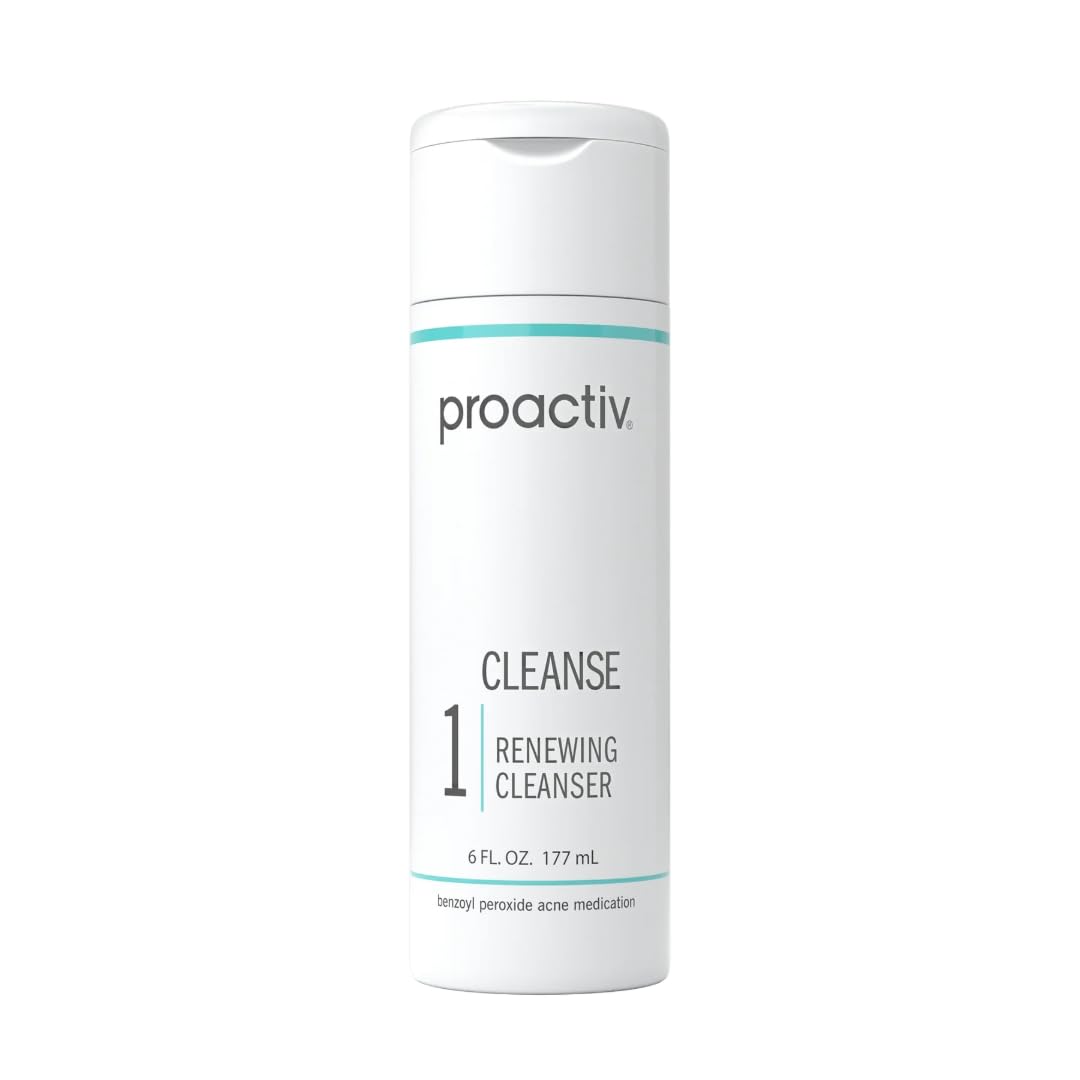
Source: Amazon
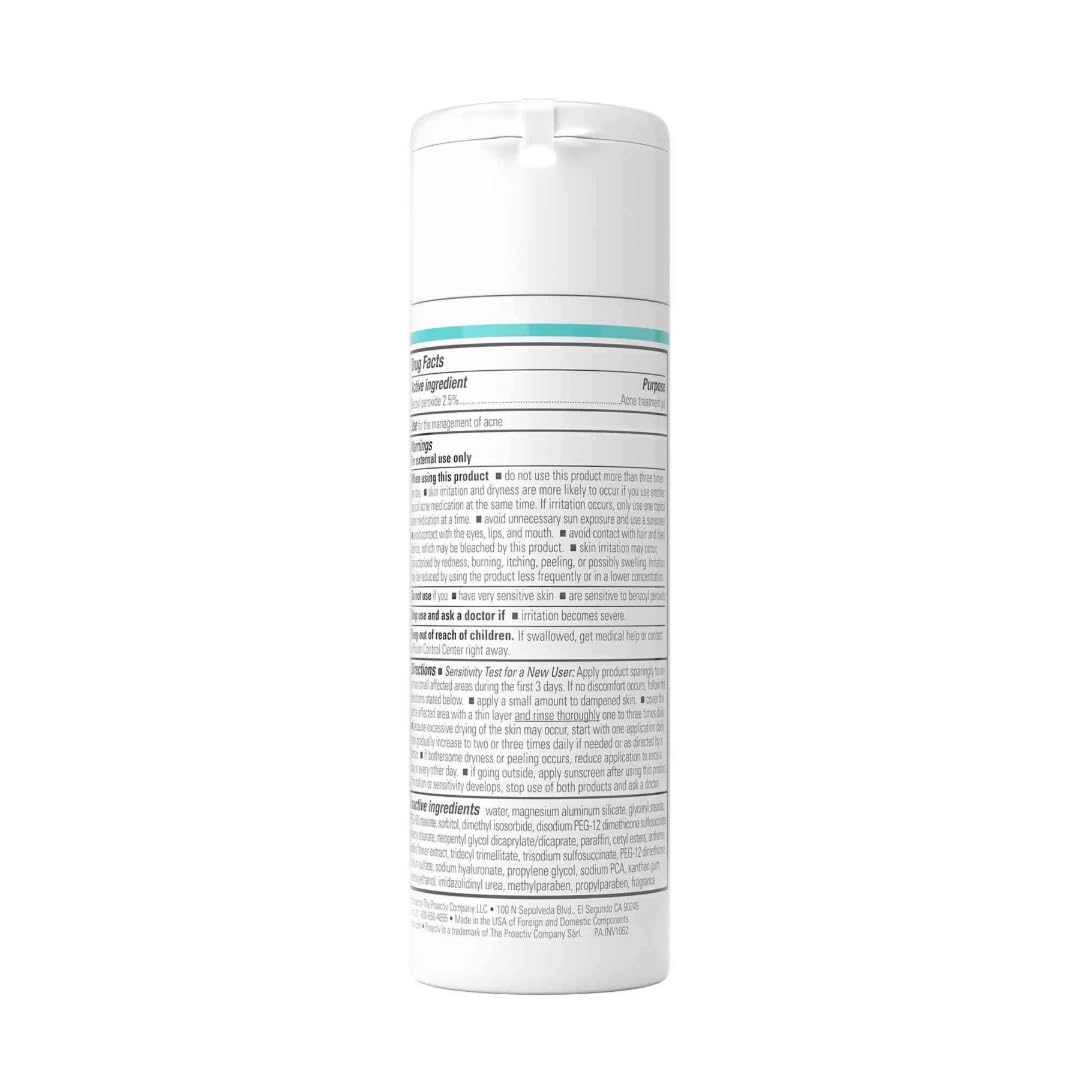
Source: Amazon
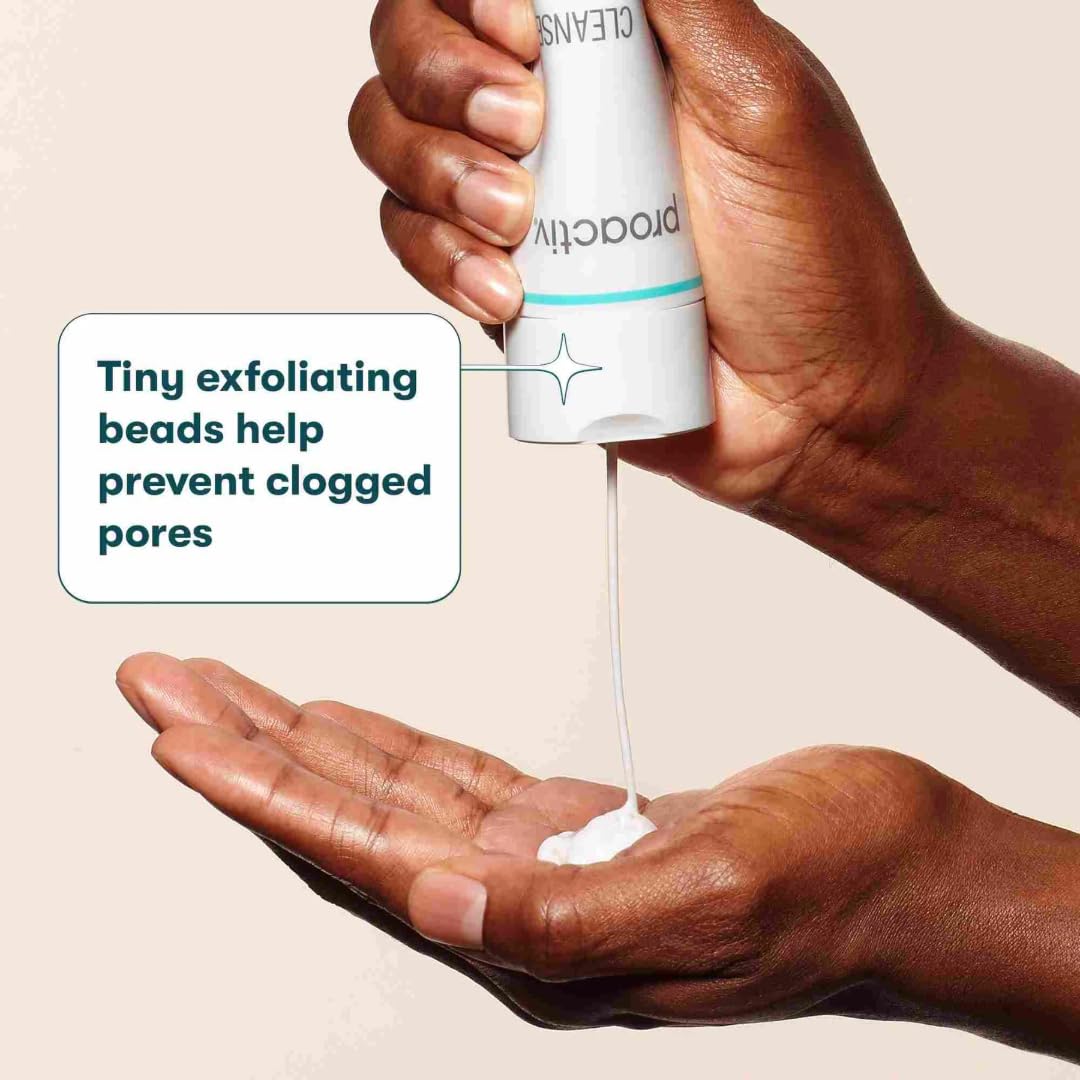
Source: Amazon
Three listing images were published for this ASIN and all three are shown. No buyer-uploaded photographs were rendered on the page at capture time, so none are reproduced here — the gallery is not padded with stock imagery.
1.3 The claims on the listing
| Claim as written | What it commits to |
|---|---|
| Medicated acne treatment, not a pimple cream | The product must function as a drug: kill acne bacteria, remove impurities, help prevent future flare-ups. |
| Contains hyaluronic acid to maintain hydration | A named humectant claim, and a direct admission that the active is drying. |
| Safe for teens and adults, all skin types | A tolerance claim across age groups — the widest claim on the listing and the one the review data tests hardest. |
| Finely milled benzoyl peroxide penetrates pores | A particle-size claim. Nothing on the listing quantifies it. |
| One to two minutes on damp skin, twice daily | An operating instruction that makes this a treatment step rather than a quick wash. |
2. Product Rating
The listing carries 4.7 out of 5 across 10,840 ratings. On a medicated wash that number needs more interpretation than on a cosmetic one, because the people who could not tolerate benzoyl peroxide are unlikely to still be rating it. What the distribution shows is a product that works for most of the people who stayed.
2.1 How the ratings are distributed
| Stars | Share | Approximate ratings |
|---|---|---|
| 5 star | 86% | ~9,322 |
| 4 star | 8% | ~867 |
| 3 star | 3% | ~325 |
| 2 star | 1% | ~108 |
| 1 star | 2% | ~217 |
| Total | 100% | 10,840 |
This is the most front-loaded distribution in the set. Five stars take 86%, and the entire one-to-three-star range accounts for 6% combined. A 4.7 average against 86% five-star is arithmetically coherent: the eight-point four-star band carries almost as much weight as the whole negative tail, which is why the average sits below the mode.
Two cautions. The shares are rounded whole percentages, so the 1% two-star band is roughly 108 ratings — a small share but a real population, not noise. And a heavily five-star shape on a drug-active wash carries a survivorship effect: someone who reacted badly in week one tends to stop using the product rather than return to rate it later, so the tail understates intolerance more than it would on a moisturiser.
2.2 What buyers say, in the platform's own summary
Customers find the cleanser effective for acne treatment and appreciate its ability to keep skin clear for years. The product receives positive feedback for its gentle, creamy texture that makes skin soft. Regarding skin irritation and expiration, experiences are mixed - while some find it gentle on sensitive skin, others report severe reactions, and while some say it lasts a long time, others mention receiving expired products. The Proactiv content receives mixed reviews, with some loving the brand while others question its authenticity.
That summary is unusually candid for an auto-generated block. It names two positives — effectiveness and a creamy, soft-feeling texture — and then names three genuinely split themes rather than smoothing them over: irritation, expiry, and whether the contents are authentic Proactiv. For a medicated product bought online, the last two are supply-chain questions, not formula questions, and they are the ones a price-led purchase ignores at its own risk.
2.3 Which themes drive the score
| Aspect | Mentions | Positive | Negative | Positive share |
|---|---|---|---|---|
| Skin feel | 51 | 39 | 12 | 76% |
| Proactiv content | 49 | 33 | 16 | 67% |
| Expiration | 57 | 25 | 32 | 44% |
| Skin irritation | 92 | 42 | 50 | 46% |
| Skin clarity | 193 | 144 | 49 | 75% |
| Effectiveness | 635 | 559 | 76 | 88% |
Read the mentions column before the percentages. Effectiveness dominates with 635 mentions and sits at 88% positive — that is the product doing its job, measured across the largest sample on the page. Skin clarity follows at 193 mentions and 75%. Both are the themes a buyer is actually shopping for.
Then look at the bottom of the list, because that is where the decision risk lives. Skin irritation is effectively a coin flip at 46% positive across 92 mentions, and expiration is 44% positive across 57. Neither is a rounding error: 50 people wrote that the product irritated them, and 32 wrote that what arrived was out of date. On a drug-active wash, an irritation theme at 46% is the single most important number on this page.
2.4 A second, much smaller reading
A community ingredient database scores the same product 1.0 out of 5 from one single rating, and places it in the top price band for its category. One rating is not evidence of anything — it is a data point about how thinly that record has been used, not a verdict on the product. It is reported here only so the gap between 4.7 from 10,840 and 1.0 from 1 is not mistaken for a contradiction.
2.5 What the rating cannot tell you
- A rating is not a review. 10,840 people left a star score; the written review block did not render during capture, so no individual review is quoted anywhere in this report.
- Aspect counts overlap. One review mentioning effectiveness and irritation is counted in both rows. The rows are not additive.
- Survivorship inflates the score. People who could not tolerate the active stop using it, and most never come back to rate it.
- Ratings drift. The figures are a snapshot from 30 October 2026.
3. Product Ingredients
Coverage: 26 of 26 ingredients. The full inactive list was captured complete, in INCI order, and the declared active matches the Drug Facts panel. Two independent ingredient databases were targeted; one answered and one refused access at capture time, so every per-ingredient statement below rests on a single source. That is flagged wherever it changes what the data can support.
3.1 The ingredients, in order
Position order runs from highest to lowest concentration, and on a medicated product it also separates the drug from the vehicle: everything after position 1 exists to carry the benzoyl peroxide or to make the skin tolerate it. A dash in the rating columns means unrated, not zero — missing data, not a clean result.
| # | Ingredient | Function | Comedogenic | Irritancy |
|---|---|---|---|---|
| 1 | Benzoyl Peroxide 2.5% | Acne fighting (drug active) | — | — |
| 2 | Water | Skin conditioning | — | — |
| 3 | Magnesium Aluminum Silicate | Absorbent / thickener | 0 | 0 |
| 4 | Glyceryl Stearate | Emollient | 1 | 0 |
| 5 | PEG-100 Stearate | Surfactant / emulsifier | 0 | 0 |
| 6 | Sorbitol | Humectant | 0 | 0 |
| 7 | Dimethyl Isosorbide | Solvent / solubiliser | — | — |
| 8 | Disodium PEG-12 Dimethicone Sulfosuccinate | Cleansing | — | — |
| 9 | Tridecyl Stearate | Emollient | — | — |
| 10 | Neopentyl Glycol Dicaprylate/Dicaprate | Emollient | — | — |
| 11 | Paraffin | Skin conditioning | — | — |
| 12 | Cetyl Esters | Emollient | 1 | 1 |
| 13 | Anthemis Nobilis Flower Extract | Masking | — | — |
| 14 | Tridecyl Trimellitate | Emollient | — | — |
| 15 | Trisodium Sulfosuccinate | Buffering | — | — |
| 16 | PEG-12 Dimethicone | Skin conditioning (silicone) | — | — |
| 17 | Sodium Sulfate | Not classified | — | — |
| 18 | Sodium Hyaluronate | Humectant | 0 | 0 |
| 19 | Propylene Glycol | Humectant | 0 | 0 |
| 20 | Sodium PCA | Humectant | 0 | 0 |
| 21 | Xanthan Gum | Emulsifying / structuring | — | — |
| 22 | Phenoxyethanol | Preservative | — | — |
| 23 | Imidazolidinyl Urea | Preservative | — | — |
| 24 | Methylparaben | Preservative | 0 | 0 |
| 25 | Propylparaben | Preservative | 0 | 0 |
| 26 | Parfum | Masking | — | — |
Only six of twenty-six rows carry any rating, and the two highest readings on the page are a 1 — on glyceryl stearate for comedogenicity and on cetyl esters for both. Fifteen unrated rows cannot be averaged into a formula risk score; there is nothing to average. What the numbers can do is identify the ingredients that carry the most irritation potential, and the honest answer is that the ratings do not point at benzoyl peroxide at all — the drug active is unrated on both axes because databases rate cosmetic ingredients, not drugs. The irritation theme in section 2 comes from the active, not from the emollients.
3.2 What the formula is actually built around
2.5% benzoyl peroxide at position 1, declared on a Drug Facts panel. Everything else in the tube exists to carry it.
A cream, not a gel: five emollient esters plus a fatty-acid emulsifier system and a clay thickener.
Four humectants, led by sorbitol at position 6, plus sodium hyaluronate, propylene glycol and sodium PCA.
Position 1 is the whole story. Benzoyl peroxide at 2.5% is a drug concentration, declared on the label as the active ingredient for the management of acne, and the pack carries a full Drug Facts panel with warnings about irritation, dryness, sun exposure and contact with hair and dyed fabrics. That is not marketing language; it is a regulatory declaration, and it tells a buyer more about what to expect than any claim in the A+ content.
The vehicle is deliberately rich. Glyceryl stearate at 4, PEG-100 stearate at 5 and cetyl esters at 12 form a fatty-acid emulsifier pair with an ester emollient, joined by tridecyl stearate, tridecyl trimellitate and neopentyl glycol dicaprylate/dicaprate. Magnesium aluminium silicate and xanthan gum thicken the whole thing into a cream that holds its shape on the skin for the one to two minutes the directions require. A thin gel would run off before the active had time to work, so the richness is functional rather than cosmetic.
The humectant block is the tolerance strategy, and it is bigger than a token. Sorbitol at position 6 is a meaningful dose of a humectant that doubles as a texture agent; sodium hyaluronate, propylene glycol and sodium PCA follow at 18 to 20 as support. The listing makes a point of naming hyaluronic acid as the answer to benzoyl-peroxide dryness, and the formula does back that up — with the caveat that positions 18 to 20 are low-concentration placements.
Preservation is conventional and fully disclosed. Phenoxyethanol, imidazolidinyl urea, methylparaben and propylparaben form a four-part system. That is effective and unremarkable, and it is also why this product fails both the paraben-free and the reef-safe claims. Imidazolidinyl urea is a formaldehyde releaser; for anyone with a known formaldehyde sensitivity that is the ingredient to look at first, ahead of the fragrance. Silicones appear twice as well — a cleansing silicone sulfosuccinate at 8 and a conditioning dimethicone at 16 — and they are what put the slip in the cream.
3.3 Function groups: where the ingredients go
| Group | Count | Ingredients |
|---|---|---|
| Emollient | 5 | Glyceryl Stearate, Tridecyl Stearate, Neopentyl Glycol Dicaprylate/Dicaprate, Cetyl Esters, Tridecyl Trimellitate |
| Humectant | 4 | Sorbitol, Sodium Hyaluronate, Propylene Glycol, Sodium PCA |
| Preservative | 4 | Phenoxyethanol, Imidazolidinyl Urea, Methylparaben, Propylparaben |
| Emulsifying / structuring | 3 | Magnesium Aluminum Silicate, PEG-100 Stearate, Xanthan Gum |
| Solubiliser and buffering | 3 | Dimethyl Isosorbide, Trisodium Sulfosuccinate, Sodium Sulfate |
| Fragrance / masking | 2 | Anthemis Nobilis Flower Extract, Parfum |
| Skin conditioning | 2 | Paraffin, PEG-12 Dimethicone |
| Drug active | 1 | Benzoyl Peroxide 2.5% |
| Cleansing | 1 | Disodium PEG-12 Dimethicone Sulfosuccinate |
| Solvent | 1 | Water |
Emollient at five is the largest group, and emollients plus structuring agents together account for eight of twenty-six positions. Preservatives tie humectants at four — a high preservative count for any cosmetic, and a direct consequence of a water-based cream that has to stay stable for years. There is exactly one dedicated cleansing surfactant in the entire formula, which is why this is a treatment you massage in rather than a lather you build.
3.4 Classification by position: the concentration ladder
Because INCI order is a concentration ranking, the most useful level classification is by position band. On a medicated product the bands also tell you which part of the formula you are trusting.
| Band | Positions | Count | What sits there |
|---|---|---|---|
| Leading 1-6 | 1–6 | 6 | Benzoyl Peroxide 2.5%, Water, Magnesium Aluminum Silicate, Glyceryl Stearate, PEG-100 Stearate, Sorbitol |
| Core 7-13 | 7–13 | 7 | Dimethyl Isosorbide, Disodium PEG-12 Dimethicone Sulfosuccinate, Tridecyl Stearate, Neopentyl Glycol Dicaprylate/Dicaprate, Paraffin, Cetyl Esters, Anthemis Nobilis Flower Extract |
| Supporting 14-20 | 14–20 | 7 | Tridecyl Trimellitate, Trisodium Sulfosuccinate, PEG-12 Dimethicone, Sodium Sulfate, Sodium Hyaluronate, Propylene Glycol, Sodium PCA |
| Trace 21-26 | 21–26 | 6 | Xanthan Gum, Phenoxyethanol, Imidazolidinyl Urea, Methylparaben, Propylparaben, Parfum |
The leading band is where the product is decided: the active at 1, the water, the clay thickener, the fatty-acid emulsifier pair and a real humectant dose at 6. Nothing in that band is decorative.
The trace band is almost entirely preservatives plus the fragrance, which is the normal place for them and is also why the claim matrix fails the way it does. The hyaluronic acid the listing names sits at 18, in the supporting band — present and claimable, but not at a concentration that will carry the hydration story on its own. The sorbitol at 6 does more of that work and gets no marketing attention at all.
3.5 What the product claims, and how the claims hold up
Twelve claim badges are published for this product. Five hold and seven fail, and the seven failures describe the product more accurately than the five passes.
| Claim | Status | Note |
|---|---|---|
| Alcohol-free | Holds | No denatured alcohol or ethanol in the 26-row list. |
| EU-allergen-free | Holds | None of the 26 declarable fragrance allergens is named individually. |
| Oil-free | Holds | No mineral oil or triglyceride; the emollients are esters and fatty alcohols. |
| Sulfate-free | Holds | No SLS, SLES or related sulfate surfactant. |
| Pore-clogger-free | Holds | Nothing on the current pore-clogger trigger list — but only six rows are rated at all. |
| Fragrance-free | Fails | Parfum at 26 plus a masking flower extract at 13. Two fragrance ingredients. |
| Paraben-free | Fails | Methylparaben and propylparaben. Both declared on the pack. |
| Silicone-free | Fails | Disodium PEG-12 Dimethicone Sulfosuccinate and PEG-12 Dimethicone. |
| Cruelty-free | Fails | No certification carried for this line. |
| Fungal-acne-safe | Fails | Four flagged ingredients: Glyceryl Stearate, Tridecyl Stearate, Cetyl Esters, PEG-100 Stearate. |
| Reef-safe | Fails | Methylparaben and propylparaben fail reef standards. |
| Vegan | Fails | Not declared vegan; the formula does not establish it either way. |
The listing says “unscented” and the formula says parfum. That is not a contradiction in Amazon's own fields — unscented means no added scent story, not necessarily no fragrance ingredient — but for a buyer it is the single most consequential line on this table. A product marketed to acne-prone and sensitive skin carries two fragrance ingredients, and the review data shows irritation at a 46% positive rate.
Four of the seven failures trace to the same three decisions. Parabens and reef-safety fail together, silicone-free fails on the two dimethicones, and fungal-acne-safety fails on four fatty esters that are also the emollient backbone. Removing any of them would change what the product feels like, so a buyer who needs a paraben-free, silicone-free, fragrance-free, fungal-acne-safe wash should read this as a different product category rather than a compromised version of this one.
3.6 Concerns worth knowing before you buy
May worsen itching or irritation for eczema.
Can trigger flare-ups in rosacea-prone skin.
May cause stinging, redness, or sensitivity.
Can strip moisture and worsen dryness.
Four concerns, and unlike a cosmetic wash these are not generic class warnings — they are the same four effects the Drug Facts panel warns about in its own words. Benzoyl peroxide is a genuine irritant by mechanism, which is why the directions tell users to start with one application a day, build up, and cut back if peeling appears. The dryness flag is the one the formula actively works against with four humectants and five emollients; the irritation and eczema flags are the ones no amount of emollient fully fixes.
3.7 The benefits, ranked by how many ingredients carry them
| Benefit | Description | Ingredients | Weight |
|---|---|---|---|
| Hydrating | Boosts hydration and relieves dry, tight skin. | 4 | |
| Barrier repair | Strengthens and restores the skin's natural barrier. | 3 | |
| Reduces irritation | Eases discomfort and supports skin resilience. | 2 | |
| Redness reducing | Soothes visible redness and calms irritation. | 2 | |
| Acne fighting | Fights acne and helps prevent breakouts. | 1 | |
| Anti-aging | Softens lines and helps skin look youthful. | 1 | |
| Good for oily skin | Balances oil and helps reduce shine. | 1 |
Seven benefits, and the ranking is inverted for this product: hydrating leads at four ingredients and barrier repair follows at three, while acne fighting — the entire reason anyone buys this — sits at one, because it rests on a single active. That is not a flaw in the data. It is an accurate picture of a formula that is one drug plus a tolerance vehicle, and it explains why the listing spends as much copy on dryness as on breakouts. Nothing below barrier repair should influence a purchase.
3.8 Key ingredient groups
| Group | Mechanism as published | Ingredients |
|---|---|---|
| Benzoyl Peroxide | Targets acne-causing bacteria and clears breakouts. | 1 |
| Hyaluronic Acid | Hydrates by attracting and holding water. | 1 |
Two key groups, one for the drug and one for the antidote. That pairing is the whole design of the product in two rows: an active that clears acne and dries the skin, plus a humectant to hold water against it. The hyaluronic acid here is sodium hyaluronate at position 18.
4. Product Price
The price analysis comes last because on a medicated product the price is the least interesting variable until the formula and the ratings are settled. Once they are, though, this listing has a genuinely unusual price story: it is selling at a real discount to its own reference price, and the record behind that reference price goes back to 2010.
Read the next few tables as one argument: where $25.55 sits against the band this product has traded in for sixteen years, and whether that makes today a good moment to buy.
4.1 Today's price
This is the one listing in the set with a real published reference price: $36.00, struck through against $25.55 with a 29% saving badge. The subscription tier takes it to $21.72, which is 40% below list and below every all-time average in the record — a rare case where the discounted channel is also the historically cheap one.
4.2 The full price record
| Price type | Lowest ever | Highest ever | Current | Average |
|---|---|---|---|---|
| Amazon | $18.75 (Jan 10, 2020) | $37.50 (Jan 13, 2021) | $25.55 (Oct 19, 2026) | $32.90 |
| 3rd Party New | $12.75 (Jun 22, 2012) | $49.99 (Jan 10, 2013) | $25.55 (Oct 19, 2026) | $34.19 |
| 3rd Party Used | $22.49 (Sep 09, 2016) | $24.02 (Jul 07, 2016) | — | $23.38 |
The current readings are last observations, not live quotes: both were stamped 11 days before capture. The used row is unusual and worth reading carefully — it has a low, a high and an average, but no current price, because the used market tracked a handful of offers in 2016 and nothing since. Its average of $23.38 sits below both new-channel averages, which inverts the usual relationship and is best treated as a historical curiosity rather than a live alternative channel.
Four metrics per channel makes the structure obvious. The Amazon series is contained: a floor at $18.75, a ceiling at $37.50, and today's price sitting between them but far closer to the floor than to the ceiling. The third-party series is not contained — a $49.99 peak against a $12.75 floor is a range almost four times its own bottom, and the current price is nowhere near the top of it. The used series barely moves at all because it is one or two sellers holding a price in a market nobody is trading.
The visual also settles an argument the averages cannot. Both new-channel averages sit in the low thirties, yet both current prices are $25.55. That is a listing that spent most of its life priced higher than it is today.
4.3 Where the current price actually sits
| Benchmark | Amazon | 3rd Party New |
|---|---|---|
| Current vs all-time low | +36.3% | +100.4% |
| Current vs all-time average | −22.3% | −25.3% |
| Current vs all-time high | −31.9% | −48.9% |
| Current vs list price | −29.0% | −29.0% |
Unlike a list-price sale, three of the four benchmarks here point the same way: today's price is below the Amazon average by 22.3%, below the third-party average by 25.3%, and below the manufacturer's reference price by 29.0%. The only benchmark it exceeds is the floor, and it exceeds that by 36.3% on Amazon and by 100.4% on the third-party channel.
The practical reading is that $25.55 is a good price and not the best price. The floor is $18.75 on Amazon and $12.75 on the third-party channel, and the third-party floor dates to 2012 — more than a decade ago, which makes it a weak guide to what is achievable now. Against the last several years rather than the full record, $25.55 looks close to normal rather than exceptional.
4.4 Volatility and the averages
| Price type | All-time spread | Spread as % of low | Average vs list |
|---|---|---|---|
| Amazon | $18.75 | 100.0% | −8.6% |
| 3rd Party New | $37.24 | 292.1% | −5.0% |
| 3rd Party Used | $1.53 | 6.8% | −35.1% |
The Amazon series is unusually stable for a sixteen-year record: a spread of exactly 100% of its own floor, which for a beauty product is tight. The third-party series is the volatile one at 292%, driven almost entirely by a $49.99 reading from January 2013 that reads as a launch-era or reseller artefact rather than a market high. That single point also drags the third-party average up, which is why its average is $1.29 above Amazon's despite today's parity.
Both new-channel averages sit below list, by 8.6% and 5.0%. That is a narrower gap than a typical mass-market beauty listing shows, and it fits the category: a medicated wash with a manufacturer-set price holds closer to its reference than a commodity body wash does.
4.5 The channel comparison
This listing shows the textbook relationship that the cosmetic listings in this set invert. The third-party average of $34.19 sits $1.29 above the Amazon average of $32.90, because Amazon anchors the low end of the market and marketplace sellers price around it. Today both channels read $25.55 exactly, so the premium has collapsed to zero — which means the channel decision is currently about shipping speed and seller reliability, not price.
One caution on the used row: an average of $23.38 with no current price is not a cheaper alternative, it is an empty market. Do not plan a purchase around it.
4.6 Timeline of the dated extremes
| Date | Event | Price | Channel |
|---|---|---|---|
| 2010-12-04 | Price monitoring begins | — | — |
| 2012-06-22 | Third-party all-time low | $12.75 | 3rd Party New |
| 2013-01-10 | Third-party all-time high | $49.99 | 3rd Party New |
| 2016-07-07 | Used all-time high | $24.02 | 3rd Party Used |
| 2016-09-09 | Used all-time low, and last used data | $22.49 | 3rd Party Used |
| 2020-01-10 | Amazon all-time low | $18.75 | Amazon |
| 2021-01-13 | Amazon all-time high | $37.50 | Amazon |
| 2026-10-19 | Current reading, both new channels | $25.55 | Amazon / 3rd Party New |
Three dates carry most of the meaning. The $49.99 third-party peak in January 2013 comes from the earliest stretch of the record and is more than double today's price — treat it as an artefact, not a high-water mark the market ever returned to. The Amazon low of $18.75 was set in January 2020, a full decade after monitoring began, which says the listing was repriced rather than that it has always traded in this band. And the Amazon high of $37.50 in 2021 is above today's $36.00 list price, so the reference price itself has moved down since.
The used market is a single 2016 episode: one high in July, one low in September, then nothing for a decade. It is included because it is in the record, not because it is actionable.
4.7 What this means for the purchase decision
- Today is a discount, and a real one. $25.55 against a $36.00 reference is 29% off, and it is below every all-time average in the record.
- The subscription is the better buy. At $21.72 with a 40% saving, Subscribe & Save beats both the current price and every historical average — but benzoyl peroxide is a product people stop using when it irritates, so only subscribe if it has already worked for you.
- It is not the floor. The Amazon floor is $18.75 and it was reached as recently as 2020, so waiting is not irrational if the need is not urgent.
- Price is the wrong filter for this product. A $25 wash that irritates is more expensive than a $36 one that does not; the irritation theme at 46% positive matters more than a few dollars.
5. Who It Is For
| A good fit if you… | Look elsewhere if you… |
|---|---|
| Have mild to moderate acne and want a drug-active wash rather than a cosmetic one | Have very sensitive, eczema-prone or rosacea-prone skin — all four concerns apply directly |
| Will use it as directed: damp skin, one to two minutes, then rinse | Expect a foaming wash — there is exactly one cleansing surfactant and it does not lather much |
| Need a cream texture that stays put on the skin long enough to work | Need a paraben-free, silicone-free or fragrance-free formula — it fails all three |
| Have used benzoyl peroxide before and know how your skin responds | Have never used benzoyl peroxide and are buying a full-size tube first |
| Are buying from a seller with a clear expiry and authenticity record | Are buying purely on the lowest price — expired and grey-market stock is a named theme in the reviews |
One practical note the listing does not say out loud: benzoyl peroxide bleaches fabric. The Drug Facts panel warns about contact with hair and dyed fabrics, and that warning is worth reading before the first use rather than after a towel turns orange.
6. Method and Confidence
| Element | Confidence | Basis |
|---|---|---|
| Title, brand, category, specifications | High | Read from the listing's own labelled fields |
| Rating and rating count | High | 4.7 / 10,840, all five histogram buckets present and summing to 100% |
| Current price and list price | High | Both rendered in the buy box with a 29% saving badge, native USD |
| Subscribe & Save price | Medium-high | Read from the subscription row, not confirmed at checkout |
| Ingredient list | Medium-high | Complete at 26 of 26, INCI order preserved, but a single source |
| Drug-active declaration | High | 2.5% benzoyl peroxide confirmed twice — on the listing and on the pack |
| Per-ingredient ratings | Low | Only 6 of 26 rows rated; no second database to cross-check |
| Price history | High for values, medium for currency | Transcribed verbatim; current readings 11 days old |
| Reviewer sentiment themes | Medium | Aggregate aspect counts, not quoted reviews |
6.1 Limitations, stated plainly
- One ingredient database answered. A second was targeted and refused access at capture time, so no independent count check was possible and a single missed row would be invisible.
- No individual reviews are quoted. The written review block did not render during capture; section 2 rests on the aggregate distribution, the platform summary and aspect counts.
- No buyer photographs. None were published at capture time; the gallery was not padded with listing imagery to fill the gap.
- Price history is all-time only. Five values per channel, not a change log. A six-month low cannot be read from it, and the shape of the series between dated extremes is unknown.
- The used channel is not live. Three 2016 values and no current price.
- Everything is a snapshot. Price, rank and rating counts move; all figures are as of 30 October 2026.
- Reference only. Ingredient ratings come from a community database and are not a regulatory or dermatological determination.
Snapshot date 30 October 2026. All prices in US dollars as published for a US delivery address, with no currency conversion applied. Reviewer identities are withheld throughout.