L'Oreal Paris Bright Reveal Dark Spot Exfoliant Peel 25% AHA BHA PHA, 0.84 fl oz
Facial Peels · Amazon US, USD · captured 13 November 2026 · 25 declared materials
| Rating | Buy box | Acids declared | Second material | Rank |
|---|---|---|---|---|
| 4.2 / 5 1,143 ratings | $21.99 5% under list | 5 positions 3 to 12 | Alcohol Denat. irritancy 5 | #33 Facial Peels |
Reading. The `AHA BHA PHA` in the name is real - five acids are declared between positions 3 and 12 - but the second material in the formula is alcohol denat. at an irritancy score of 5, a fragrance sits at 19 and four colourants fill the panel, which is not what `gentle` looks like on an INCI. The `25%` cannot be verified anywhere, and the SPF lotion the title promises has no sunscreen declaration on the page. At $26.18 an ounce it is also the most expensive product in this batch by a factor of six.
01 Product information
A serum-strength peel in 0.84 fl oz, sold with a second formula on the same page.
| Field | As printed |
|---|---|
| Brand | L'Oreal Paris |
| Item form | Liquid |
| Skin type claimed | All |
| Product benefits claimed | Dark spot correction |
| Material feature | Exfoliating |
| Item volume | 1 fl oz |
| Size | 0.84 fl oz (pack of 1) |
| Item weight | 1 oz |
| UPC | 071249695159 |
| Dimensions | 4.75 x 1.8 x 1.5 in; 1 oz |
| Best sellers rank | #20,047 Beauty; #33 Facial Peels |
What the brand writes
Your Gentle Face Exfoliator Solution: Bright Reveal Dark Spot Exfoliant Peel visibly fades all types of dark spots and renews skin texture.
25% Multi-Acid Face Exfoliator Blend: With our unique combination of AHAs, BHA and PHA, this peel is inspired by professional peels to provide gentle exfoliation, brighten skin tone and improve skin texture.
Dermatologist Validated: After 1 use, skin looks instantly brighter and feels retexturized and softer. After 2 weeks, skin looks resurfaced and dramatically brighter.
The A+ module is a four-SKU routine table rather than a story: niacinamide serum at $31.99, this peel at $21.99, a vitamin C moisturiser at $21.99 and a UV lotion SPF 50 with no price. The peel's column is tagged Treat, PM, key ingredient Multi Acid: AHAs, BHA PHA. It is the cheapest step in the routine and the only one tagged for evening use.
The listing also publishes two ingredient declarations, each with a L'Oreal F.I.L. code. The first, Z70043468/1, is the peel and is the subject of this report. The second, V293607/13, is a 32-row formula that belongs to another product in the routine - and, as section 03 shows, it cannot be the SPF lotion the title promises.
02 Rating and buyer sentiment
4.2 from 1,143 ratings, and the widest split in this batch: irritation at 40%.
Fig. 1 — Star distribution, 1,143 ratings. 65% five-star, 6% one-star.
This is the softest distribution of the three products: 21% of ratings sit at three stars or below, and the one-star block at 6% is larger than the five-star-to-four-star step. A product with a genuine mid-range of disappointment reads like this.
Fig. 2 — Positive share of each aspect, ascending. Mentions in brackets.
Three aspects sit at or below 55%, and the worst is skin irritation at 40% over 40 mentions - the lowest aspect score anywhere in this batch, on the product with the most acids and the only one with alcohol at position 2. Effectiveness splits almost exactly down the middle at 62% over 131 mentions, which is what the platform's own summary says in words: some seeing results after the first use while others say it did nothing.
Customers report mixed experiences with the exfoliant's effectiveness... Opinions are divided on skin irritation and value for money, with some finding it a good investment while others say it's not worth $20. The scent and ease of application also receive mixed reviews.
Note where the positives sit: gentleness at 88% and brightening at 82%. Buyers who like it describe it as gentle, and the ones who do not are describing irritation and no result. Both are consistent with a five-acid solution diluted by an alcohol-forward base - it either lifts the surface or it stings, and which one depends on the skin.
03 Product ingredients
25 materials, five acids in the first twelve positions - and alcohol ahead of all of them.
Two channels were read and they agree on 24 of 25 rows in the same order. The listing prints the peel's declaration with a F.I.L. code and 25 rows; a community database record sourced from the brand's own site carries 24, omitting only the CI 19140 colourant at position 21. A colorant dropped from a database transcription is the most ordinary kind of gap, so the listing's version is the spine.
A third database does not carry the product at all: the brand is indexed with 599 products but this SKU is not among them, two slug patterns return 404 and its search endpoint ignores the query. The formula therefore rests on two channels rather than three, which is enough - they agree - but it means there is no independent second opinion on how the materials are classified.
Fig. 3 — The 25 materials by function. Four single-material classes are folded into one slice.
Five of twenty-five materials are acid exfoliants and four are pigments. For a product sold on the word peel, that ratio is the honest summary: a fifth of the formula is doing the work and a sixth of it is doing the looking.
Fig. 4 — First declaration position of each functional class.
The acid run arrives at 3 and is complete by 12, which is early - genuinely early, not marketing-early. But the solvent chart starts at 1 and the second solvent is alcohol denat. at 2, so the acids are delivered in an alcohol base rather than a water-glycerin one. That single positional fact explains the 40% irritation score better than anything else in the panel.
Fig. 5 — Irritancy score where the database assigns one. Higher is more irritating.
Four of the six scored materials sit at 4 or above. Glycolic acid at 3-6 is the highest, and it is the second acid in the formula; alcohol denat. at 5 is the second material overall. A `gentle` peel whose irritancy profile is dominated by its own solvent and its strongest acid is not a contradiction in the formula - it is a contradiction between the formula and the copy.
What is inside, by class
| Class | Materials | Share |
|---|---|---|
| Acid exfoliant | 5 | 20% |
| Pigment and colour | 4 | 16% |
| Texture and rheology | 4 | 16% |
| Solvent and carrier | 3 | 12% |
| pH and buffer | 3 | 12% |
| Fragrance | 2 | 8% |
| Humectant | 1 | 4% |
| Active | 1 | 4% |
| Chelator | 1 | 4% |
| Emulsifier | 1 | 4% |
The two declarations on the page
| F.I.L. code | Rows | What it can be |
|---|---|---|
| Z70043468/1 | 25 | The peel. Five acids, alcohol at 2, fragrance at 19, four colourants. The subject of this report. |
| V293607/13 | 32 | A lotion with no UV filter: water, alcohol, glycerin, a styrene/acrylate copolymer, dimethicone, butyloctyl salicylate, silica, emollient esters, cetearyl alcohol, tocopherol, adenosine, phenylethyl resorcinol, ascorbyl glucoside - and no sunscreen active. It cannot be the UV Lotion SPF 50 named in the routine table. |
That second declaration is the finding a buyer is least likely to catch. The title promises Includes SPF Lotion Sample, the routine table lists UV Lotion SPF 50, and the only other formula printed on the page contains nothing that filters UV. Whether the sample ships with a properly labelled sunscreen cannot be established from this listing - what can be established is that the listing does not declare one.
The pack shots do show it. The first image is a three-part composition: the carton, the 25 ml bottle, and a small sachet printed Sample, 50 Invisible Sunscreen, Daily UV Lotion, Fragrance-free. So the sample is real and is pictured as a 50 SPF sunscreen - it simply has no ingredient declaration anywhere on the page, and the one other formula the listing does publish is not it.
The same images also disagree with the copy on timing. Bullet three promises results after 2 weeks and after 3 weeks; the before-and-after image states -47% on post-acne marks with a footnote reading clinical scoring of colour intensity after 6 weeks. The number a reader is most likely to remember is attached to a window twice as long as the bullet implies, and the footnote misspells scoring.
Full declaration, 25 materials in order
| # | Material | Function | Acne | Irritancy |
|---|---|---|---|---|
| 1 | Aqua / Water | Solvent | - | 1 |
| 2 | Alcohol Denat. | Solvent | 0 | 5 |
| 3 | Lactic Acid | AHA exfoliant | - | 2-5 |
| 4 | Glycolic Acid | AHA exfoliant | - | 3-6 |
| 5 | Gluconolactone | PHA exfoliant | - | 1 |
| 6 | Propanediol | Solvent | - | 1 |
| 7 | Sodium Hydroxide | pH adjuster | - | 1-4 |
| 8 | Glycerin | Humectant | 0 | 0 |
| 9 | Silica | Texture | - | - |
| 10 | Salicylic Acid | BHA exfoliant | - | 1 |
| 11 | Mica | Pigment | - | 1 |
| 12 | Mandelic Acid | AHA exfoliant | - | 1 |
| 13 | Polyacrylate Crosspolymer-6 | Texture | - | 1 |
| 14 | CI 77891 / Titanium Dioxide | Pigment | 0 | 0 |
| 15 | Ethyl Menthane Carboxamide | Fragrance, cooling | - | 1 |
| 16 | Hydroxyethylcellulose | Texture | - | 1 |
| 17 | Niacinamide | Active | - | 1 |
| 18 | Xanthan Gum | Texture | - | 1 |
| 19 | Parfum / Fragrance | Fragrance | - | 4 |
| 20 | Trisodium Ethylenediamine Disuccinate | Chelator | - | 1 |
| 21 | CI 19140 / Yellow 5 | Pigment | - | - |
| 22 | CI 42090 / Blue 1 | Pigment | - | 2-7 |
| 23 | Disodium Phosphate | Buffer | - | 1 |
| 24 | Polysorbate 60 | Emulsifier | - | 1-2 |
| 25 | Sodium Phosphate | Buffer | - | 1 |
Positions follow the listing, which includes CI 19140 at 21; the database record omits that row. A dash means the database assigns no score, not a score of zero.
Claim audit
| Claim | What the declaration supports | Verdict |
|---|---|---|
| `25% Multi-Acid` blend of AHAs, BHA and PHA | The composition is right and the number is not testable. Three AHAs (lactic 3, glycolic 4, mandelic 12), one BHA (salicylic 10) and one PHA (gluconolactone 5) are declared - five acids, all before position 12. No percentage is printed for any of them, and INCI carries none. | Structure holds, number unverified |
| `Gentle`, `for sensitive skin` | Alcohol Denat. is the second declared material, ahead of every acid, with an irritancy score of 5. A fragrance appears at 19 and four colourants fill positions 11 to 22. Buyer sentiment puts skin irritation at 40% positive over 40 mentions - the lowest aspect in this batch. | Disputed |
| `Dark spot correction`, `visibly fades all types of dark spots` | Niacinamide at 17, one material, plus five exfoliating acids. No dedicated depigmenting agent - no tranexamic acid, no arbutin, no vitamin C - is declared. | Partly |
| `Dermatologist validated`, with results at 1, 2 and 3 weeks | No protocol, sample size, site or measurement method is published on the listing. The three timepoints are printed as outcomes without a test behind them. | Unverifiable |
| Includes an `SPF Lotion Sample` | Two declarations are printed. The second, 32 rows, contains no UV filter of any kind - no avobenzone, octocrylene, zinc oxide or titanium dioxide - so the SPF lotion has no sunscreen declaration anywhere on the page. | Does not hold |
| `Inspired by professional peels` | Five acids in the first twelve positions is consistent with a cosmetic peel; the comparison to a professional peel is a positioning statement, not a claim about strength. | Unverifiable |
Three of six claims fail or cannot be tested. The acid composition is real, which is more than many peel listings can say; the percentage is not published anywhere and cannot be inferred from an INCI order; and the SPF sample has no sunscreen declaration behind it.
04 Product price
$21.99, 5.1% under list, unchanged for at least 77 days, with no competing marketplace offer.
Two price channels, one of them empty at capture. The third-party row has a low, a high and an average but no current value - which is what an out-of-stock marketplace offer looks like - so this ASIN is priced by a single seller of record. The only alternative on the page is a 15% Subscribe & Save rate of $18.69, and a subscription is a commitment rather than a competing price.
| Price type | Lowest ever | Highest ever | Current | Average |
|---|---|---|---|---|
| Amazon, first-party | $16.68 29 Jul 2025 | $29.40 28 Nov 2025 | $21.99 28 Aug 2026 | $21.51 |
| 3rd party new | $14.99 02 May 2025 | $22.99 12 Aug 2025 | no current offer | $19.63 |
Fig. 6 — The tracked series as bars, both channels. Third-party new has no current value.
Both extremes land inside five months: $16.68 on 29 July 2025 and $29.40 on 28 November 2025 - a Black Friday high followed by nothing in particular. The $21.51 average sits almost exactly where the price has been parked since. The series reads as one violent autumn and then a plateau at a 5% discount to list.
The tracker's current value is dated 28 August 2026 and is therefore 77 days stale at capture - the oldest of the three products in this batch. The live buy box prints the identical $21.99, which does not make the tracker current; it makes the price demonstrably unchanged, and those are different statements about different things.
Fig. 7 — Capture price against four benchmarks, as percentage deviation.
| Benchmark | Deviation | Basis |
|---|---|---|
| List price, $23.17 | -5.1% | Derived |
| Listing Was, $26.18 | -16.0% | Derived against the listing's own figure, $3.01 above the tracker's list |
| First-party average, $21.51 | +2.2% | Derived |
| First-party low, $16.68 | +31.8% | Derived |
| Cost per fluid ounce, 0.84 fl oz | $26.18 | Derived from the size field, not the volume field |
| Subscribe & Save rate | $18.69 | Printed by the listing, 15% below the buy box |
The size fields disagree with each other - Item volume 1 fluid ounce against Size 0.84 Fl Oz - and Amazon's own printed per-ounce figure uses 0.84. At 0.84 fl oz and $21.99 this is $26.18 an ounce, by a wide margin the most expensive product per millilitre in the batch and roughly six times the cost per unit of the pad. That is what a serum-format acid solution costs; it is also the number a buyer comparing three peels should see first.
05 Product images
Three frames per row, in listing order.
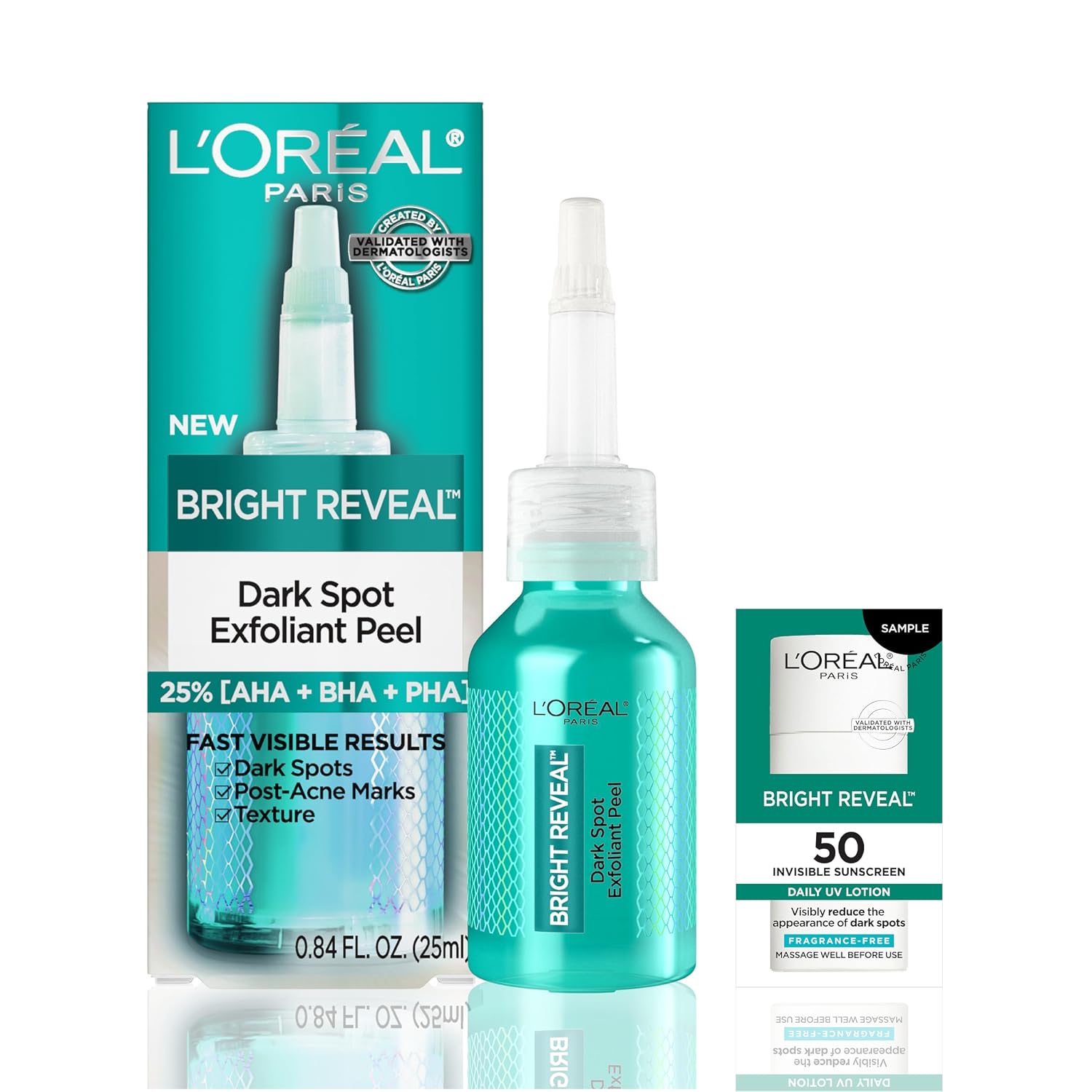 | 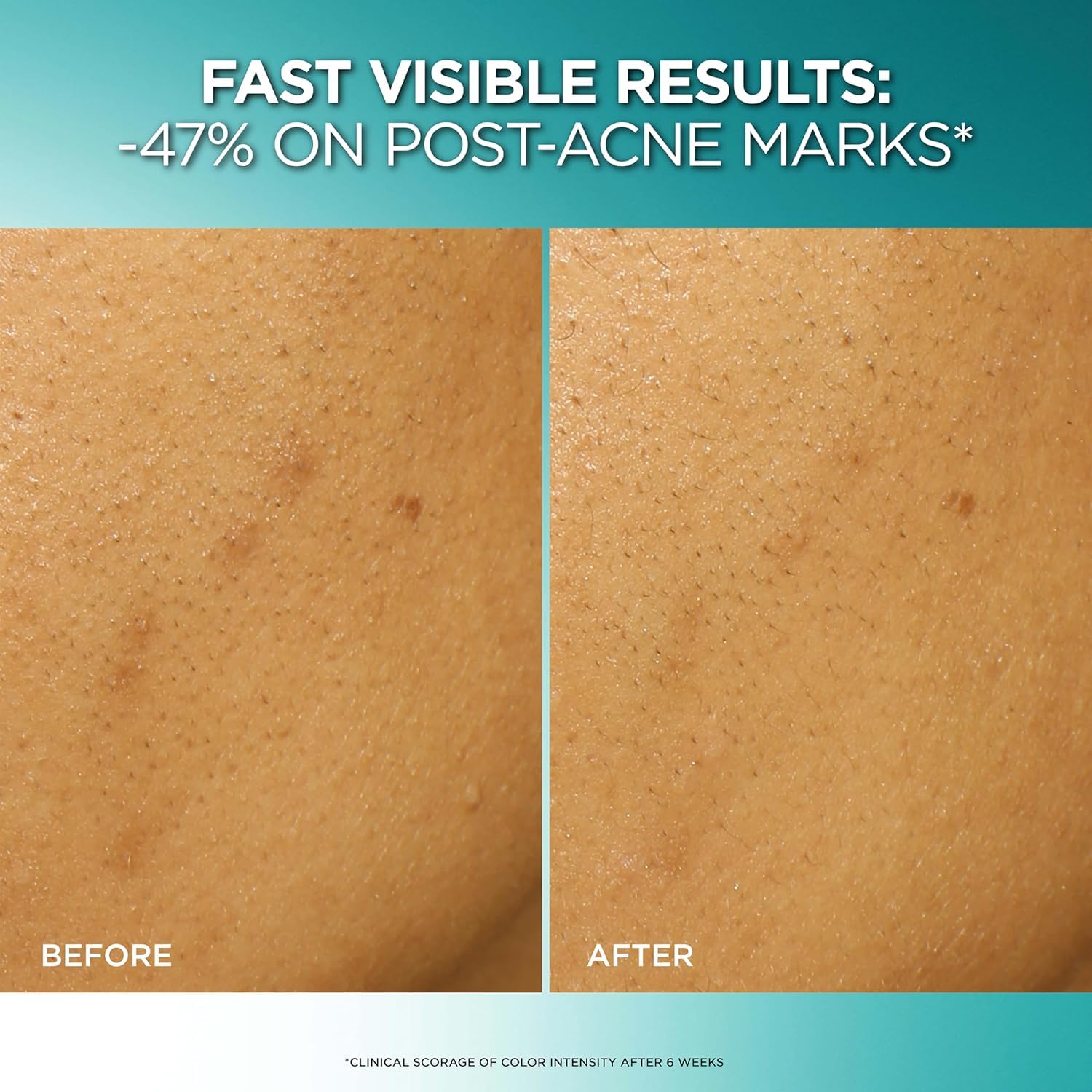 | 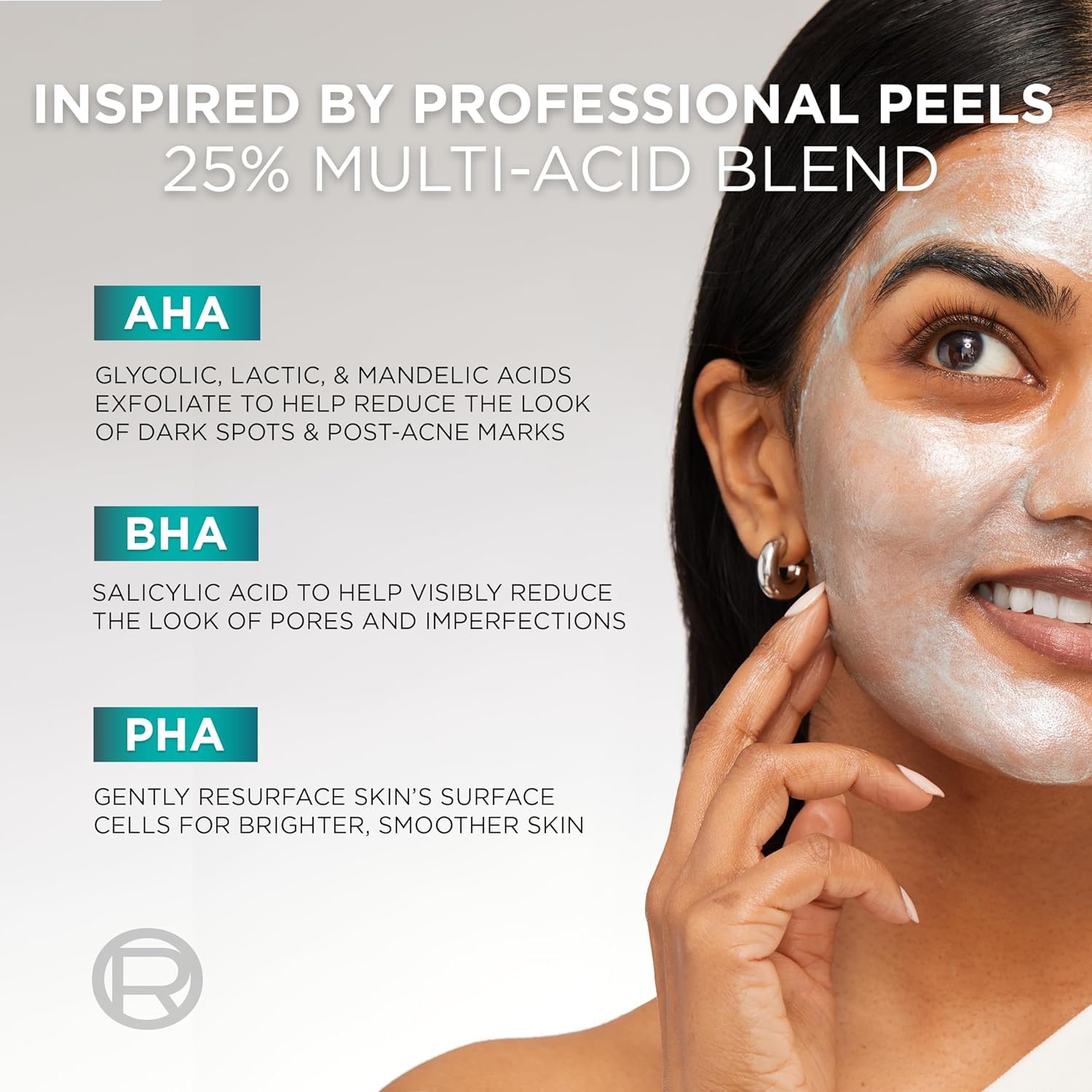 |
| Carton, bottle and the sample sachet | Before and after, -47% on post-acne marks | Claims panel with the 50 SPF sample |
Source: Amazon.
Three of the nine frames the listing exposes were downloaded. No buyer photos were available for this ASIN.
06 Method, confidence and limits
Channels read, and what each contributed
| Channel | Contribution | Status |
|---|---|---|
| Amazon detail page | Title, specs, two declarations with F.I.L. codes, bullets, routine table, rating, aspects | Collected |
| Community ingredient database | 24 of 25 rows with per-material scoring, record sourced from the brand's site, dated 22 Mar 2025 | Collected, one colourant missing |
| Skincare database | Nothing. Brand indexed with 599 products; this SKU not located under four routes | Not located |
| Price tracker | 863-day record, both channels, third-party channel currently unoffered | Collected, current value 77 days stale |
| Review bodies and buyer photos | Nothing; both returned empty for a 1,143-rating listing | Not available |
Confidence
| Element | Confidence | Basis |
|---|---|---|
| Product identity | High | ASIN, UPC and EAN printed and consistent |
| Formula, 25 materials | High | Manufacturer declaration with a F.I.L. code, corroborated 24/25 by an independent database |
| The `25%` figure | None | No concentration is declared anywhere; not verifiable and not inferred |
| The second declaration's identity | Medium | It is on the page and it is not the peel; what it actually is, the listing does not say |
| Price at capture | High | Native USD, New York 10001, 13 Nov 2026 |
| Buyer sentiment | Medium | The platform's aggregation only, with no review bodies available |
Limits
- The `25%` blend strength cannot be tested. INCI carries no percentages and no source publishes the formula's acid load. The claim is reported as a claim throughout, never as a measurement.
- No pH is printed, so the free-acid fraction cannot be computed for any of the five acids. That is a genuine ceiling on how much this report can say about strength, and it is not worked around by assuming a pH.
- The second declaration on the page is a different product. It is reported as what the listing prints, and the inference that it contradicts the `SPF Lotion Sample` promise rests only on the absence of any UV filter in its 32 rows - not on knowing which product it is.
- The size fields contradict each other (1 fl oz against 0.84 fl oz). The per-ounce figure uses 0.84 because Amazon's own printed figure does; the contradiction is disclosed rather than resolved.
- Review text and buyer photos were not served, so no review is quoted. The sentiment layer is the platform's aggregation.
- The skincare database does not carry this SKU. Its claim matrix, benefit counts and community rating are therefore absent for this product, and the report cites them nowhere.
- The tracker's current value is 77 days old. It is corroborated by a live capture at the identical price, which establishes that the price did not move over that window but does not establish what happened inside it.