US Beauty & Personal Care / Skin Care / Face / Treatments & Masks / Serums
A dual-retinoid facial serum built on retinol plus retinal, with a vitamin C and E antioxidant block and a five-peptide fraction. Independent multi-source analysis of the US listing, ingredient dossiers and price record.
1. Product Information
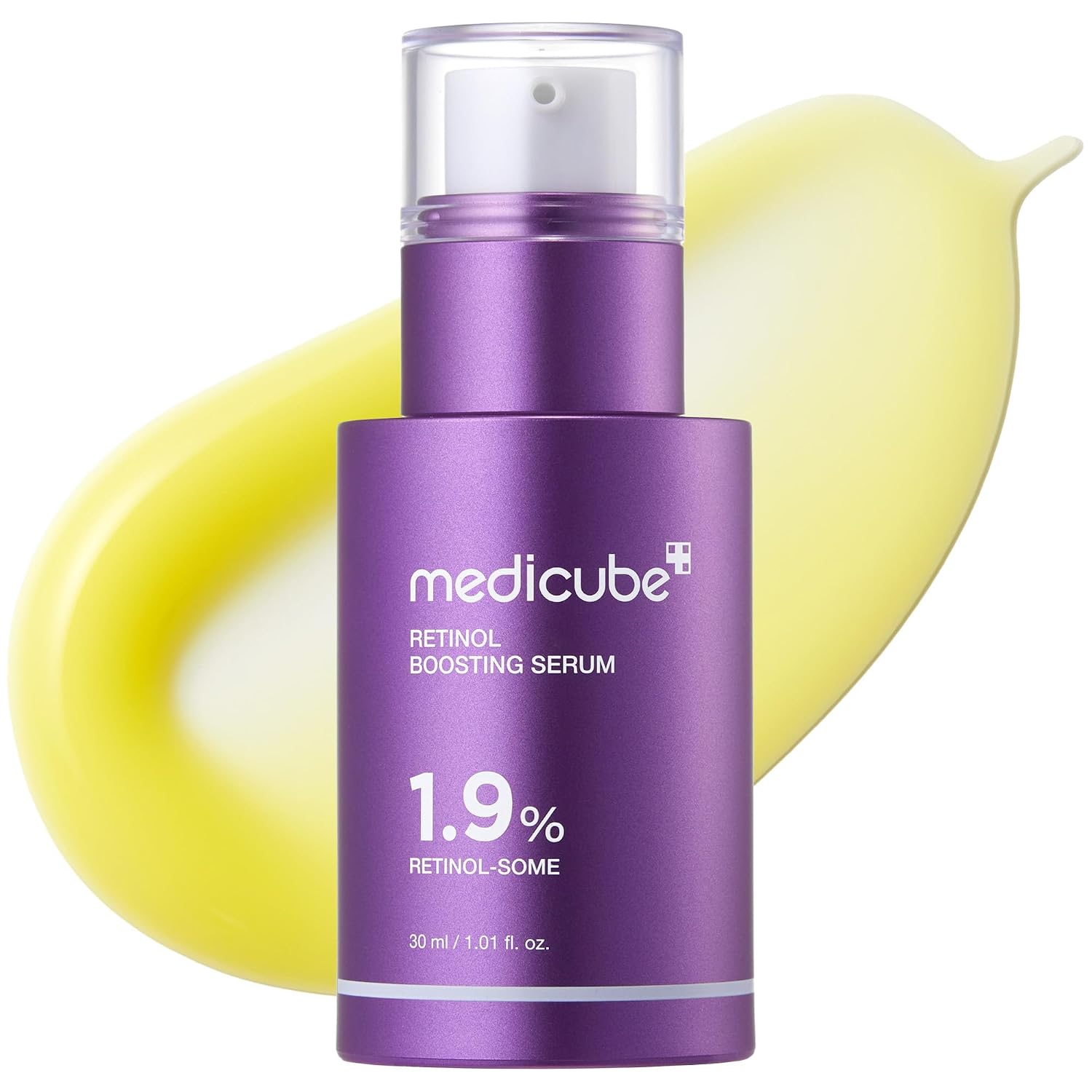
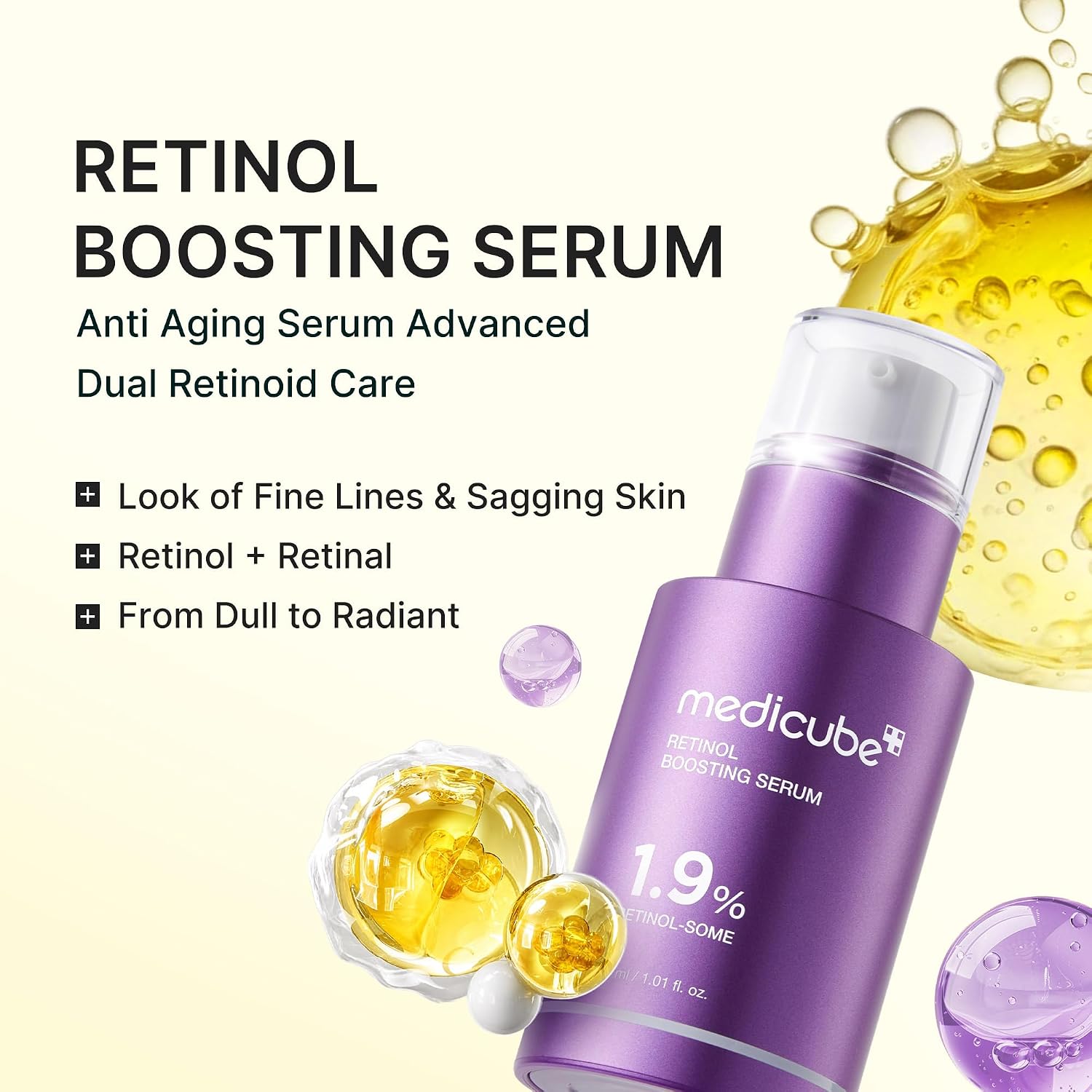
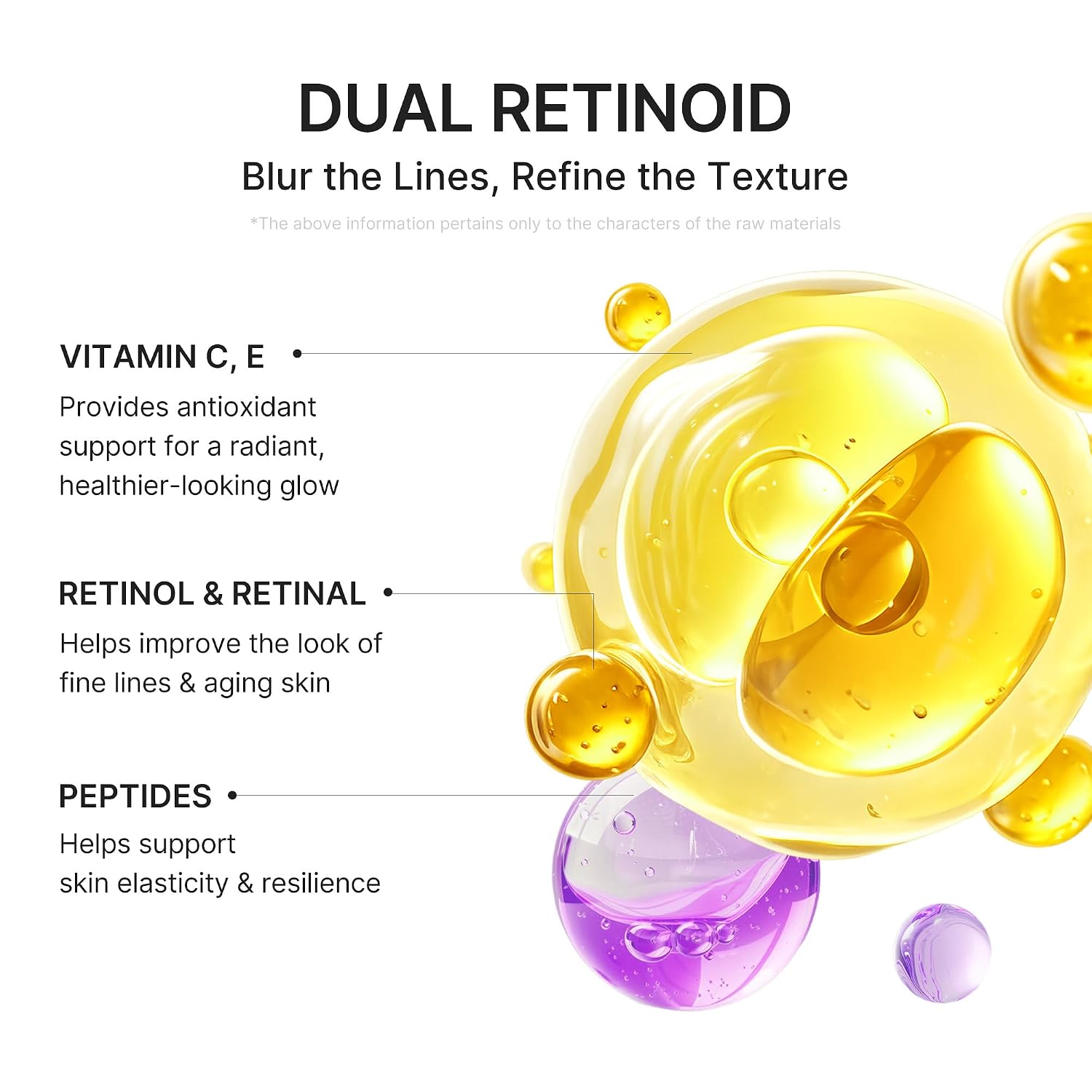
medicube Retinol Boosting Serum is a leave-on anti-ageing facial treatment supplied as a 30 ml (1.01 fl oz) pump bottle in the brand's metallic purple packaging. The listing centres on a retinoid complex it calls Retinol-Some at a declared 1.9%, and the brand artwork frames the formula as "Dual Retinoid Care" - retinol paired with retinal, the aldehyde form that converts to retinoic acid in one fewer enzymatic step than retinol itself. That pairing is reinforced by a supporting antioxidant block (vitamin C and vitamin E) and a peptide fraction described as supporting elasticity and resilience. Within the US catalogue it is filed under Skin Care > Face > Treatments & Masks > Serums, and at capture it ranked #92 in Facial Serums and #3,317 in Beauty & Personal Care.
The brand's core positioning claim is high performance at low irritation: "low-irritation technology" that delivers noticeable results "while maintaining skin comfort", explicitly described as gentle enough for sensitive skin. Use is night-only and deliberately graduated - a small amount applied in the evening after cleansing, focused on areas of concern, starting every other night and adjusting frequency to tolerance. Two handling constraints are stated in the listing itself: retinol is sensitive to light and heat so nighttime use is recommended, and sunscreen is required during daytime use. The intended outcomes are firmer and smoother-looking skin, improved appearance of uneven texture and enlarged pores, and a more refined, balanced-looking complexion.
1.1 Product Imagery
1.2 Listing Specifications
| Attribute | Value | Attribute | Value |
|---|---|---|---|
| Skin type | All | Use for | Face |
| Item form | Drop | Number of items | 1 |
| Unit count | 1.01 fluid ounces | Manufacturer | APR |
| Package dimensions | 4.02 x 1.65 x 1.65 in; 2.82 oz | Brand | medicube |
| Availability | In Stock | Delivery reference | New York 10001 |
| Sold by | Medicube & Aprilskin | Ships from | Amazon |
| Best Sellers Rank | #3,317 in Beauty & Personal Care; #92 in Facial Serums | ||
1.3 Declared Benefits and Directions
What the listing claims
- Noticeable results with retinol - advanced facial serum with a retinol-based complex to support firmer, smoother, more refined-looking skin.
- Firming and plumping support - enhanced with peptide-based ingredients to support the appearance of elasticity and resilience.
- Refining texture and pore appearance - improves the appearance of uneven skin texture and enlarged pores.
- High-performance, low-irritation formula - designed with low-irritation technology; gentle enough for sensitive skin.
- Dual retinoid architecture - retinol plus retinal, supported by vitamin C, vitamin E and peptides.
Directions and precautions
- Apply a small amount in the evening after cleansing, focusing on areas of concern.
- Begin with use every other night and adjust frequency based on skin tolerance.
- Retinol is sensitive to light and heat - nighttime use is recommended.
- Apply sunscreen during daytime use.
- The brand carries its own disclaimer that ingredient descriptions pertain only to the characteristics of the raw materials.
2. Product Rating and Buyer Sentiment
2.1 Rating Distribution
2.2 Aspect Sentiment
Eight aspects carry sentiment counts. Every one of them sits above 75% positive - there is no aspect on this product that falls below the halfway line, which is unusual for a retinoid treatment.
| Aspect | Mentions | Positive | Negative | Positive share | Reading |
|---|---|---|---|---|---|
| Effectiveness | 138 | 126 | 12 | 91% | Strongly positive |
| Moisturising | 57 | 50 | 7 | 88% | Strongly positive |
| Skin appearance | 42 | 39 | 3 | 93% | Near-unanimous |
| Value for money | 38 | 31 | 7 | 82% | Strongly positive |
| Texture | 34 | 32 | 2 | 94% | Near-unanimous |
| Skin irritation | 32 | 24 | 8 | 75% | Weakest aspect, still positive |
| Non-greasy | 23 | 18 | 5 | 78% | Positive |
| Fragrance-free | 19 | 17 | 2 | 89% | Strongly positive |
2.3 What Buyers Say
"Customers find this serum effective and appreciate its moisturizing properties for mature skin, with one noting significant lightening of dark spots. The product receives positive feedback for its texture, making faces feel soft and smooth, while being gentle and suitable for sensitive skin. Customers like its non-greasy formula and fragrance-free nature, and consider it worth the price."
Aggregate summary published on the listing. No individual reviewer is named, quoted by handle, or linked.
Recurring positives and complaints
Recurring positives
- Effectiveness - 126 of 138 mentions positive (91%), the highest-volume aspect.
- Moisturising - 50 of 57 positive (88%), singled out for mature skin.
- Skin appearance - 39 of 42 positive (93%), including a report of significant lightening of dark spots.
- Texture - 32 of 34 positive (94%); faces feel soft and smooth.
- Value for money - 31 of 38 positive (82%); considered worth the price.
- Fragrance-free - 17 of 19 positive (89%); the absence of scent is noticed and welcomed.
Recurring complaints
- Skin irritation - the only aspect below 80% positive, at 75% (24 positive against 8 negative across 32 mentions). Expected for a retinoid; still net positive.
- Non-greasy - 78% positive (18 of 23). A texture preference rather than a product defect.
- No aspect on this product falls below the halfway line, and none below 75%.
3. Ingredient Analysis
Two independent ingredient dossiers were captured and merged for this section. Both resolve to the same 63-ingredient list in INCI order, and both match the official brand ingredient list exactly once its repeated carrier names are de-duplicated. Function and comedogenic/irritancy ratings come from the claim database; the safety rating comes from the ingredient database. Sixty-one of the 63 entries carry a safety rating; two do not.
3.1 What's Inside - Claim Matrix
Twelve claims were tested. Eight pass and four fail. Read the polarity carefully: a claim marked means the product is not that thing.
3.2 Ingredients List - 63 Entries in INCI Order
Level is derived from the safety rating's upper bound: 1 is the safest figure and a higher value calls for more caution. Comedogenic and irritancy run the other way, where 0 is safest. A dash means not rated - which is missing data, not a clean bill of health.
| # | Ingredient | Function | Comedogenic | Irritancy | Safety | Level |
|---|---|---|---|---|---|---|
| 1 | Water | Skin Conditioning | - | - | 1 | Level 1 |
| 2 | Glycereth-26 | Humectant | 0 | 0 | 1-2 | Level 2 |
| 3 | Niacinamide | Smoothing | - | - | 1 | Level 1 |
| 4 | Glycerin | Humectant | 0 | 0 | 1-2 | Level 2 |
| 5 | Caprylic/Capric Triglyceride | Masking | - | - | 1 | Level 1 |
| 6 | Macadamia Ternifolia Seed Oil | Emollient | - | - | 1 | Level 1 |
| 7 | Butylene Glycol | Humectant | 1 | 0 | 1 | Level 1 |
| 8 | Hydrogenated Lecithin | Emulsifying | - | - | 1-2 | Level 2 |
| 9 | Retinol | Skin Conditioning | - | - | 1-9 | Level 9 |
| 10 | Brassica Campestris Sterols | Emollient | - | - | 1 | Level 1 |
| 11 | 1,2-Hexanediol | Skin Conditioning | - | - | 1 | Level 1 |
| 12 | Cholesterol | Emollient | 0 | 0 | 1 | Level 1 |
| 13 | Polyglyceryl-10 Laurate | Skin Conditioning | - | - | 1 | Level 1 |
| 14 | Phytosteryl/Behenyl/Octyldodecyl Lauroyl Glutamate | Skin Conditioning | - | - | 1 | Level 1 |
| 15 | Aluminum/Magnesium Hydroxide Stearate | Emulsion Stabilising | - | - | 1 | Level 1 |
| 16 | Pentaerythrityl Tetra-Di-T-Butyl Hydroxyhydrocinnamate | Antioxidant | - | - | 2 | Level 2 |
| 17 | Potassium Cetyl Phosphate | Emulsifying | - | - | 1 | Level 1 |
| 18 | Tris(Tetramethylhydroxypiperidinol)Citrate | Stabilising | - | - | 1 | Level 1 |
| 19 | Glyceryl Citrate/Lactate/Linoleate/Oleate | Emulsifying | - | - | 1 | Level 1 |
| 20 | Elaeis Guineensis Oil | Emollient | - | - | 1 | Level 1 |
| 21 | Cetyl Ethylhexanoate | Emollient | - | - | 1 | Level 1 |
| 22 | Hydroxyacetophenone | Antioxidant | - | - | 1 | Level 1 |
| 23 | Ammonium Acryloyldimethyltaurate/Vp Copolymer | Not classified | - | - | 1 | Level 1 |
| 24 | Polyacrylate Crosspolymer-6 | Emulsion Stabilising | - | - | 1 | Level 1 |
| 25 | Aluminum Starch Octenylsuccinate | Absorbent | - | - | 1-3 | Level 3 |
| 26 | Retinal | Skin Conditioning | - | - | 1-9 | Level 9 |
| 27 | Squalane | Emollient | 1 | 0 | 1 | Level 1 |
| 28 | Polyquaternium-51 | Skin Conditioning | - | - | 1 | Level 1 |
| 29 | Tocopherol | Antioxidant | 0-3 | 0-3 | 1 | Level 1 |
| 30 | Panthenol | Skin Conditioning | 0 | 0 | 1 | Level 1 |
| 31 | Allantoin | Skin Conditioning | 0 | 0 | 1 | Level 1 |
| 32 | Adenosine | Skin Conditioning | - | - | 1 | Level 1 |
| 33 | Disodium EDTA | Chelating | - | - | 2 | Level 2 |
| 34 | Bifida Ferment Lysate | Skin Conditioning | - | - | 1 | Level 1 |
| 35 | Lactobacillus Ferment Lysate | Skin Conditioning | - | - | 1 | Level 1 |
| 36 | Lactococcus Ferment Lysate | Skin Conditioning | - | - | 1 | Level 1 |
| 37 | Dipropylene Glycol | Humectant | - | - | 1 | Level 1 |
| 38 | Centella Asiatica Leaf Extract | Skin Conditioning | - | - | 1 | Level 1 |
| 39 | Asiaticoside | Antioxidant | - | - | 1 | Level 1 |
| 40 | Asiatic Acid | Skin Conditioning | - | - | 1 | Level 1 |
| 41 | Madecassic Acid | Skin Conditioning | - | - | 1 | Level 1 |
| 42 | Beta-Glucan | Skin Conditioning | - | - | 1 | Level 1 |
| 43 | Ceramide NP | Skin Conditioning | - | - | 1 | Level 1 |
| 44 | Propanediol | Solvent | - | - | 1 | Level 1 |
| 45 | Eriobotrya Japonica Leaf Extract | Skin Conditioning | - | - | 1 | Level 1 |
| 46 | Mentha Viridis Extract | Masking | - | - | 3 | Level 3 |
| 47 | Sodium Hyaluronate Crosspolymer | Humectant | - | - | 1 | Level 1 |
| 48 | Pentylene Glycol | Skin Conditioning | - | - | 1 | Level 1 |
| 49 | Ethylhexylglycerin | Skin Conditioning | - | - | 2 | Level 2 |
| 50 | Nicotinamide Mononucleotide | Antioxidant | - | - | - | Not rated |
| 51 | Akebia Quinata Extract | Skin Conditioning | - | - | - | Not rated |
| 52 | Caprylyl/Capryl Glucoside | Cleansing | - | - | 1-2 | Level 2 |
| 53 | Camellia Japonica Flower Extract | Emollient | - | - | 1 | Level 1 |
| 54 | Polyglyceryl-10 Oleate | Skin Conditioning | - | - | 1 | Level 1 |
| 55 | Acetyl Hexapeptide-8 | Humectant | - | - | 1 | Level 1 |
| 56 | Acetyl Tetrapeptide-5 | Humectant | - | - | 1 | Level 1 |
| 57 | Carnosine | Skin Conditioning | - | - | 1 | Level 1 |
| 58 | Palmitoyl Tetrapeptide-7 | Skin Conditioning | - | - | 1 | Level 1 |
| 59 | Palmitoyl Tripeptide-5 | Skin Conditioning | - | - | 1 | Level 1 |
| 60 | Yeast Beta-Glucan | Skin Conditioning | - | - | 1 | Level 1 |
| 61 | Ferulic Acid | Antimicrobial | - | - | 1-2 | Level 2 |
| 62 | 3-O-Ethyl Ascorbic Acid | Skin Conditioning | - | - | 1 | Level 1 |
| 63 | Ascorbic Acid | Antioxidant | - | - | 1 | Level 1 |
3.3 Ingredient Count by Safety Level
| Level | Meaning | Count | Share | Representative ingredients |
|---|---|---|---|---|
| Level 1 | Lowest concern band | 49 | 77.8% | Water, Glycerin, Niacinamide, Panthenol, Allantoin, Ceramide NP, Squalane, Centella complex, peptides |
| Level 2 | Low concern | 8 | 12.7% | Glycereth-26, Hydrogenated Lecithin, Disodium EDTA, Ethylhexylglycerin, Ferulic Acid, Caprylyl/Capryl Glucoside |
| Level 3 | Moderate caution | 2 | 3.2% | Aluminum Starch Octenylsuccinate (1-3), Mentha Viridis Extract (3) |
| Level 9 | Widest rated range - the retinoids | 2 | 3.2% | Retinol (1-9), Retinal (1-9) |
| Not rated | No data | 2 | 3.2% | Nicotinamide Mononucleotide, Akebia Quinata Extract |
3.4 Functional Composition
| Functional group | Count | Key ingredients | Role in the formula |
|---|---|---|---|
| Skin conditioning and soothing | 28 | Panthenol, Allantoin, Beta-Glucan, Ceramide NP, Centella Asiatica Leaf Extract, Asiaticoside, Asiatic Acid, Madecassic Acid, ferment lysates | The largest group by far - the barrier and soothing cushion that makes a retinoid tolerable |
| Humectants | 7 | Glycerin, Glycereth-26, Butylene Glycol, Dipropylene Glycol, Sodium Hyaluronate Crosspolymer | Water binding and the hydration load |
| Emollients and barrier lipids | 7 | Squalane, Cholesterol, Macadamia Ternifolia Seed Oil, Brassica Campestris Sterols, Ceramide-supporting esters | Replenishes the lipid barrier that retinoid use taxes |
| Antioxidants | 7 | 3-O-Ethyl Ascorbic Acid, Ascorbic Acid, Ferulic Acid, Tocopherol, Hydroxyacetophenone, Carnosine, Nicotinamide Mononucleotide | The vitamin C plus E plus ferulic network the listing markets |
| Emulsifiers and stabilisers | 6 | Hydrogenated Lecithin, Potassium Cetyl Phosphate, Glyceryl Citrate/Lactate/Linoleate/Oleate, Polyacrylate Crosspolymer-6 | Emulsion architecture and the liposomal delivery system |
| Surfactants and multifunctionals | 4 | Niacinamide, Caprylic/Capric Triglyceride, Caprylyl/Capryl Glucoside, Mentha Viridis Extract | Actives and multi-role materials |
| Solvents, absorbents and chelators | 3 | Propanediol, Aluminum Starch Octenylsuccinate, Disodium EDTA | Carry, finish and chelate |
| Not classified | 1 | Ammonium Acryloyldimethyltaurate/VP Copolymer | No function recorded |
3.5 Flagged Ingredients
Only two entries are flagged at all, and neither is a retinoid side-effect flag.
The two flags
| Ingredient | Trigger | Reading |
|---|---|---|
| Tocopherol | Comedogenic 2-3; irritancy 0-3 | Vitamin E at a moderate rating. Both are ranges, so judged on the upper bound of 3 |
| Mentha Viridis Extract | Safety 3 | Spearmint extract - the single highest safety figure in the list |
Tocopherol's ratings are printed as ranges, which means the underlying sources disagree. Reproduced as printed and judged on the upper bound so the ingredient is not understated.
The retinoids carry a range, not a high rating
Retinol (position 9) and Retinal (position 26) are both recorded as safety 1-9. That is the database saying published tolerability varies with concentration and vehicle - not a rating of 9.
It matters that this is read correctly: a reader who sees "safety 9" without the 1- prefix will badly misjudge the product. No concentration can be derived from an INCI list, so the brand's declared 1.9% Retinol-Some is recorded as a brand statement only.
3.6 Benefit and Concern Signals
Benefits by supporting ingredient count
Community sentiment on the ingredient list
Class-level concerns flagged
| Concern | Description |
|---|---|
| May worsen rosacea | Can trigger flare-ups in rosacea-prone skin. |
| May trigger acne | Can clog pores or trigger breakouts. |
Only two concerns are raised, against four on a typical retinoid product. They are ingredient-class warnings - "this formula contains ingredients capable of ..." - not a verdict on the product or any individual. The acne flag is consistent with the pore-clogger and fungal-acne-safe claims both failing, and traces to the ester and plant-oil content (Caprylic/Capric Triglyceride, Cetyl Ethylhexanoate, Elaeis Guineensis Oil, Macadamia Seed Oil).
Key ingredient groups recognised
| Group | Mechanism | Ingredients |
|---|---|---|
| Antioxidants | Shields skin from free radical damage | 7 |
| Peptides | Supports hydration and improves firmness | 4 |
| Retinoid | Visibly reduces the signs of aging | 2 |
| Vitamin C | Brightens, evens tone, supports collagen | 2 |
| Vitamin E | Protects skin and soothes irritation | 1 |
| Niacinamide | Strengthens, smooths, brightens | 1 |
| Ceramides | Locks in moisture, supports barrier | 1 |
| Hyaluronic Acid | Hydrates by attracting and holding water | 1 |
Eight groups are recognised - the widest spread of any product in this series - and the retinoid group correctly resolves to the two entries (retinol and retinal) that the listing markets as its dual-retinoid core.
3.7 Formula Logic
| Group | Representative ingredients | Role |
|---|---|---|
| Solvent and humectant base | Water, Glycereth-26, Glycerin, Butylene Glycol, Dipropylene Glycol, Propanediol, Pentylene Glycol, 1,2-Hexanediol | Carries the formula and delivers the hydration load |
| Retinoid actives | Retinol (9), Retinal (26) | The dual-retinoid core; both carry the widest safety range in the list |
| Antioxidant and brightening | 3-O-Ethyl Ascorbic Acid, Ascorbic Acid, Ferulic Acid, Tocopherol, Hydroxyacetophenone, Carnosine, Nicotinamide Mononucleotide, Asiaticoside | Vitamin C plus E plus ferulic network plus the NMN-active |
| Barrier lipids and emollients | Macadamia Seed Oil, Squalane, Cholesterol, Ceramide NP, Brassica Campestris Sterols, Elaeis Guineensis Oil | Replenishes the lipid barrier that retinoid use taxes |
| Peptides and ferments | Acetyl Hexapeptide-8, Acetyl Tetrapeptide-5, Palmitoyl Tetrapeptide-7, Palmitoyl Tripeptide-5, Bifida / Lactobacillus / Lactococcus Ferment Lysates, Yeast Beta-Glucan | Firmness support plus a postbiotic fraction |
| Emulsifiers, texture and preservation | Polyglyceryl-10 Laurate/Oleate, Potassium Cetyl Phosphate, Polyacrylate Crosspolymer-6, Aluminum Starch Octenylsuccinate, Disodium EDTA, Ethylhexylglycerin, Hydroxyacetophenone | Emulsion architecture, sensory finish, chelation and preservation |
The official brand ingredient list publishes 82 comma-separated entries against 63 unique names, because the brand lists compound ingredient groups and repeats carriers such as Water, Glycerin and 1,2-Hexanediol inside each group. De-duplicated, the official list is 63 names and matches the merged list above name for name and order for order - so there is no formula-version gap.
4. Price Analysis
The US listing was captured with a New York delivery reference (ZIP 10001) and priced natively in USD - no conversion, no estimation. Long-run figures come from a third-party Amazon price tracker that has monitored this product since 18 January 2026, roughly nine and a half months of history. That is a short record, and it is read as one throughout.
4.1 Live Listing Snapshot
| Item | Value | Note |
|---|---|---|
| Current price | $18.90 | Buy box with a New York 10001 delivery reference |
| List price | Not shown on the listing | The tracker records a $21.80 list price for the product |
| Subscribe & Save | $17.01 | 10% below the one-off price - the deeper of the two discounts |
| Discount or coupon | None active | No percentage-off or coupon was rendered at capture |
| Unit price | $18.71 per fluid ounce | Consistent with an $18.90 price on a 1.01 fl oz bottle |
| Availability | In Stock | Free delivery quoted for Thursday, 5 November; overnight for Prime |
| Sold by / ships from | Medicube & Aprilskin / Amazon | Brand-operated offer, fulfilled by Amazon |
4.2 Long-Run Price Record
| Price type | Lowest ever | Highest ever | Current | Average |
|---|---|---|---|---|
| Amazon (sold and shipped by Amazon) | No data | No data | No data | No data |
| 3rd party new | $15.12 (18 Feb 2026) | $28.91 (23 Apr 2026) | $18.90 (31 Aug 2026) | $17.52 |
| 3rd party used | No data | No data | No data | No data |
4.3 Price Level Comparison
Bar comparison of every price in the long-run record plus the list price. The current price sits well below the ceiling and below list.
4.4 Position Against Benchmarks
| Benchmark | Value | Current vs benchmark | Reading |
|---|---|---|---|
| Lowest ever | $15.12 | +25.0% | Above the floor |
| Highest ever | $28.91 | -34.6% | A third below the ceiling |
| Tracked average | $17.52 | +7.9% | Slightly above the mean |
| List price | $21.80 | -13.3% | A real discount to list |
4.5 Volatility and Timeline
Volatility measures
| Metric | Value |
|---|---|
| Spread (high - low) | $13.79 |
| Spread as a share of the low | 91.2% |
| Dated extremes recorded | 2 (one low, one high) |
| Tracked average vs list price | -19.6% |
| Subscribe & Save vs list price | -22.0% |
| Monitoring window | 18 Jan 2026 to 1 Nov 2026 |
A 91.2% spread is very wide - but it must be read against a nine-and-a-half-month record. The ceiling is nearly double the floor and both extremes fall in the first half of that window. That is price discovery during a launch period, not a mature product with a wide normal range.
Timeline of dated extremes
| Date | Event | Price |
|---|---|---|
| 18 Jan 2026 | Monitoring begins | Not recorded |
| 18 Feb 2026 | Lowest ever observed | $15.12 |
| 23 Apr 2026 | Highest ever observed | $28.91 |
| 31 Aug 2026 | Current value | $18.90 |
| 1 Nov 2026 | This capture | $18.90 (last observation, 62 days old) |
The low precedes the high by about two months, and the single later observation sits between them and closer to the floor. Three dated points across nine months is too few to describe the path between them.
5. Positioning and Who It Suits
The case for it
- The dual-retinoid claim is real. Both retinol and retinal are present in the list, which is exactly what "Retinol + Retinal" promises and is not always true of products that market a retinoid complex.
- Exceptional safety profile. 57 of 63 entries (90.5%) sit at Level 1 or 2; only two ingredients are flagged at all.
- Barrier support is built in at scale. 28 conditioning entries plus a ceramide, cholesterol, squalane and phytosterol quartet. Barrier Repair is backed by 21 ingredients and Hydrating by 20.
- Fragrance-free, verified. No Parfum and no declarable allergen anywhere in 63 names - and buyers rate that aspect 89% positive.
- Buyer sentiment is uniformly positive. Every one of eight aspects scores above 75% positive, including skin irritation at 75%.
- Priced below list. $18.90 against a $21.80 list price, with $17.01 on subscription.
The case against it
- It is still a retinoid. Photo-sensitising, requires night use, gradual introduction and daytime sunscreen.
- Concentration is undisclosed. The 1.9% figure is a brand statement about a delivery complex, not a published retinol percentage.
- Not acne-safe. Both the fungal-acne-safe and pore-clogger-free claims fail, and the database raises a "May Trigger Acne" flag from the ester and plant-oil content.
- Rosacea flag. "May worsen rosacea" is raised as a class-level concern.
- Not vegan, not oil-free.
- Short price history. Monitored for under ten months, with a 91.2% spread that reflects launch instability.
Suitability guidance
| Audience | Verdict | Basis |
|---|---|---|
| Beginners establishing a retinoid routine | Good fit | Large barrier and soothing cushion; listing specifies every-other-night ramp |
| Sensitive or reactive skin wanting anti-ageing | Good fit with ramp-up | Fragrance-free, EU-allergen-free, 90.5% of entries at Level 1-2 |
| Mature or dry skin wanting firming plus hydration | Good fit | Moisturising aspect 88% positive; 20 hydrating ingredients |
| Anyone needing a fragrance-free retinoid | Good fit | No Parfum and no declarable allergen in 63 names |
| Acne-prone or congestion-prone skin | Caution | Pore-clogger-free and fungal-acne-safe both fail; "May Trigger Acne" flagged |
| Rosacea-prone skin | Caution | "May worsen rosacea" flagged; retinoids are inherently vaso-active |
| Pregnancy or breastfeeding | Avoid | Standard retinoid contraindication |
| Vegan requirement | Not suitable | Claim flagged as failing |
6. Method, Confidence and Limitations
6.1 Confidence by Element
| Element | Confidence | Basis |
|---|---|---|
| Title, brand, specifications, availability, sold-by | High | Read directly from the live US listing with a US delivery reference |
| Price, Subscribe & Save, unit price | High | Native USD from the live listing, no conversion |
| Rating, rating count, distribution | High | Published on the listing; buckets are rounded percentages |
| Aspect sentiment counts | High | Published aggregate, but not attributable to readable individual reviews |
| Merged ingredient list (63 entries) | High | Two independent dossiers agree name-for-name and order-for-order; both match the de-duplicated official list exactly |
| Claim matrix (12 badges) | High | Complete badge block captured; polarity read from the printed prefix |
| Safety, comedogenic and irritancy ratings | Medium | Community-aggregated reference data; only 10 rows carry a comedogenic value and 8 an irritancy value |
| Long-run price low / high / average | High | Verbatim from the tracking record |
| Price trend interpretation | Low | Under ten months of history with three dated observations |
| Current tracked price as a live quote | Low | 62 days stale at capture; corroborated but not replaced by the live listing read |
| Individual buyer reviews | Not available | Zero inline reviews rendered on any page variant in this run |
| Buyer photos | Not available | The listing exposed no customer image tiles |
| Period-specific price statistics | Not available | The tracking record exposes all-time summary values only; the 1-year window is disabled |
6.2 Limitations
- Snapshot, not a series. Every figure is a capture taken on 1 November 2026. Rank, price and rating counts move between captures.
- No individual review text. The desktop listing, the mobile listing and the review-endpoint fallbacks all returned zero inline reviews, so Section 2 rests on published aggregates and aspect counts rather than on verbatim buyer quotes. No reviewer is named, handled or linked anywhere in this report.
- No buyer photography. The listing exposed no customer image tiles. All imagery shown is listing-supplied and labelled as such.
- All-time price only, and a short all-time at that. The tracking record's summary block is identical at every chart window, so no period-specific low, high or average can be produced. Monitoring began on 18 January 2026, so averages and ranges here are far less stable than for a product tracked for years.
- Three dated price observations. Nothing can be said about how many times the price changed or how long it spent at any level.
- Single tracked channel. Only third-party new carries data, so no first-party versus marketplace comparison is possible.
- Retinoid ratings are ranges, not values. Retinol and Retinal are recorded as 1-9. Both are classified on the upper bound, which is conservative and may overstate the real risk at the concentration used.
- Concentration is not derivable. The brand's 1.9% claim refers to a delivery complex, not to a published retinol or retinal percentage.
- Reference data, not regulation. Ingredient ratings come from community databases. They are reference material, not a compliance determination and not a substitute for a patch test.
- Unrated is not safe. A dash means no data. Fifty-three of 63 entries carry no comedogenic value and 55 carry no irritancy value.
- Database naming differs from retail naming. The dossiers index this product under variant names. Identification was established on three converging pieces of evidence rather than an exact title match; if regional variants exist under these names, a residual identification risk remains.
- Access friction disclosed. Both the ingredient page and the price tracker were behind Cloudflare challenges on direct read; content was recovered through alternate read paths and in one case required three attempts. Nothing was substituted or inferred to fill a gap.
Analysis compiled 1 November 2026. Pricing is native USD captured against a New York (10001) delivery reference. Rank and price are live values and will move. Ingredient ratings are aggregated reference data and are not a regulatory or clinical determination.