Product dossier · Amazon US · 27 October 2026
Monistat Chafing Relief Powder Gel is a 1.2% dimethicone gel sold in a four-tube pack to stop friction burns - and used, by a sizeable share of its buyers, as a makeup primer instead. Eight ingredient rows across two databases, three of twelve claims that fail, and a genuine 31.7% discount against list.
Product information
This is not a powder and it is not a cream. It is a silicone gel - dimethicone declared at 1.2% as a skin protectant - that spreads clear and dries to a matte, powder-like finish, which is where the 'powder gel' name comes from. Four 1.5 oz tubes to a pack, positioned for the bikini line, inner thighs, under arms and under breasts, sold on the two jobs of preventing chafe and calming the irritation that is already there.
The formula is unusually short: six rows in the COSDNA entry, seven in the Skinsort entry, eight between them. Five of those eight are silicones. That is the whole design - a volatile carrier that evaporates, a dimethicone film that stays, an elastomer that gives the gel its body and a silica that gives it the powder finish. There is no water, no preservative and no fragrance anywhere, which is why the fragrance-free and paraben-free claims are true by construction rather than by careful formulation.
Then there is the use the brand does not advertise. 327 buyers mention using it as a makeup primer, and 98% of those mentions are positive - the highest-scoring theme on the listing, ahead of chafing relief itself. It is not a mystery why: a dimethicone-and-silica gel that dries matte is structurally the same idea as a silicone face primer. Anyone buying it for chafing is getting a passable primer in the same tube; anyone buying it as a primer is getting a very cheap one.
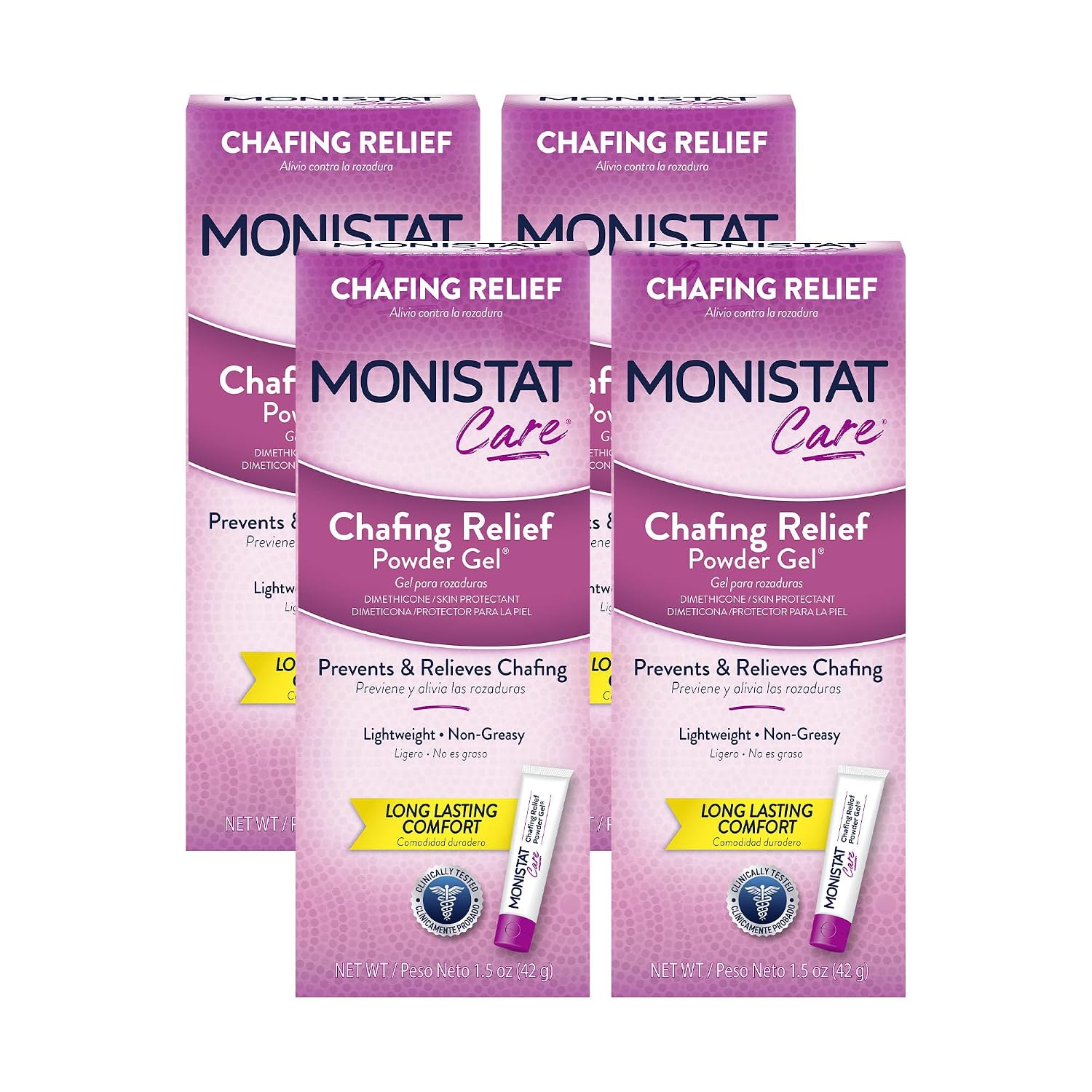
Three listing images in carousel order. Two of the three carry no product information at all, which is itself worth noting: the pack shot is the only frame that states the format and the active.
Declared specification
What the listing sells, line by line
- Daily, long-lasting chafing prevention and relief, positioned for intimate and delicate areas.
- A smooth, breathable moisture-control barrier wherever friction and sweat cause irritation.
- Safe under arms, under breasts, on the bikini area and on inner thighs; also sold against shaving irritation.
- Combines the protection of a lotion with the finish of a powder - non-greasy, fragrance-free, dries clear, does not stain.
- Four tubes of 1.5 oz each, which is the format the pricing in this report is calculated on.
The listing publishes no ingredient block, which is the one real gap on this page. Every formula claim in this report comes from the COSDNA and Skinsort entries, both of which were captured in full, and the two of them do not agree on the row count - a discrepancy documented rather than smoothed over.
One pricing detail matters before the numbers. Amazon shows no strike-through and no 'Was' price on this offer, so the only list price available is the $42.36 the price tracker carries. The 31.7% discount in this report is measured against that figure, not against anything printed on the page.
Product rating and buyer voice
Share of the 32,156 global ratings by star, as published on the listing. Percentages are the platform's own rounded figures.
4.7 from 32,156 ratings, with 84% of them five-star and a low tail of 2%. This is the most settled rating profile in the batch by a wide margin - a product with enough volume that the average has stopped moving and enough consistency that there is no failure mode to find.
The theme counts are where the interesting signal is, because the product is being judged on two different jobs. Chafing relief scores 94% from 1,148 mentions; primer quality scores 98% from 327. Effectiveness and texture both score 94%. The weakest theme, at 75%, is duration - and that is the one a buyer should actually weigh.
What the ratings are actually about
The platform groups the reviews it indexed into themes and counts positive against negative mentions. Positive runs right, negative runs left, so a bar that is mostly rose is a theme buyers complain about.
Eight themes, 6,074 mentions - by far the largest evidence base in this batch. Duration is the only theme below 85%.
| Aspect | Mentions | Positive | Negative | Positive share |
|---|---|---|---|---|
| Quality | 1702 | 1607 | 95 | 94% |
| Effectiveness | 1455 | 1347 | 108 | 93% |
| Chafing Relief | 1148 | 1074 | 74 | 94% |
| Value For Money | 433 | 384 | 49 | 89% |
| Texture | 366 | 343 | 23 | 94% |
| Duration | 344 | 257 | 87 | 75% |
| Primer Quality | 327 | 322 | 5 | 98% |
| Non-Greasy | 299 | 271 | 28 | 91% |
Duration at 75% is the honest weak point, and it is worth more attention than the 4.7 average suggests. 344 people mentioned how long the product lasts, 87 of them negatively - a quarter of everyone who raised the subject. A gel that needs reapplying on a long day is a real limitation for the use case the product is sold against, and it is the one place where the review data and the marketing disagree.
The primer finding cuts the other way. 327 mentions at 98% positive is the strongest single theme on the listing, and it describes a use the brand does not market. For anyone weighing this purchase, that is the most actionable thing in the review data: the product has a second, well-validated job, and it costs $7.24 a tube.
Product ingredients
Two ingredient databases, merged. The COSDNA entry supplies six rows with acne, irritant and safety grades; the Skinsort entry supplies seven rows with comedogenic and irritancy ratings. Five rows are shared, one is COSDNA-only and two are Skinsort-only, so the union below is eight rows - and that union, not either table alone, is the formula.
The two channels agree where it matters. Dimethicone comes back comedogenic 1 and irritancy 0 on Skinsort against acne 1 and irritant 0 on COSDNA; tocopheryl acetate is 0 / 0 on both. The disagreement is about completeness, not about risk: Skinsort names two siloxanes COSDNA omits and COSDNA names a crosspolymer Skinsort omits. Neither table is a superset.
How the levels are assigned
Levels come from COSDNA's safety grade, mapped on the upper bound of any range: 1 to 2 becomes level 1, 3 becomes level 3, 5 or above becomes level 5. Rows that only Skinsort carries, or that COSDNA leaves ungraded, sit at level 0 and are unrated rather than safe. Safety is the inverse metric - 1 is the best grade and a higher number means more caution is due. Acne risk and irritant, the two columns beside it, are read low-is-safer, and they are 0 or 1 on every row in this formula.
| Level | Meaning | Rows | Share |
|---|---|---|---|
| Level 2 | functional, low concern | 1 | 12% |
| Level 3 | preservative system | 2 | 25% |
| Level 5 | declared fragrance | 2 | 25% |
| Unrated | unrated | 3 | 38% |
Nothing at level 1 or 4; two rows at level 5 and three unrated. A single-class formula produces a single-class distribution, and the class is silicone.
Read the level chart against the two grade columns and it stops looking alarming. Both level-5 rows score 0 or 1 on acne and 0 on irritant; the fifth level is the safety column alone, and on this database the safety column is where regulatory and environmental attention on volatile siloxanes lands. Nothing in the eight rows is rated as an irritant, and nothing is rated above comedogenic 1.
That changes what the practical advice should be. For a reader worried about breakouts, this is an unusually clean formula - Skinsort's pore-clogger-free badge is consistent with the highest comedogenic score being a 1. For a reader worried about silicone generally, the formula is 62% silicone by row count and there is no silicone-free version of this product. Both readers are being told the truth by the data; they are asking different questions.
Function groups in the formula
Five of eight rows are silicones, split by what they do: two film formers, three volatile carriers, one elastomer. The remaining three rows are a powder, an antioxidant and nothing else.
What the listing promises, checked against the list
Twelve claims from the Skinsort badge set, each tested against the eight merged rows. The listing makes most of them in its own bullets; the badge set goes further.
Nine hold and three fail, and the three failures are honest rather than damaging. Silicone-free fails because five of eight rows are silicones - that is the product, not a defect. Cruelty-free and vegan fail because the brand makes no claim either way, which is a statement about certification, not about the formula.
The nine that hold are the ones that matter to a sensitive-skin buyer: no fragrance, no oil, no alcohol, no sulfate, no paraben, no EU allergen, fungal-acne-safe, pore-clogger-free, reef-safe. On this formula that is not marketing - an anhydrous silicone gel genuinely cannot support the things those claims exclude. The one to read with care is reef-safe, since the second row is a volatile cyclosiloxane that COSDNA grades 6 on safety; the badge reflects the absence of UV filters and microplastics, not an endorsement of every siloxane.
The declared ingredient list, in order
The merged eight rows. Rows 1 to 6 are the COSDNA spine in entry order; rows 7 and 8 come from Skinsort only and are marked accordingly.
The carrier
Cyclopentasiloxane and trisiloxane are the volatiles. They make the gel spread and then leave, which is why the product feels dry within a minute. Skinsort's second row, decamethyltetrasiloxane, is the same idea with a longer chain and is not in the COSDNA entry - the two databases are describing the same function with different names.
The film
Dimethicone at 1.2% is the declared skin protectant and the reason the product is regulated as one rather than as a cosmetic. Hydrogen dimethicone, the Skinsort-only row, is a surface-treated variant doing the same job lower in the list.
The body and the finish
Dimethicone/vinyl dimethicone crosspolymer is the elastomer that turns a runny silicone into a gel, and silica is the powder that gives it the matte dry-down the name promises. Together they are the difference between this and a plain silicone oil.
The one active cosmetic
Tocopheryl acetate, vitamin E, is the only row doing anything other than texture and protection. It is an antioxidant at a low position, and it is the single ingredient behind all four of the benefit rows Skinsort lists.
Full ingredient table
Complete merged table, eight rows, both channels. A dash means the channel does not carry that row or that grade - not a zero. The COSDNA row count and the Skinsort row count each match their own source exactly.
| # | Ingredient | COSDNA acne | COSDNA irritant | COSDNA safety | Skinsort comedo | Skinsort irrit. | Role in this formula | Level |
|---|---|---|---|---|---|---|---|---|
| 1 | Dimethicone Skin conditioning, Emollient | 1 | 0 | 2-5 | 1 | 0 | Silicone film former, skin protectant 1.2% | Level 5 |
| 2 | Cyclopentasiloxane (Skinsort: Cyclomethicone) Solvent, Emollient | EM | EM | 6 | 0 | 0 | Volatile silicone carrier | Level 5 |
| 3 | Dimethicone/Vinyl Dimethicone Crosspolymer Viscosity Control | EM | EM | 1-2 | - | - | Silicone elastomer, powder-gel texture | Level 2 |
| 4 | Silica Viscosity Control | EM | EM | EM | EM | EM | Powder phase | Unrated |
| 5 | Tocopheryl Acetate Skin conditioning, Moisturizer, Antioxidant | 0 | 0 | 2-3 | 0 | 0 | Antioxidant | Level 3 |
| 6 | Trisiloxane Emollient | EM | EM | 2-3 | EM | EM | Volatile silicone carrier | Level 3 |
| 7 | Decamethyltetrasiloxane Skinsort lists this row; COSDNA does not | - | - | - | EM | EM | Volatile silicone carrier | Unrated |
| 8 | Hydrogen Dimethicone Skinsort lists this row; COSDNA does not | - | - | - | EM | EM | Silicone film former | Unrated |
Two channels, one formula. Five rows shared, one COSDNA-only, two Skinsort-only; the count discrepancy is a finding, not an error to be resolved away.
Product price
This is the only product in this batch with a real discount in it. The four-pack sells for $28.94 against a $42.36 list price - 31.7% off - and both channels read the same $28.94 at capture, as they did for the other two products.
It is also the freshest record here: the price was observed one day before this report and the last automated scan was 17 hours before that. Where the other two records needed a staleness caveat, this one barely does.
| Price type | Lowest ever | Highest ever | Current | Average |
|---|---|---|---|---|
| Amazon | $15.77 Jul 30, 2019 | $37.12 Apr 09, 2026 | $28.94 Oct 26, 2026 | $27.53 |
| 3rd Party New | $15.99 Jul 22, 2019 | $40.45 Sep 03, 2021 | $28.94 Oct 26, 2026 | $27.26 |
| 3rd Party Used | - | - | - | - |
Transcribed from the price-history summary. The page itself prints no strike-through, so the $42.36 list figure comes from this source rather than from the listing.
The price record as bars
Both channels, four measures each. The two current bars are identical because both channels read $28.94 at capture.
Dated observations, plotted
Every dated observation in the record plotted in order. Monthly buckets take the highest value where two observations share a month, so the line shows the ceiling of each period rather than an average.
Position against every benchmark
| Measure | Value | Basis |
|---|---|---|
| Current vs list price | -31.7% | ($28.94 - $42.36) / $42.36 |
| Current vs Amazon average | +5.1% | ($28.94 - $27.53) / $27.53 |
| Current vs third-party average | +6.2% | ($28.94 - $27.26) / $27.26 |
| Current vs Amazon floor | +83.5% | ($28.94 - $15.77) / $15.77 |
| Current vs Amazon high | -22.0% | ($28.94 - $37.12) / $37.12 |
| Subscribe and Save vs current | -15.0% | ($24.60 - $28.94) / $28.94 |
| Amazon channel band | $21.35 | $37.12 - $15.77, i.e. 135.4% of the low |
| Third-party spread | $24.46 | $40.45 - $15.99, i.e. 152.9% of the low |
| Channel gap at capture | $0.00 | Both channels read $28.94 |
| Cost per ounce at current price | $4.82 | $28.94 / 6 oz |
| Cost per tube | $7.24 | $28.94 / 4 tubes |
The discount is real but it is not a promotion. $28.94 sits 5.1% above the Amazon average and 6.2% above the third-party average, which means today's price is an ordinary day in the upper half of the range, not a markdown a buyer has to catch. The 31.7% off list is simply how this multipack is priced against a suggested retail that nobody charges.
The record's extremes are four years apart and both look like artefacts of their moment. The July 2019 floor of $15.77 was a pre-pandemic drugstore price; the April 2026 high of $37.12 is 31% above list and reads as a stock gap rather than a market level. Neither is a reasonable benchmark for a purchase today.
Channel parity for the third time in the batch is the structural signal. Two live channels, identical to the cent, on a commodity drugstore item, means no seller is competing on price - the buy box sets the number and the marketplace follows. A buyer gains nothing from checking both channels, and the only lever available is the 15% subscription.
At $4.82 an ounce and $7.24 a tube, the unit economics are the strongest in the batch by a factor of ten against the styling powder. That is the real value story here, and it lines up with the one thing the review data says that the marketing does not: 89% of value-for-money mentions are positive.
How this was assembled, and how far to trust it
Method
- The product record was captured from the US listing with a New York delivery address, so every price is native USD with no conversion anywhere in this document.
- The rating distribution and the theme counts are the platform's own published aggregates. No review text was retrievable at capture, which is disclosed rather than worked around.
- The ingredient layer merges two channels. COSDNA supplied six graded rows from the 2019 `Official Site` entry, cross-checked against the 2022 entry for row count; Skinsort supplied seven rows with comedogenic and irritancy ratings through its reader channel, complete at 7 of 7.
- The union is eight rows. Shared, single-channel and ungraded rows are labelled individually in the table rather than being averaged into a single number.
- Skinsort's 12-badge claim matrix was captured in full and tested against the merged list; its concerns block was confirmed absent with a dedicated check rather than inferred.
- Price history comes from the tracker's all-time summary. Those values are all-time for every chart window and are never presented as period statistics.
- The listing prints no list price, so the $42.36 figure used for the discount is the tracker's own and is labelled as such wherever it appears.
Confidence
- Ingredient rows and grades · High. Two channels captured in full, with the count discrepancy reported rather than smoothed
- Claim matrix · High. All 12 badges read from the Skinsort page and each tested against the merged list
- Rating distribution and theme counts · High. Platform-published aggregates at 32,156 ratings
- Price history values · High. Transcribed verbatim with dates; the freshest record in the batch
- Reading of the level-5 grades · Medium. The grades are transcribed; attributing them to volatile-siloxane attention is inference
- Explanation of channel parity · Low. The equality is certain; the single-pricer explanation is not
- Primer use as a buyer behaviour · High. 327 positive mentions of primer quality, above chafing relief in share