What this is. A 20 ml temporary eye tightener that sets into a film under the eye, sold with an applicator brush, at $33.15 against a $39.00 list price.
What the data says. 3.6 stars on 5,002 ratings, with 49% at five stars and 19% at one star. That is not a lukewarm product; it is a product that either visibly works or visibly fails, and the complaint that dominates the listing is residue.
The tension worth reading for. A formula whose tightening chemistry is four silicate rows, marketed through peptides and vitamins, on a listing that prints seven application rules because the product breaks when used like a cream.
| Product | Peter Thomas Roth Instant FIRMx Eye Temporary Eye Tightener, Easy-Wear Formula, 20 ml / 0.67 fl oz |
|---|---|
| Brand | Peter Thomas Roth (United States) |
| Category | Beauty & Personal Care > Skin Care > Eyes |
| Price today | $33.15 after a 15% reduction from a $39.00 list price; $31.49 on Subscribe & Save |
| Rating | 3.6 out of 5 from 5,002 ratings |
| Sales rank | #1,911 in Beauty & Personal Care, #40 in Eye Treatment Products |
| Snapshot date | 1 November 2026, US delivery context (New York 10001), native USD |
1. Product Information
The listing is unusually explicit about what this product is not. It is not a moisturiser and it is not a treatment that works over months; the name says temporary, the panel says instantly, and the directions say do not put eye cream under it. What remains after those three statements is a cosmetic film former with a peptide story attached, priced at a premium, and rated by a buying public that split almost exactly in two.
The formula confirms the reading. Positions 4, 5 and 6 are sodium silicate, magnesium aluminum silicate and sodium magnesium fluorosilicate: three mineral rows whose job is to dry into a tense film on the skin. Everything the marketing leans on, the two peptides at positions 7 and 8 and the vitamin and botanical block behind them, sits on top of that film rather than instead of it.
1.1 The listing at a glance
| Attribute | Value |
|---|---|
| Item Form | Cream |
| Colour | Sheer Tint |
| Skin Type | All |
| Recommended Uses For Product | Face |
| Material Type Free | Fragrance Free |
| Item Weight | 1.5 milligrams (as printed; the fill is 20 ml) |
| Item Dimensions | 6.25 x 3.75 x 1.25 inches |
| Number of Items | 1 |
| UPC | 670367021859 |
| Manufacturer | Peter Thomas Roth |
| ASIN | B0FC5W77MB |
| Best Sellers Rank | #1,911 in Beauty & Personal Care; #40 in Eye Treatment Products |
1.2 What the pack looks like
Source: Amazon
Source: Amazon
Source: Amazon
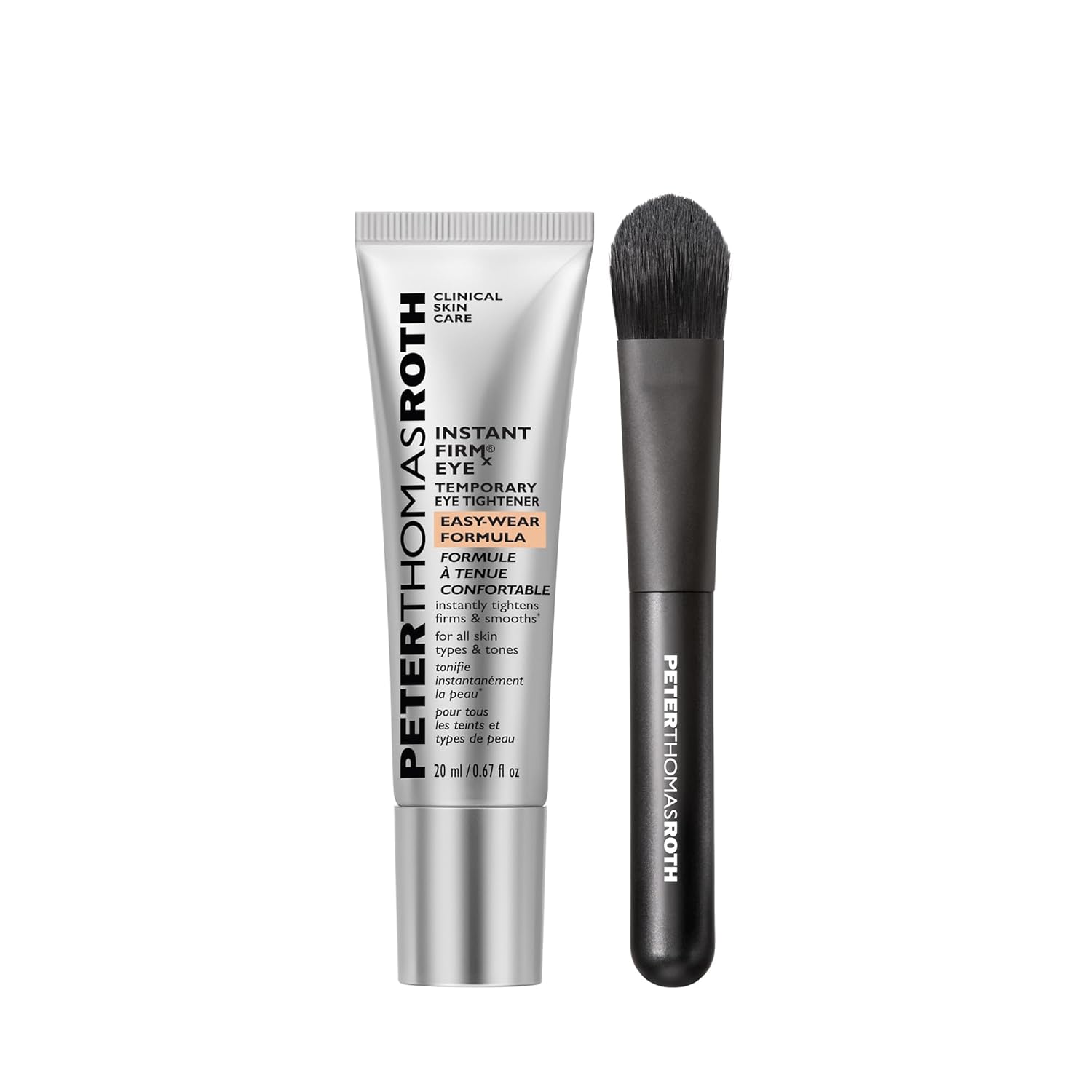
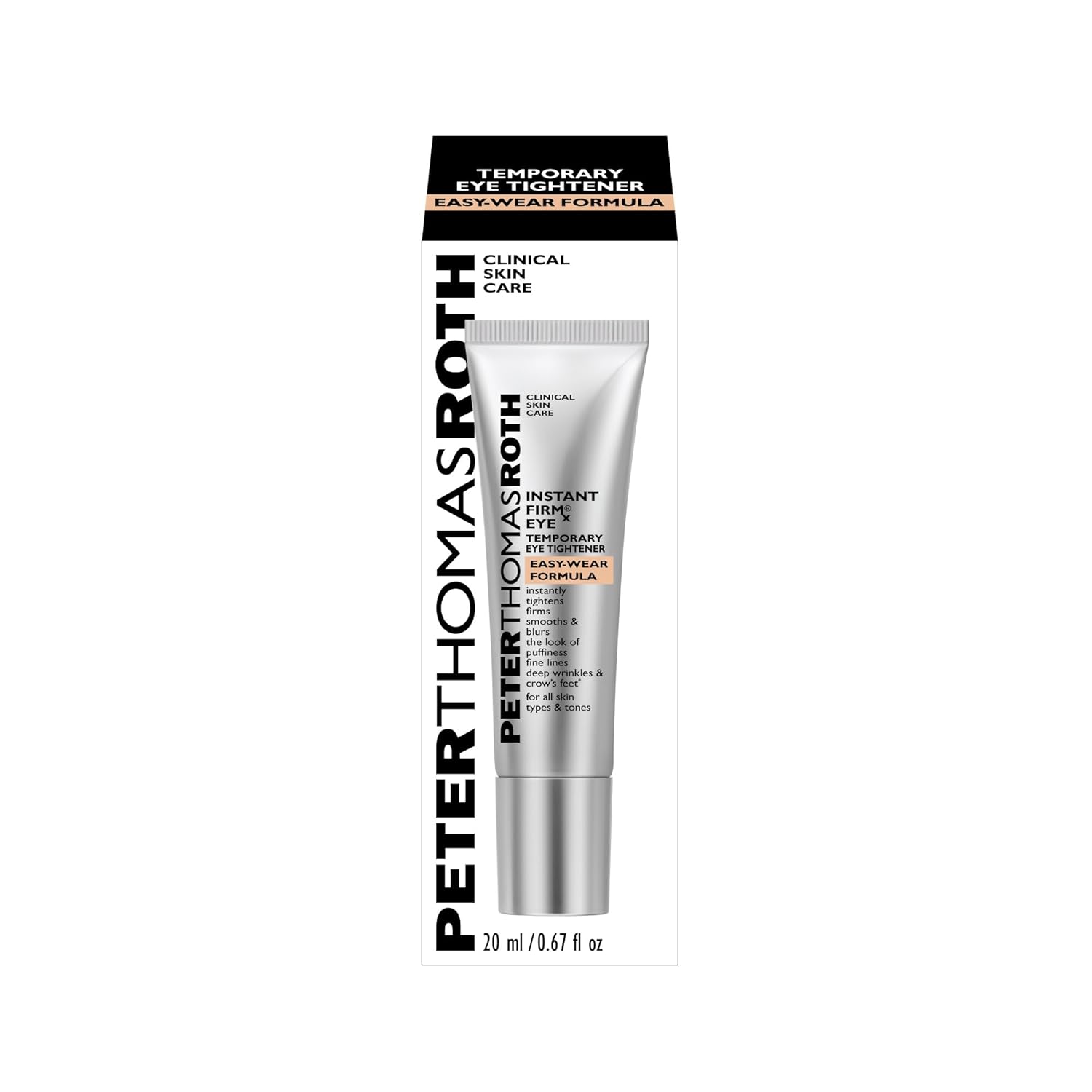
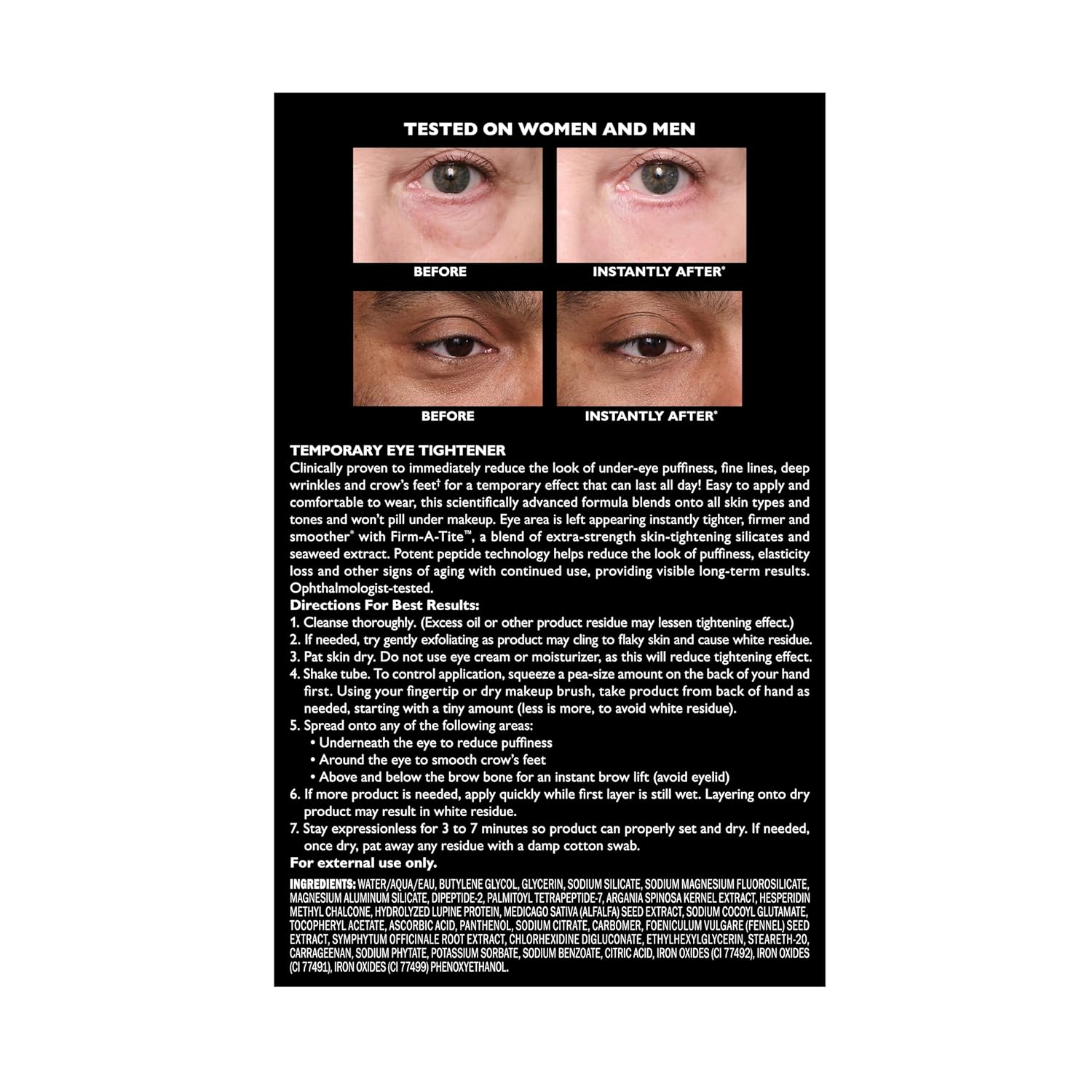
Three listing images are published for this ASIN and all three are shown. One is a product shot with the brush, one is the carton, and the third is a claims panel carrying the before-and-after pairs, the directions and the ingredient list. No buyer photography exists in the gallery.
1.3 The claims on the listing
| Claim as written | What it commits to |
|---|---|
| Instantly reduces the look of puffiness and wrinkles | A film-forming effect, not a change in the skin. The panel's own before-and-after is labelled INSTANTLY AFTER, and the word temporary appears three times on the packaging. |
| Effect can last all day | A duration claim, and the one that the aspect table partly supports: longevity scores 57% positive across 196 mentions. |
| For all skin types and tones | A positioning claim. The formula is fragrance-free and oil-free, but it carries a comedogenic 2 surfactant and a pore-clogging flag, which is a narrower promise than all. |
| Won't pill under makeup | The most contested claim on the listing. Blendability scores 28% positive across 159 mentions, and the platform summary states the product cannot be used with makeup. |
| Ophthalmologist-tested | A testing claim with no published protocol, sample size or result. It is printed on the panel and cannot be verified from the listing. |
| Firm-A-Tite blend of silicates and seaweed extract | The silicates are real and visible at positions 4 to 6. The seaweed component is argonia spinosa kernel extract and medicago sativa seed extract, both at positions 15 and 17. |
2. Product Rating
The headline is 3.6 out of 5 across 5,002 ratings, a full point below the two serums reviewed in the previous batch and on a sample of the same order. The number is not the interesting part; the shape is.
Forty-nine per cent of ratings are five-star and nineteen per cent are one-star, with the four-star bucket holding only 12%. A product that polarises this hard is telling you something about the mechanism rather than the marketing.
2.1 How the ratings are distributed
| Stars | Share | Approximate ratings |
|---|---|---|
| 5 stars | 49% | 2,451 |
| 4 stars | 12% | 600 |
| 3 stars | 11% | 550 |
| 2 stars | 9% | 450 |
| 1 stars | 19% | 950 |
Read the shape against a normal curve. A well-liked cosmetic usually runs something like 70/12/8/4/6. This one runs 49/12/11/9/19. The five-star peak is still the tallest, but the one-star block is more than three times the size you would expect, and the two-star block at 9% is larger than the four-star block would normally be at this rating level.
The consequence for a buyer is practical: the average of 3.6 describes nobody. There is no typical experience of this product. Roughly half of the people who bought it think it is excellent, and roughly one in five think it does not work at all. The rest of the distribution is thin enough that the average is an artefact of two populations rather than a verdict.
2.2 What buyers say, in the platform's own summary
Customers have mixed opinions about the eye tightener's effectiveness, with some reporting it decreases eye bags while others say it doesn't eliminate them. The product receives mixed feedback about its tightening effect and natural appearance, with some finding it makes them look younger while others say it makes them look older. Moreover, the product leaves white flaky residue and cannot be used with makeup, and customers feel it's not worth the price.
The platform summary is the most useful paragraph on the listing, because it names the failure mode instead of hinting at it: white flaky residue, cannot be used with makeup, and not worth the price. It also captures the split honestly, noting that some buyers see a decrease in eye bags while others see no elimination at all.
One phrase deserves attention because it appears nowhere in the brand's own copy: some buyers say it makes them look older. For a product sold on the promise of a younger look, that is the sharpest possible contradiction, and it is the direct consequence of a film that shows as a pale cast on the skin.
2.3 Which themes drive the score
| Aspect | Mentions | Positive | Negative | Positive share |
|---|---|---|---|---|
| disappointing | 677 | 401 | 276 | 59% |
| residue | 543 | 126 | 417 | 23% |
| value for money | 364 | 102 | 262 | 28% |
| coverage | 309 | 188 | 121 | 61% |
| natural appearance | 240 | 83 | 157 | 35% |
| longevity | 196 | 112 | 84 | 57% |
| skin tightening | 169 | 113 | 56 | 67% |
| blendability | 159 | 45 | 114 | 28% |
Eight aspects and a clear hierarchy. Skin tightening at 67% positive across 169 mentions is the strongest theme and confirms that the mechanism does something. Coverage at 61% is second and is about area rather than effect. Longevity at 57% says the effect holds for a working day, as claimed.
Then the table inverts. Residue is the most-mentioned theme on the entire listing at 543 mentions and only 23% of them are positive: 417 negatives against 126 positives. Value for money at 28% across 364 mentions and blendability at 28% across 159 mentions complete the picture. The disappointing theme at 677 mentions is the largest bucket, but it is nearly balanced at 59% positive, which means the word is being used broadly rather than as a verdict.
The most useful single comparison is residue against tightening. The thing this product does well is mentioned 169 times; the thing it does badly is mentioned 543 times, three times as often. Any buying decision has to start there.
2.4 A second, much smaller reading
There is no second rating set to compare. The ingredient aggregator that supplied the formula table carries this product without a single community rating, so the Amazon 3.6 stands alone. That absence is worth stating rather than papering over: for the two products reviewed immediately before this one, a smaller outside rating set existed and pointed in the same direction as Amazon. Here there is nothing to cross-check, which makes the polarised histogram the only evidence of buyer experience available.
2.5 What the rating cannot tell you
- A 3.6 average on a bimodal distribution is a statistical description of two groups, not of the product. Read the histogram before the score.
- No review text was captured from Amazon, so every quotation-shaped statement in this report is the platform's aggregation, not a named reviewer.
- 5,002 ratings on a product variant that launched in 2025 is a fast accumulation, which usually means heavy sampling or a promotional push; the ratings may not represent full-price buyers evenly.
- The aspect counts overlap: a single review can mention residue, blendability and value at once, so the eight rows cannot be added together.
3. Product Ingredients
Coverage: 35 of 35 ingredients. All 35 rows published by the only reachable channel are reproduced, in page order. The second channel was blocked at the network edge, so there is no independent cross-check of the acne and irritancy columns and coverage is 35 of 35 by one channel.
3.1 The ingredients, in order
Thirty-five rows, and the first six explain the product. Water, glycerin and butylene glycol carry the liquid; sodium silicate, magnesium aluminum silicate and sodium magnesium fluorosilicate are the film. Those three mineral rows are what make the tube worth its price and what make the residue complaints inevitable, because a silicate film that is applied too thickly or over an oil dries white and flakes.
| # | Ingredient | Function | Comedogenic | Irritancy |
|---|---|---|---|---|
| 1 | Water | Skin Conditioning | — | — |
| 2 | Glycerin | Humectant | 0 | 0 |
| 3 | Butylene Glycol | Humectant | 1 | 0 |
| 4 | Sodium Silicate | Buffering | — | — |
| 5 | Magnesium Aluminum Silicate | Absorbent | 0 | 0 |
| 6 | Sodium Magnesium Fluorosilicate | Abrasive | — | — |
| 7 | Palmitoyl Tetrapeptide-7 | Skin Conditioning | — | — |
| 8 | Dipeptide-2 | Skin Conditioning | — | — |
| 9 | Ascorbic Acid | Antioxidant | — | — |
| 10 | Tocopheryl Acetate | Antioxidant | 0 | 0 |
| 11 | Hesperidin Methyl Chalcone | Antioxidant | — | — |
| 12 | Retinyl Palmitate | Skin Conditioning | 1-3 | 1-3 |
| 13 | Panthenol | Skin Conditioning | 0 | 0 |
| 14 | Foeniculum Vulgare Seed Extract | Skin Conditioning | — | — |
| 15 | Medicago Sativa Seed Extract | Skin Conditioning | — | — |
| 16 | Carrageenan | Not published | — | — |
| 17 | Argania Spinosa Kernel Extract | Skin Conditioning | — | — |
| 18 | PEG-8 Dimethicone | Emulsifying | — | — |
| 19 | Silica | Abrasive | — | — |
| 20 | Octyldodecanol | Emollient | — | — |
| 21 | Symphytum Officinale Leaf Extract | Skin Conditioning | — | — |
| 22 | Sodium Propoxyhydroxypropyl Thiosulfate Silica | Not published | — | — |
| 23 | BHT | Antioxidant | — | — |
| 24 | Disodium EDTA | Chelating | — | — |
| 25 | Hydrolyzed Lupine Protein | Skin Conditioning | — | — |
| 26 | Steareth-20 | Cleansing | 2 | 1 |
| 27 | Sodium Cocoyl Glutamate | Cleansing | — | — |
| 28 | Carbomer | Emulsion Stabilising | 1 | 0 |
| 29 | Chlorhexidine Digluconate | Antimicrobial | — | — |
| 30 | Ethylhexylglycerin | Skin Conditioning | — | — |
| 31 | Potassium Sorbate | Preservative | — | — |
| 32 | Citric Acid | Buffering | — | — |
| 33 | Sodium Citrate | Buffering | — | — |
| 34 | Sodium Benzoate | Masking | — | — |
| 35 | Phenoxyethanol | Preservative | — | — |
Only 8 of 35 rows carry any published comedogenic or irritancy rating, and 4 of those are above zero. Judged on the upper bound, the heaviest flag is Retinyl Palmitate at 1-3 on both columns, followed by Steareth-20 at 2 for comedogenicity, with Butylene Glycol and Carbomer at 1. The gap is the real precision limit: 27 rows are simply unrated rather than clean, and the three silicate film formers that define this product carry no rating at all.
3.2 What the formula is actually built around
Three silicate rows at positions 4 to 6 do the work the name promises. Sodium silicate is the classic tightening agent: it dries, contracts and pulls the skin surface with it. The effect is real, it is temporary, and it is the reason the directions forbid applying anything oily underneath.
Palmitoyl Tetrapeptide-7 and Dipeptide-2 at positions 7 and 8, backed by hesperidin methyl chalcone, hydrolyzed lupine protein and two seed extracts. This is the long-term half of the pitch and it is credible as a blend; what it cannot do is act instantly, which is why the panel separates the two claims.
The listing specifies a sheer tint and the pack panel lists three iron oxides. That tint is what makes the product wearable without concealer and also what makes an over-application visible as a pale mask. Coverage and natural appearance in the aspect table are the two sides of this single design decision.
Read the claim matrix against the table and a pattern appears. The formula passes every clean-label badge except the ones that require absence of a specific functional ingredient: it is alcohol-free, fragrance-free, oil-free, paraben-free, sulfate-free and reef-safe, and it fails silicone-free on a single row, cruelty-free and vegan on brand policy, and the two risk badges on a retinoid ester and a seaweed-derived thickener.
The preservative system is three rows and it is thorough: chlorhexidine digluconate, potassium sorbate and phenoxyethanol, with sodium benzoate and ethylhexylglycerin as support. For a water-based film product that will be opened and closed daily for months, that is a sensible level of protection rather than a minimal one, and it is one of the few places where this formula is more careful than its price peers.
3.3 Function groups: where the ingredients go
| Group | Count | Ingredients |
|---|---|---|
| Humectants | 2 | Glycerin, Butylene Glycol |
| Emollients | 1 | Octyldodecanol |
| Solvents and texture | 2 | Magnesium Aluminum Silicate, Carbomer |
| Emulsifiers | 1 | PEG-8 Dimethicone |
| Skin conditioning and protecting | 11 | Water, Palmitoyl Tetrapeptide-7, Dipeptide-2, Retinyl Palmitate, Panthenol, Foeniculum Vulgare Seed Extract et al. |
| Antioxidants | 4 | Ascorbic Acid, Tocopheryl Acetate, Hesperidin Methyl Chalcone, BHT |
| pH, buffering and chelating | 4 | Sodium Silicate, Disodium EDTA, Citric Acid, Sodium Citrate |
| Masking and amino acids | 1 | Sodium Benzoate |
| Preservatives | 3 | Chlorhexidine Digluconate, Potassium Sorbate, Phenoxyethanol |
| Other | 6 | Sodium Magnesium Fluorosilicate, Carrageenan, Silica, Sodium Propoxyhydroxypropyl Thiosulfate Silica, Steareth-20, Sodium Cocoyl Glutamate |
The largest group is Humectants at 2 rows, and that is the honest characterisation of the formula: it is a conditioning and protecting formula with a mineral film laid over it, not a treatment formula. The second largest group is not a functional category at all but a set of abrasives, surfactants and unclassified rows, which is what a texture-driven product looks like when its ingredients are sorted by role.
3.4 Classification by position: the concentration ladder
Thirty-five rows split into three bands. The split matters more than usual here because the mechanism is concentrated at the top: everything that makes the product tighten sits inside the first ten positions.
| Band | Positions | Count | What sits there |
|---|---|---|---|
| Lead actives | Positions 1-10, the top of the INCI order | 10 | Water, Glycerin, Butylene Glycol, Sodium Silicate, Magnesium Aluminum Silicate, Sodium Magnesium Fluorosilicate, Palmitoyl Tetrapeptide-7, Dipeptide-2 et al. |
| Core support | Positions 11-25 | 15 | Hesperidin Methyl Chalcone, Retinyl Palmitate, Panthenol, Foeniculum Vulgare Seed Extract, Medicago Sativa Seed Extract, Carrageenan, Argania Spinosa Kernel Extract, PEG-8 Dimethicone et al. |
| Trace and buffer | Positions 26-40 | 10 | Steareth-20, Sodium Cocoyl Glutamate, Carbomer, Chlorhexidine Digluconate, Ethylhexylglycerin, Potassium Sorbate, Citric Acid, Sodium Citrate et al. |
The lead band is water, two humectants, three silicates and two peptides. That is a complete description of the product in eight rows: a liquid carrier, a film, and a firmness story. Nothing in this band is decorative.
The middle band is where the actives and the antioxidants live: retinyl palmitate at 12, panthenol at 13, two seed extracts, the silicone, silica, an emollient alcohol, the second botanical, the BHT and EDTA pair, and hydrolyzed lupine protein. It is a support band in the ordinary sense, with one exception: retinyl palmitate carries the highest published risk rating in the whole table and it sits here rather than at the top.
The tail band is texture and preservation: a surfactant pair, carbomer, three preservatives, a buffer pair, a masking agent and phenoxyethanol. This is the part of the formula that determines whether the film sets evenly, and it is also the part that most buyers never read.
3.5 What the product claims, and how the claims hold up
Twelve badges, seven hold and five fail. The five failures are of three different kinds, and separating them matters more than the count.
| Claim | Status | Note |
|---|---|---|
| Alcohol-free | Holds | No denatured alcohol in the 35-row table |
| EU-allergen-free | Holds | No EU-listed fragrance allergen |
| Fragrance-free | Holds | No fragrance row; the listing's Material Type Free field states Fragrance Free and the aggregator states that no ingredient it classifies as fragrance is present |
| Oil-free | Holds | No triglyceride or mineral oil; the emollient rows are an alcohol and an ester |
| Paraben-free | Holds | Preserved with phenoxyethanol, potassium sorbate and sodium benzoate |
| Sulfate-free | Holds | The two surfactants are a glutamate and a steareth, not a sulfate |
| Reef-safe | Holds | No UV filter and no tracked restricted ingredient |
| Silicone-free | Not met | One row: PEG-8 Dimethicone at position 18 |
| Cruelty-free | Not met | The aggregator states outright that the product is not cruelty-free |
| Fungal-acne-safe | Not met | One flagged row: Retinyl Palmitate, an ester that Malassezia can cleave |
| Pore-clogger-free | Not met | One flagged row: Carrageenan, a precautionary flag rather than a studied one |
| Vegan | Not met | The aggregator states outright that the product is not vegan |
Silicone-free fails on one row, PEG-8 Dimethicone at position 18, which is an emulsifying silicone rather than a slip agent. Fungal-acne-safe fails on retinyl palmitate, an ester that Malassezia can break down for food, and pore-clogger-free fails on carrageenan, which the aggregator itself labels a precautionary flag reported by some users with no formal study behind it.
Cruelty-free and vegan fail as policy statements rather than as chemistry. Both are printed plainly by the aggregator, and both are rarer failures than they should be in a product at this price: a premium brand that is neither vegan nor cruelty-free is making a deliberate choice that a buyer can act on before looking at a single ingredient.
3.6 Concerns worth knowing before you buy
Carrageenan carries the pore-clogging flag, and Steareth-20 carries a comedogenic rating of 2. Both sit in the second half of the list.
The same two rows, plus the film former itself, which seals the surface rather than letting it breathe.
Retinyl Palmitate is rated 1-3 on both columns. The range means the aggregator's sources disagree; judged on the upper bound this is the most heavily flagged row in the formula.
Two class-level concerns plus one row-level flag, which is a light count for a 35-row formula and should be read that way. The acne and oiliness concerns trace to the same two rows, carrageenan and steareth-20, and both sit deep enough in the list that their concentration is likely low. The retinyl palmitate flag is the one worth taking seriously if you are pregnant, breastfeeding, or using a prescription retinoid alongside.
3.7 The benefits, ranked by how many ingredients carry them
| Benefit | Description | Ingredients | Weight |
|---|---|---|---|
| Scar healing | Improves the look of marks and scars | 5 | |
| Anti-aging | Softens lines and helps skin look youthful | 3 | |
| Hydrating | Boosts hydration and relieves dry, tight skin | 3 | |
| Brightening | Restores radiance to dull, tired skin | 3 | |
| Barrier repair | Strengthens and restores the skin's natural barrier | 3 | |
| Good for oily skin | Balances oil and helps reduce shine | 2 | |
| Redness reducing | Soothes visible redness and calms irritation | 2 | |
| Dark spots | Fades dark spots for even skin tone | 2 | |
| Skin texture | Smooths rough patches and refines texture | 2 | |
| Reduces irritation | Eases discomfort and supports resilience | 1 | |
| Reduces large pores | Minimises the look of enlarged pores | 1 |
Eleven benefits, and the ordering is a reminder that this ranking counts ingredients, not efficacy. Scar healing leads at 5 supporting ingredients on the strength of the peptide and vitamin block, while anti-aging, hydrating, brightening and barrier repair all sit at 3. The two counts of 1, irritation and pore size, are single-ingredient claims and carry almost no evidential weight.
3.8 Key ingredient groups
| Group | Mechanism as published | Ingredients |
|---|---|---|
| Antioxidants | Shields skin from free radical damage | 4 ingredients: Ascorbic Acid, Tocopheryl Acetate, Hesperidin Methyl Chalcone, BHT |
| Peptides | Supports hydration and improves firmness | 2 ingredients: Palmitoyl Tetrapeptide-7, Dipeptide-2 |
| Exfoliators | Removes dead cells to smooth texture | 2 ingredients: Ascorbic Acid, Citric Acid |
| Retinoid | Visibly reduces the signs of aging | 1 ingredient: Retinyl Palmitate |
| Vitamin C | Brightens, evens tone, supports collagen | 1 ingredient: Ascorbic Acid |
| Vitamin E | Protects skin and soothes irritation | 1 ingredient: Tocopheryl Acetate |
Six key groups, and three of them are the same three molecules seen from different angles: ascorbic acid is counted as an antioxidant, an exfoliator and the vitamin C group; tocopheryl acetate as an antioxidant and vitamin E. Read the group table as a description of what the brand considers its actives, not as six independent mechanisms.
4. Product Price
There is a discount here, which is a change from the previous batch. The buy box reads $33.15 against a $39.00 list price, a 15% reduction that Amazon prints as a savings line, and Subscribe & Save takes a further 19% to $31.49. For a 20 ml tube, $33.15 works out at $49.48 per fluid ounce.
The price history explains where that $39.00 comes from and why it should not be read as a fixed reference. The tracker's own list price for the same ASIN is $38.00, a dollar below the figure on the listing, and both channels have traded well below it for most of the monitored period.
4.1 Today's price
This is the rare case in this series where the discount is real and the reference price is soft. The listing claims $39.00 list and prints $33.15; the tracker publishes $38.00 list and records an Amazon average of $34.97. Today's price is below all three reference points, which makes it a defensible entry rather than a promotional illusion.
4.2 The full price record
| Price type | Lowest ever | Highest ever | Current | Average |
|---|---|---|---|---|
| Amazon | $25.93 | $39.00 | $33.15 | $34.97 |
| 3rd Party New | $19.50 | $39.00 | $33.15 | $31.20 |
| 3rd Party Used | — | — | — | — |
Two of the three rows are populated and the third is empty in every column. Both current observations are nine and ten days old, which is fresh enough to position today's price but not fresh enough to treat as a live quote. The used row is empty because no used market is tracked for a sealed cosmetic.
Four bars per channel, and the pair that matters is the middle two: the current bar sits well below the highest-ever bar on both channels and close to the average bar. That is the visual signature of a product trading mid-band rather than at an extreme.
The 3rd Party New series is the wide one. A $19.50 low and a $39.00 high on the same channel is a 100.0% spread, which no promotional calendar produces on a premium cosmetic. It is a stock signal.
4.3 Where the current price actually sits
| Benchmark | Amazon | 3rd Party New |
|---|---|---|
| Current versus all-time low | +27.8% | $25.93 |
| Current versus all-time average | -5.2% | $34.97 |
| Current versus all-time high | -15.0% | $39.00 |
| Current versus list price | -15.0% | $39.00 |
Position against four benchmarks, anchored on the Amazon current observation of $33.15. Every benchmark except the low sits above today's price, so the gaps are negative and the product looks cheap against its own history.
The two rows that read -15.0% are not a coincidence: the tracker's highest-ever Amazon price of $39.00 and the listing's list price of $39.00 are the same number. The product spent part of 2026 selling at exactly its stated list price, which is why the discount looks larger than the historical average suggests.
4.4 Volatility and the averages
| Price type | All-time spread | Spread as % of low | Average vs list |
|---|---|---|---|
| Amazon | $13.07 | 50.4% | -10.3% |
| 3rd Party New | $19.50 | 100.0% | -20.0% |
Volatility is high on both channels and much higher on the third-party one. Amazon moved $13.07 between its low and its high inside fifty days in mid-2026. The third-party channel moved $19.50, exactly double its low, inside twelve days in September.
Both averages sit below the $39.00 list price, at $34.97 and $31.20. That is the normal relationship between a street price and a reference price, and it means today's $33.15 is not an artificial low created by a fake list: it is close to where the Amazon channel has averaged for the whole monitored period.
4.5 The channel comparison
The two channels have swapped roles during the monitored window. Third-party sellers have averaged $31.20 against Amazon's $34.97, a 12.1% undercut, which is the usual pattern for a beauty SKU where Amazon does not hold the buy box continuously. Today both print $33.15.
That parity is the one thing in this report that cannot be resolved from the source. Either the buy box has moved to a third-party seller at Amazon's price, or Amazon has matched a market that came up to meet it. The 100.0% third-party spread suggests the second reading is more likely: a channel capable of selling at $19.50 and at $39.00 eighteen days apart is not a channel that sets a stable price.
4.6 Timeline of the dated extremes
| Date | Event | Price | Channel |
|---|---|---|---|
| 2026-05-04 | Amazon all-time high | $39.00 | Amazon |
| 2026-06-23 | Amazon all-time low | $25.93 | Amazon |
| 2026-09-18 | 3rd Party New all-time low | $19.50 | 3rd Party New |
| 2026-09-30 | 3rd Party New all-time high | $39.00 | 3rd Party New |
Four dated extremes and they tell two different stories. The Amazon pair, a $39.00 high on 4 May 2026 and a $25.93 low on 23 June 2026, is a fifty-day promotional arc on a recently launched variant. The 3rd Party New pair is twelve days from $19.50 to $39.00, which is not a promotion at all.
The two current observations, ten and nine days before this snapshot, land at $33.15 on both channels. That value sits 27.8% above the Amazon low and 5.2% below the Amazon average, which is exactly where a mid-band price should sit.
4.7 What this means for the purchase decision
- Today's $33.15 is 15% below the listing's $39.00 list price, 12.8% below the tracker's $38.00 list price, and 5.2% below the Amazon all-time average. The discount is real on every reference available.
- The lowest price ever recorded is $19.50, on 18 September 2026, six weeks before this snapshot. It was a third-party offer and it lasted a matter of days before the channel swung to $39.00.
- Subscribe & Save at $31.49 is 5.0% below the page price and 9.9% below the Amazon average, which makes it the cheapest standard route to this product today.
- $49.48 per fluid ounce is a premium unit price for a 20 ml fill, and value for money scores only 28% positive across 364 mentions, so the price objection in the reviews is about unit economics rather than about the $33.15 ticket.
- If the goal is to test whether the mechanism works on your own under-eye area, the 20 ml tube is roughly two months of twice-daily use at the prescribed pea-sized dose, which is enough to judge it without repurchasing.
5. Who It Is For
| A good fit if you… | Look elsewhere if you… |
|---|---|
| want a visible, immediate tightening under the eye for a specific event rather than a slow-acting cream | expect a cream: this sets as a film, and the same panel that promises an instant effect prints seven steps to keep it from flaking |
| have under-eye bags rather than hollows, and want a temporary lift without a procedure | wear concealer or foundation over the eye area, since the platform summary states the product cannot be used with makeup |
| accept a sheer tint that also does a little colour correction | have deep-set or very fair skin: 35% of appearance mentions are positive across 240 mentions, the weakest large theme after residue |
| are prepared to apply a pea-sized amount and stay expressionless for three to seven minutes | want a one-step routine: the directions forbid layering over eye cream or moisturiser, and layering is the reason most complaints start |
| value a 20 ml tube with a brush at $33.15 | are price-sensitive: value for money scores 28% positive on 364 mentions, and the fill works out at $49.48 per fluid ounce |
One practical note the listing makes and the reviews confirm: this product is judged in the first application. If the first attempt dries white or flakes, the cause is almost always too much product or an oil underneath, not a defective tube. A pea-sized amount on bare, dry skin, spread thin with the brush and left alone for three to seven minutes, is the difference between the 67% of tightening mentions that are positive and the 23% of residue mentions that are not.
6. Method and Confidence
| Element | Confidence | Basis |
|---|---|---|
| Title, specifications, rank | High | Read from the US product page in a US delivery context |
| Price | High | Buy box in USD with a New York ZIP set; no conversion applied |
| Rating and histogram | High | Rendered by the page itself, 5,002 ratings |
| Customers say and aspects | High | Platform summary, eight aspects with mention counts |
| Individual review text | Not available | No review body rendered on desktop, mobile or the retry loop |
| Buyer photos | Not available | The listing exposes zero buyer image tiles for this ASIN |
| Ingredient table | High for names and order | Complete 35-row list from the aggregator channel, cross-checked against the pack panel |
| Price history | High | Both channels carry current observations dated nine and ten days before the snapshot |
6.1 Limitations, stated plainly
- No review bodies were captured. Three surfaces returned zero inline reviews across four attempts, so no review quotation appears here and none was reconstructed.
- No buyer photos exist for this ASIN, so the gallery shows the three listing images only, one of which is a claims panel rather than a photograph of the product.
- The second ingredient channel was blocked at the network edge on this run. Every count and band in the ingredient analysis therefore derives from one source rather than two, and no independent acne or irritancy score exists for this product.
- The aggregator publishes no community rating for this product, so there is no second rating set to compare with the Amazon 3.6.
- Two rows carry a rating printed as a range, 1-3, which means the source's own references disagree. The upper bound is used wherever a risk judgement is made, and the range is reproduced as printed.
- The pack panel and the aggregator table do not match row for row: the panel lists three iron oxides that the aggregator does not carry, and the aggregator carries a retinyl palmitate and several texture rows that are not legible on the panel. Neither list is treated as authoritative over the other.
- The listing's Item Weight field reads 1.5 milligrams, which cannot be right for a 20 ml tube. It is reproduced as printed and not used in any calculation.
- Position in the INCI list is a proxy for concentration, not a measurement.
- Everything here is a snapshot taken on 1 November 2026.
Snapshot date 1 November 2026. All prices in US dollars as published for a US delivery address; no currency conversion applied. Reviewer identities are withheld throughout. Ingredient ratings are community-sourced and describe ingredient classes, not this finished formula.