RoC built this pen around a four-shade model of under-eye discolouration and a retinoid it calls patented. The formula supports part of that: niacinamide sits at position five, ahead of the retinol at thirteen, inside a 37-row emulsion that carries nine of twelve claim badges and a single pore-clogger flag. What the record also holds is an Amazon attribute naming benzoyl peroxide that is nowhere in the formula, a headline number that appears as four-out-of-five on the imagery and three-out-of-four in the copy, and a dark-circle claim that scores 41% positive on the second-largest mention count on the page.
Amazon US · captured with a New York 10001 delivery address · snapshot 1 November 2026 · all prices native USD · no reviewer identities reproduced
| Live price | Rating | Ratings | Ingredients | Claims held |
|---|---|---|---|---|
| $29.99 | 4.2 / 5 | 3,580 | 37 | 9 / 12 |
Price, rating and volume read from the listing on 1 November 2026. Of the twelve claim badges Skinsort checks, nine hold and three fail - fungal-acne-safe, pore-clogger-free and vegan. No list price and no discount are published on the listing.
Part one
The pen, its rank, and an attribute that is not true
An eye cream in a silver applicator pen, 0.5 fluid ounces, sold and shipped by Amazon in the US. The breadcrumb puts it at Beauty & Personal Care > Skin Care > Eyes > Creams, and the badge puts it at #7 in Eye Treatment Creams behind an overall #2,116 in Beauty & Personal Care - a top-ten position in the niche and a rank outside the top two thousand overall, which is what a young, concentrated ASIN looks like before broad volume arrives. The pack is a pen with a metal cooling tip rather than a jar, and that format decision turns out to matter twice: once in the usage instructions, and once in the consistency complaints.
Source: Amazon
Source: Amazon
Source: Amazon
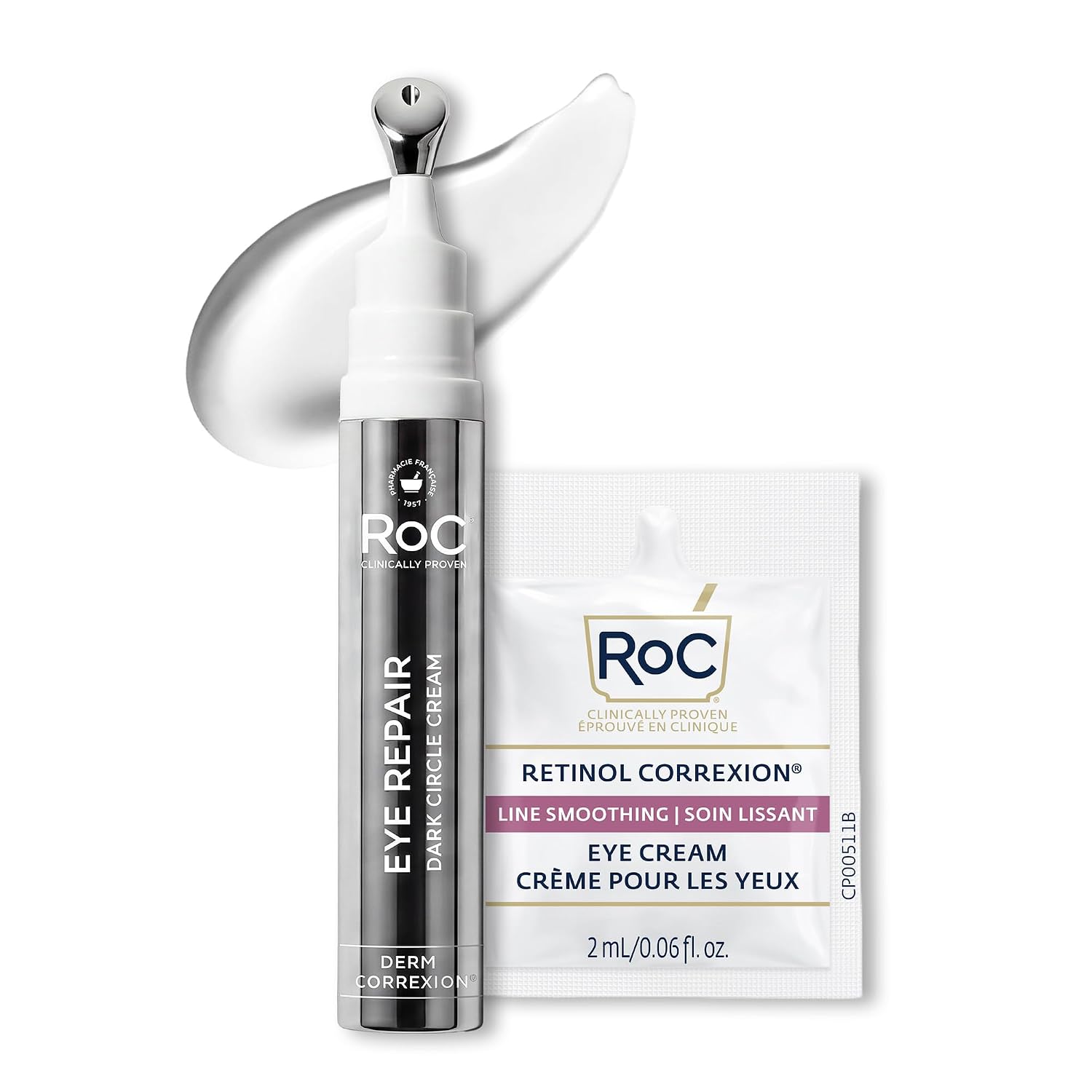
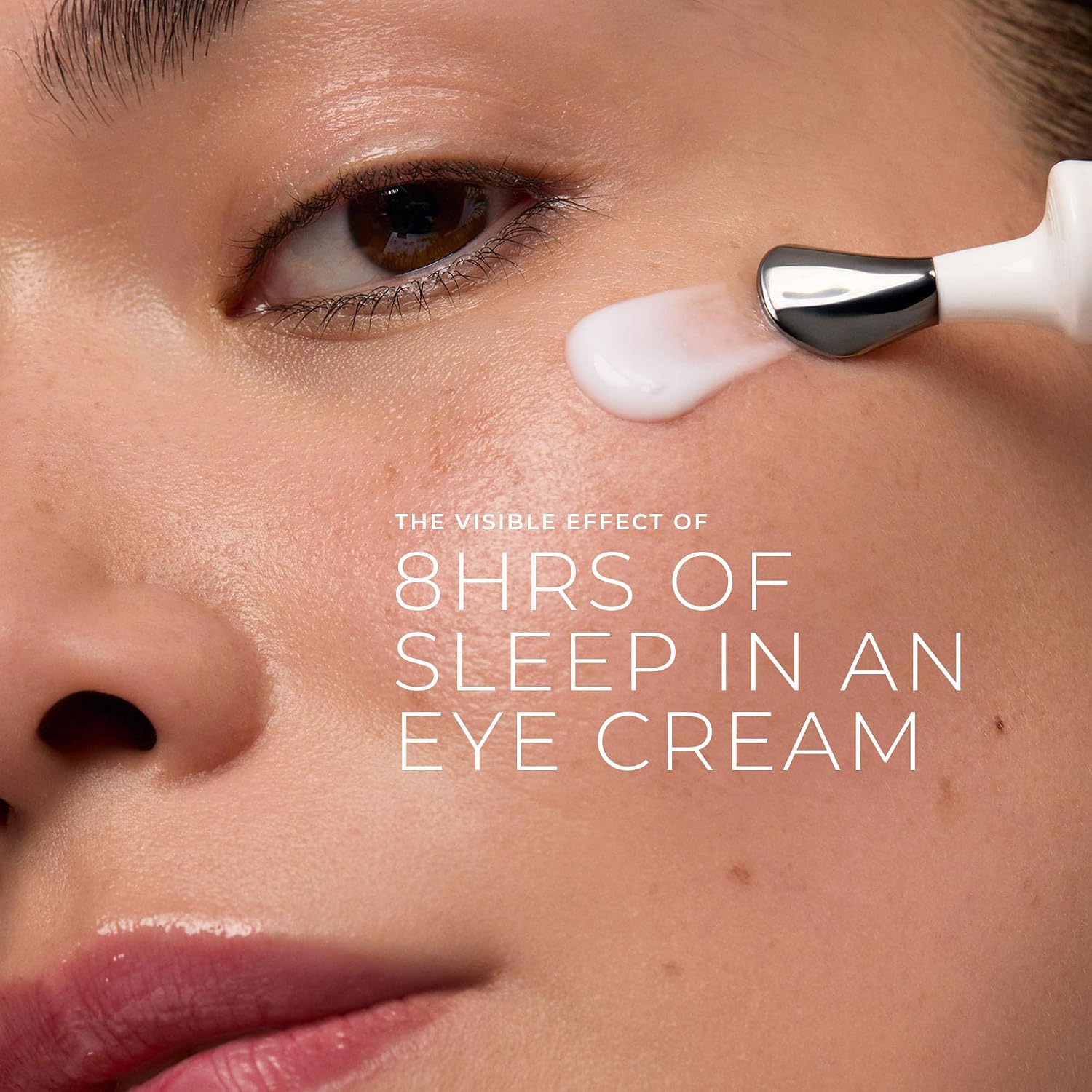
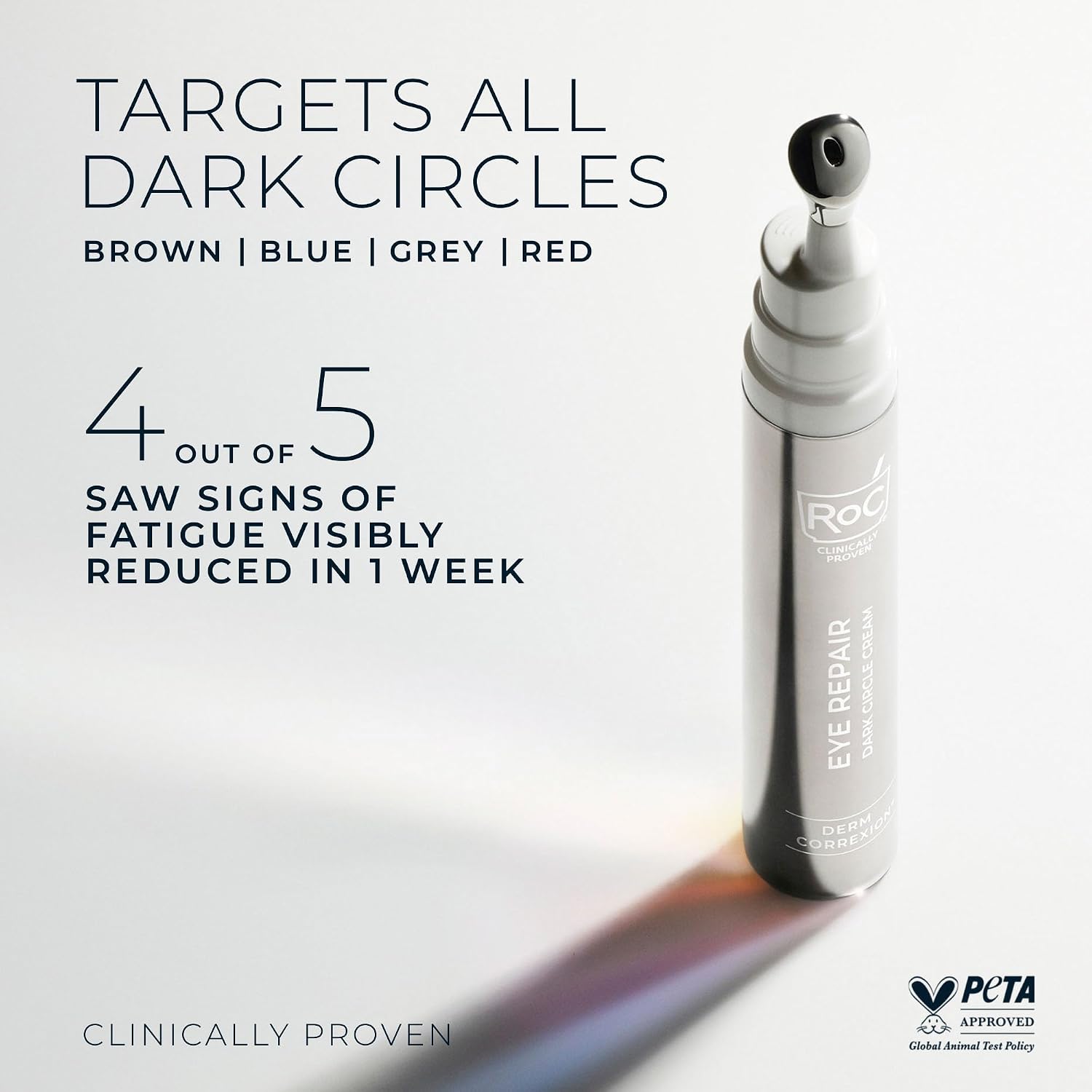
The carousel exposes nine images and the three above carry almost all of its argument. The first is the one to look at closely: the sachet standing beside the pen is labelled Retinol Correxion Line Smoothing Eye Cream, 2 mL, which is a different RoC eye product, not a sample of the cream in the pen. No frame in the set states the 0.5 oz fill of the product being sold. The second frame is a simile rather than a measurement, and the third carries the number that contradicts the bullet copy - four out of five here, three out of four there. A set that mixes a sibling SKU, an uncited simile and a figure inconsistent with the copy is a promotional set rather than an evidential one, and it should be read that way.
Declared specifications
| Field | Value |
|---|---|
| Brand | RoC |
| Item Volume | 0.5 fluid ounces |
| Age Range (Description) | Adult |
| Special Feature | Hypoallergenic |
| Active Ingredients | Benzoyl Peroxide, Niacinamide, Retinol |
| Item Weight | 1.92 ounces |
| Package Dimensions | 9.41 x 8.27 x 1.5 inches; 1.95 ounces |
| UPC | 840103215242 |
| Manufacturer | RoC |
| ASIN | B0FDK4B3JD |
| Best Sellers Rank | #2,116 in Beauty & Personal Care; #7 in Eye Treatment Creams |
What the seller promises
- NON-INVASIVE EYE TREATMENT DEVELOPED WITH DERMATOLOGISTS: Helps reverse the look of persistent dark circles for dramatically brighter, rested, younger-looking eyes. Cooling precision tip massages away signs of fatigue. RoC Patented Retinol: targets grey tones. Niacinamide: targets brown tones. Resveratrol: targets red tones. Proxygen: targets blue/purple tones.
- CLINICALLY PROVEN RESULTS: Inspired by advanced lasers, this formula combines 4 ingredients clinically proven to reduce the 4 shades of under-eye discoloration instantly & over time. In 1 Week 3 out of 4 saw signs of fatigue visibly reduced* **Clinical study - Self-Assessment - 32 volunteers. TESTED ON CONSUMER VOLUNTEERS. PETA-APPROVED. 100% CRUELTY FREE.
- ANTI-AGING FORMULAS: Whether you are looking for an eye cream to visibly reduce puffy eyes, crow's feet, or undereye bags, we have an anti-aging eye treatment formula that's right for you. Dermatologist & Ophthalmologist tested. Fragrance-free. Paraben-free. Hypoallergenic. Non-drying and non-greasy. Appropriate for sensitive skin.
- SCIENCE & BEAUTY: We produce a wide array of skin care products & treatments including daily moisturizers with SPF, hyaluronic and niacinamide acids, facial cleansers, vitamin C serums, retinol skin tone & wrinkle regimens & creams for under eyes, neck firming, decollete & much more.
- SKIN CARE INNOVATION: Our products are recognized by beauty industry leaders & dermatologists for their best-in-class effectiveness. We continue to research & innovate new formulas for healthier skin.
Five bullets, two of which are about the product. The substantive pair builds a four-shade model - retinol for grey, niacinamide for brown, resveratrol for red, Proxygen for blue/purple - and then attaches one clinical claim to it: 3 out of 4 saw signs of fatigue visibly reduced in one week, footnoted as a self-assessment study of 32 volunteers. Three things follow from that footnote. It is self-reported rather than instrumented. Thirty-two people is a small panel for a claim this specific. And the imagery prints 4 out of 5 for the same proposition, so the listing carries two different headline figures for one result. The third bullet is a range-level attribute list - dermatologist and ophthalmologist tested, fragrance-free, paraben-free, hypoallergenic - which the ingredient record largely supports.
From the manufacturer
The manufacturer block is where the brand's technical story is strongest and its numbers are loosest. The four-actives-to-four-shades mapping is repeated with more detail, and the retinol gets a claim of its own: clinically proven to be 7X more effective than standard retinol, backed by 30+ years of expertise and 26 patents. No concentration, no comparator and no study design are published for the 7X figure. The usage advice is more useful than the claims: a rice-grain amount for both eyes, the cooling tip from inner to outer corner, and a 60 to 90 second wait before SPF or concealer - which is an instruction for managing residue, presented as a tip. The FAQ's existence tells you the brand knows the pen can feel sticky, and the review data agrees.
Part two
4.2 from 3,580, and the claim the buyers actually argue with
The listing carries 4.2 out of 5 across 3,580 ratings. That is a good average and a misleading one, because the interesting information is not in the mean but in which claims the buyers contest. On the ingredient database the same product is scored 2.0 out of 5 from a single review - a number with no statistical weight, reported only because the page publishes it, and noted here so that it is not mistaken for a verdict.
Share of ratings by star bucket, as published on the listing.
62% five-star, 16% four-star, 11% three-star, 4% two-star, 7% one-star. The weighted sum is 4.22, matching the displayed 4.2. Unlike most prestige eye creams, this distribution is not piled at the top: 27% of ratings sit at three stars or below, which at this volume is roughly 950 ratings. The internal order is also inverted in the familiar way - the one-star share at 7% is almost double the two-star share at 4%. Buyers who dislike this product do not grade it down, they reject it. That pattern is what a claim that either works or does nothing for a given person produces.
What buyers actually argue about
Eight themes are counted across 795 total mentions, and the ordering is almost the reverse of the product's promise. The two aspects with the most positive sentiment are not the two the pen is sold on.
Share of positive mentions per theme, with mention volume.
| Theme | Mentions | Positive | Negative | Positive share |
|---|---|---|---|---|
| effectiveness | 247 | 172 | 75 | 70% |
| dark circles | 125 | 51 | 74 | 41% |
| value for money | 113 | 32 | 81 | 28% |
| texture | 93 | 57 | 36 | 61% |
| skin irritation | 82 | 31 | 51 | 38% |
| consistency | 54 | 15 | 39 | 28% |
| moisturizing | 45 | 37 | 8 | 82% |
| puffy eyes | 36 | 20 | 16 | 56% |
Moisturizing at 82% on 45 mentions is the strongest theme and the smallest substantive one - the product is good at the thing it does not advertise. Effectiveness at 70% on 247 mentions is the volume anchor and it is merely decent. Then the two claims the product is actually named for: dark circles at 41% on 125 mentions, with 74 negatives against 51 positives, and puffy eyes at 56% on 36. A named benefit that draws more complaints than praise, on the second-largest mention count on the page, is the finding this report is built around. Below them sit the two collapse points: value for money at 28% on 113 mentions - 81 negatives against 32, the lowest score in this batch - and consistency at 28% on 54 mentions, which is a package complaint rather than a formula one. Skin irritation at 38% on 82 mentions is the fifth weak theme and sits awkwardly against the words hypoallergenic and sensitive skin on the same page.
Customers find the eye cream effective at moisturizing and hydrating the undereye area, with a silky texture that makes skin feel soft. However, experiences with dark circles and puffy eyes are mixed - while some report improvement, others note no difference in dark circles and increased puffiness. Moreover, the product receives mixed feedback about skin irritation, with some finding it non-irritating while others report burning sensations. Additionally, customers consider it an expensive waste of money and report issues with the product drying out quickly and becoming watery.
Amazon's synthesis is unusually blunt for an AI summary. It states that experiences with dark circles and puffy eyes are mixed, that some report no difference at all while others report increased puffiness, that irritation is split between non-irritating and burning, and that customers consider it an expensive waste of money while also reporting the cream drying out and turning watery. The mechanism behind the last one is visible in the format: a pen with a wide dispensing mouth and a metal tip cycles air through the product every time it is used, and a cream designed to be rich enough for an eye area will skin over and separate under that treatment. That reading is inferential, but it fits the 28% consistency score, the brand's own 60-90 second residue tip, and the specific words in the summary.
The review text layer
No review body rendered. The desktop page, the mobile fallback and a second unswitched session were each fetched, with three timed retries on the last, and none returned review text or buyer-uploaded photographs. The eight aspect counters above are Amazon's own aggregates, published independently of the review bodies, so they survive the failure intact. Nothing in this report quotes a buyer, and no individual review is paraphrased.
Part three
Thirty-seven rows, and the retinoid sitting at thirteen
Two channels were queried. Skinsort returned the complete 37-row declaration with both its comedogenic and its irritancy columns, plus twelve claim badges. COSDNA returned nothing - the desktop search endpoint and the mobile mirror both served a Cloudflare interstitial, twice in total, and the channel was abandoned rather than retried. So this section rests on one database, the level column is Skinsort's scale rather than a merged score, and that limitation is carried through every count below.
Level by level
Ingredient rows by level, after merging the two ingredient channels.
| Level | Rule | Rows | Share of formula |
|---|---|---|---|
| Level 1 | 0-1 rated | 4 | 11% |
| Level 2 | 2-3 rated | 3 | 8% |
| Unrated | no numeric rating | 30 | 81% |
| Total | 37 | 100% |
Four rows at Level 1 - squalane, glycerin, tocopheryl acetate, polysorbate 20 - and three at Level 2: glyceryl stearate SE at 3, tocopherol at 0-3, sorbitan isostearate at 1-2. No row reaches Level 3. For a product page carrying three concern flags, a 37-row list in which nothing scores a 4 or a 5 is a notable result, and it is the cleanest formulation profile in this batch. The number that matters is the fourth slice: 30 of 37 rows, 81% of the formula, carry no numeric rating at all - and that unrated block includes the retinol, the niacinamide, both barrier lipids and every emulsifier past row 10. Unrated is not cleared, and in a formula this long it is where the interesting chemistry lives.
The same list by function
Ingredient rows grouped by the job they do in this formula.
| Function group | Rows | Share |
|---|---|---|
| Emulsifier | 6 | 16% |
| Antioxidant | 5 | 14% |
| Humectant | 3 | 8% |
| Preservative system | 3 | 8% |
| Rheology modifier | 3 | 8% |
| Stated active | 3 | 8% |
| Barrier lipid | 2 | 5% |
| Botanical and ferment | 2 | 5% |
| Colorant | 2 | 5% |
| Emollient | 2 | 5% |
| Emollient triglyceride | 2 | 5% |
| Chelator | 1 | 3% |
| Electrolyte | 1 | 3% |
| Exfoliant | 1 | 3% |
| Solvent | 1 | 3% |
Six rows are emulsifiers - the largest group, and the reason a pen-dispensed cream holds its structure: an olivate pair, a self-emulsifying stearate, and two polysorbates. Five are antioxidants (tocopherol, resveratrol, dihydroxy methylchromone, tocopheryl acetate and a hindered phenolic), three humectants, three stated actives, three rheology modifiers, three preservative-system rows, two emollient triglycerides, two emollients, two barrier lipids, two colorants, two botanical and ferment rows, and five singles: a solvent, an exfoliant, a chelator, an electrolyte and the water itself. The positional point is decisive. The retinoid is row 13 of 37 - behind water, a triglyceride, squalane, glycerin, niacinamide, both olivate emulsifiers, two solvents, a stearate emulsifier, a second triglyceride and a crosspolymer. The product is named for the retinol; the list places it mid-formula.
What is inside: the claim matrix
Skinsort checks twelve claim badges against the declared list. Nine hold and three fail - the best claim performance in this batch, and the three failures are all screens rather than defects.
| Claim | Verdict | Evidence |
|---|---|---|
| Alcohol-free | YES | No ethanol or alcohol denat. in the 37 declared rows |
| EU-allergen-free | YES | No EU-declarable fragrance allergen is declared |
| Fragrance-free | YES | Skinsort: fragrance free, no fragrance ingredients found |
| Oil-free | YES | Skinsort: oil free. Squalane and the caprylic/capric triglyceride are emollients but not oils in the sense the badge tests |
| Paraben-free | YES | Preservation runs on 1,2-hexanediol, caprylyl glycol, sodium benzoate and caprylhydroxamic acid |
| Silicone-free | YES | No dimethicone or any other -cone / -siloxane row |
| Sulfate-free | YES | Skinsort: no SLS, SLES or their cleansing-surfactant cousins; the emulsifiers are olivate esters and polysorbates |
| Cruelty-free | YES | Skinsort: certified cruelty-free, RoC appears on PETA's Beauty Without Bunnies list |
| Reef-safe | YES | Skinsort: nothing in the formula fails reef standards |
| Fungal-acne-safe | NO | 9 flagged ingredients - 7 esters, 1 triglyceride, 1 ferment |
| Pore-clogger-free | NO | 1 flagged ingredient - Glyceryl Stearate Se at row 10, rated 3 comedogenic |
| Vegan | NO | Not vegan per Skinsort; no obviously animal-derived row is named in the 37, so the flag rests on sourcing outside the declaration |
Fungal-acne-safe fails on nine flagged rows - seven esters, one triglyceride and one ferment - which is the standard emollient load of an oil-in-water cream and a screen that a great many well-tolerated products fail. Pore-clogger-free fails on exactly one row: glyceryl stearate SE at 10, rated 3 comedogenic, an emulsifier rather than an active. Vegan fails with no visible cause; nothing in the 37 rows is obviously animal-derived, so the flag rests on sourcing outside the declaration and is reported unexplained. On the passing side the badges are earned rather than assumed: fragrance-free carries Skinsort's own 'no fragrance ingredients found' note, oil-free holds despite a squalane and a caprylic triglyceride because neither is an oil in the sense the test means, and cruelty-free rests on a named third-party listing - RoC on PETA's Beauty Without Bunnies list - rather than on a brand assertion.
The complete ingredient list
Every row below is a declared ingredient in INCI order, with the CosIng function set for each name. A dash in a rating column means the database publishes no value for that row, not that the row scored zero. Level is the higher of the two ratings, which is why a row rated exactly 3 lands in Level 2 while a range reaching 4 lands in Level 3.
| # | Ingredient | Function (CosIng) | Group | Comedogenic | Irritancy | Level |
|---|---|---|---|---|---|---|
| 1 | Water | Solvent, skin conditioning | Solvent | - | - | Unrated |
| 2 | Caprylic/Capric Triglyceride | Masking, skin conditioning | Emollient triglyceride | - | - | Unrated |
| 3 | Squalane | Emollient | Emollient | - | - | Level 1 |
| 4 | Glycerin | Humectant, skin conditioning | Humectant | - | - | Level 1 |
| 5 | Niacinamide | Smoothing | Stated active | - | - | Unrated |
| 6 | Cetearyl Olivate | Emulsifying | Emulsifier | - | - | Unrated |
| 7 | Propanediol | Solvent, humectant | Humectant | - | - | Unrated |
| 8 | 1,2-Hexanediol | Solvent, skin conditioning | Humectant | - | - | Unrated |
| 9 | Sorbitan Olivate | Emulsifying | Emulsifier | - | - | Unrated |
| 10 | Glyceryl Stearate Se | Emulsifying | Emulsifier | - | - | Level 2 |
| 11 | Triolein | Skin conditioning | Emollient triglyceride | - | - | Unrated |
| 12 | Allyl Methacrylates Crosspolymer | Emulsion stabilising | Rheology modifier | - | - | Unrated |
| 13 | Retinol | Skin conditioning | Stated active | - | - | Unrated |
| 14 | Tocopherol | Antioxidant | Antioxidant | - | - | Level 2 |
| 15 | Caffeine | Skin conditioning | Stated active | - | - | Unrated |
| 16 | Fucus Vesiculosus Extract | Emollient, skin conditioning | Botanical and ferment | - | - | Unrated |
| 17 | Saccharomyces Cerevisiae Extract | Skin conditioning | Botanical and ferment | - | - | Unrated |
| 18 | Resveratrol | Antioxidant | Antioxidant | - | - | Unrated |
| 19 | Ceramide NP | Skin conditioning | Barrier lipid | - | - | Unrated |
| 20 | Dihydroxy Methylchromone | Antioxidant | Antioxidant | - | - | Unrated |
| 21 | Tetraacetylphytosphingosine | Skin conditioning | Barrier lipid | - | - | Unrated |
| 22 | Tocopheryl Acetate | Antioxidant | Antioxidant | - | - | Level 1 |
| 23 | Glyceryl Dioleate | Emollient | Emollient | - | - | Unrated |
| 24 | Polysorbate 20 | Emulsifying | Emulsifier | - | - | Level 1 |
| 25 | Sorbitan Isostearate | Emulsifying | Emulsifier | - | - | Level 2 |
| 26 | Gluconolactone | Chelating | Exfoliant | - | - | Unrated |
| 27 | Xanthan Gum | Emulsifying, viscosity controlling | Rheology modifier | - | - | Unrated |
| 28 | Hydroxyethyl Acrylate/Sodium Acryloyldimethyl Taurate Copolymer | Emulsion stabilising | Rheology modifier | - | - | Unrated |
| 29 | Polysorbate 60 | Emulsifying | Emulsifier | - | - | Unrated |
| 30 | Trisodium Ethylenediamine Disuccinate | Chelating | Chelator | - | - | Unrated |
| 31 | Sodium Chloride | Masking, viscosity controlling | Electrolyte | - | - | Unrated |
| 32 | Pentaerythrityl Tetra-Di-T-Butyl Hydroxyhydrocinnamate | Antioxidant | Antioxidant | - | - | Unrated |
| 33 | Caprylyl Glycol | Emollient, preservative | Preservative system | - | - | Unrated |
| 34 | Sodium Benzoate | Masking, preservative | Preservative system | - | - | Unrated |
| 35 | Caprylhydroxamic Acid | Chelating, preservative | Preservative system | - | - | Unrated |
| 36 | Mica | Colorant | Colorant | - | - | Unrated |
| 37 | CI 77891 | Colorant | Colorant | - | - | Unrated |
Declared order, unbroken
Water, Caprylic/Capric Triglyceride, Squalane, Glycerin, Niacinamide, Cetearyl Olivate, Propanediol, 1,2-Hexanediol, Sorbitan Olivate, Glyceryl Stearate Se, Triolein, Allyl Methacrylates Crosspolymer, Retinol, Tocopherol, Caffeine, Fucus Vesiculosus Extract, Saccharomyces Cerevisiae Extract, Resveratrol, Ceramide NP, Dihydroxy Methylchromone, Tetraacetylphytosphingosine, Tocopheryl Acetate, Glyceryl Dioleate, Polysorbate 20, Sorbitan Isostearate, Gluconolactone, Xanthan Gum, Hydroxyethyl Acrylate/Sodium Acryloyldimethyl Taurate Copolymer, Polysorbate 60, Trisodium Ethylenediamine Disuccinate, Sodium Chloride, Pentaerythrityl Tetra-Di-T-Butyl Hydroxyhydrocinnamate, Caprylyl Glycol, Sodium Benzoate, Caprylhydroxamic Acid, Mica, CI 77891
Readings that matter more than the list
- The listing's own
Active Ingredientsattribute names benzoyl peroxide, and it is not in the formula. It is not in the 37 rows, not in any bullet, and not in the A+ block. Benzoyl peroxide in an eye cream marketed as hypoallergenic would be a serious safety story; the likelier explanation is an attribute inherited from another RoC product. It is the single clearest data error in this report and it is on Amazon's page, not in the brand's copy. - Niacinamide outranks the retinol by eight positions. It sits at row 5, inside the humectant block, where a formula puts something it wants present at strength. The pen is named for the retinoid; by position, the niacinamide is the ingredient doing more of the work.
- Nothing in 37 rows reaches Level 3. The worst-rated row is a 3, and it is an emulsifier. That is a stronger structural statement than any single flag, and it sits oddly beside nine fungal-acne flags and a 38% irritation score - the database's numeric scale and its class screens are measuring different things.
Proxygenis a trade name, not an ingredient, and it cannot be located. Three of the four advertised actives are in the list - retinol at 13, niacinamide at 5, resveratrol at 18. The fourth is a proprietary complex with no INCI. That is normal practice and it also means the four-shade story rests on three disclosed actives plus one undisclosed blend.- The retinoid has no published concentration, anywhere. Not on the listing, not on the database page, not in the A+. For a product sold as hypoallergenic and appropriate for sensitive skin, and flagged by Skinsort for rosacea on the strength of that same retinol, the percentage is the number that would decide the safety question - and it is the one number missing.
- The barrier-lipid pair is real but late. Ceramide NP at 19 and tetraacetylphytosphingosine at 21 sit behind the whole emulsifier system. In a 37-row list that is a genuine inclusion and a modest one, and it is the part of the formula most consistent with the 82% moisturizing score.
Part four
List price, all-time high, and nothing in between
The buy box reads $29.99 with no reference price and no percentage off - a single number with nothing struck through, which in this category is close to a statement in itself. The price record agrees independently: the tracker publishes a $29.99 list, a $29.99 current on both channels, and a 15-month history that has never strayed far from either. The only discount anywhere is the $26.99 subscription tier.
| Field | Value |
|---|---|
| Live buy-box price | $29.99 |
| List price | not published |
| Discount vs list | none |
| Unit price | not published |
| Subscribe & Save | $26.99 (10% off) |
| Monitoring start | Aug 02, 2025 |
| Last tracked | Oct 16, 2026 (16 days before collection) |
The price history table, as published
| Price type | Lowest ever | Highest ever | Current | Average |
|---|---|---|---|---|
| Amazon | $25.64 (Feb 05, 2026) | $29.99 (Oct 20, 2025) | $29.99 (Oct 17, 2026) | $28.79 |
| 3rd Party New | $27.29 (Oct 01, 2026) | $29.99 (Oct 17, 2026) | $29.99 (Oct 17, 2026) | $28.84 |
| 3rd Party Used | - | - | - | - |
The four numbers, side by side
Lowest ever, highest ever, current and average for each channel that carries data.
Dated observations
Monitoring began on 2 August 2025, so the record covers roughly fifteen months of a young ASIN rather than a decade. Four dated observations survive across the two live channels, and both channels currently sit at the top of their own range.
Every dated observation the free record exposes, plotted in order.
$29.99 on 20 October 2025, $25.64 on 5 February 2026, $27.29 on 1 October 2026, $29.99 on 17 October 2026. Read in date order, that is a product that opened at list, dipped 15% in its first winter, recovered through the spring and is now back at the ceiling. Fifteen months is enough to establish a floor and a ceiling and not enough to establish a promotional calendar, so the chart plots four observations rather than drawing a trend through them.
Buying today means buying at the all-time high, on both channels. The Amazon high of $29.99 was set in October 2025 and the current is again $29.99 as of 17 October 2026; the third-party channel's high and current are the same $29.99 on the same date. There is no discount to wait out and no lower recent price to anchor against - the observed band is $25.64 to $29.99 on Amazon and $27.29 to $29.99 in the marketplace.
Against its own averages the price is 4% high, and that is a small number worth respecting as small. $29.99 is 4.2% above the $28.79 Amazon average and 4.0% above the $28.84 third-party average. A product that has oscillated between about $26 and $30 for fifteen months has an average near $28.80; today's price is a normal dollar twenty above it. Calling that inflated would overstate the case, and calling it a bargain would be false.
A 17% total spread across fifteen months is the tightest in this batch. The Amazon range runs $25.64 to $29.99, a spread of $4.35 or 17.0% of the low. Brand-controlled pricing on a newly launched mass-prestige SKU looks exactly like this, and it means the price is being used as a fixed attribute of the product rather than as a lever. The practical consequence for a buyer is that there is no timing strategy available from this data.
The subscription is the only discount in the record, and it does not undercut Amazon's own floor. At $26.99, Subscribe and Save is 10% below the buy box, $1.35 above the Amazon-channel low of $25.64 and $0.30 below the third-party floor of $27.29. So it beats the marketplace's best-ever price and loses to Amazon's own - which is the opposite of the usual pattern, and a consequence of Amazon itself holding the buy box on this ASIN.
Both current values are fifteen days old and both are exact. The tracker recorded $29.99 on 17 October 2026; the live buy box on 1 November 2026 reads $29.99. Two weeks of staleness with no drift is the best available evidence that this is a standing price rather than a momentary one - and it is also why the averages, not the current figure, are the part of the record that needs a caveat.
No used market exists. The used row is empty across all four columns. For a fifteen-month-old cosmetics ASIN with no resale demand that is the expected result rather than a gap, and it means the price layer rests on two new-offer channels that currently agree with each other.
Part five
Method, confidence, and the five things this report cannot settle
Every figure here is a single reading taken on 1 November 2026 from three sources: the Amazon listing in a New York delivery context, the Skinsort ingredient page, and the camelcamelcamel price record for the same ASIN. Nothing is estimated, nothing is converted, and every derived percentage is labelled as a derivation. Where a channel failed or a source contradicted itself, that is stated in the section it affects.
| Element | Confidence | Basis |
|---|---|---|
| Live price, absence of a list price | High | Rendered buy box with a US ZIP applied, corroborated independently by the price tracker |
| Rating, histogram, aspect counters | High | Amazon's own aggregates, published independently of the review bodies |
| Review text and buyer photos | None | No review body rendered on any of three fetches with three timed retries |
| Ingredient list, 37 rows | High | Skinsort returns the complete declaration in INCI order |
| Comedogenic and irritancy ratings | Medium | Skinsort's scale, patch-test derived, covering 7 of 37 rows |
| Level classification | Medium | Derived: higher of the two ratings, bucketed 0-1 / 2-3 / 4-5, ranges read on the upper bound |
Active Ingredients specification field | Low, do not use | Names benzoyl peroxide, which appears in no other source and in no bullet |
| Claim matrix, 12 badges | High | Complete on Skinsort with its own parentheticals, including the PETA listing |
| Price history extremes | High | Transcribed verbatim with dates, including an empty used row |
| Skinsort's 2.0 / 5 | Not usable | One review; reported because the page publishes it, weighted accordingly |
What this report cannot settle
- No review text was readable, so nothing here reflects what an individual buyer wrote. The aspect counters are Amazon's counts of mentions, and the 41% dark-circle score is described rather than explained.
- One ingredient channel was blocked. COSDNA served a Cloudflare interstitial on both hostnames, twice each, so there is no second opinion on any rating and no independent check on the 37-row count.
- The retinol concentration is published nowhere. Position 13 is a sequence, not a strength, and for a retinoid that is the difference between a well-tolerated eye cream and an irritating one.
- The listing contradicts itself twice. The headline result appears as four-out-of-five on the imagery and three-out-of-four in the copy, and the
Active Ingredientsfield names a material that is not in the formula. Both are recorded and neither is resolved. - The clinical evidence is thin and self-reported. One week, 32 volunteers, self-assessment, no control arm and no instrumented endpoint. It is reported as the brand publishes it, not as an established effect size.
- The price record is fifteen months long. That is enough for a floor and a ceiling and not enough for seasonality, promotional cycles or competitive response.
Snapshot, 1 November 2026. A pen launched in mid-2025 that has reached a top-seven subcategory rank on a 37-row formula with no high-concern row, nine of twelve claim badges and a retained retinoid with no published strength; a review profile whose one-star tail is nearly double its two-star bucket and whose named claim - dark circles - sits at 41% positive; and a price pinned at list, at its own all-time high, with a 10% subscription as the only discount in the record.