A 0.5 oz retinol eye cream that has been on the American market since at least 2008, priced a third below its own suggested retail, rated 4.3 by 34,706 buyers, and carrying eight of twelve clean-beauty claims. This dossier reads the listing, the ratings, the 30-ingredient formula and nineteen years of price history as one document.
- Brand
- RoC — Pharmacie Française, est. 1951
- Format
- 0.5 fl oz / 15 ml laminate tube, brushed-gold screw cap
- Core active
- Retinol, supported by a magnesium / zinc / copper mineral complex
- Stated target
- Lines and crow's feet, dark circles, puffiness
- Amazon ASIN
- B0009RFB76
- Category path
- Beauty & Personal Care › Skin Care › Eyes › Creams
- Snapshot
- 01 November 2026, US delivery ZIP 10001, all prices USD
01 Product information
What is in the box, what the pack says, and where it sits in the catalogue.
Specification sheet
- Item volume
- 15 ml (0.5 fl oz)
- Dimensions
- 2 × 2 × 3 in
- Item weight
- 18.14 g (0.64 oz)
- Model number
- 10840103215737
- UPC
- 840103216294 / 840103215730
- Age range
- Adult
- Special features
- Anti-ageing, hypoallergenic, non-comedogenic
- Sold by
- Amazon.com (own buy box)
- Availability
- In stock — free delivery Friday 6 November
Rank and position
The listing carries a two-level rank, which is unusual and useful: a broad rank inside the whole of Beauty & Personal Care, and a narrow rank inside Eye Treatment Creams. The narrow rank is the more informative of the two, because the category is small enough that a top-three position represents a genuinely dominant share of a defined shelf.
- Beauty & Personal Care
- #307
- Eye Treatment Creams
- #2
- Purchase signal
- 40,000+ bought in the past month
- Ratings base
- 34,706
Rank is a live snapshot. Two captures a day apart can differ by several places; treat #2 as a position within the category on 01 November, not as a stable fact.
What the listing promises
One cream, three signs
The headline claim is compression: rather than three products, one cream addresses puffiness, dark circles and wrinkles together, "clinically proven to visibly rejuvenate the delicate skin around the eyes." That is the whole proposition, and every other bullet on the page either supports it or describes the wider RoC range.
Positioned as gentle
The second claim is tolerance. RoC calls the formula hypoallergenic and "gentle enough for daily use" while still promising "dramatic results" — a pairing that is doing real work, because a 0.5 oz retinol product sold to a mass market has to answer the obvious objection that retinol stings. The listing leans on 30+ years of company expertise and 26 patents to make that credible rather than on a specific soothing ingredient.
What the bullets do not say
There is no concentration figure for the retinol anywhere on the page — not in the bullets, not in the specification table, not in the A+ content. For a product whose entire identity is "retinol", the absence of a percentage is the single largest informational gap in the listing, and it means the formula cannot be compared on strength with any competitor.
Brand copy, distilled
RoC's A+ panel makes four claims worth separating, because they are different kinds of statement. Targeting is qualitative: visibly improves crow's feet, fine lines, dark circles and puffiness, leaving the area "smoother, brighter, and non-greasy". Mechanism is proprietary: "high tolerance retinol" backed by three decades of expertise and 26 patents. Timeline is quantitative: lines appear smoother in minutes, dark circles and puffiness visibly improved at 4 weeks, crow's feet and wrinkles visibly reduced by 50% at 12 weeks. Protocol is instructional: dot on the orbital bone, smooth in, morning or evening, avoid the waterline, follow with cream, wear SPF 30+ by day.
The 50% figure carries an asterisk on the packaging itself and is attributed to a 12-week clinical study of 27 subjects; the 90% dark-circle and 84% puffiness figures on the third image come from a self-assessment study of 32 subjects over the same 12 weeks. Self-assessment percentages and instrument-measured percentages are not the same kind of evidence, and the pack presents them side by side.
02 Rating and buyer verdict
34,706 ratings, a 4.3 average, and the shape of the distribution behind it.
A high average carried by an unusually heavy top end: two thirds of all ratings are five stars, and four in five are four stars or better. What makes the number worth reading carefully is the tail — 8% of buyers land at two stars or below, and because the base is large that 8% is a stable minority rather than noise.
Amazon renders each bucket as a rounded whole percentage, so the five bars sum to 100 but are not exact counts.
Star distribution as published. The 5-star bar is roughly four times the 4-star bar and more than seven times the 3-star bar — a polarised shape, not a bell curve.
What buyers say in aggregate
Amazon's own synthesis of the review corpus is more specific than the star average, and more mixed. Buyers consistently praise the texture — silky, smooth, and by several accounts so rich that "a little goes a long way". They disagree about results: some report visible improvement in dark circles and puffiness, others report no change at all. They disagree more sharply about tolerance, with some finding the cream soothing and others describing burning. The synthesis also records a split on appearance, with a brightening effect reported alongside dryness under the eye.
Share of positive mentions per aspect, with the mention count beside each bar. Effectiveness (57% positive across 1,556 mentions) and skin irritation (46% across 429) are the two aspects where sentiment splits rather than leans; quality and texture are the strongest.
Reading the split
Where the rating is strong
Quality — 79% positive, 1,492 mentions. The largest positive signal on the page and the one least about results: it describes how the product feels and behaves rather than what it does. Texture — 71% positive, 232 mentions. Together these explain why a product with contested efficacy still averages 4.3: the sensory experience is doing a lot of the rating work.
Dark circles — 68% positive, 740 mentions. The second-largest topic by volume after effectiveness, and the one the marketing leads on. Two thirds positive is a real signal, but it also means roughly 237 mentions are not.
Where it splits
Effectiveness — 57% positive, 1,556 mentions. The most-discussed aspect is the least decisive. A 57/43 split on the single question the product exists to answer is the central tension in this listing.
Skin irritation — 46% positive, 429 mentions. The only aspect where sentiment leans negative. This is the mechanical consequence of a retinol product sold without a stated concentration: some buyers tolerate it, some do not, and the pack cannot tell them which group they are in. It also explains why the brand's own directions devote more words to the tolerance protocol than to the results.
03 The formula
Thirty ingredients, twelve claims, four of which fail, and one row that carries most of the risk.
What's inside — the claim matrix
Skinsort tests twelve consumer claims against the ingredient list. Eight hold. The four that fail are reproduced below with their polarity intact, because a failed claim written as a pass is the single easiest error to make in this kind of table.
- Alcohol-free
- EU-allergen-free
- Oil-free
- Paraben-free
- Silicone-free
- Sulfate-free
- Cruelty-free
- Reef-safe
Fragrance-free— contains fragranceFungal-acne-safe— 6 flaggedPore-clogger-free— 1 flaggedVegan— not vegan
The four failures, and what they rest on
Fragrance. Skinsort attributes the failure to a single fragrance-functioning ingredient. The list contains no declared Parfum, which is worth stating plainly: the verdict rests on an ingredient whose database function is fragrance, so the accurate reading is "contains fragrance-functioning material", a weaker statement than "contains added perfume", and a stronger one than "unscented".
Vegan. Lactose sits at position 3. It is a milk sugar, and it is the only animal-origin material visible anywhere in the thirty rows. That is an inference from the ingredient name rather than a Skinsort statement, but it is consistent with the badge and there is nothing else in the formula that would explain it.
Pore-clogging. One flagged ingredient, and the table identifies it: isopropyl myristate at position 19, comedogenic 3–5. Everything else in the formula rates 2 or lower on that axis.
Fungal acne. Six flagged ingredients — the badge eye creams most often fail, because esters and fatty alcohols feed Malassezia. Around the eye, where milia and blocked ducts are the practical concern, this is a lower-stakes failure than it would be on a full-face cream, but it is not nothing.
The four concerns Skinsort raises
These are class-level warnings about ingredients the formula contains, not predictions about any buyer:
| Concern | Basis |
|---|---|
| May trigger acne | Can clog pores or trigger breakouts |
| May worsen irritation | May cause stinging, redness or sensitivity |
| May worsen oily skin | May increase shine or excess oil |
| May worsen rosacea | Can trigger flare-ups in rosacea-prone skin |
Three of the four trace to the same two materials: the isopropyl myristate (acne, oily skin) and the retinol itself (irritation, rosacea). The rosacea warning is the one a buyer should take literally, because it is the same precaution the brand states in its own directions when it tells users to start every other night and pause if the area reddens.
Ingredient levels, classified and counted
Each of the thirty rows carries a comedogenic grade and an irritancy grade on a 0–5 scale where low is safer and a blank means unrated — missing data, never zero risk. Counted by level, the formula looks like this:
Twenty of thirty rows carry no grade at all. Of the ten that do, six sit at level 0 on the comedogenic axis and eight at level 0 on irritancy — the formula is concentrated at the safe end, with a single outlier.
| Level | Comedogenic | Irritancy | Members at this level |
|---|---|---|---|
| 0 — no known risk | 6 | 8 | Glycerin, PEG-100 Stearate, Panthenol, Tocopheryl Acetate, Sorbitol, Polysorbate 20, Glyceryl Stearate, Carbomer |
| 1 — minimal | 2 | 0 | Glyceryl Stearate, Carbomer |
| 2 — mild | 1 | 1 | Stearyl Alcohol |
| 3–5 — material | 1 | 1 | Isopropyl Myristate |
| Unrated | 20 | 20 | The remaining twenty rows, including retinol itself |
What the formula is actually built from
Counted by the function each ingredient is indexed under. Skin conditioning and antioxidant support together account for twelve of thirty rows; the structural and preservative machinery accounts for the rest.
The skeleton
This is a conventional oil-in-water emulsion and it is worth saying so plainly, because the marketing does not. Water first, glycerin second, then an ester emollient pair — C12-15 alkyl benzoate and cetearyl ethylhexanoate — held together by glyceryl stearate with PEG-100 stearate as the emulsifier pair. Stearyl alcohol gives the cream its body at position 18; carbomer builds the gel structure at 22; tromethamine and citric acid hold the pH. Lactose at position 3 is unusual in an eye cream and functions here as a humectant alongside glycerin, PEG-8 and sorbitol.
Phenoxyethanol with ethylhexylglycerin is the preservative system, backed by chlorhexidine digluconate, and disodium EDTA chelates. There is no alcohol, no silicone, no sulfate and no paraben, which is what the eight passing claims add up to.
The payload
Everything functional happens in a seven-row block from position 9 to 15. Retinol opens it. The mineral trio the listing markets as a complex — magnesium aspartate, zinc gluconate, copper gluconate — follows immediately, then panthenol and tocopheryl acetate. Ascorbic acid arrives at 16, with dihydroxy methylchromone at 10 and propyl gallate plus BHT later as antioxidant support.
Position matters. Retinol at 9 is roughly as high as it can sit in a formula that has to stay tolerable on the orbital bone, and it is above the fatty alcohol and the isopropyl myristate, which is the right ordering for a product whose active must be felt. It is also below the emulsifier pair, which means the retinol is dispersed in a finished emulsion rather than solubilised at the start — normal for this product class, and one reason the brand can claim high tolerance.
Headline benefits, and how thin the evidence is
| Benefit | Ingredients credited | Reading for an eye cream |
|---|---|---|
| Scar healing | 5 | Top of Skinsort's ranking, irrelevant to this product's use |
| Hydrating | 3 | Load-bearing — glycerin, PEG-8, sorbitol |
| Brightening | 3 | Load-bearing — ascorbic acid, retinol |
| Barrier repair | 3 | Load-bearing — panthenol, tocopheryl acetate |
| Acne fighting | 2 | Class-level match; nobody buys an eye cream for this |
| Anti-ageing | 2 | The actual proposition, credited to only two ingredients |
| Good for oily skin | 2 | Class-level match |
| Reduces large pores | 2 | Class-level match |
| Dark spots | 2 | Adjacent to the dark-circle claim but not the same claim |
| Skin texture | 2 | Consistent with the texture praise in the reviews |
| Reduces irritation | 1 | Single-ingredient claim — weak evidence |
| Redness reducing | 1 | Single-ingredient claim — weak evidence |
Rows with one or two credited ingredients are weak evidence by the collector's own rule. "Reduces irritation" sits directly opposite the "may worsen irritation" concern; both can be true — panthenol soothes while retinol provokes — but the benefit list should not be read as a safety signal.
Complete ingredient list
Thirty rows, in pack order. The scale is 0–5, low is safer, and a dash is unrated. The one range in the table means the underlying sources disagree and is judged on its upper bound.
| # | Ingredient | Function | Comedogenic | Irritancy |
|---|---|---|---|---|
| 1 | Water | Skin conditioning | — | — |
| 2 | Glycerin | Humectant | 0 | 0 |
| 3 | Lactose | Humectant | — | — |
| 4 | C12-15 Alkyl Benzoate | Antimicrobial | — | — |
| 5 | Cetearyl Ethylhexanoate | Emollient | — | — |
| 6 | Glyceryl Stearate | Emollient | 1 | 0 |
| 7 | PEG-100 Stearate | Surfactant | 0 | 0 |
| 8 | PEG-8 | Humectant | — | — |
| 9 | Retinol | Skin conditioning | — | — |
| 10 | Dihydroxy Methylchromone | Antioxidant | — | — |
| 11 | Magnesium Aspartate | Skin conditioning | — | — |
| 12 | Zinc Gluconate | Skin conditioning | — | — |
| 13 | Copper Gluconate | Skin conditioning | — | — |
| 14 | Panthenol | Skin conditioning | 0 | 0 |
| 15 | Tocopheryl Acetate | Antioxidant | 0 | 0 |
| 16 | Ascorbic Acid | Antioxidant | — | — |
| 17 | Sorbitol | Humectant | 0 | 0 |
| 18 | Stearyl Alcohol | Emollient | 2 | 2 |
| 19 | Isopropyl Myristate | Emollient | 3–5 | 3 |
| 20 | Propyl Gallate | Antioxidant | — | — |
| 21 | Tromethamine | Buffering | — | — |
| 22 | Carbomer | Emulsion stabilising | 1 | 0 |
| 23 | Polysorbate 20 | Emulsifying | 0 | 0 |
| 24 | Methyl Methacrylate / Glycol Dimethacrylate Crosspolymer | — | — | — |
| 25 | Chlorhexidine Digluconate | Antimicrobial | — | — |
| 26 | Phenoxyethanol | Preservative | — | — |
| 27 | Ethylhexylglycerin | Skin conditioning | — | — |
| 28 | Disodium EDTA | Chelating | — | — |
| 29 | BHT | Antioxidant | — | — |
| 30 | Citric Acid | Buffering | — | — |
Product images
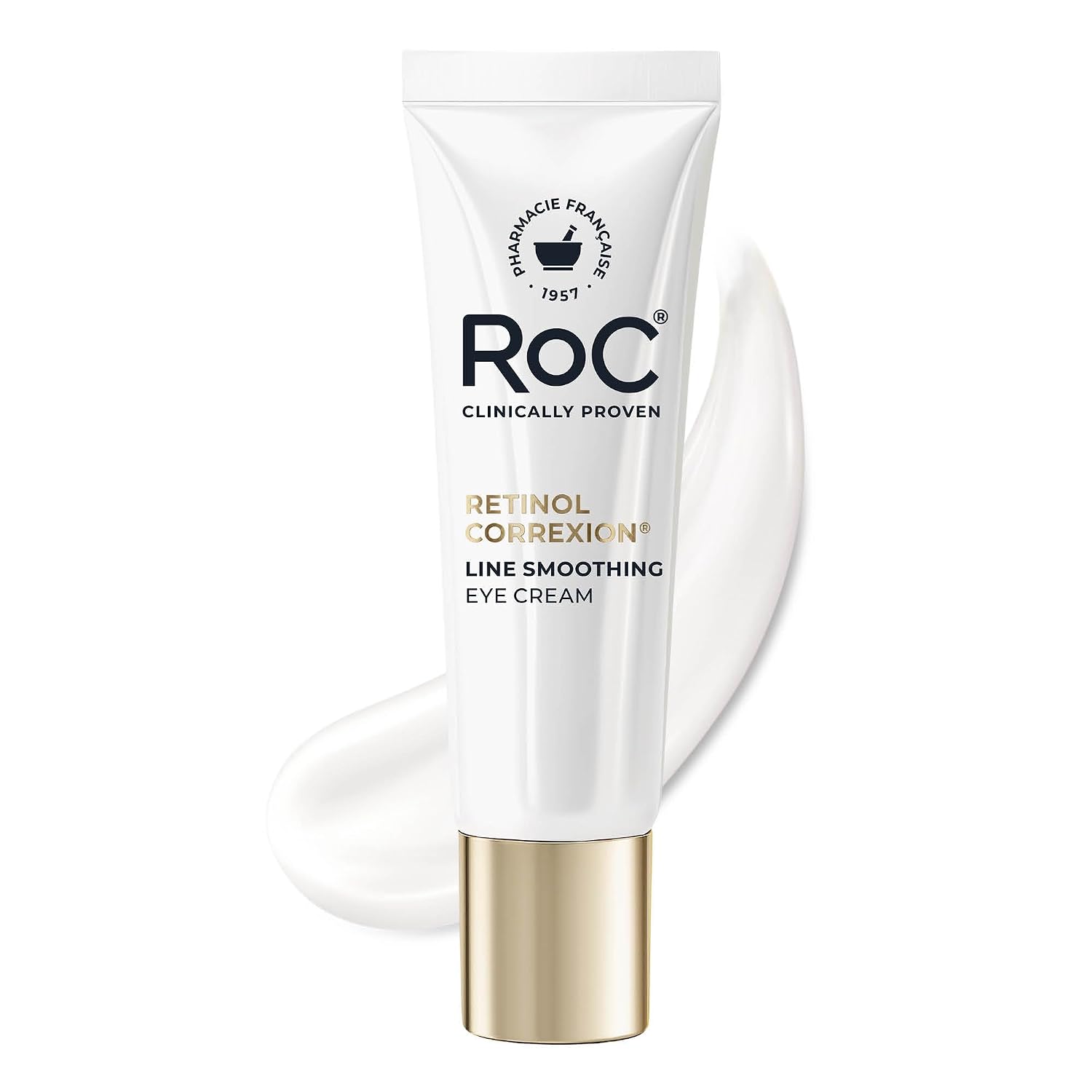
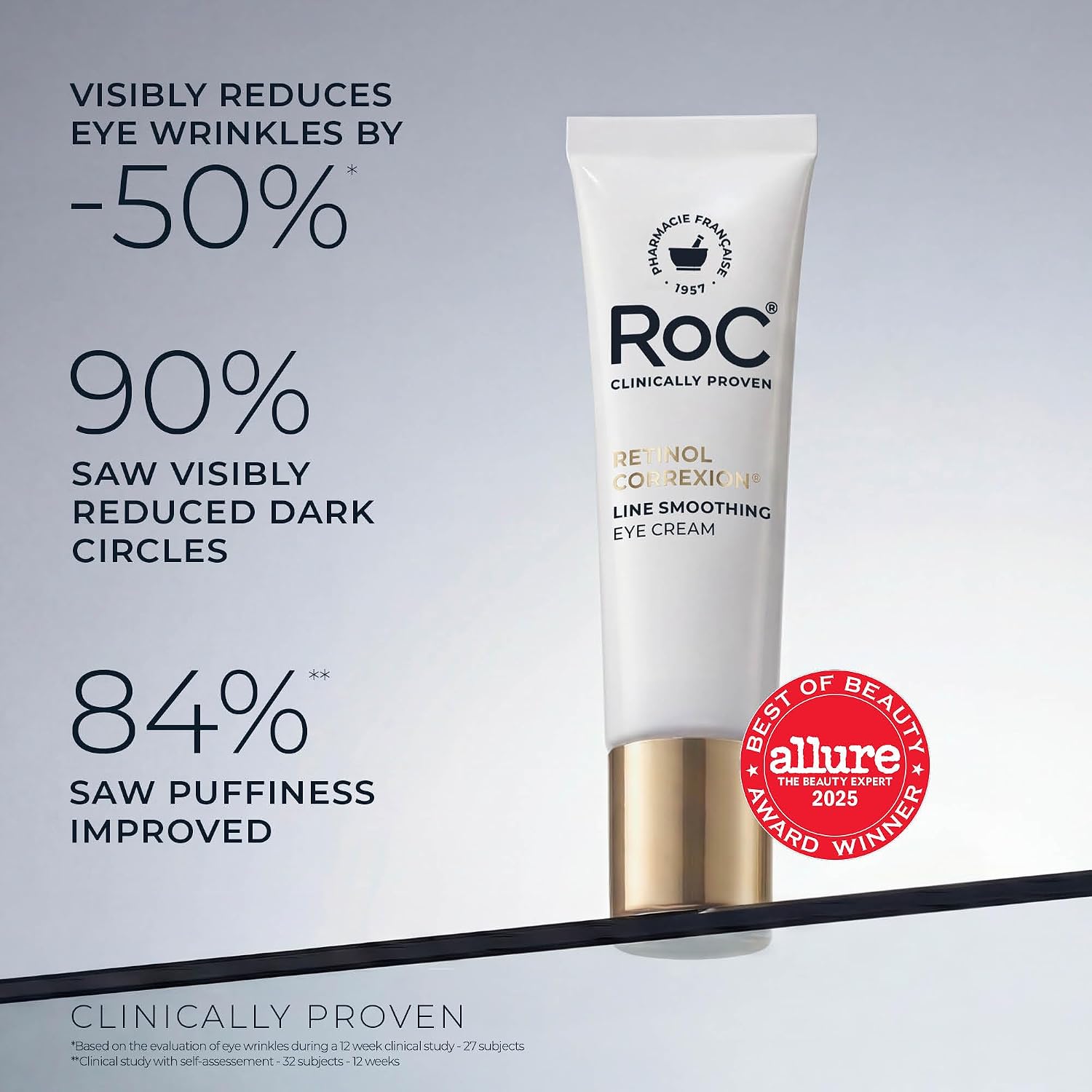
Three images were rendered on this listing and all three are marketing assets — pack shot, in-use crop, claim card. No buyer-uploaded photo and no photograph of the ingredient panel was present, so none could be reproduced here. The percentages on the third card come from a 27-subject clinical study and a 32-subject self-assessment study, both over 12 weeks.
04 Price and price history
$19.97 today, against a $21.97 list, a $20.74 nineteen-year average and a $9.90 floor.
Nine percent below the $21.97 list price the listing itself shows, and eighteen percent below the $17.97 subscribe-and-save price. The unit figure Amazon prints — $39.94 per fluid ounce — is the honest way to read a 0.5 oz eye cream: by the ounce, this is a premium product in a drugstore bottle.
Buy box on 01 November: sold and shipped by Amazon.com, in stock, free delivery Friday 6 November.
The current offer
- Current price
- $19.97
- List price
- $21.97 — 9% savings shown
- Subscribe & save
- $17.97 — 18% off, one-time equivalent
- Unit price
- $39.94 per fluid ounce
- Coupon
- None offered at capture
- Seller
- Amazon.com
Where it sits in the record
Nineteen years of tracking put the long-run Amazon average at $20.74. At $19.97 the product is 3.7% below its own average and 19.8% below its all-time high of $24.91, set in November 2022. It is also 101.7% above its all-time low of $9.90 from August 2023.
That combination — below average, but double the floor — describes a listing that runs a standing discount rather than a promotion. The $9.90 episode is the outlier, not the norm: it appears once in nineteen years.
Price history, all three channels
The tracker holds three price types for this ASIN. Every value below is the source's own all-time record, not a period statistic — the tracker's summary block cannot be filtered by window, so a "lowest price in the last six months" figure does not exist and is not implied.
| Price type | Lowest ever | Highest ever | Current | Average |
|---|---|---|---|---|
| Amazon | $9.90 Aug 28, 2023 | $24.91 Nov 23, 2022 | $19.97 Oct 29, 2026 | $20.74 |
| 3rd Party New | $4.00 Apr 02, 2014 | $35.09 Sep 23, 2025 | $19.97 Oct 30, 2026 | $20.64 |
| 3rd Party Used | $8.60 Jun 25, 2014 | $19.03 Jul 05, 2015 | — | $12.19 |
The four values per channel, side by side. The marketplace series is the one to watch: its high is 14% above list, which is what a stockout looks like in a price record, and it drags the marketplace average to within ten cents of Amazon's despite a range nearly nine times as wide.
Position against every benchmark
Amazon channel, current $19.97 measured against five reference points. Negative values mean the current price is below the benchmark.
Range and volatility, channel by channel
Each bar spans that channel's all-time low to all-time high; the diamond marks its long-run average. Amazon's range is narrow and recent. The marketplace's is wide and old at the bottom — its $4.00 floor is from 2014, and nothing since has come close.
Parity, not competition
The two live channels quote the identical $19.97, 3.7% and 3.2% below their respective averages. That is parity, and it tells you something structural: when Amazon holds the buy box and the lowest marketplace offer matches it to the cent, the marketplace is following Amazon's price rather than competing with it. There is nothing to gain from choosing a third-party seller at this moment, and no reason to expect a marketplace discount to appear on its own.
The used channel has no current offer at all. That empty row is a finding, not a gap — there is no second-hand market for this product at the moment of capture, which is itself a signal about how the product moves.
Two list prices, and which to trust
The tracker records a $29.99 list price. The Amazon listing shows $21.97. Both are transcribed as published; they are not reconciled here, and the discrepancy changes the discount story materially — the same $19.97 is 33.4% below one list and 9.1% below the other.
The listing's own figure is the safer basis for any discount claim, and it is the one used in this report. The tracker's $29.99 most likely reflects a historical suggested retail that the brand has since lowered, but that is an inference and is flagged as one.
What nineteen years of record says about the price
Three readings follow from the table, each with its own confidence.
The current price is normal for this listing, not a deal. Being 3.7% below a nineteen-year average is not a discount event; it is the resting state. Across the record the product has spent far more time near $20 than near either extreme, and the extremes themselves are single observations rather than plateaus. Confidence: high — the average is published and the current observation is corroborated by the listing page.
The low is unreachable and the high is not informative. A 101.7% gap to the 2023 floor means the $9.90 print was a one-off, most likely a clearance or a pricing error, and waiting for a repeat is not a strategy. At the other end, the $35.09 marketplace high from September 2025 is above list, which almost always indicates a stockout or a speculative reseller rather than demand at that price. Confidence: medium — both readings are inferential, though the arithmetic is exact.
The discount is the product's business model. With a $21.97 list and a $19.97 street price held for years, the 9% saving is a permanent feature of the shelf, and the 18% subscribe-and-save is the only lever that actually moves the number. Confidence: high on the observation, medium on the interpretation, because a nineteen-year average says nothing about the next quarter.
05 Reading this dossier
What is solid, what is inferred, and what is missing.
| Element | Confidence | Basis |
|---|---|---|
| Price, list price, savings | High | Single rendered listing with US context confirmed; corroborated by the tracker's current value of $19.97 |
| Rating and star distribution | High | 34,706 ratings, buckets as published; individual buckets are rounded |
| Aspect sentiment percentages | High | Amazon's own synthesis, with mention counts beside each share |
| Individual review quotations | None | No review body rendered across three page variants and a three-pass retry |
| Ingredient list and grades | Medium | Complete against the source's own total of 30; not verified against a manufacturer INCI |
| Claim matrix | High | Twelve badges captured with polarity intact; the fragrance verdict rests on a database function label |
| Price history extremes and dates | High | Transcript of the rendered table, read twice with identical output |
| Current price dates | Medium | Last-observation values 2–3 days before capture, not live quotes |
| Derived percentages and spreads | High | Exact arithmetic on transcribed figures; interpretation of causes is inferential |
| Rank | Medium | Live quantity; a snapshot, not a stable fact |
| Second-database count check | Not run | Independent ingredient database unreachable on the collection date |
| Buyer photographs | None | Listing exposed zero customer image tiles |
Limitations, in order of how much they matter
One ingredient channel. The formula analysis rests on a single database. No cross-check against a second table, no manufacturer INCI, no back-label photograph. The thirty rows may be the whole formula; this dossier cannot prove it.
No review text. Every review-derived statement here is aggregate. There are no quotations, no recurring complaint named from a review body, and no way to test the aspect summary against the words underneath it.
Price history is a summary, not a series. Five values per channel and nothing in between. The path a price took to reach an extreme is not observable, so no trend shape is claimed.
Two list prices. $29.99 in the tracker, $21.97 on the listing. Neither is reconciled; the smaller figure is used for discount claims and the larger is disclosed.
Nothing here is a regulatory or dermatological conclusion. Ingredient grades are community-database aggregates, the claim matrix is a consumer-claims screen, and both are reference material for a buyer, not advice for a patient.
Snapshot. All listing, rating and price observations were captured on 01 November 2026 with a US delivery address in ZIP 10001; all currency is USD and no figure has been converted. Price history values are the tracker's all-time record as of that date. Ratings, rank and buy-box price move between captures and should be re-read before any purchase decision.
Anonymity. No reviewer name, handle, profile link or identifier appears anywhere in this dossier, and no individual review is quoted.