CASE FILE 03 · UNITED STATES MARKET · CAPTURED 31 OCTOBER 2026 · PRICES IN USD, UNCONVERTED
A brightening serum for troubled skin, launched on the US marketplace in 2025, sold by the brand itself, and priced with a working discount for the first time in this batch. What makes it worth reading closely is a small detail visible only at full resolution: the bottle is labelled with a different product name than the listing. Everything else in this file follows from that mismatch, from which formula we are actually looking at to which search query the listing is written for.
1. The listing as sold
| Listing title | medicube Kojic Acid Turmeric Clarifying Capsule Serum for Troubled Skin |
|---|---|
| Name on the bottle | Kojic Acid Turmeric Niacinamide Serum |
| Actives printed on the label | Kojic acid + turmeric 1% · niacinamide 5% |
| Brand | medicube |
| Format | Dropper bottle, 30 ml / 1.01 fl oz, with suspended micro-capsules |
| Category path | Beauty & Personal Care › Skin Care › Face › Treatments & Masks › Serums |
| Rank at capture | #2,123 in Beauty & Personal Care · #61 in Facial Serums |
| Seller | Medicube & Aprilskin — the brand's own account |
| Price | $18.90, from a $21.80 list |
| Rating | 4.5 from 3,602 ratings |
1.1 The two names, and why it matters
The listing sells a Capsule Serum. The bottle sells a Niacinamide Serum. Both are the same SKU, and both are true: the formula contains niacinamide at 5% and it contains visible capsules.
Three consequences follow, and none of them are cosmetic:
- Search intent splits. "Capsule serum" and "niacinamide serum" are different queries with different competitors, and this one page answers both while committing to neither.
- Ingredient lookups fail by name. Every database that indexes this formula — including the one used for Section 3 — does so under the bottle name. A shopper who searches the listing title finds nothing.
- The formula had to be matched, not assumed. Section 3 uses a record under the label name, and it was matched on five distinctive markers rather than on the name. That method is stated so it can be checked.
1.2 What the brand claims
| Claim | Support offered | Status |
|---|---|---|
| Kojic acid fades uneven patches and brightens overall tone | Ingredient function; 1% declared with turmeric | Plausible and quantified |
| Turmeric is antioxidant-rich and soothes stressed skin | Ingredient function; part of the 1% declaration | Plausible |
| Niacinamide improves uneven tone and texture | 5% declared on the label | Quantified |
| Snowflake-like micro-capsules release squalane and thioctic acid on contact | Visible in gallery imagery; both ingredients appear in the INCI | Verified against the formula |
| Dermatologist-tested and suitable for delicate skin | Attributed to a named institute, with a "results may vary" caveat | Unverifiable from the page; no numbers published |
The fourth row is the one that earns its place. The capsule claim is not a metaphor: squalane sits at position 30 and thioctic acid at 31 of the 32-entry list, and the beads are photographed suspended in the serum. That is a formulation feature a buyer can verify by looking, which is rare on a page where the only quantitative claims are the two percentages on the label.
The fifth row is the weakest. "Clinically tested" is attributed to an institution but published with no subject count, no duration, no endpoint and no result. Compare that with the two older products in this batch, both of which print sample sizes beside their percentages. Here the number is missing and the claim stands alone.
1.3 Gallery
 |
 |
 |
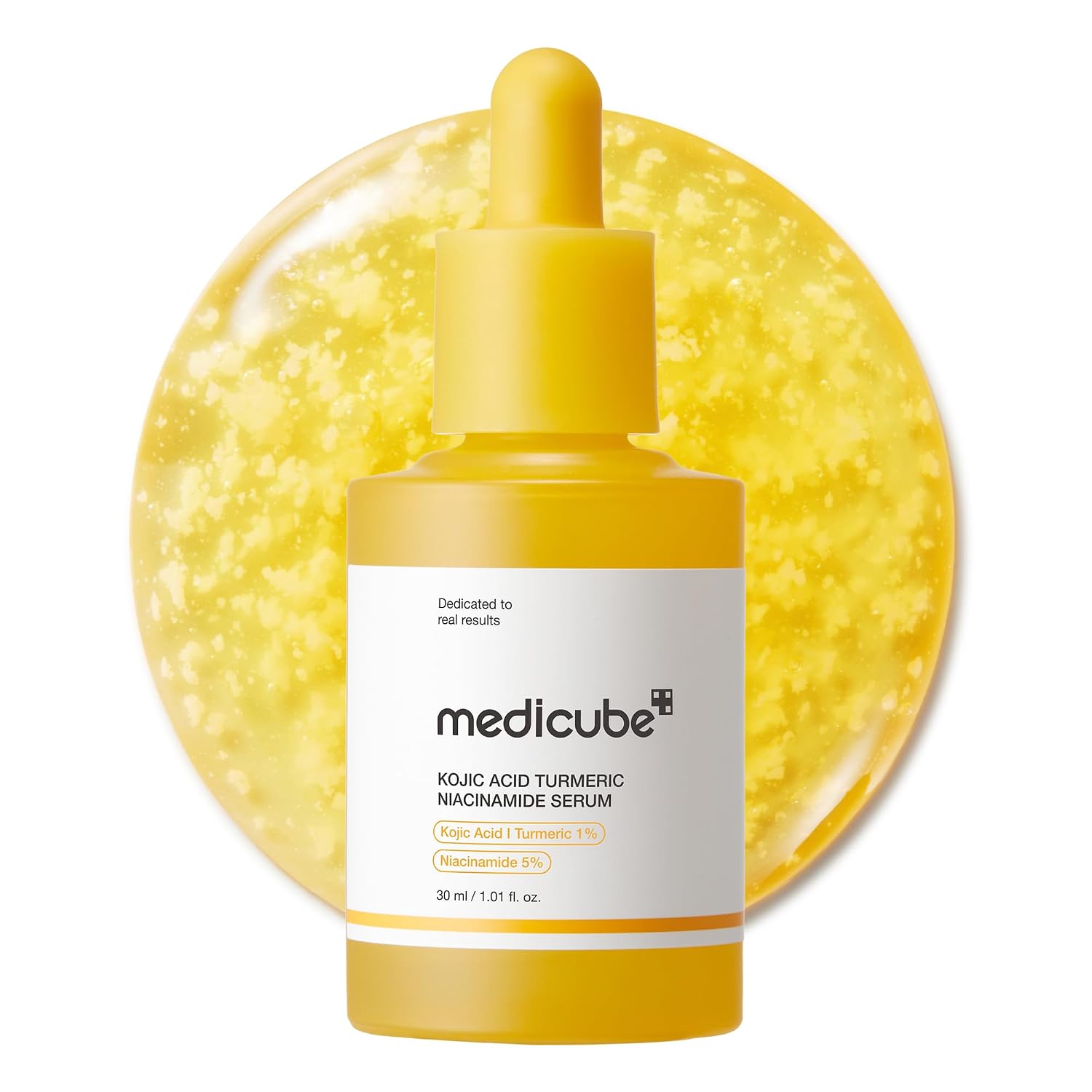
| Front: amber glass dropper, white label reading "Kojic Acid Turmeric Niacinamide Serum", actives ringed at 1% and 5%. The background droplet shows the suspended beads. Source: Amazon |
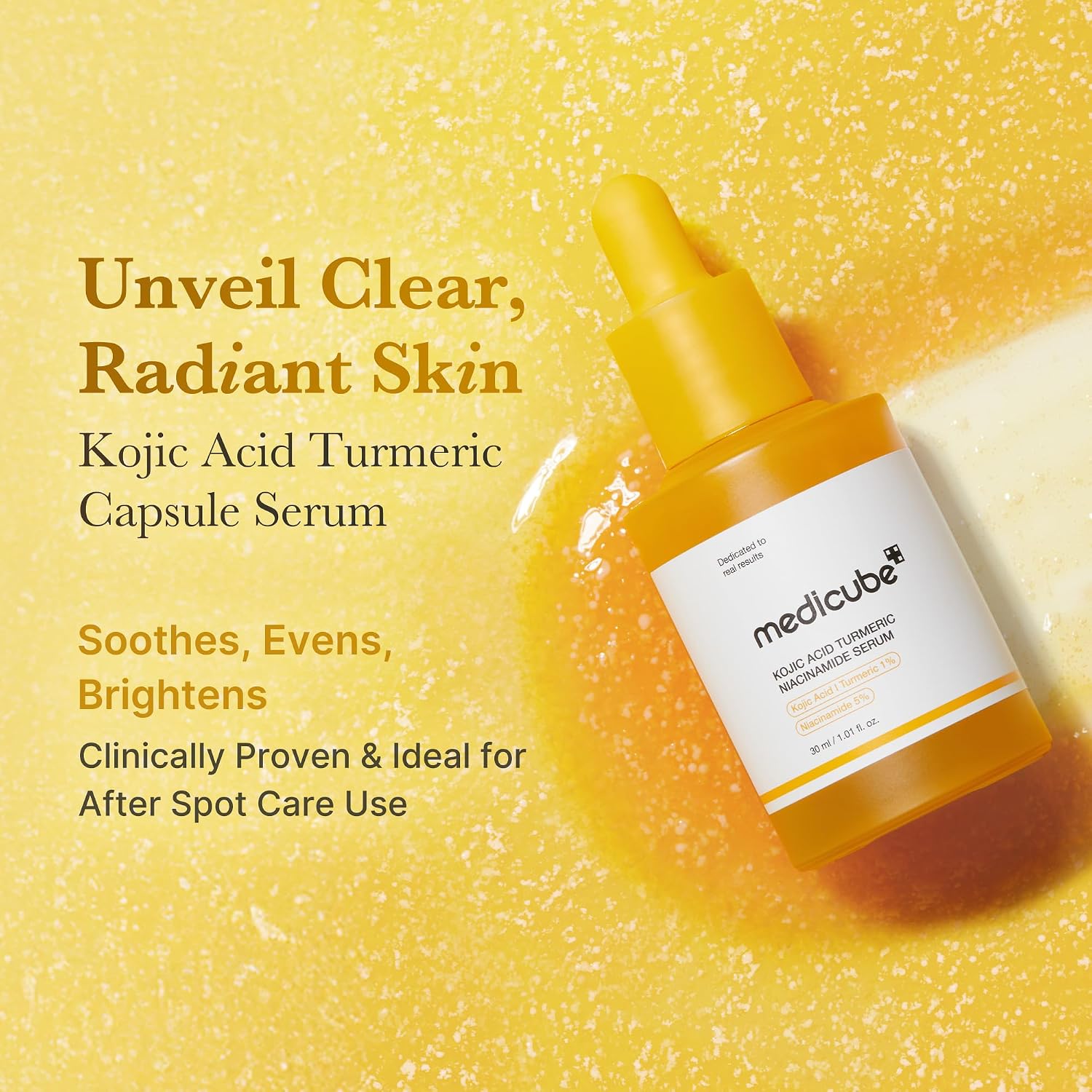
Lifestyle still: "Unveil Clear, Radiant Skin", positioned for after-spot-care use, bottle resting in a pool of beaded serum. Source: Amazon |
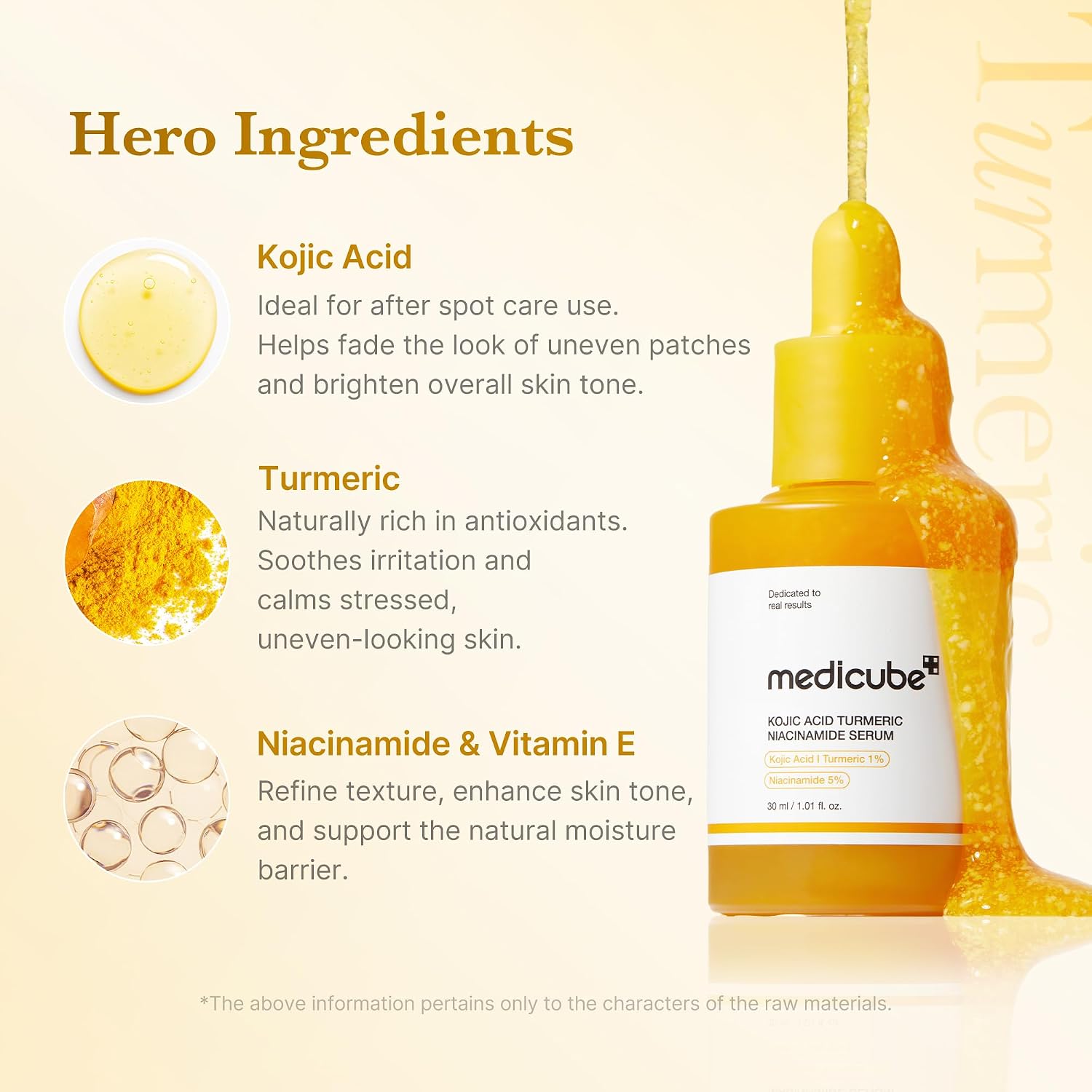
Hero ingredient panel: kojic acid, turmeric, niacinamide and vitamin E, each with a function line, footnoted to raw-material characteristics only. Source: Amazon |
The listing exposes nine gallery images; the first three are shown. No buyer photographs were available on this capture. The third image carries a footnote worth noting — "the above information pertains only to the characters of the raw materials" — which is a candid admission that the ingredient claims describe the raw materials rather than tested outcomes on skin.
1.4 An empty A+ module
The A+ content area on this listing contains navigation chrome and nothing else: no comparison table, no clinical panel, no FAQ, no routine diagram. For a brand-operated storefront at #61 in its category, that is a conspicuous omission, and it means the nine gallery images and four bullets are carrying the entire persuasive load. Section 2 shows the cost of that: the listing sells an experience buyers like and an outcome buyers are not yet convinced of.
2. How buyers have responded
4.5 out of 5 from 3,602 ratings, on a listing roughly twelve months old. That is a strong start and an unusually fast accumulation of ratings for a sub-$20 serum.
2.1 Star distribution
| Stars | Share | Approximate ratings | Reading |
|---|---|---|---|
| 5 star | 77% | ~2,773 | Strong but not exceptional at this volume |
| 4 star | 10% | ~360 | Normal shoulder |
| 3 star | 6% | ~216 | Graded, conventional |
| 2 star | 2% | ~72 | Lowest cell in the curve |
| 1 star | 5% | ~180 | Slightly above the two-star bucket |
This is a textbook curve: a graded tail, a two-star bucket below its neighbours, and no cliff. At 3,602 ratings one percentage point is about 36 ratings, so these shares are stable rather than noise. Where the two older products in this batch showed a 1% two-star sliver suggesting a binary failure mode, this one shows the standard shape of a product with a small number of strong adverse reactions.
2.2 The aspect profile is inverted
| Theme | Mentions | Positive share | What it means |
|---|---|---|---|
| Skin feel | 49 | 94% | Almost unanimous — the texture lands |
| Moisturising | 58 | 90% | Hydration is not in dispute |
| Brightening | 39 | 90% | Small but very positive sample |
| Non-greasy | 32 | 78% | No residue, as claimed |
| Skin appearance | 144 | 73% | Glow and smoothness |
| Value for money | 74 | 72% | Priced fairly at $18.90 |
| Effectiveness | 148 | 68% | Lowest substantive theme |
| Skin irritation | 66 | 53% | Coin toss — half of mentions are problems |
Read the two ends together. The experience of this serum is nearly unanimous: 94% positive on how it feels, 90% on hydration, 78% on being non-greasy. The outcome is where the disagreement lives, with effectiveness at 68% across the largest mention count on the page.
That is what a young, texture-led brightening product looks like in review data. Nobody disputes that it feels good; a third of effectiveness mentions do not confirm that it worked. Brightening is a claim judged over weeks, the listing is twelve months old, and the buyers who have had time to judge are only now arriving.
2.3 The irritation signal
… experiences with skin irritation are mixed, with some customers reporting no irritation while others experienced burning sensations.
The marketplace's own summary uses that phrase without softening it, in a product whose fourth bullet says it is "dermatologist-tested and gentle" and "suitable for all skin types, including delicate skin". Half of the sixty-six irritation mentions report a problem.
Section 3.5 shows which ingredients the formula databases blame, and the answer is instructive: not the ones that explain it. The flagged concerns are a precautionary note on a red algae extract and a trace of glycolic acid at the very last position. The likeliest mechanism — 5% niacinamide, a well-known stinging threshold for reactive skin, plus two aromatic botanicals — carries no irritancy grade at all.
2.4 What could not be collected
Review text and buyer photographs did not render. Three escalating fallbacks were attempted after the initial fetch. No review body appeared and the buyer-photo carousel reported zero tiles. This file quotes no reviewer, shows no customer imagery, and reconstructs nothing from the summary.
3. The formula
Thirty-two entries. The label declares kojic acid + turmeric at 1% and niacinamide at 5%, which is specific enough to check the ordering against — and the ordering holds.
3.1 Identity of the record
The formula is documented under the bottle name, not the listing name, so the match was established on five independent markers rather than assumed:
| Marker | Listing | Ingredient record |
|---|---|---|
| Brand | medicube | MediCube |
| Kojic acid | Hero active, bullet 1 | Position 9 |
| Turmeric | Hero active, 1% declared | Curcuma Longa Root Extract, position 6 |
| Niacinamide | Named in bullet 2, 5% declared | Position 2 |
| Capsule payload | "Squalane and thioctic acid released on contact" | Squalane position 30, thioctic acid position 31 |
Five markers, all present, in an order consistent with the declared percentages. Niacinamide at position 2 of 32 matches a 5% load; kojic acid at position 9 matches a sub-1% load. The formula and the label agree with each other, which is not something every listing in this category can demonstrate.
3.2 The complete list
Expand all 32 entries with function and grading
| # | Ingredient | Function | Comedogenic | Irritancy |
|---|---|---|---|---|
| 1 | Water | Skin conditioning, solvent | — | — |
| 2 | Niacinamide | Smoothing | — | — |
| 3 | Butylene Glycol | Humectant | 1 | 0 |
| 4 | Jojoba Esters | Emollient | — | — |
| 5 | 1,2-Hexanediol | Skin conditioning, solvent | — | — |
| 6 | Curcuma Longa Root Extract | Antioxidant, masking, perfuming | — | — |
| 7 | Caprylic/Capric/Succinic Triglyceride | Emollient | — | — |
| 8 | Coco-Caprylate/Caprate | Emollient | — | — |
| 9 | Kojic Acid | Antioxidant | — | — |
| 10 | Ammonium Acryloyldimethyltaurate/VP Copolymer | Stabiliser | — | — |
| 11 | Hydrogenated Castor Oil/Sebacic Acid Copolymer | Emollient, skin conditioning | — | — |
| 12 | Melia Azadirachta Flower Extract | Skin conditioning | — | — |
| 13 | Ocimum Sanctum Leaf Extract | Skin conditioning | — | — |
| 14 | Coccinia Indica Fruit Extract | Skin conditioning | — | — |
| 15 | Eclipta Prostrata Extract | Skin conditioning | — | — |
| 16 | Melia Azadirachta Leaf Extract | Skin conditioning | — | — |
| 17 | Allantoin | Soothing | 0 | 0 |
| 18 | Cetyl Alcohol | Emollient, emulsifying | 2 | 2 |
| 19 | Silica Silylate | Emollient, stabilising | — | — |
| 20 | Sodium Citrate | Buffering, chelating | — | — |
| 21 | Ethylhexylglycerin | Skin conditioning | — | — |
| 22 | Corallina Officinalis Extract | Skin conditioning | — | — |
| 23 | Adenosine | Skin conditioning | — | — |
| 24 | Chamaecyparis Obtusa Wood Oil | Masking | — | — |
| 25 | Behenyl Alcohol | Emollient, stabilising | — | — |
| 26 | Arginine | Masking, skin conditioning | — | — |
| 27 | Citric Acid | Buffering, chelating | — | — |
| 28 | Tocopherol | Antioxidant, masking | 0-3 | 0-3 |
| 29 | Panthenol | Skin conditioning | 0 | 0 |
| 30 | Squalane | Emollient, skin conditioning | 1 | 0 |
| 31 | Thioctic Acid | Antioxidant | — | — |
| 32 | Glycolic Acid | Buffering | — | — |
A dash means the database carries no grade. It does not mean zero risk.
3.3 Roles across the 32
Two groups dominate and neither is the active: eight emollients and seven botanical extracts make up nearly half the formula. That is what the capsules and the "calming complex" look like on paper — the emollient eight include the squalane the capsules carry, and the botanical seven are the five-extract soothing block at positions 12 to 16 plus turmeric and the red algae.
The declared actives occupy only five slots: niacinamide, kojic acid, adenosine, panthenol and allantoin. Everything else is vehicle, texture, preservation or botanical support. That is a normal ratio for a treatment serum and it is worth stating plainly against the marketing, which gives the impression of a four-active formula.
3.4 How thin the grading is
| Grading status | Count | Ingredients |
|---|---|---|
| Graded 0 / 0 | 2 | Allantoin, panthenol |
| Graded 1 comedogenic / 0 irritant | 2 | Butylene glycol, squalane |
| Graded 2 / 2 — highest in the formula | 1 | Cetyl alcohol |
| Range-rated 0–3 | 1 | Tocopherol |
| Ungraded | 26 | Everything else, including niacinamide and kojic acid |
Twenty-six of thirty-two entries carry no grade. The single graded problem is cetyl alcohol at 2/2 — a fatty alcohol and very common emollient, graded at the upper end of what is usually assigned to it, and the entry that would most benefit from a second database's opinion. That second opinion was not available: the independent ingredient channel was unreachable for the fourth consecutive day, so no cross-grading exists.
Meanwhile the two entries most likely to explain the burning reported in Section 2.3 — niacinamide at 5% and the cypress wood oil — carry no score at all.
3.5 The claim matrix
| Claim | Holds | Evidence |
|---|---|---|
| Alcohol-free | Yes | No drying alcohol; cetyl and behenyl alcohols are fatty alcohols |
| EU-allergen-free | Yes | No individually declarable allergen |
| Paraben-free | Yes | 1,2-hexanediol and ethylhexylglycerin |
| Silicone-free | Yes | No silicone in the list |
| Sulfate-free | Yes | No sulfate surfactant |
| Vegan | Yes | Asserted |
| Cruelty-free | Yes | Brand self-report, not a certification |
| Reef-safe | Yes | Nothing on the tracked restriction list |
| Fragrance-free | No | Turmeric extract is fragrance-functioning; cypress wood oil is a masking aromatic |
| Oil-free | No | Castor/sebacic copolymer and cypress wood oil |
| Fungal-acne-safe | No | Jojoba esters, castor/sebacic copolymer, cetyl alcohol |
| Pore-clogger-free | No | Corallina Officinalis Extract, precautionary flag |
3.6 "Unscented" versus "not fragrance-free"
The specification table says Scent: Unscented. The matrix says the product is not fragrance-free. Both are true, and the reason is the most interesting thing in this formula:
- There is no parfum and no fragrance entry anywhere in the 32. Nothing has been added for scent.
- The failure rests on turmeric root extract — the product's own headline ingredient, whose database function includes perfuming — and on Chamaecyparis Obtusa Wood Oil, a genuine aromatic wood oil labelled as a masking agent.
So the scent is the formula. This product cannot be made fragrance-free without removing the ingredient it is named after, which is a structural difference from a serum carrying a removable parfum at the end of its list. For a buyer avoiding fragrance on sensitisation grounds, both products fail the same badge for entirely different reasons — and only one of them could ever pass.
3.7 Concerns, and what they do not explain
| Concern | Ingredient | Evidence quality |
|---|---|---|
| May trigger acne | Corallina Officinalis Extract | Precautionary — "reported by some users; no formal study" |
| May worsen rosacea | Glycolic Acid | Class-level; the acid sits at position 32 of 32 |
Both flags are technically correct and practically negligible. A red marine algae extract at position 22 is not a known comedogen, and the database says so itself. Glycolic acid in the final position of a 32-entry list is a pH adjuster at trace level, not an exfoliating dose.
Which leaves the burning unanswered by the risk data, and that is the honest state of this analysis: the formula databases flag two things that do not explain it, and are silent on the two things that would.
3.8 Benefits, weighted
| Benefit | Ingredients | Weight |
|---|---|---|
| Hydrating | 9 | Strongest support in the formula |
| Scar healing | 7 | Aligned with the post-blemish positioning |
| Anti-ageing | 6 | Supported |
| Reduces irritation | 6 | Supported by the botanical block |
| Redness reducing | 6 | Supported by the botanical block |
| Barrier repair | 6 | Supported |
| Brightening | 5 | The commercial claim, and it is structurally supported |
| Dark spots | 4 | Supported |
| Good for oily skin | 3 | Secondary effect |
| Acne fighting | 2 | Weak — single-ingredient effects |
| Reduces large pores | 2 | Weak |
| Skin texture | 2 | Weak |
This is the only product in the batch where the marketing claim is also the best-supported structural claim. Brightening at five and dark spots at four sit on a base of nine hydrating and six barrier-supporting entries — the formula is an emulsion with a genuine support structure under the promise, not a single acid in a gel. The three two-ingredient benefits at the bottom are secondary effects and should be read as such.
4. Price
| Current price | $18.90 |
|---|---|
| List price | $21.80, displayed as a 13% saving |
| Subscribe & save | $17.01 — 10% off the current price, 22% off list |
| Coupon | None |
| Unit price | $18.71 per fluid ounce |
| Delivery | Free over $35; Prime same-day window offered |
Three levers stack here: a list price to discount from, a 13% on-page reduction, and a subscription step that reaches 22% below list. A subscriber pays $17.01 where a one-time buyer pays $18.90 — a 10% gap that exists to convert repeat purchase, and the only real price architecture in this batch.
4.1 The record, and the channel that is missing
| Channel | Lowest ever | Highest ever | Current | Average |
|---|---|---|---|---|
| Amazon retail | No data at any point — Amazon has never sold this ASIN, only the brand's own account has | |||
| Third-party new | $15.12 (25 Mar 2026) | $21.80 (5 Sep 2025) | $18.90 (31 Aug 2026) | $17.28 |
| Third-party used | No data at any point | |||
Three dated observations, plus the list price as a reference line. Nothing is interpolated between points.
4.2 Reading a single-channel record
The missing row is the finding. The Amazon-retail row is empty across all four columns, and the page states explicitly that it has no data for that price type. That is not a tracking gap: the buy box is held by the brand's own marketplace account, so there has never been an Amazon-retail offer to record. Two independent observations — the empty row and the seller name — agree. For a brand-operated listing this is normal and it removes an entire axis of comparison that the other products in this batch have.
The high is the launch price. $21.80 is dated 5 September 2025, the first day of monitoring, and equals the published list. A highest-ever value that coincides with both the monitoring start and the list price is the listing's opening position, not a peak the market reached. So "13.3% below the all-time high" describes a discount off list, not a fall from a market top.
The average sits 20.7% below list. That is the most useful single number here: over fourteen months the product has transacted well under its own list, which means the $21.80 is a reference rather than a price anyone pays. The operating band is roughly $15 to $19.
Staleness. The current observation is dated 31 August 2026 — sixty-one days before capture, the oldest in this batch. It agrees exactly with the live price on the listing today, which is fortunate rather than guaranteed. The live page is the better source for any transaction decision; the tracker's value is the history.
4.3 Position summary
| Benchmark | Value | Current versus benchmark |
|---|---|---|
| All-time low | $15.12 | +25.0% |
| All-time high (= launch = list) | $21.80 | −13.3% |
| All-time average | $17.28 | +9.4% |
| List price | $21.80 | −13.3% |
5. Verdict
| Question | Answer | Confidence |
|---|---|---|
| Does the formula match the label? | Yes — five markers, ordering consistent with the declared 1% and 5% | High |
| Are the capsules real? | Yes — squalane and thioctic acid are both present, and the beads are photographed in the serum | High |
| Does brightening hold up? | Structurally yes — five supporting ingredients, the strongest claim in the formula | Medium-high |
| Is it gentle on sensitive skin? | Disputed — half of irritation mentions report burning, and the flagged concerns do not explain it | Medium-low |
| Is it fragrance-free? | No, and it cannot be: the fragrance is the turmeric the product is named for | High |
| Is it fungal-acne safe? | No — three flagged entries, the most in this batch | High |
| Is the price competitive? | Yes, and it is the only discounted listing here — average 20.7% below list, subscription 22% below | High |
| Is the listing well built? | No on naming and on A+ — two product names and an empty content module | High |
| Are buyer voices represented? | Only in aggregate; no review text or photography rendered | Low |
6. Method and limits
Method. One capture on 31 October 2026 with the delivery address set to a United States ZIP code before any price was read and the currency pinned to US dollars. All prices native USD; none converted, estimated or ranged. Gallery images downloaded at 1500 pixels and the bottle label was read from that imagery at full resolution. The formula record was matched to this product on brand plus four ingredient markers, because the listing and the bottle use different names. No reviewer name, handle, identifier or profile link was collected, and none appears here.
| Element | Confidence | Basis |
|---|---|---|
| Price, list price and subscription price | High | All three rendered on the page under a verified US context |
| Rating and distribution | High | Rendered directly |
| Declared percentages | High | Printed on the bottle in gallery image 1 |
| Ingredient table | High | 32 of 32, matched on five markers |
| Theme tally | Medium | Mention counts of 32–148, an order of magnitude smaller than the older products here |
| Per-ingredient grading | Low | 6 of 32 graded; 26 ungraded |
| Current price as a live quote | Medium | Tracker value 61 days old; agrees with the live page today |
| Buyer reviews and photos | None collected | Did not render; not reconstructed |
- Review bodies and buyer photography did not render; no verbatim buyer language appears.
- The listing title and the bottle label name different products; the formula was matched on ingredients, and that method is disclosed rather than assumed.
- Only 6 of 32 ingredients are graded, and the two that best explain the reported burning are ungraded.
- The independent second ingredient database was unreachable, so no cross-grading or count check exists.
- The price record is single-channel and 61 days stale at capture; re-verify before any transaction.
- "Clinically tested" is published with no subject count, duration or endpoint, so it is reported as an unverifiable claim rather than a finding.
- Aspect mention counts are small; each percentage moves more per review than on the mature products in this batch.
Captured 31 October 2026 with a United States delivery context. Prices in US dollars, unconverted. Treat every figure as an observation of that date.