Naturium's Vitamin C Complex Serum puts a stabilised vitamin C salt ahead of pure L-ascorbic acid, wraps both in six fruit extracts, and sells the result for less than half what the clinical end of the category charges. This is what the listing, the rating distribution, the 35-row formula and six and a half years of price records actually say about it.
Amazon US · captured with a New York 10001 delivery address · snapshot 31 October 2026 · all prices native USD · no reviewer identities reproduced
| Live price | Rating | Ratings | Ingredients | Claims held |
|---|---|---|---|---|
| $16.79 | 4.6 / 5 | 8,435 | 35 | 11 / 12 |
Live price and rating read from the listing on 31 October 2026. Ingredient count and claim tally come from the 35-row declared list; the single failed claim is the fungal-acne badge.
Section one
What the product actually is
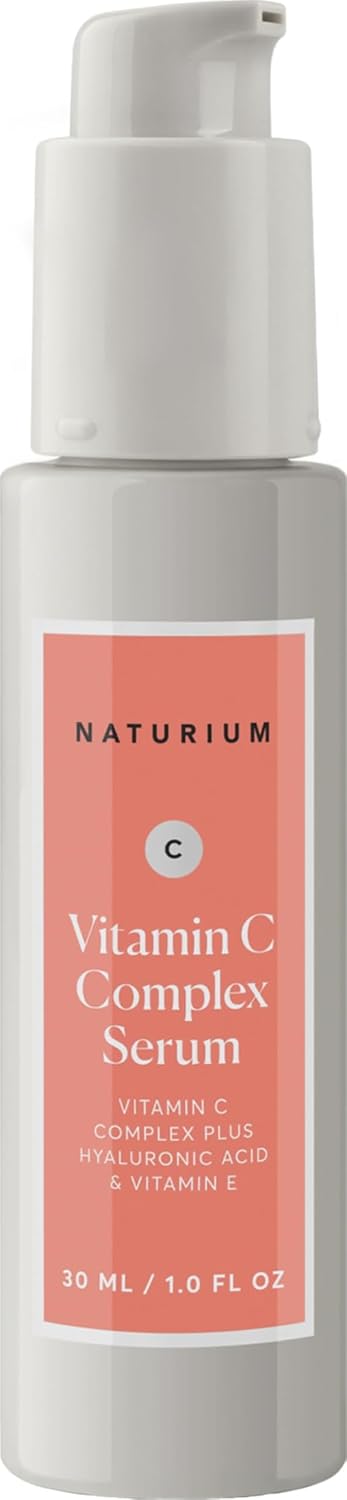
This is a 30 ml / 1.0 fl oz water-based facial serum in a white pump bottle, labelled Vitamin C Complex Serum with the sub-line Vitamin C Complex plus Hyaluronic Acid & Vitamin E. It sits in Naturium's core range, the value-priced line the brand built its reputation on, and the listing files it under Beauty & Personal Care > Skin Care > Face > Treatments & Masks > Serums.
Source: Amazon
Source: Amazon
Source: Amazon
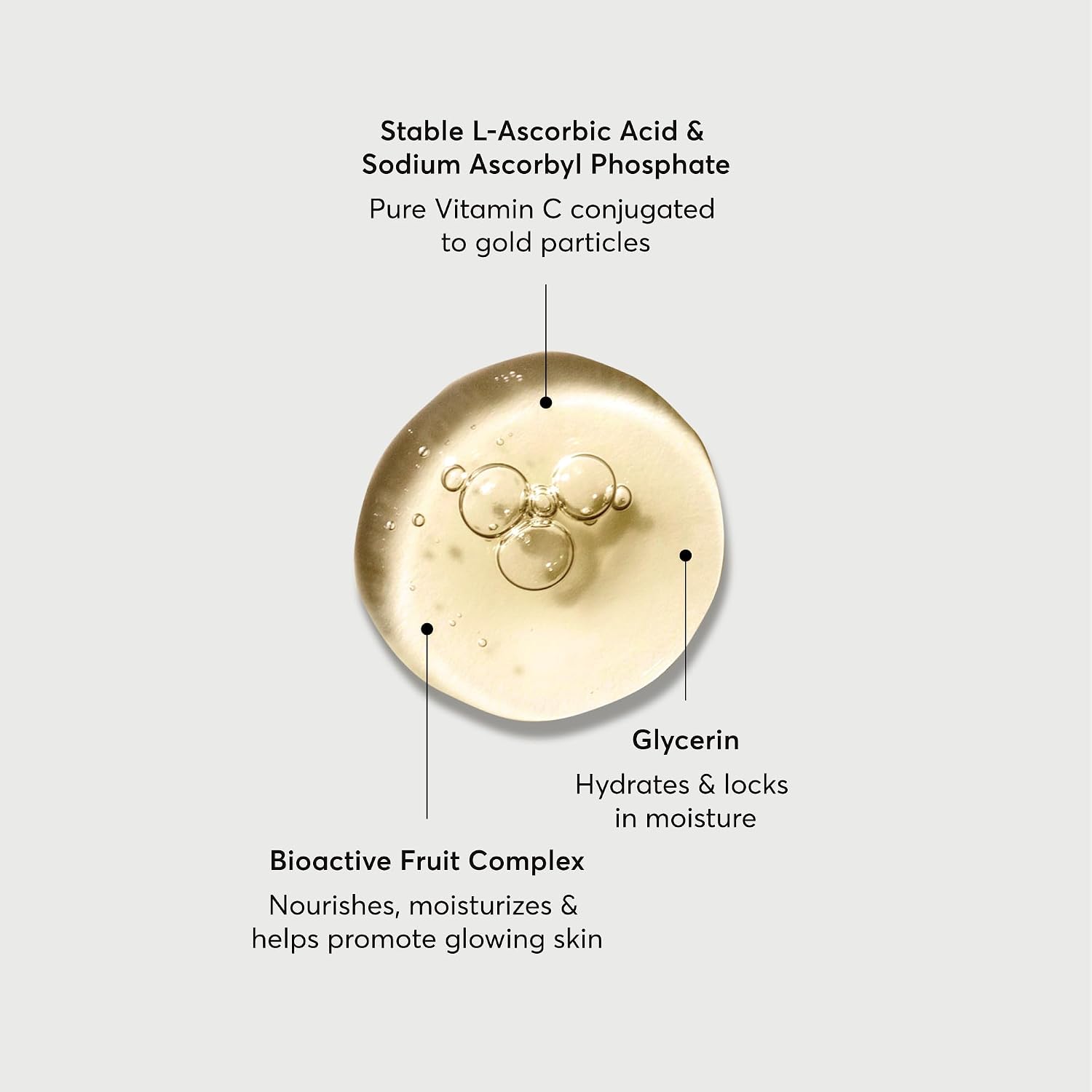
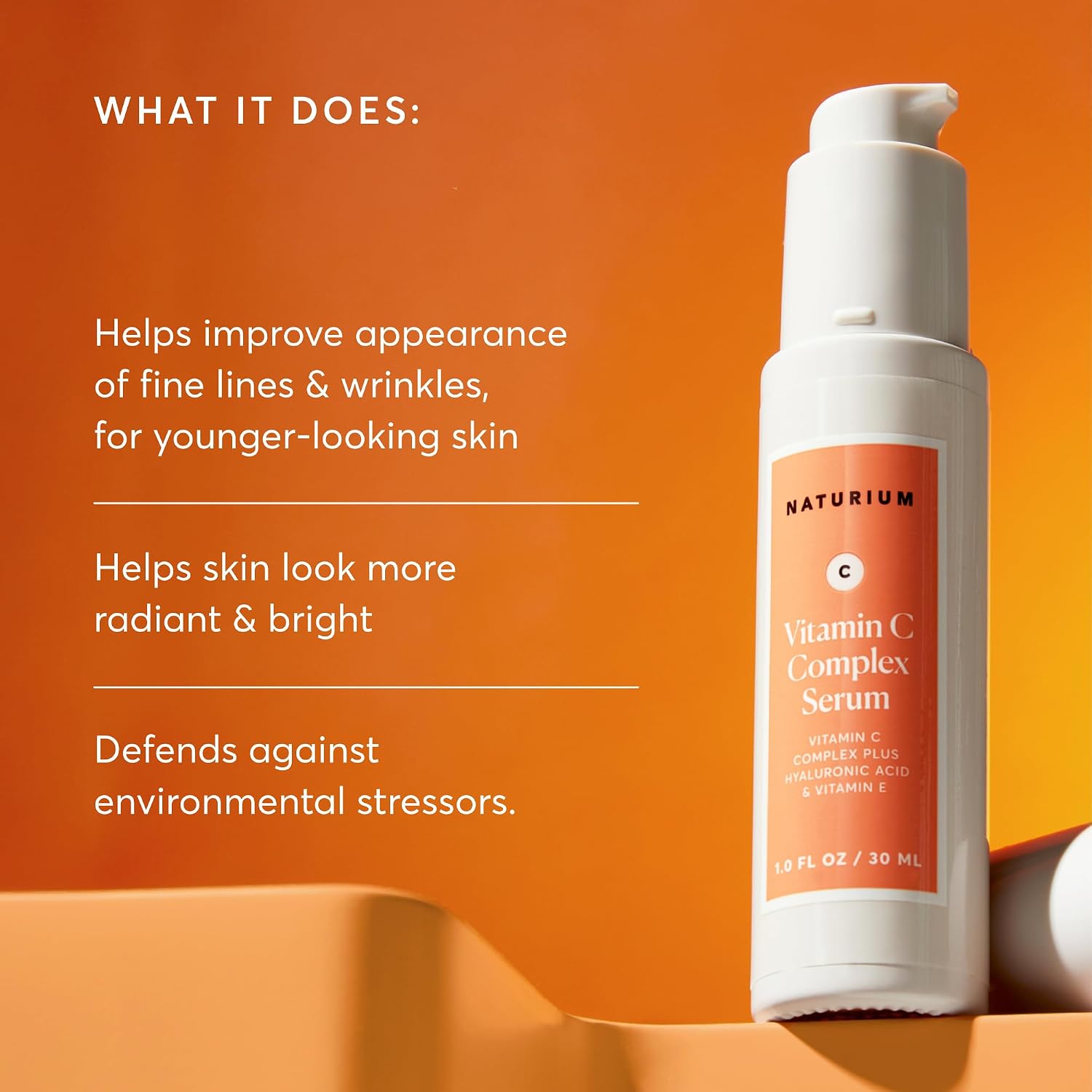
The three carousel frames above are the first three in listing order and are the only images used in this report. No buyer-uploaded photograph rendered for this ASIN on any capture attempt, and the listing exposed no review-media gallery at all, so there is no real-photo layer to show. That is a statement about what the page renders, not a judgement about the product.
Declared specifications
| Field | Value |
|---|---|
| Brand | Naturium |
| Title | Naturium Vitamin C Complex Serum with Hyaluronic Acid, 1 fl oz |
| Size | 30 ml / 1.0 fl oz |
| Item form | Pump serum |
| Skin type (declared) | Acne prone, combination, dry, normal, sensitive |
| Declared benefit | Brightening |
| Scent | Fragrance free, unscented |
| Special ingredients (declared) | Antioxidants, hyaluronic acid, vitamin C, vitamin E |
| Item model number | NATR-10001 |
| UPC | 850010792071 |
| Dimensions | 1.4 x 1.4 x 5.4 in; 1 oz |
| Availability | In stock |
| Sold by | Amazon.com |
| Category rank | #1,192 in Beauty & Personal Care; #38 in Facial Serums |
What the brand claims
- Radiant-looking complexion. A potent vitamin C serum that helps defend skin against everyday environmental stressors and supports a radiant-looking complexion.
- Vitamin C and fruit blend. A stabilised l-ascorbic acid complex with sodium ascorbyl phosphate and a bioactive fruit blend, plus sodium hyaluronate and tocopheryl acetate.
- Morning and night. Apply to clean skin AM and PM, then follow with moisturiser and daily sun protection. Developed for sensitive, dry and combination skin; patch test advised.
- Proudly formulated. pH-appropriate, made in the USA, vegan, cruelty-free, paraben-free, gluten-free, skin-compatible and dermatologist-tested.
- Skincare that works. The brand's stated position: affordable essentials using only ingredients that directly benefit skin health.
Two things are conspicuously absent from all of that copy: a vitamin C percentage and a concentration for anything else. The bottle names three ingredient families and the bullets name a mechanism, but the only number on the entire page is the volume. For a serum whose entire proposition is an active, that is a real information gap rather than a formatting choice - and it is why the ingredient section below leans on position in the list rather than on declared strength.
Section two
How 8,435 buyers rate it
The listing carries a 4.6 out of 5 from 8,435 ratings, and 8,283 of those are global ratings counted in the histogram. The distribution is where the useful signal sits, so it is plotted first.
Share of ratings by star, as published on the listing histogram. Bars sum to 100%.
77% five-star, 12% four-star, 6% three-star, 2% two-star, 3% one-star. The shape is a classic mature mass-market product: a heavy top block, a thin but non-trivial middle, and a bottom that is larger than the one below it - two-star at 2% is smaller than one-star at 3%, which is unusual and worth noting because it means the angriest cohort outnumbers the merely disappointed one. With 8,435 ratings a single percentage point is 84 ratings, so the 2% versus 3% ordering is stable rather than noise.
The eight themes Amazon indexes
Amazon groups review text into aspects and counts positive against negative mentions. Eight themes were indexed for this ASIN, and the positivity share separates the things buyers agree on from the things they do not.
Share of positive mentions per aspect. Bars are ordered by mention volume, most-discussed first, not by score.
| Aspect | Mentions | Positive | Negative | Positive share |
|---|---|---|---|---|
| effectiveness | 735 | 617 | 118 | 84% |
| texture | 321 | 236 | 85 | 74% |
| skin appearance | 302 | 214 | 88 | 71% |
| moisturizing | 198 | 185 | 13 | 93% |
| value for money | 183 | 157 | 26 | 86% |
| brightening | 179 | 169 | 10 | 94% |
| skin sensitivity | 168 | 119 | 49 | 71% |
| fragrance-free | 108 | 95 | 13 | 88% |
Read the volume column and the share column separately, because they disagree. Effectiveness dominates with 735 mentions and holds 84% positive - that is the product delivering on its headline promise, and it is the single most-cited theme by a factor of two. But the two highest-scoring aspects are the smallest ones: brightening at 94% on 179 mentions and moisturizing at 93% on 198. The themes where buyers are least satisfied are texture (74%), skin appearance (71%) and skin sensitivity (71%) - and skin sensitivity is the one to watch, because 49 negative mentions out of 168 on a serum the brand explicitly markets for sensitive skin is a meaningful dissent rate, not a rounding error.
What buyers say in aggregate
Customers find this vitamin C serum effective and appreciate its smooth, non-greasy texture that keeps skin soft and hydrated. They report significant improvements in skin appearance, noting it fades acne scars and creates a healthy glow. The serum is well-tolerated by sensitive skin, with no irritation reported, and customers find it affordable and worth the price.
That summary is Amazon's own synthesis, not a quotation from a buyer, and it is worth flagging one tension inside it: the summary says the serum is well-tolerated by sensitive skin, with no irritation reported, while the aspect counters show 49 negative mentions under skin sensitivity. Both come from the same page. The summary is a smoothed narrative; the counters are a tally. Where they disagree, the counters are the more honest instrument, and this report treats them as such.
No individual review body rendered. The desktop page, the mobile fallback and the China-context retry all returned zero review text across three timed retries with fresh sessions each time. Nothing is quoted anywhere in this report as a buyer's words, and no review is paraphrased into a quotation. The rating, the histogram and the aspect counters are the only buyer-voice evidence that exists for this ASIN today.
Section three
The formula, 35 rows deep
The complete declared list runs to 35 ingredients, and it was captured in full. COSDNA, one of the two ingredient databases used for this queue, returned a Cloudflare challenge on both its desktop and mobile search endpoints, so its acne, irritancy and safety columns are unavailable here - the level classification below is therefore a functional-risk class derived from each ingredient's job in this serum, with Skinsort's published comedogenic and irritancy values used as an override where they exist. It is a class ranking, not a database safety score, and the two should not be quoted as if they were the same thing.
Rows per functional-risk class. Level 1 is the benign carrier, humectant and antioxidant backbone; Level 5 would be a high-concern row, of which this formula has none.
| Level | Meaning | Rows | Share |
|---|---|---|---|
| Level 1 | carrier, humectant or antioxidant backbone | 10 | 29% |
| Level 2 | low-concern functional | 16 | 46% |
| Level 3 | preservative system or pH-active | 8 | 23% |
| Level 4 | rated concern row | 1 | 3% |
| Level 5 | high concern | 0 | 0% |
The distribution tells you what kind of product this is before you read a single ingredient name. Ten Level 1 rows and sixteen Level 2 rows account for three quarters of the formula: water, glycerin, propanediol, the two vitamin C forms, glutathione, sodium hyaluronate, beta-glucan, sorbitol and six fruit extracts. Eight Level 3 rows are the preservation and pH machinery. Exactly one row reaches Level 4 - hexylene glycol, the only ingredient here carrying a published comedogenic range that reaches 2 - and nothing reaches Level 5. There is no fragrance, no alcohol denat., no sulfate and no silicone anywhere in the 35.
The same formula by function
Grouping the rows by what they do in this specific serum, rather than by how concerning they are, gives a second read on the formulation logic.
Ingredient count per functional group. Seven groups across 35 rows.
Two groups are deliberately padded and one is deliberately thin. Botanical fruit extracts hold six rows in a contiguous block at positions 7 to 12 - pineapple, papaya, mango, kakadu plum, Pleiogynium and Podocarpus - which is the 'bioactive fruit blend' the second carousel frame advertises, and it is a real block rather than a dusting. Humectants and hydrators hold five, which is why the moisturizing aspect scores 93%. Against that, vitamin C and antioxidants holds only five rows and only two of them are vitamin C - the entire brightening story rests on those two, one of which is handicapped by the formula's own pH.
What is inside: twelve claims, one failure
Skinsort tests each marketing badge against the declared list rather than against the brand's copy. Of the twelve badges on this product, eleven hold and one fails.
| Claim | Result | Why |
|---|---|---|
| Alcohol-free | Holds | no denatured or drying alcohol; propanediol and hexylene glycol are the only alcohols |
| EU allergen free | Holds | no ingredient from the EU 1223/2009 declarable-allergen list |
| Fragrance-free | Holds | no Fragrance or Parfum row at any position |
| Oil-free | Holds | no plant, mineral or synthetic oil; tocopheryl acetate is an ester |
| Paraben-free | Holds | phenoxyethanol plus a sorbate and benzoate pair instead |
| Silicone-free | Holds | no dimethicone, cyclopentasiloxane or other siloxane |
| Sulfate-free | Holds | no SLS, SLES or other sulfate surfactant |
| Cruelty-free | Holds | brand-level Leaping Bunny listing; not testable against the INCI list |
| Pore-clogger-free | Holds | no row on the comedogenic blocklist, though carbomer is rated 1 |
| Reef-safe | Holds | no oxybenzone, octinoxate or octocrylene; no UV filter at all |
| Vegan | Holds | no animal-derived row |
| Fungal acne safe | Fails | polysorbate 60 at position 34 - the only Malassezia-cleavable ester |
The single failure deserves weight precisely because of who the product is for. The listing's own Skin Type field names acne prone first, and the badge matrix says the formula is not fungal-acne safe because of one solubiliser near the end of the list. For a buyer with run-of-the-mill blemish-prone skin that is probably irrelevant; for anyone whose breakouts are Malassezia-driven, it is the difference between a serum that helps and one that feeds the problem. Eleven clean badges and one load-bearing failure is a more useful summary than a single 'clean formula' verdict.
The complete ingredient list
Thirty-five rows in declared INCI order, with the CosIng function set for each name and its role in this formula. A dash in the comedogenic or irritancy column means the database publishes no rating for that ingredient - it does not mean zero.
| # | Ingredient | Function | Role here | Comedo. | Irrit. | Level |
|---|---|---|---|---|---|---|
| 1 | Water | Skin conditioning, solvent | Solvent / carrier base | - | - | 1 |
| 2 | Glycerin | Humectant, skin conditioning, skin protecting | Primary humectant | 0 | 0 | 1 |
| 3 | Propanediol | Solvent, skin conditioning | Solvent and humectant | - | - | 1 |
| 4 | Sodium Ascorbyl Phosphate | Antioxidant, skin conditioning | Stabilised vitamin C salt, first active | - | - | 1 |
| 5 | Ascorbic Acid | Antioxidant, buffering, masking | Pure L-ascorbic acid, second active | - | - | 2 |
| 6 | Glutathione | Antioxidant, skin conditioning | Antioxidant tripeptide, tone support | - | - | 1 |
| 7 | Ananas Sativus Fruit Extract | Skin conditioning | Pineapple extract, enzyme-bearing | - | - | 2 |
| 8 | Carica Papaya Fruit Extract | Skin conditioning | Papaya extract, enzyme-bearing | - | - | 2 |
| 9 | Mangifera Indica Fruit Extract | Skin conditioning | Mango extract, antioxidant adjunct | - | - | 2 |
| 10 | Terminalia Ferdinandiana Fruit Extract | Antioxidant, bleaching | Kakadu plum, high-ascorbate botanical | - | - | 2 |
| 11 | Pleiogynium Timoriense Fruit Extract | Skin conditioning | Native plum extract, antioxidant adjunct | - | - | 2 |
| 12 | Podocarpus Elatus Fruit Extract | Skin conditioning | Illawarra plum extract, antioxidant adjunct | - | - | 2 |
| 13 | Aloe Barbadensis Leaf Juice | Skin conditioning | Soothing botanical base | - | - | 1 |
| 14 | Sodium Hyaluronate | Humectant, skin conditioning | Hyaluronic acid salt, water binding | 0 | 0 | 1 |
| 15 | Carbomer | Emulsion stabilising, gel forming | Gel former, builds the serum body | 1 | 0 | 2 |
| 16 | Tocopheryl Acetate | Skin conditioning, antioxidant | Vitamin E ester, antioxidant partner | 0 | 0 | 1 |
| 17 | Phenoxyethanol | Preservative | Primary preservative | - | - | 3 |
| 18 | Caprylyl Glycol | Emollient, humectant, skin conditioning | Preservative booster and emollient | - | - | 2 |
| 19 | Citric Acid | Buffering, chelating, masking | pH trim toward the declared pH 6 | - | - | 3 |
| 20 | Hydroxyethylcellulose | Emulsion stabilising, stabilising | Rheology modifier | - | - | 2 |
| 21 | Sodium Hydroxide | Buffering | Alkali used to set final pH | - | - | 3 |
| 22 | Beta-Glucan | Skin conditioning | Barrier and soothing polysaccharide | - | - | 1 |
| 23 | Potassium Sorbate | Preservative | Secondary preservative | - | - | 3 |
| 24 | Hexylene Glycol | Emulsifying, skin conditioning, solvent | Solvent and viscosity reducer, rated for mild comedogenicity | 0-2 | 0-1 | 4 |
| 25 | Sorbitol | Humectant, masking, skin conditioning | Humectant | 0 | 0 | 1 |
| 26 | Xanthan Gum | Emulsifying, emulsion stabilising, gel forming | Gum thickener | - | - | 2 |
| 27 | Algin | Masking, binding, film forming | Film former and thickener | - | - | 2 |
| 28 | Benzoic Acid | Masking, preservative | Acid preservative, eczema caution flag | - | - | 3 |
| 29 | Sorbic Acid | Preservative | Acid preservative | - | - | 3 |
| 30 | 1,2-Hexanediol | Skin conditioning, solvent | Solvent and mild preservative adjunct | - | - | 2 |
| 31 | Sodium Benzoate | Masking, preservative | Salt form of the benzoate preservative pair | - | - | 3 |
| 32 | Disodium Phosphate | Buffering, masking | Buffer pair with sodium phosphate | - | - | 2 |
| 33 | Gold | Cosmetic colorant | Colloidal gold, the carrier named on the carousel | - | - | 2 |
| 34 | Polysorbate 60 | Emulsifying, surfactant | Solubiliser, the single fungal-acne flag | - | - | 3 |
| 35 | Sodium Phosphate | Buffering | Buffer pair with disodium phosphate | - | - | 2 |
Declared INCI order, unbroken
Water, Glycerin, Propanediol, Sodium Ascorbyl Phosphate, Ascorbic Acid, Glutathione, Ananas Sativus Fruit Extract, Carica Papaya Fruit Extract, Mangifera Indica Fruit Extract, Terminalia Ferdinandiana Fruit Extract, Pleiogynium Timoriense Fruit Extract, Podocarpus Elatus Fruit Extract, Aloe Barbadensis Leaf Juice, Sodium Hyaluronate, Carbomer, Tocopheryl Acetate, Phenoxyethanol, Caprylyl Glycol, Citric Acid, Hydroxyethylcellulose, Sodium Hydroxide, Beta-Glucan, Potassium Sorbate, Hexylene Glycol, Sorbitol, Xanthan Gum, Algin, Benzoic Acid, Sorbic Acid, 1,2-Hexanediol, Sodium Benzoate, Disodium Phosphate, Gold, Polysorbate 60, Sodium Phosphate.
Six readings that matter more than the list itself
- The salt leads and the acid follows. Sodium ascorbyl phosphate is at position 4, L-ascorbic acid at 5. That is the stability trade made visible: SAP is far more stable in water but needs conversion in skin, while pure ascorbic acid is the form with the strongest evidence base and only works below roughly pH 3.5. This formula is declared at pH 6, which means the ascorbic acid is largely a label presence. The real vitamin C engine is the SAP.
- Gold is at position 33. The second carousel frame says the vitamin C is 'conjugated to gold particles', and Gold is indeed declared - but thirty-third of thirty-five, after every preservative. Whatever the delivery claim is, the metal sits at near-trace level at the very end of the list.
- The preservation system is a five-part stack. Phenoxyethanol (17), potassium sorbate (23), benzoic acid (28), sorbic acid (29) and sodium benzoate (31), supported by caprylyl glycol (18) and 1,2-hexanediol (30). Five preservative-class rows in a water formula is conservative and appropriate - and it is why the paraben-free badge is honest rather than decorative.
- One real fungal-acne flag. Polysorbate 60 at 34 is the only Malassezia-relevant ester in the list, and it alone turns the fungal-acne badge to NO. The badge rule is ingredient-based, not concentration-based.
- Benzoic acid carries the only formal concern. Skinsort's Concerns block lists exactly one warning - may worsen eczema, one ingredient, benzoic acid - which sits awkwardly against a listing that markets the product for sensitive skin. Citric acid and polysorbate 60 also carry a seborrheic-dermatitis icon on the page but are not promoted into the formal block.
- Six fruit extracts, unquantified. Pineapple, papaya, mango, kakadu plum, Pleiogynium and Podocarpus occupy positions 7 to 12 as a contiguous block. Their placement ahead of the preservatives means the blend is not a dusting, but no enzyme activity or extract concentration is disclosed anywhere.
Section four
Six and a half years of price, and where $16.79 sits in it
The price record starts on 17 February 2020 and runs to this snapshot. Everything below is native USD with no conversion, transcribed from the tracker's all-time summary and cross-checked against the live listing on the collection date.
| Field | Value |
|---|---|
| List price | $20.99 |
| Live price, 31 Oct 2026 | $16.79 - 20.0% off list |
| Subscribe & Save | $14.27 - 32% off list |
| Amazon all-time low | $14.69, 05 Jul 2026 |
| Amazon all-time high | $20.99, 23 Oct 2025 |
| Amazon all-time average | $18.44 |
| 3rd Party New all-time low | $15.99, 11 Aug 2022 |
| 3rd Party New all-time high | $61.99, 14 Jul 2023 |
| 3rd Party New average | $20.77 |
| 3rd Party Used | no data for this price type |
| Monitoring start | 17 Feb 2020 |
The price history table, as published
| Price type | Lowest ever | Highest ever | Current | Average |
|---|---|---|---|---|
| Amazon | $14.69 (05 Jul 2026) | $20.99 (23 Oct 2025) | $16.79 (02 Oct 2026) | $18.44 |
| 3rd Party New | $15.99 (11 Aug 2022) | $61.99 (14 Jul 2023) | $16.79 (20 Sep 2026) | $20.77 |
| 3rd Party Used | - | - | - | - |
The four measures from the table above, channel against channel. Note the 2023 marketplace high of $61.99 compresses everything else in the frame - the same numbers are plotted again below without it.
That chart is honest but unreadable, and the reason is worth stating: the 3rd Party New all-time high of $61.99, set on 14 July 2023, is almost certainly not a market price. A single-unit 30 ml serum does not triple for a fortnight. It reads like a bundle, a multi-pack listing or a stranded reseller offer that inherited this ASIN. Because the summary block has no observation-level history, there is no way to confirm that from this source - so it is reported as published, and the interpretation is labelled as inference.
The dated observations, plotted
The free page exposes only five values per price type, which means six dated observations in total for this product. Plotting those six is the closest thing to a price series that this source allows, and it is deliberately presented as six points rather than as a line implying continuous data.
Every dated observation in the record, in chronological order. Six points across two channels; no interpolation between them.
What the six points actually support: the product has been cheaper than list for most of the period the record covers. The Amazon line touches $20.99 exactly once, in October 2025, and that value is identical to the list price - meaning the SKU spent at least one moment at full suggested retail in the last year and has otherwise been discounted. The floor of $14.69 is recent, July 2026, less than four months before this snapshot. The 3rd Party New current of $16.79, dated September 2026, lands on exactly the same figure as Amazon, which is parity rather than competition.
Where $16.79 sits
The discount is structural. $16.79 against a $20.99 list is the 20% the listing itself prints, and it is 8.9% below the Amazon all-time average of $18.44. A product averaging $18.44 over six and a half years and currently asking $16.79 is trading at a standing discount, not a promotional one.
Inside the range, it is low but not at the floor. Current sits 14.3% above the all-time low of $14.69 and 20.0% below the all-time high of $20.99. The Amazon spread is $6.30, or 42.9% of the low - a wide band for a product with one size and a stable formula.
The subscription is the cheapest recorded route. Subscribe & Save at $14.27 is 15.0% below the one-time price and, notably, $0.42 below the all-time Amazon low. For a 30 ml serum used twice daily, the replenishment price undercuts every price this tracker has ever recorded on the single-purchase channel.
Two channels, no arbitrage. Amazon and 3rd Party New both read $16.79. The marketplace average of $20.77 sits above Amazon's $18.44, but almost entirely because of the 2023 artefact. Excluding it, the two channels have tracked each other closely, and today there is nothing to choose between them.
Freshness. The Amazon current is dated 2 October 2026, twenty-nine days before collection - just inside the thirty-day staleness threshold - and it was independently confirmed against the live listing on 31 October, which also rendered $16.79. Two sources twenty-nine days apart agreeing on the same figure is the strongest evidence in this section. The 3rd Party New current is forty-one days old and should be treated as softer.
Section five
Method, confidence and what is missing
This document is a snapshot, not a live quote. Prices, rank and rating counts move, and every figure here is one reading taken on 31 October 2026 with a New York 10001 delivery address so that all pricing is native USD.
| Element | Confidence | Basis |
|---|---|---|
| Live price of $16.79 | High | Listing read on the collection date, agrees with the tracker 29 days apart |
| List price of $20.99 | High | Printed on both the listing and the tracker |
| Rating 4.6 from 8,435 | High | Read from the listing rating block |
| Star distribution | High | Listing histogram, five buckets summing to 100% |
| Aspect counters | Medium | Amazon's own grouping of review text; themes overlap and counts are not exclusive |
| Ingredient list (35 rows) | High | Declared list, count matches the database total |
| Level classification | Medium | Functional-risk class assigned by role, not a database score |
| COSDNA acne / irritancy / safety | Not available | Channel blocked by Cloudflare on both endpoints |
| Individual review text | Not available | Zero review bodies rendered on three capture attempts |
| Buyer photographs | Not available | Listing rendered no review-media gallery |
| Price series between observations | Not available | Five values per channel is the whole record |
| Interpretation of the 2023 high | Low | The value is certain; the artefact explanation is inference |
What this report cannot tell you
- No vitamin C percentage exists anywhere on the page. Without it, no claim about this serum's strength relative to another can be made from collected data.
- No individual review is quoted, because none rendered. Aggregate counters are used instead, and the report says so wherever it relies on them.
- No buyer photographs exist for this ASIN, so the gallery in this report is listing imagery only, labelled as such.
- No COSDNA grades exist for this SKU in this pass, so the level column is a class ranking rather than a database safety score.
- No period-specific price statistics exist. The tracker's summary is all-time for every chart window; the six dated observations are the entire series.
- No concentration is disclosed for any of the 35 ingredients, so position in the INCI list is the only abundance signal available - and position is a rough proxy at best.
- The pH 6 reading is the database's own figure, not an independently measured value, and its consequence for ascorbic acid efficacy is inference rather than measurement.
Snapshot, 31 October 2026. This is one reading of a live listing, a community ingredient database and a price tracker, taken on the same day and reconciled against each other. Where they disagreed, the disagreement is reported rather than smoothed.
Collected and compiled 31 October 2026. Prices in USD. No reviewer names, handles, profile links or identifiers appear in this document.