Product file · Toner
Sold on Amazon as a niacinamide toner for oily and combination skin; sold everywhere else as SKIN BALANCING Pore-Reducing Toner. The formula is the cleanest in this collection - 22 of 26 ingredients sit at the lowest risk level - and the most interesting finding is not in the ingredients at all. It is that 142 buyers mention irritation, and nothing in the formula above level 2 explains them.
Captured 27 October 2026 · Amazon US, delivery ZIP 10001 · all prices in USD · 190 ml / 6.4 fl oz
The short version
- The formula is close to exemplary on paper. 22 of 26 rows at level 1, three at level 2, one at level 4 - the single flagged row is phenoxyethanol, the most common cosmetic preservative there is. Niacinamide sits at position 4 and a five-lipid ceramide package at 13-17.
- The fragrance-free badge fails, and the badge is technically right. There is no parfum and no EU-declarable allergen in the list; the failure rests on chamomile extract at position 7, which databases classify as masking/perfuming. Buyers read the product as unfragranced - 47 of 51 fragrance mentions are positive.
- Irritation is the one soft spot, and it is unexplained. 142 mentions at 42% positive is the lowest aspect score on the listing, and 3% one-star out of 10,975 ratings is a real sample. Either the preservative or the twice-daily application pattern is doing it; this data cannot tell you which.
Product information
The listing title and the bottle disagree, and the bottle is right. Amazon sells this as Niacinamide Face Toner, Combination or Oily Skin; the product inside is Paula's Choice SKIN BALANCING Pore-Reducing Toner, 190 ml, the brand's long-running oil-control toner. Same ASIN, same formula, two names. That matters for anyone trying to match reviews or ingredient lists across sites, because half the internet files this product under its old name.
What is in the bottle is a water-thin, fragrance-free liquid with niacinamide declared at position 4 - high enough to be a dose rather than a label entry - sitting on a base of glycerin, butylene glycol and polysorbate 20. The unusual part for a toner is positions 13 to 17: three ceramides, phytosphingosine and cholesterol, the same lipid set used in barrier creams. Applied with a cotton pad after cleansing, twice a day, not rinsed.
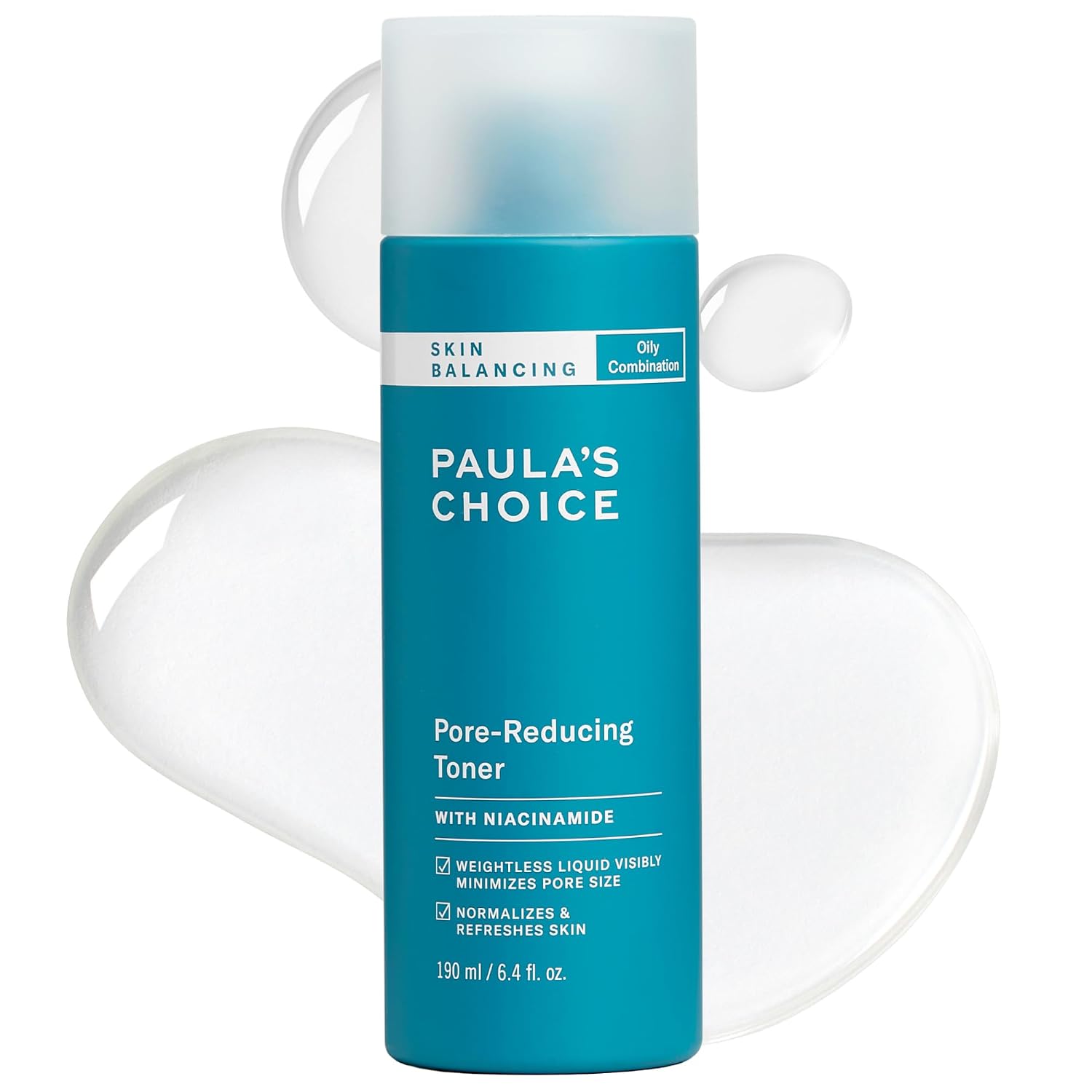
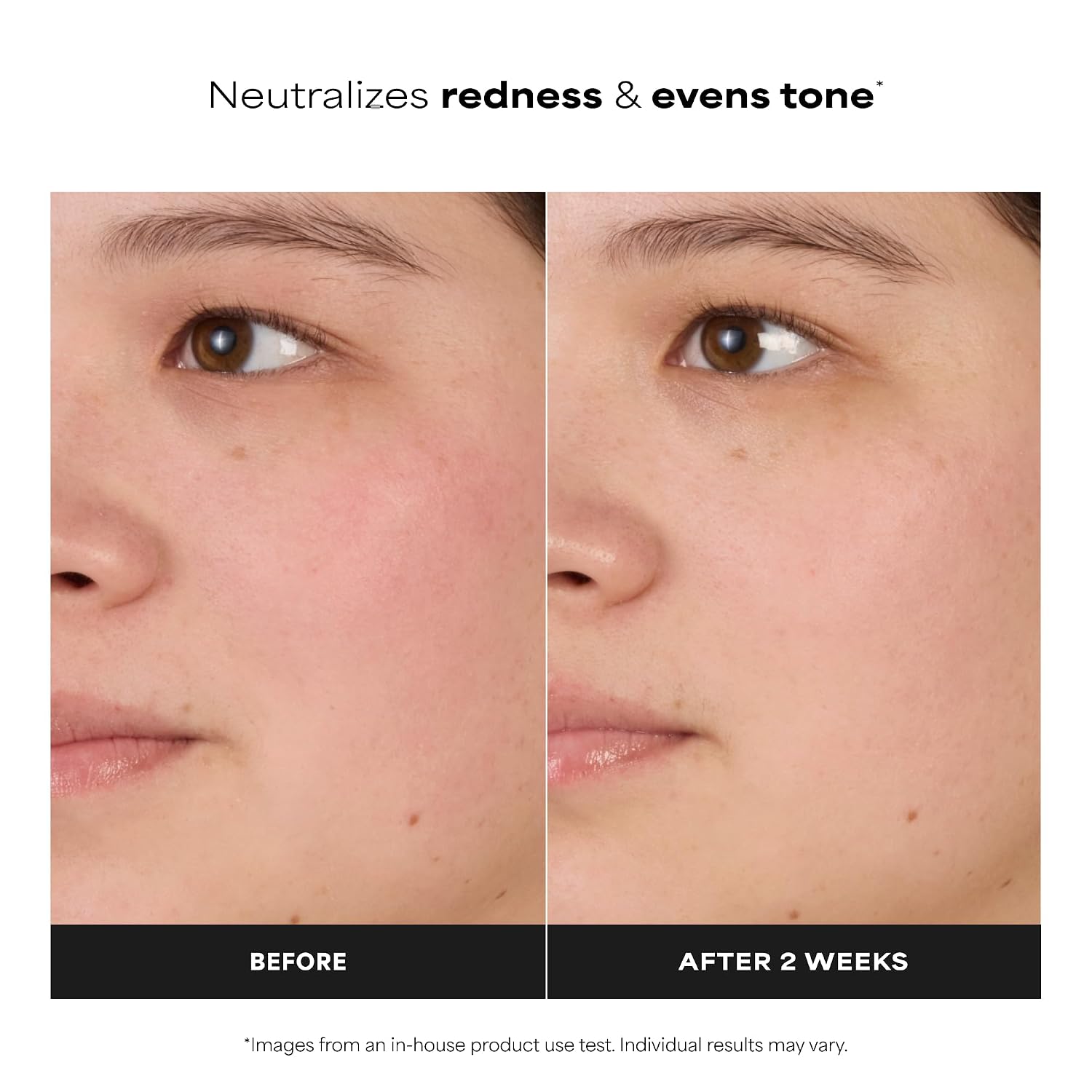
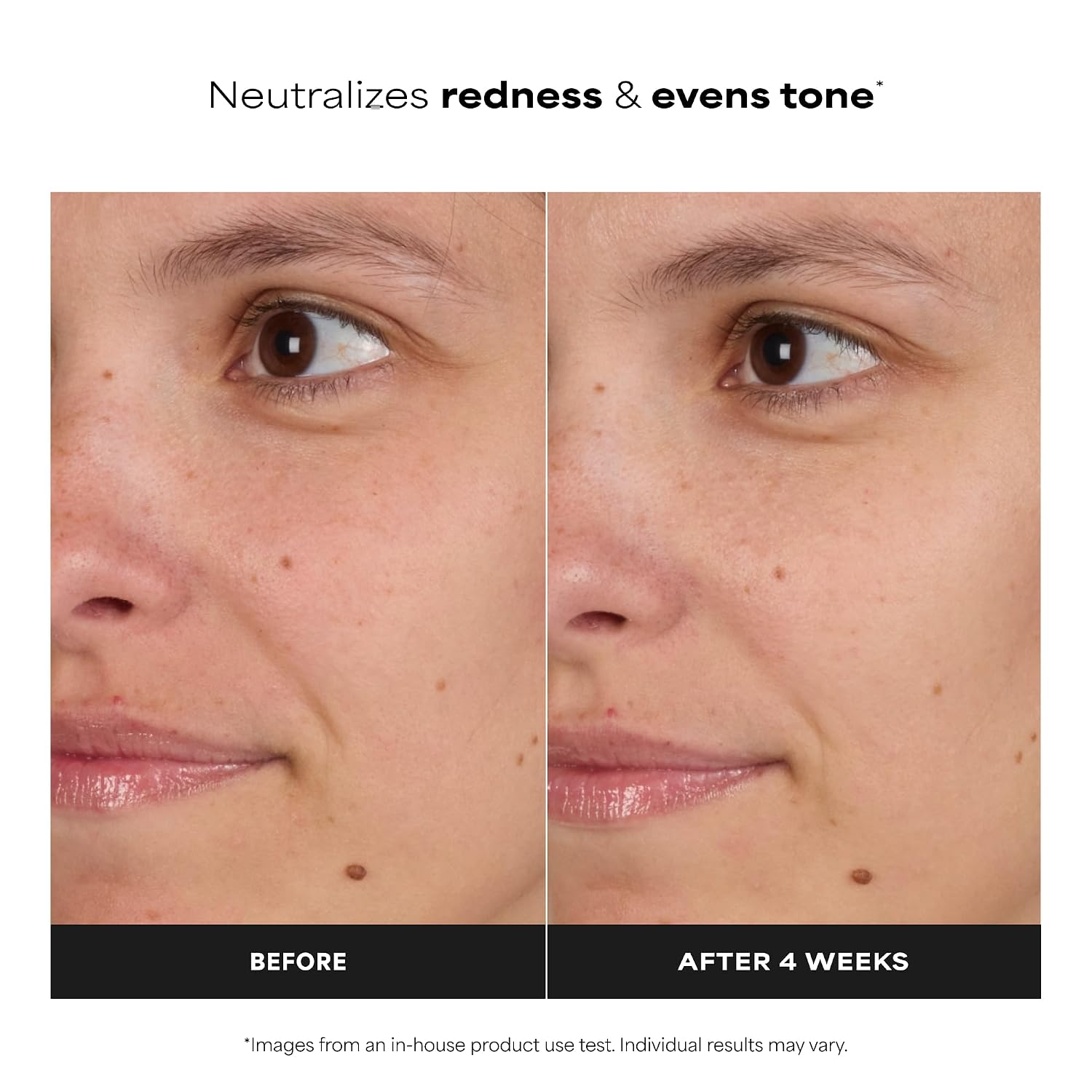
The three listing frames, in carousel order. Note what the before/after series actually demonstrates: redness and tone, not pore diameter. In-house test, individual results vary - the footnote is on the image, not added here.
Declared specification
What the brand claims
- MINIMIZE PORES AND ENHANCE YOUTHFUL APPEARANCE: Fight the effects of aging and reduce the appearance of enlarged pores, for smooth, unblemished skin. A great addition to your day or night routine.
- INGREDIENT TRANSPARENCY: Contains antioxidants and hydrating ceramides, making oily areas less noticeable and skin more even. This toner is specially formulated for use with oily skin, combination skin, enlarged pores, blemish-prone skin to balance, refine, and protect your skin.
- DAILY USE, AT ANYTIME: Our SKIN BALANCING Pore-Reducing face toner with Antioxidants balances oily, combination, and blemish-prone skin. Use the facial toner day & night after your favorite Paula's Choice cleanser to remove the last traces of makeup, clear pores, & renew skin before moisturizing.
- INGREDIENT TRANSPARENCY: Formulated with niacinamide, antioxidants, and hydrating agents, this fragrance-free toner helps visibly refine pores, balance oil production, and replenish skin after cleansing. It calms redness, improves skin texture, and preps your complexion without causing dryness or irritation.
- Paula's Choice Skincare makes products that work. No fragrance, no fluff. Just effective, science-backed formulas that target any concern from wrinkles to breakouts
Two things to keep in mind about that table. The rank of #31 in Facial Toners is a live position that moves daily, so treat it as a snapshot rather than a fact. And the price block is more interesting than it looks: the listing shows $25.60 against a $32.00 list, a 20% saving, while the independent price tracker for the same ASIN publishes a list price of $29.00. Both are reported as published in part 04, and neither is reconciled.
Product rating and buyer voice
Amazon's rounded star shares. 89% of 10,975 ratings land at four or five stars; the 5% in the bottom two buckets is about 550 ratings, which is why the complaints below are worth reading as a pattern.
4.6 from 10,975 ratings is a mature, stable figure, and the shape behind it is a classic long-run distribution: 76% five-star, 13% four-star, then a thin tail of 6% three-star, 2% two-star and 3% one-star. Nothing about that shape suggests a product with a defect. It suggests a product that works for most people and provokes a minority.
The aspect table is where this report becomes useful, because it disagrees with the rating. Effectiveness at 75% and moisturising at 70% are good but not ecstatic, and skin irritation at 42% - the only aspect below half - is the signal. On 142 mentions that is 83 negative ones. Compare that with texture at 88% and fragrance-free at 92%: buyers are not describing a harsh product. They are describing a product that occasionally stings or reddens, while agreeing it feels weightless and unfragranced.
What the ratings talk about
Amazon's review-summary model counts how many reviews mention each aspect and how many of those mentions are positive. Read the counts, not just the percentages: 531 effectiveness mentions carry the average, while 142 irritation mentions carry the complaints.
Green is positive mentions, red is negative. The irritation bar is the shortest positive block on the chart, and the only one where red outweighs green.
| Aspect | Mentions | Positive | Negative | Positive share |
|---|---|---|---|---|
| Effectiveness | 531 | 398 | 133 | 75% |
| Moisturizing | 257 | 181 | 76 | 70% |
| Skin Irritation | 142 | 59 | 83 | 42% |
| Value For Money | 127 | 68 | 59 | 54% |
| Skin Appearance | 119 | 82 | 37 | 69% |
| Texture | 84 | 74 | 10 | 88% |
| Fragrance-Free | 51 | 47 | 4 | 92% |
| Routine | 40 | 26 | 14 | 65% |
This is the tension the ingredients cannot resolve. The formula has one row above level 2 - phenoxyethanol, the near-universal preservative - and no acid, no alcohol, no fragrance and no essential oil. A 42% irritation score on a formula like that usually means one of three things: a preservative sensitivity in a susceptible minority, an application pattern (twice daily, on skin already using exfoliants and retinoids), or a review pool that includes people who bought it for the wrong skin type. The data here supports all three and distinguishes none.
What can be said with confidence is the negative: this is not an irritation story driven by the usual suspects. There is no denatured alcohol, no menthol, no citrus oil and no EU-declarable allergen anywhere in the 26 rows. If you react to this, the reaction is worth noting down precisely, because the formula does not offer an obvious candidate.
What review text is available
Product ingredients
Two ingredient channels were merged: COSDNA, which grades each ingredient for acne risk, irritation and safety, and Skinsort, which publishes the claim matrix, the concern list and its own comedogenic and irritancy columns. Unusually for this collection, the two agree exactly - 26 rows each, in the same order, with Skinsort's grades never contradicting COSDNA's. The 26-row count also matches the brand's own published US INCI. The EU version of the same product lists 29, adding citric acid, carbomer and ethylhexylglycerin.
How the levels are assigned
Each ingredient sits at a level equal to the upper bound of its COSDNA safety band: 1 is level 1, 1-2 level 2, 2-4 level 4. Ranges are read high on purpose. Two properties of the scale matter here: safety is inverse - 1 is safest, 5 is most flagged - and a blank cell is unrated, not zero risk. Nothing in this formula needed the top two levels.
| Level | Rows | Share |
|---|---|---|
| Level 1 minimal | 22 | 85% |
| Level 2 low | 3 | 12% |
| Level 4 elevated | 1 | 4% |
85% of the formula sits at level 1. The single level 4 row is the preservative, and there is no row at level 3 or level 5 anywhere in the 26.
A profile this clean is worth interrogating rather than celebrating. Three checks make it credible. First, the coverage is complete - 26 of 26 rows, matching the brand's own list, so nothing was dropped to flatter the result. Second, the two channels agree independently, including on the one range value in the table (hexylene glycol, comedogenic 0-2), which is where disagreement would normally show up. Third, the flagged row is real: phenoxyethanol at 2-4 is a genuine grade for a genuine preservative, and it is the row you would predict.
The two rows worth knowing about below the threshold are Oleth-10 and Hexylene Glycol, both graded acne 2 - mild, and both emulsifier/solvent types that sit at positions 19 and 22. Neither is a concern at these doses. They are named because they are the only rows with any comedogenic grade above 0, and because anyone chasing a breakout should start there rather than at the niacinamide.
Function groups
Barrier lipids are five rows - three ceramides, phytosphingosine and cholesterol - the second-largest group in a 26-row formula. That is the structural reason the hydration and barrier claims have substance, and it is unusual at this price point in this step of a routine.
What is inside, claim by claim
Skinsort publishes twelve badges for this product. Nine hold and three fail; a failing badge arrives with a Not prefix, which is stripped here so the verdict sits in the colour and the note rather than in the label.
The nine that hold are the ones you would expect from a Paula's Choice formula: no alcohol, no oil, no paraben, no silicone, no sulfate, no pore cloggers, and a Leaping Bunny cruelty-free certification rather than a brand claim. The EU-allergen-free badge passing is the important one, because it is the check that would catch a hidden fragrance.
Fragrance-free is the badge that needs a paragraph. Skinsort marks it as not holding and names exactly one ingredient: Anthemis Nobilis Flower Extract, the chamomile extract at position 7. There is no parfum in the list, no essential oil, and not one of the 26 EU-declarable allergens - which is precisely why the EU-allergen badge passes while this one fails. COSDNA assigns the same chamomile extract a Fragrance function. So the database is consistent and, in its own taxonomy, correct: the formula does contain a botanical classified as masking and perfuming. But a shopper asking 'is this fragrance-free' is asking whether perfume was added, and the answer to that is no. Both statements belong in the report; neither cancels the other.
The two remaining failures are narrow. Fungal-acne-safe fails on polysorbate 20 and hydrolysed jojoba esters - ester-type ingredients, the standard basis for that flag, and relevant only if you are managing malassezia folliculitis. Vegan fails with no parenthetical explanation on the page; the reason is not published and is not inferred here.
Flagged rows
The threshold used across this collection is safety 3+, acne risk 3+ or irritant 3+. One row qualifies - and that is the finding. The two rows one step below it are listed for completeness.
| Ingredient | Pos. | Function | Acne | Irritant | Safety | Level |
|---|---|---|---|---|---|---|
| Phenoxyethanol | 26 | Preservative | - | - | 2-4 | Level 4 |
| Oleth-10 | 19 | Surfactant, emulsifier | 2 | 1 | 1-2 | Level 2 |
| Hexylene Glycol | 22 | Surfactant, solvent | 2 | 1 | 1 | Level 1 |
Phenoxyethanol is at the very end of the list, position 26, which is where a preservative belongs - it is dosed to protect the product, not the skin, and it is typically under 1%. Its band of 2-4 is the widest in the formula and the grade covers the whole class. If the 142 irritation mentions have a formula cause, this is the only candidate the table offers; it is also, notably, a preservative that most of the market uses without incident.
Which is why the honest conclusion on irritation is an open one. A formula with no alcohol, no fragrance, no acid and no essential oil, in which 22 of 26 rows are at the lowest grade, should not produce a 42% irritation score. Either the score reflects the population rather than the product - people applying it twice a day on top of actives - or phenoxyethanol sensitivity is more common in this customer base than the numbers usually suggest. Nothing in the collected data settles it, and inventing a culprit would be worse than leaving the question open.
What independent screening flags
| Concern | As described |
|---|---|
| Not Fragrance-free | Contains Fragrance - 1 fragrance ingredient: Anthemis Nobilis Flower Extract |
| Not Fungal-acne-safe | 2 flagged ingredients: Polysorbate 20, Hydrolyzed Jojoba Esters |
| Not Vegan | Not Vegan |
These three are the failing badges restated as rows, not an independent risk assessment - worth knowing because it means the Concerns block on this page is the badge list, not a separate screening. The one with substance is the fungal-acne flag: polysorbate 20 and hydrolysed jojoba esters are both ester-type ingredients, and ester load is the usual basis for that classification. For anyone managing malassezia folliculitis that is the row to read; for everyone else it is a narrow caveat.
The formula in order
The declaration order, complete. Niacinamide at 4 is the earliest active; the ceramide block runs 13 to 17; the preservative is last. There is no fragrance line anywhere in the sequence.
What this formula actually is
A barrier-support toner with a 5%-class niacinamide dose. Skinsort's own benefit counts make the case better than the marketing does: hydrating on 12 of 26 ingredients, barrier repair on 12, irritation reduction on 10. Pore reduction rests on 2 ingredients and dark spots on 1. The product is better at the first three than the last two.
Where the name oversells
Pore-reducing is the claim in the title and the thinnest claim in the count. Niacinamide does have sebum and pore-appearance evidence at 2-5%, and this formula doses it high enough to matter, so the claim is not empty - but the before/after imagery on the listing shows redness and tone evening, not pore diameter, and the review aspects agree: texture 88%, appearance 69%.
Who should skip it
Anyone managing fungal acne - the ester load is flagged. Anyone who has reacted to phenoxyethanol before. And anyone buying it as a treatment toner: it is a hydrating, barrier-supporting prep step, and the $25.60 buys a well-built one, but it will not exfoliate, and it will not replace a retinoid or an acid.
Full ingredient table
All 26 rows, in declaration order, with both channels side by side. Only nine rows carry any comedogenic or irritancy grade on the Skinsort side - the sparsity is normal for this database and is not a gap in the capture.
| # | Ingredient | Function | Acne | Irritant | Safety | Level | Skinsort comed. / irrit. |
|---|---|---|---|---|---|---|---|
| 1 | Water | Solvent | - | - | 1 | Level 1 | - / - |
| 2 | Glycerin | Solvent, Viscosity Control, Skin conditioning, Moisturizer | 0 | 0 | 1-2 | Level 2 | 0 / 0 |
| 3 | Butylene Glycol | Solvent, Fragrance, Viscosity Control, Skin conditioning, Moisturizer | 1 | 0 | 1 | Level 1 | 1 / 0 |
| 4 | Niacinamide | Skin conditioning | - | - | 1 | Level 1 | - / - |
| 5 | Polysorbate 20 | Surfactant, Emulsifier | 0 | 0 | 1 | Level 1 | 0 / 0 |
| 6 | Adenosine | - | - | - | 1 | Level 1 | - / - |
| 7 | Anthemis Nobilis Flower Extract | Fragrance, Skin conditioning | - | - | 1-2 | Level 2 | - / - |
| 8 | Arctium Lappa Root Extract | Skin conditioning | - | - | 1 | Level 1 | - / - |
| 9 | Hydrolyzed Jojoba Esters | Skin conditioning | - | - | 1 | Level 1 | - / - |
| 10 | Sodium PCA | Antistatic, Skin conditioning, Moisturizer | 0 | 0 | 1 | Level 1 | 0 / 0 |
| 11 | Panthenol | Antistatic, Skin conditioning, Moisturizer, Anti-inflammatory | 0 | 0 | 1 | Level 1 | 0 / 0 |
| 12 | Sodium Hyaluronate | Skin conditioning, Moisturizer | 0 | 0 | 1 | Level 1 | 0 / 0 |
| 13 | Ceramide NP | Moisturizer | - | - | 1 | Level 1 | - / - |
| 14 | Ceramide AP | Skin conditioning | - | - | 1 | Level 1 | - / - |
| 15 | Ceramide EOP | Skin conditioning | - | - | 1 | Level 1 | - / - |
| 16 | Phytosphingosine | Skin conditioning | - | - | 1 | Level 1 | - / - |
| 17 | Cholesterol | Viscosity Control, Skin conditioning, Emollient, Emulsifier | 0 | 0 | 1 | Level 1 | 0 / 0 |
| 18 | Tetrahexyldecyl Ascorbate | Skin conditioning, Antioxidant | - | - | 1 | Level 1 | - / - |
| 19 | Oleth-10 | Surfactant, Emulsifier | 2 | 1 | 1-2 | Level 2 | 2 / 1 |
| 20 | Sodium Lauroyl Lactylate | Emulsifier | - | - | 1 | Level 1 | - / - |
| 21 | Caprylyl Glycol | Moisturizer, Emollient | - | - | 1 | Level 1 | - / - |
| 22 | Hexylene Glycol | Surfactant, Solvent, Emulsifier | 2 | 1 | 1 | Level 1 | 0-2 / 0-1 |
| 23 | Sodium Citrate | pH Adjusters, Antioxidant | - | - | 1 | Level 1 | - / - |
| 24 | Xanthan Gum | Surfactant, Viscosity Control | - | - | 1 | Level 1 | - / - |
| 25 | Trisodium EDTA | - | - | - | 1 | Level 1 | - / - |
| 26 | Phenoxyethanol | Preservative | - | - | 2-4 | Level 4 | - / - |
Two scales in one table: the Acne / Irritant / Safety columns are COSDNA's 0-5 grades with safety inverted (1 safest), and the last column is Skinsort's comedogenic / irritancy pair (0 safest). A dash means unrated, never zero.
Product price
This listing has been price-tracked since September 2013, which makes it one of the longest records in this collection - and it still only has one live channel. The Amazon retail and used rows are both empty because the product has been sold by the brand and fulfilled by Amazon throughout. Everything below is the third-party new channel.
| Price type | Lowest ever | Highest ever | Current | Average |
|---|---|---|---|---|
| Amazon | - | - | - | - |
| 3rd Party New | $13.00 Jun 27, 2015 | $65.88 Mar 14, 2016 | $25.60 Oct 09, 2026 | $23.21 |
| 3rd Party Used | - | - | - | - |
The summary block as published. Current is $25.60 as of 09 October 2026, eighteen days before this capture, and the tracker flags it as over seven days old for that reason. The live listing showed the same $25.60 on the collection date, so the figure is right in substance - just not fresh on paper. The list price conflict ($29.00 here, $32.00 on Amazon) is disclosed rather than resolved.
The same table as bars
Four numbers, one channel. The $65.88 ceiling is the outlier that makes the other three hard to read: at 227% of list it is a 2016 stock-out or reseller artefact, not a market high.
Dated observations
Five dated observations across thirteen years. This connects extremes to the last known value; it does not show the path between them, because the source publishes no observation-level history.
Position against every benchmark
| Measure | Value | Basis |
|---|---|---|
| Current vs lowest ever | +96.9% | $25.60 against the $13.00 low of 27 Jun 2015 |
| Current vs highest ever | -61.1% | $25.60 against the $65.88 high of 14 Mar 2016 |
| Current vs all-time average | +10.3% | $25.60 against the $23.21 average |
| Current vs list price | -11.7% | $25.60 against the $29.00 list on this source |
| Average vs list price | -20.0% | $23.21 against the $29.00 list |
| All-time spread | $52.88 | 406.8% of the $13.00 low |
| Amazon channel | No data | Listed Out of Stock throughout the tracked period |
| Subscribe & Save | $23.04 | 28% below the $32.00 list displayed on the listing |
| Unit price | $4.00 / fl oz | Derived from $25.60 against the 6.4 fl oz fill |
Current price is ordinary for the listing and slightly above its own average: 10.3% over the $23.21 thirteen-year mean, 11.7% under the $29.00 list. The two extreme numbers are history, not context - a $13.00 floor from 2015 and a $65.88 spike from 2016, neither of which describes what this product costs today.
The $65.88 high deserves a sentence of its own. It is 227% of list, it lands two and a half years after tracking began, and it sits nine months after the $13.00 low. That is the profile of a stock-out or a marketplace reseller, not a price anyone chose to charge. Because it is in the same average as everything else, it pulls the $23.21 mean upward - so the average here is less useful than the operating band, which has sat in the high teens to high twenties for years.
The practical conclusion is that there is no discount to wait for. At $25.60 the product is at a normal standing price, and the cheaper route is already visible on the listing: Subscribe & Save at $23.04, which is below both the current price and the all-time average. For a twice-daily product that most buyers repurchase, that is worth more than watching for a flash drop that the record does not show happening.
How this was assembled, and how far to trust it
Method
- Listing data - title, breadcrumb, specification table, bullets, price block, rating and star shares, aspect counts - read from the Amazon US product page with the delivery address set to ZIP 10001 so every price is native USD. Nothing was converted.
- Product identity was cross-checked before any ingredient work: the ASIN resolves to SKIN BALANCING Pore-Reducing Toner on the brand's own site, which is why the ingredient records use that name and the report names both.
- Product images: the first three carousel frames downloaded at full size, and each caption written by looking at the file rather than by paraphrasing listing copy.
- Ingredient data merged from COSDNA (26 rows, acne / irritant / safety grades) and Skinsort (26 rows, claim matrix, concerns, benefits, comedogenic / irritancy). Both channels agree on row count and order.
- Levels are computed, not published: the upper bound of each COSDNA safety band, rounded up into five levels, with ungraded rows held separately. The rule is stated in part 03 so the classification can be audited.
- Price history read from a third-party tracker covering Sep 2013 to the capture date. Only the all-time summary exists there; no period-specific statistic was available or presented.
- Where two sources disagree - the $29.00 and $32.00 list prices - both are shown rather than reconciled.
Confidence
- Listing specification and price - High. Read from the rendered listing with a US delivery context; the price was independently confirmed at $25.60 by the price tracker
- Star distribution and aspect counts - High. Published by the listing; percentages are Amazon's rounded shares
- Individual review text - Not available. No review bodies rendered on any attempt; nothing quoted or paraphrased
- Ingredient identity and order - High. Two channels agree on 26 rows and order, and both match the brand's published US INCI
- Ingredient grades - Medium. Community database values with thin acne/irritant coverage (10 of 26 rows); safety grades are near-complete
- Level classification - Medium. A computed mapping, not a published taxonomy - a different banding would move the three level-2 rows but not the single level-4 row
- The irritation signal - Low. The aspect score is solid; the explanation for it is not established by the data and is presented as an open question
- Price history values - High. Transcribed verbatim with dates; ratios labelled as arithmetic
- Price-history interpretation - Low. The stock-out reading of the $65.88 high is inference, not a collected fact