Product file · Toner
The best-selling acid toner in Korean skincare, named after three exfoliating acids that together make up about 0.07% of the bottle. What is actually dosed - 2% niacinamide, 1% tea tree water and a deep humectant base - works well enough to earn a 4.6 on Amazon. What explains the stinging is a trace of peppermint oil at position 27, which the marketing never mentions.
Captured 27 October 2026 · Amazon US, delivery ZIP 10001 · all prices in USD · 150 ml / 5.07 fl oz
The short version
- The three acids in the name total 0.07%. Salicylic 100 ppm, lactobionic 100 ppm, citric 500 ppm - 100 to 200 times below a real exfoliating dose. The label is accurate; the product name is a category convention, not a dose statement.
- The only high-risk ingredient is peppermint oil at position 27. Graded 4 on safety, absent from every claim, and the reason three badges fail. It also explains the minty scent 85% of scent mentions like, and the stinging that 53% skin-compatibility scores describe.
- Two rating systems disagree by 1.8 points. Skinsort says 2.8 from 72 reviews; Amazon says 4.6 from 9,647 ratings. Both are honest - one grades formula design, the other measures retail satisfaction - and the gap is itself the story.
Product information
SOME BY MI's 30 Days Miracle Toner is the product that made the Korean 'mild acid toner' category mainstream, and its name is its own best advertisement: three exfoliating acid classes, a 30-day timeline, and the word miracle. The bottle underneath is 150 ml of water-thin liquid with a declared 2% niacinamide, a declared 10,000 ppm of tea tree leaf water, and an acid load that turns out to be a rounding error - which is the first thing this report has to establish before anything else in it makes sense.
The base is generous. Glycerin, dipropylene glycol, sodium hyaluronate, fructan, xylitol and hydroxyethyl urea are all humectants, joined by allantoin and adenosine for soothing, and four botanical extracts - papaya, lentil, witch hazel and lotus - plus swiftlet nest extract. Applied to a cotton pad after cleansing, twice a day, no rinse, before the rest of the routine. It is a hydrating prep step that has been marketed as a treatment.
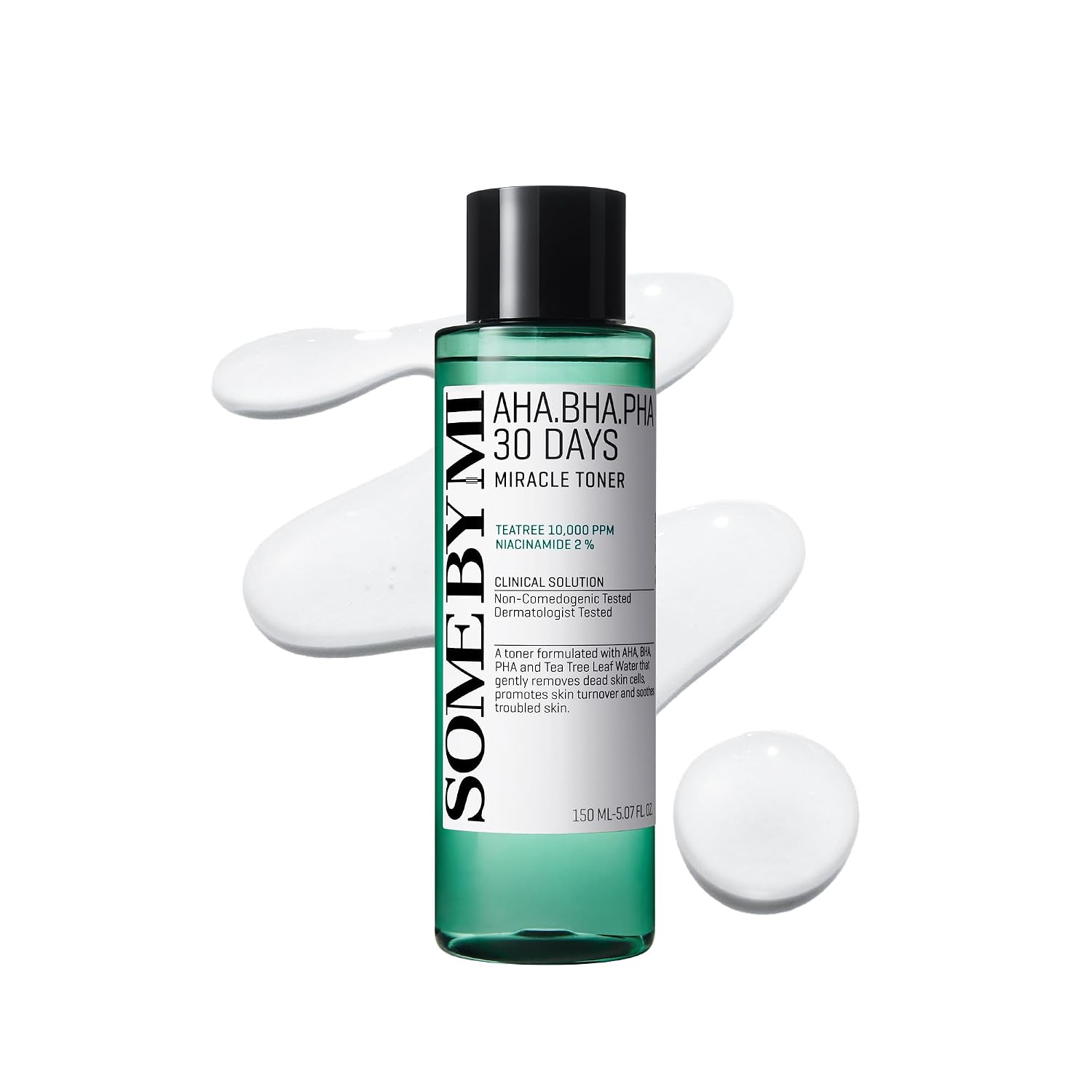
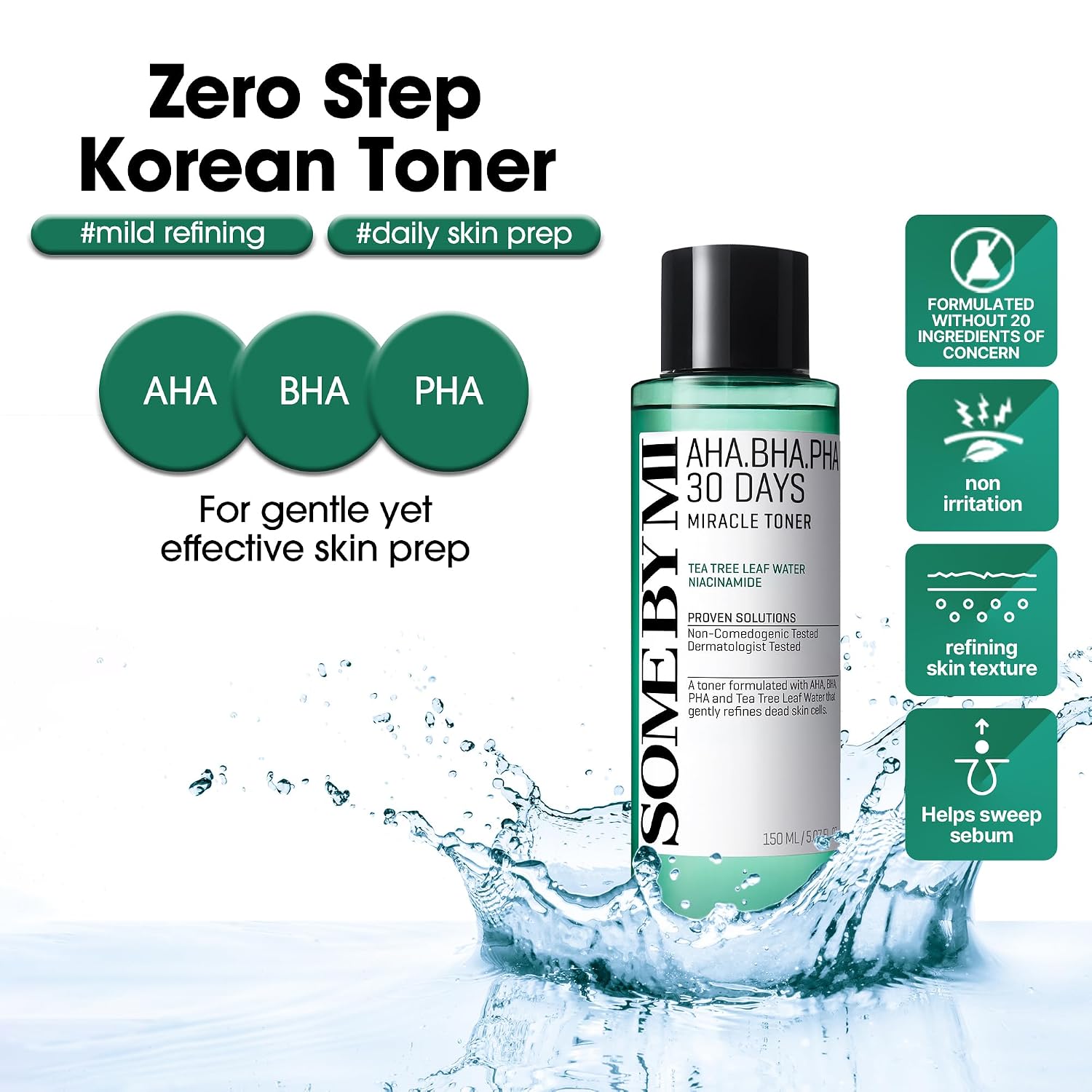
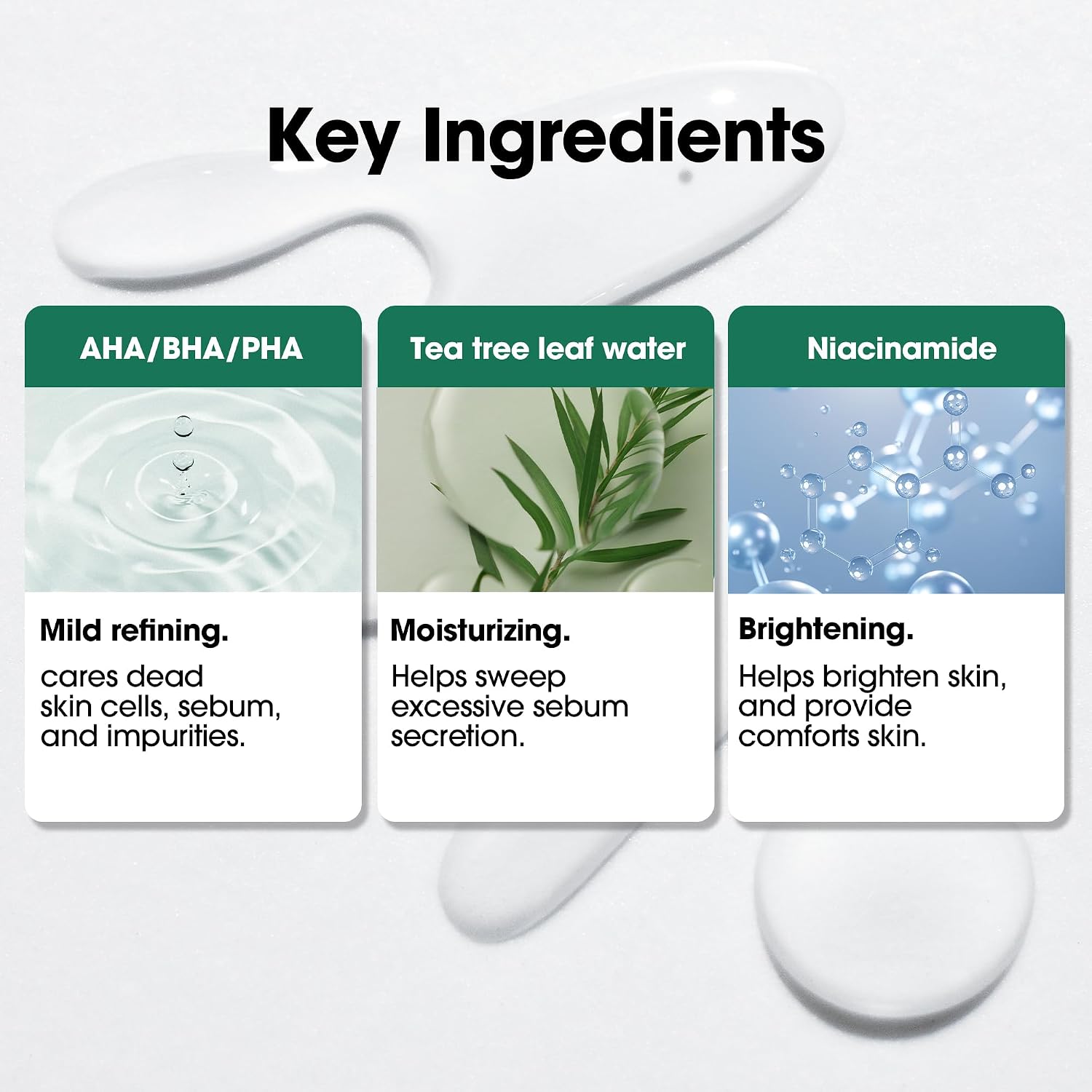
Three listing frames, in carousel order. The third is the one that matters for this report: the brand's own ingredient card names acids, tea tree and niacinamide - the two ingredients that are actually dosed, plus the one that is not.
Declared specification
What the brand claims
- AHA BHA PHA TONER FOR BLEMISH-PRONE SKIN Looking for a toner for blemish-prone skin? Formulated with AHA, BHA, and PHA to support smoother-looking skin.
- SEBUM CARE & PORE CARE Helps support clearer-looking skin while maintaining gentle daily refining care.
- CLOGGED PORES? AHA, BHA, PHA CARE Helps sweep excess buildup and support balanced-looking skin.
- UNEVEN TEXTURE? AHA BHA PHA REFINING CARE Supports smoother-looking skin and daily skin texture care.
- KOREAN TONER FOR BLEMISH-PRONE SKIN Daily toner developed for Sebum care, pore care, and balanced-looking skin.
Two notes on the specification. The declared-doses row is unusual and worth crediting: a brand that prints 100 ppm on the ingredient record is telling you the acid content is negligible, whether or not it intends to. And the seller is SOME BY MI_Official shipped by Amazon, which is why the listing has a real Amazon retail price history rather than being a pure marketplace item - a detail that matters in part 04.
Product rating and buyer voice
Amazon's rounded star shares. 89% at four or five stars is a good product by retail standards; the 12% four-star block is larger than a devoted product usually shows, and it is where the 'works, but' buyers sit.
4.6 from 9,647 ratings is a strong retail result, and the distribution behind it is unusually flat at the top: 77% five-star but 12% four-star, against the 8% or 9% four-star block a loved product typically carries. A 6% three-star share is also high. This is the shape of a product people finish and feel positive about, without the enthusiasm that produces a five.
The aspect table explains the shape. Gentleness scores 86% and scent 85% - buyers like how it feels and smells. Skin compatibility sits at 53% and drying effect at 60%, the two lowest scores, and those are exactly the aspects a trace of peppermint oil on a compromised barrier would move. Effectiveness at 79% on 633 mentions is solid but not the 90%-plus the other toners in this collection reach.
What the ratings talk about
Amazon's review-summary model counts how many reviews mention each aspect and how many of those mentions are positive. The counts matter: 633 effectiveness mentions carry the average, while 128 compatibility mentions and 73 drying mentions carry the complaints.
Green is positive mentions, red is negative. The two bars where red is closest to green - skin compatibility and drying effect - are the ones the ingredient table predicted.
| Aspect | Mentions | Positive | Negative | Positive share |
|---|---|---|---|---|
| Effectiveness | 633 | 497 | 136 | 79% |
| Skin Benefits | 447 | 316 | 131 | 71% |
| Gentleness | 155 | 134 | 21 | 86% |
| Skin Compatibility | 128 | 68 | 60 | 53% |
| Value For Money | 125 | 96 | 29 | 77% |
| Skin Appearance | 124 | 106 | 18 | 85% |
| Scent | 80 | 68 | 12 | 85% |
| Drying Effect | 73 | 44 | 29 | 60% |
There is a coherent story in these eight numbers, and it is not the story the marketing tells. Buyers report that it works (79% effectiveness), that it is gentle in the sense of not being a harsh scrub (86%), that it smells good (85%), and that it stings on active breakouts (53% compatibility) and can feel drying (60%). That is precisely what a hydrating niacinamide toner with a trace of peppermint does. A real 1% salicylic acid toner would produce a different pattern: more effectiveness, far worse gentleness, and complaints about flaking rather than stinging.
The 'doesn't show results in 30 days' complaint visible in the listing's own summary is the same finding from the buyer's side. The product name promises a 30-day transformation; the formula contains about 0.07% acid. Buyers who expected an exfoliation curve did not get one, and the ones who stayed for the hydration and the tea tree did.
What review text is available
Product ingredients
Two channels were merged: COSDNA, which grades each ingredient for acne risk, irritation and safety, and Skinsort, which publishes the claim matrix, the concerns, the benefit counts and its own comedogenic and irritancy columns. Both list 27 rows, in the same order, with no contradictions. COSDNA's entry is the 150 ml product and is the only record that publishes the declared ppm values - which is what makes the dose analysis in this part possible.
How the levels are assigned
Each ingredient sits at a level equal to the upper bound of its COSDNA safety band: 1 is level 1, 1-2 is level 2, a 4 is level 4. Ranges are read high on purpose. Safety is inverse - 1 is safest and 5 is most flagged - and a blank cell is unrated, not zero risk. One row here has no grade at all.
| Level | Rows | Share |
|---|---|---|
| Level 1 minimal | 22 | 81% |
| Level 2 low | 3 | 11% |
| Level 4 elevated | 1 | 4% |
| Unrated unrated | 1 | 4% |
The distribution is bottom-heavy: 22 of 27 rows at level 1, three at level 2, one at level 4, one ungraded. This is a gentle formula with a single flagged trace ingredient, not a formula with a diffuse risk problem.
Two readings of this chart are both defensible and they lead in opposite directions. Read strictly, it is a clean formula: 81% of ingredients at the lowest grade, no alcohol, no sulfate, no paraben, no silicone, and the one high grade on a trace fragrance oil. Read against the marketing, it is a mismatch: the acids that give the product its name are so far below an active dose that they barely register on any axis, which means the level chart is describing a hydrating toner that has been sold as an exfoliant.
The rows worth naming below the threshold are Ethylhexylglycerin at 2 and citric acid at 1-2. Neither is a concern. They are the only rows between the level-1 floor and the peppermint oil, which is a useful thing to know if you are trying to locate a reaction: there is almost nothing in this formula above baseline except one essential oil.
Function groups
Six botanical extracts and five humectants make up 11 of the 27 rows - the two largest groups are also the two least graded. The acid group is only two rows, and each is dosed at 100 ppm, which is why the bar looks the same size as everything else while mattering far less.
What is inside, claim by claim
Skinsort publishes twelve badges. Seven hold and five fail, and the five failures are almost entirely one ingredient: peppermint oil, which single-handedly breaks the fragrance, allergen and oil-free claims.
The seven that hold are the standard clean-formula set - no alcohol, paraben, silicone or sulfate, no pore cloggers, reef safe, and fungal-acne safe, which is a meaningful pass for a product aimed at blemish-prone skin. The five that fail are EU-allergen-free, fragrance-free, oil-free, cruelty-free and vegan.
Three of those five are the same fact stated three ways. Fragrance-free fails on two rows: Mentha Piperita Oil at 27 and Raspberry Ketone at 26 - Skinsort describes them as one essential oil and one synthetic. Oil-free fails because the fragrance is an oil. EU-allergen-free fails because peppermint oil is on the declarable list. One trace ingredient at the very end of a 27-row formula takes out three badges at once.
Cruelty-free and vegan failing is a different matter and needs stating plainly. Skinsort marks both as not holding, with no parenthetical explanation. The likely basis for the vegan flag is Swiftlet Nest Extract at position 12, an animal-derived ingredient; the cruelty-free flag is not explained and is not inferred here. Anyone for whom either matters should verify directly with the brand rather than rely on this page - it is the one place in this report where two channels disagree by omission rather than by evidence.
Flagged rows
The threshold used across this collection is safety 3+, acne risk 3+ or irritant 3+. One row qualifies - and in a formula whose name is three acids, the flagged row is not an acid.
| Ingredient | Pos. | Function | Acne | Irritant | Safety | Level |
|---|---|---|---|---|---|---|
| Mentha Piperita Oil | 27 | Fragrance | - | - | 4 | Level 4 |
| Ethylhexylglycerin | 25 | Preservative booster | - | - | 2 | Level 2 |
| Citric Acid (500 ppm) | 21 | pH adjuster | - | - | 1-2 | Level 2 |
The single flagged row is the last ingredient in the list and the one the marketing never mentions. Mentha Piperita Oil at position 27 is a cooling fragrance: at trace dose it produces the tingle that a lot of blemish-prone buyers read as the product working, and on active lesions or a compromised barrier it produces the sting that 47% of compatibility mentions describe. Both experiences are the same molecule.
Nothing else in this formula is above level 2. That is the finding to hold on to. For a product sold as an acid treatment, the acid rows are graded 1 and dosed at 0.01%, the strongest sensate ingredient is a fragrance, and the work is being done by niacinamide at 2% and tea tree water at 1%. None of that makes it a bad toner - it makes the name a category label rather than a promise.
What independent screening flags
| Concern | As described |
|---|---|
| May Worsen Dryness | Can strip moisture and worsen dryness. |
| May Worsen Rosacea | Can trigger flare-ups in rosacea-prone skin. |
| May Worsen Eczema | May worsen itching or irritation for eczema. |
| May Worsen Irritation | May cause stinging, redness, or sensitivity. |
Four concerns, and unlike the badge list on some products these are a genuine separate screen. All four route back to one cause: peppermint oil on a compromised barrier. The dryness concern is the odd one out - nothing in this formula is drying on paper, so that flag is best read as a caution about acid-toner use patterns rather than about the ingredients present.
The formula in order
The declaration order, complete. The three acids sit at 19, 20 and 21 - the back third of the list, next to the buffers. Peppermint is last. Niacinamide at 5 and tea tree leaf water at 6 are the earliest actives in the formula.
What this toner actually is
A hydrating, mildly antibacterial prep toner. Niacinamide 2% for tone and sebum, tea tree leaf water 1% for the antibacterial angle, and a humectant stack - glycerin, DPG, hyaluronic acid, fructan, xylitol, hydroxyethyl urea - that does most of the visible work. Allantoin and adenosine soften it. Skinsort's benefit counts agree: hydration on 8 of 27 ingredients, barrier repair on 6, acne fighting on 4.
The dose arithmetic, and why it matters
Salicylic 100 ppm is 0.01%. Lactobionic 100 ppm is 0.01%. Citric 500 ppm is 0.05%. A conventional 2% BHA toner carries 200 times more salicylic acid than this. At 0.07% total the acids function as pH control and preservative support; they cannot exfoliate at a rate a user would notice in 30 days or 300. The 30-day promise in the name is unmet by design, not by defect.
Who should skip it
Anyone with active breakouts who wants a real exfoliant - this is not one, and the peppermint will sting the lesions it is meant to treat. Anyone avoiding fragrance or essential oils, since three badges fail on one trace oil. Anyone with rosacea or eczema, where Skinsort flags all four concerns. For everyone else it is a pleasant, well-priced hydrating toner whose name overpromises a mechanism, and the 4.6 reflects that honestly.
Full ingredient table
All 27 rows in declaration order, with both channels side by side. The parenthetical doses in the ingredient names are as published by the COSDNA record and are the basis for the acid arithmetic in this part.
| # | Ingredient | Function | Acne | Irritant | Safety | Level | Skinsort comed. / irrit. |
|---|---|---|---|---|---|---|---|
| 1 | Water | Solvent | - | - | 1 | Level 1 | - / - |
| 2 | Butylene Glycol | Solvent, Fragrance, Viscosity Control, Skin conditioning, Moisturizer | 1 | 0 | 1 | Level 1 | 1 / 0 |
| 3 | Dipropylene glycol | Solvent, Moisturizer | - | - | 1 | Level 1 | - / - |
| 4 | Glycerin | Solvent, Viscosity Control, Skin conditioning, Moisturizer | 0 | 0 | 1-2 | Level 2 | 0 / 0 |
| 5 | Niacinamide (2%) | Skin conditioning | - | - | 1 | Level 1 | - / - |
| 6 | Melaleuca Alternifolia Leaf Water (1%) | Astringent | - | - | 1 | Level 1 | - / - |
| 7 | Polyglyceryl-4 Caprate | Emulsifier | - | - | 1 | Level 1 | - / - |
| 8 | Carica Papaya Fruit Extract | Skin conditioning | - | - | 1 | Level 1 | - / - |
| 9 | Lens Esculenta Seed Extract | - | - | - | 1 | Level 1 | - / - |
| 10 | Hamamelis Virginiana Extract | - | - | - | 1 | Level 1 | - / - |
| 11 | Nelumbium Speciosum Flower Extract | Skin conditioning | - | - | - | Unrated | - / - |
| 12 | Swiftlet Nest Extract | Skin conditioning | - | - | 1 | Level 1 | - / - |
| 13 | Sodium Hyaluronate | Skin conditioning, Moisturizer | 0 | 0 | 1 | Level 1 | 0 / 0 |
| 14 | Fructan | Skin conditioning | - | - | 1 | Level 1 | - / - |
| 15 | Allantoin | Skin conditioning, Anti-inflammatory, Anti-allergic | 0 | 0 | 1 | Level 1 | 0 / 0 |
| 16 | Adenosine | - | - | - | 1 | Level 1 | - / - |
| 17 | Hydroxyethyl Urea | Moisturizer | - | - | 1 | Level 1 | - / - |
| 18 | Xylitol | Moisturizer | - | - | 1 | Level 1 | - / - |
| 19 | Salicylic Acid (100 ppm) | Exfoliator, Whitening | - | - | 1 | Level 1 | - / - |
| 20 | Lactobionic Acid (100 ppm) | Antioxidant | - | - | 1 | Level 1 | - / - |
| 21 | Citric Acid (500 ppm) | pH Adjusters | - | - | 1-2 | Level 2 | - / - |
| 22 | Sodium Citrate | pH Adjusters, Antioxidant | - | - | 1 | Level 1 | - / - |
| 23 | 1,2-Hexanediol | Solvent | - | - | 1 | Level 1 | - / - |
| 24 | Benzyl Glycol | Solvent | - | - | 1 | Level 1 | - / - |
| 25 | Ethylhexylglycerin | - | - | - | 2 | Level 2 | - / - |
| 26 | Raspberry Ketone | Fragrance, Skin conditioning | - | - | 1 | Level 1 | - / - |
| 27 | Mentha Piperita Oil | Fragrance | - | - | 4 | Level 4 | - / - |
Two scales in one table: Acne / Irritant / Safety are COSDNA's 0-5 grades with safety inverted (1 safest); the last column is Skinsort's comedogenic / irritancy pair (0 safest). A dash means unrated, never zero.
Product price
This listing has the best price record of the three in this collection: two live channels rather than one, tracked since June 2018. It also produces the most interesting result, because the two channels do not behave the way they usually do - the third-party average sits comfortably below the Amazon average, which is what a crowded import market looks like.
| Price type | Lowest ever | Highest ever | Current | Average |
|---|---|---|---|---|
| Amazon | $9.98 May 05, 2024 | $27.50 Jul 12, 2023 | - | $17.50 |
| 3rd Party New | $9.10 Jul 02, 2024 | $25.90 Jun 20, 2018 | $16.80 Oct 13, 2026 | $12.97 |
| 3rd Party Used | - | - | - | - |
The summary block as published. Current is $16.80 on 13 October 2026, fourteen days before this capture, and the live listing showed the same figure. Note the Amazon row: full low, high and average, but a dash in the Current column - Amazon's own offer was out of stock at capture while third-party sellers continued.
The same table as bars
Two channels side by side. The third-party current price ($16.80) is the only live number and it sits above its own average but below the Amazon average - a combination that says the cheap third-party offers have dried up.
Dated observations
Six dated observations across two channels and eight years. The Amazon high of $27.50 in July 2023 is the outlier: 22.8% above list, on the channel that has no current price at all.
Position against every benchmark
| Measure | Value | Basis |
|---|---|---|
| Current vs lowest ever | +84.6% | $16.80 against the $9.10 third-party low of 02 Jul 2024 |
| Current vs highest ever | -35.1% | $16.80 against the $25.90 third-party high of 20 Jun 2018 |
| Current vs channel average | +29.5% | $16.80 against the $12.97 third-party average |
| Current vs list price | -25.0% | $16.80 against the $22.40 list |
| Third-party avg vs Amazon avg | -$4.53 | $12.97 against $17.50 - third parties have been the cheaper channel |
| Amazon all-time spread | $17.52 | $27.50 high against $9.98 low, a 175.6% spread |
| 3rd Party Used | No data | No used market exists for a sealed cosmetic |
| Subscribe & Save | $14.28 | 36% below list, as displayed on the listing at capture |
| Unit price | $2.73 / fl oz | Derived from $16.80 against the 5.07 fl oz fill |
The channel relationship here is inverted and it is the most useful thing in the price section. Normally third-party sellers price around the Amazon retail anchor and sit above it; here the third-party average ($12.97) is $4.53 below the Amazon average ($17.50). That is what a crowded import market looks like: many parallel sellers of the same 150 ml bottle, undercutting each other and occasionally undercutting Amazon, with Amazon matching only intermittently.
Which makes the current price expensive for its channel. $16.80 is 29.5% above the third-party average and 84.6% above the July 2024 floor. It is still 25% under list, so it is not a bad price in absolute terms - but the market has routinely been cheaper than this, and the reason it is not today is that the low-priced offers are gone. Two years ago this bottle cleared at $9 to $10 on the marketplace.
The Amazon high of $27.50 in July 2023 should be read the way the other high in this collection is read: as a stock-out event, not a market level. It is 22.8% above list, it is dated to the channel that currently has no offer at all, and it lifts the Amazon average precisely because that channel is intermittent.
Practical conclusion: at $16.80 with Subscribe & Save at $14.28, the sensible buy is the Subscribe & Save price, which lands essentially on the third-party average. Waiting for a $9 floor is a strategy with a two-year-old precedent and no guarantee; buying at list ($22.40) is the only clearly bad outcome.
How this was assembled, and how far to trust it
Method
- Listing data - title, breadcrumb, specification table, bullets, price block, rating and star shares, aspect counts - read from the Amazon US product page with the delivery address set to ZIP 10001 so every price is native USD. Nothing was converted.
- Product images: three carousel frames downloaded at full size and each caption written by looking at the file. One carousel frame carrying creator handles and partially masked reviewer IDs was deliberately excluded, and the key-ingredients frame was used in its place.
- Ingredient data merged from COSDNA (27 rows with declared ppm values) and Skinsort (27 rows, claim matrix, concerns, benefit counts). Both channels agree on row count and order.
- Levels are computed, not published: the upper bound of each COSDNA safety band, rounded up into five levels, with ungraded rows held separately.
- The dose arithmetic in part 03 is derived from the ppm values printed in the COSDNA ingredient names: 100 ppm = 0.01%, 500 ppm = 0.05%, total 0.07%. It is labelled as arithmetic, not as a measured assay.
- Price history read from a third-party tracker with two live channels, covering June 2018 to the capture date. Only the all-time summary exists there.
- Where sources disagree - the Skinsort rating of 2.8 against Amazon's 4.6 - both are shown with their sample sizes rather than averaged.
Confidence
- Listing specification and price - High. Read from the rendered listing with a US delivery context; price confirmed at $16.80 by the price tracker
- Star distribution and aspect counts - High. Published by the listing; percentages are Amazon's rounded shares
- Individual review text - Not available. No review bodies rendered on any attempt; nothing quoted
- Ingredient identity and order - High. Two channels agree on 27 rows and order; a second COSDNA entry for the 30 ml size lists the same 27 in the same order
- Declared doses (ppm, percentages) - Medium. Transcribed from the ingredient record as published by the packaging source; treated as brand declarations, not assays
- Level classification - Medium. A computed mapping, not a published taxonomy
- The Skinsort 2.8 versus Amazon 4.6 gap - Medium. Both figures are solid; the explanation for the gap is interpretive
- Price history values - High. Transcribed verbatim with dates
- Price-history interpretation - Low. The stock-out and grey-market readings are inference, not collected fact