AMAZON US · FACIAL SERUM · SNAPSHOT 31 OCTOBER 2026 · ALL PRICES USD, NO CONVERSION
A one-fluid-ounce antioxidant serum built on the classic ascorbic acid / tocopherol / ferulic acid triad, sold in the United States since 2010. This dossier reads the listing, the rating record, the ingredient profile and eleven years of price behaviour against each other. Everything below comes from a single capture on 31 October 2026 with the delivery address set to a United States ZIP code.
1. Product information
| Field | Detail |
|---|---|
| Brand | Timeless Skin Care |
| Product | 20% Vitamin C + E Ferulic Acid Serum, Antioxidant |
| Format | Pump bottle, 1 fl oz / 30 ml / 30 g |
| Category path | Beauty & Personal Care › Skin Care › Face › Treatments & Masks › Serums |
| Declared skin type | All |
| Declared scent | Unscented |
| Declared benefit | Brightening |
| Headline actives | 20% vitamin C, vitamin E, ferulic acid |
| Sales rank at capture | #574 in Beauty & Personal Care; #22 in Facial Serums |
| Availability | In stock |
| Fulfilment | Sold by a third-party seller, shipped by Amazon |
1.1 What the brand says it does
| # | Claim as published | What it commits to |
|---|---|---|
| 1 | Enriched serum for brightening skin, infused with a megadose of vitamin C to support bright skin and aid healthy skin cell turnover | Brightening plus cell-turnover support |
| 2 | Advanced formula blending 20% vitamin C and E alongside ferulic acid, formulated to aid an even tone and texture | Tone and texture evenness; names all three actives and the 20% figure |
| 3 | Supports a healthy skin defense against environmental pollutants | Barrier and pollution defence |
| 4 | For dry and oily skin; apply 2–3 pumps onto freshly cleansed skin, daily | Usage dose and frequency |
| 5 | Cruelty-free, made with zero parabens, fragrances, or dyes | Three named absences plus a cruelty position |
Claim 5 is the most consequential sentence on the page, because it is the only one a buyer can check against an ingredient list — and it is the claim the review record pushes back on hardest. Section 3.2 resolves it.
1.2 Gallery
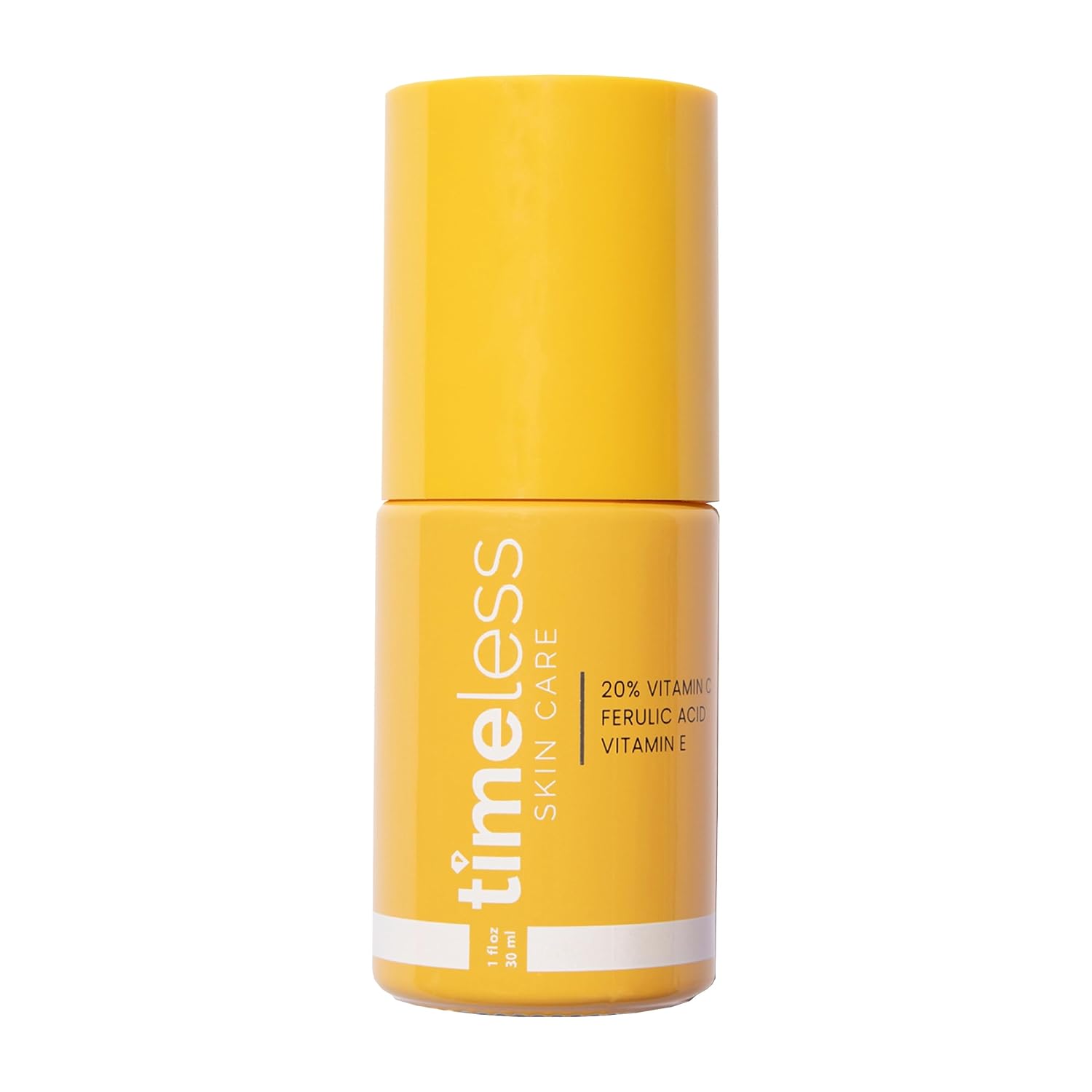 |
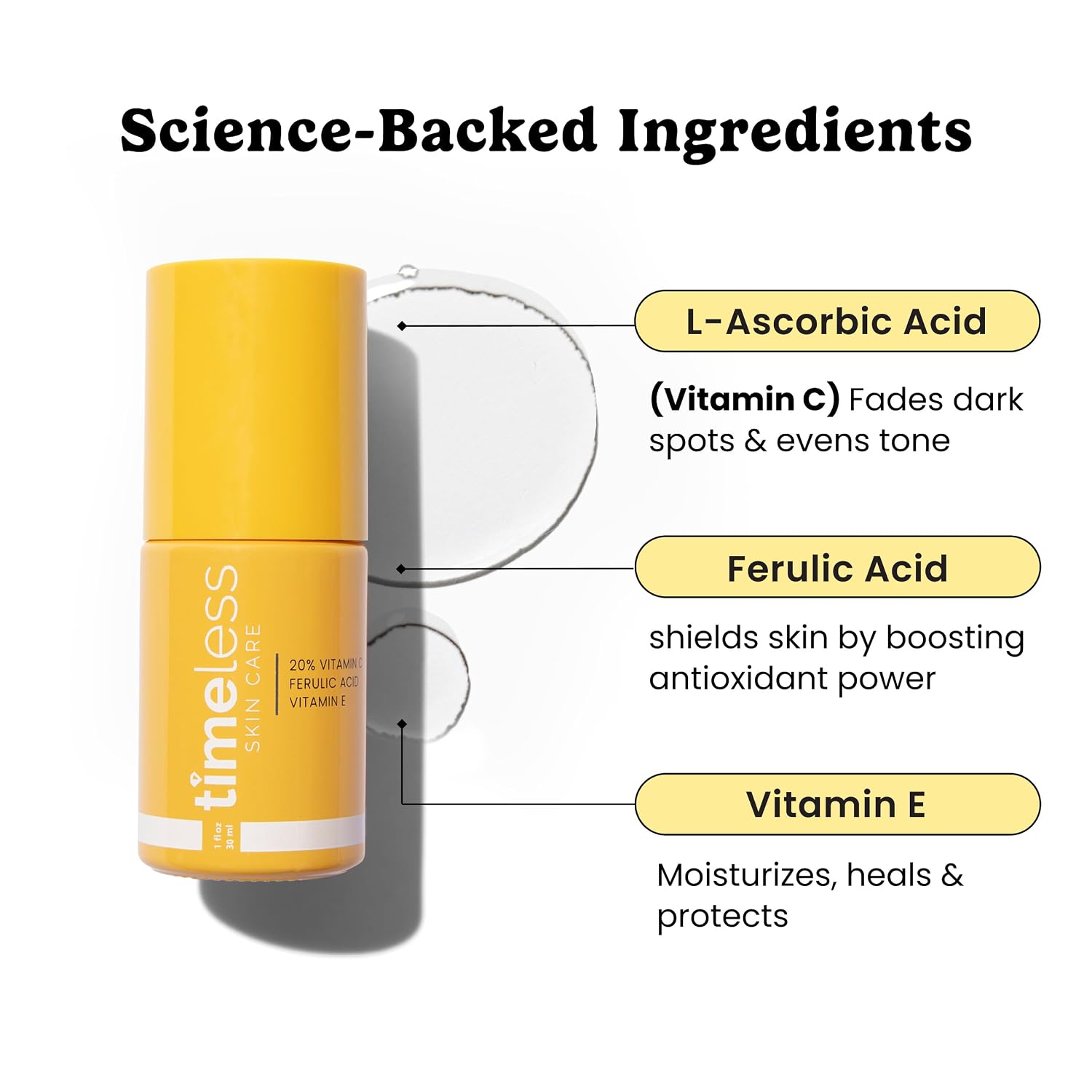 |
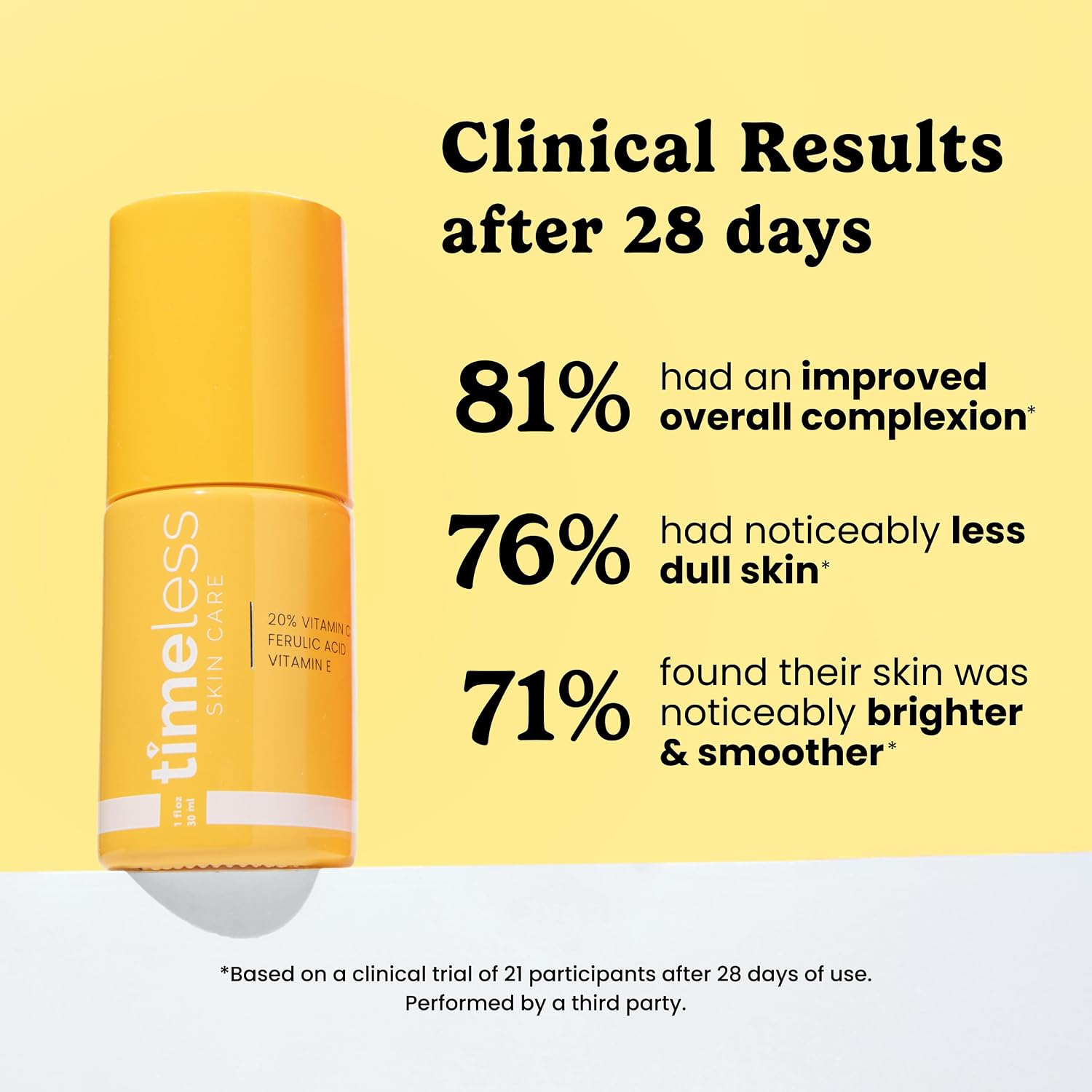 |
| Front of pack: yellow pump bottle, white vertical wordmark, three actives listed beside a hairline rule, fill size printed at the base. Source: Amazon |
Ingredient callouts: L-ascorbic acid, ferulic acid and vitamin E each tagged with a function line, against a serum droplet. Source: Amazon |
Clinical panel: 81% improved complexion, 76% less dull skin, 71% brighter and smoother, footnoted to a 21-participant 28-day third-party trial. Source: Amazon |
The listing exposes seven gallery images; the first three in carousel order are shown. No buyer photographs were available on this capture, so no customer imagery appears in this dossier.
1.3 Where it sits in the brand's own range
| Product | Price | Rating | Primary benefit | Target concern | Key ingredients |
|---|---|---|---|---|---|
| This serum, 1 oz | $27.95 | 4.3 (14,154) | Brightening, evens tone | Dullness, hyperpigmentation | 20% vitamin C, ferulic acid, vitamin E |
| Vitamin B5 Serum, 1 oz | $24.95 | 4.5 (365) | Restores barrier, soothes | Dehydrated, blemish-prone | Vitamin B5, hyaluronic acid |
| Hydrating Eye Cream, 0.5 oz | $23.95 | 4.3 (383) | Hydrates, reduces puffiness | Dehydration, ageing, wrinkles | Matrixyl 3000, rose oil, HA |
| Squalane Oil 100%, 1 oz | $12.95 | 4.6 (5,755) | Minimises moisture loss and oil | Dryness, blemishes | Pure squalane |
| HA Spray Rose, 4 oz | $20.95 | 4.5 (508) | Hydrates, refreshes | Dehydrated skin | Matrixyl 3000, aloe |
This is the most expensive item of the five in absolute terms and carries the largest rating base by a factor of four. The brand is merchandising it as the premium entry, and the comparison block confirms it contains no peptides — the peptide story belongs to the eye cream and the spray.
2. Product rating and buyer response
4.3 out of 5, from 14,154 ratings. That is a mature record: enough volume that the aggregate is stable, and old enough that the distribution reflects several packaging generations rather than one.
2.1 Star distribution
The shape is top-heavy but not clean. 82% of ratings sit at four stars or better, yet the one-star bucket at 8% is more than double the two-star bucket at 3%. A small spike at the very bottom with no matching shoulder above it is the signature of a product with one discrete failure mode, not a product that is broadly mediocre — and section 2.2 names that failure mode twice over.
2.2 What the review record actually argues about
Across the eight themes the listing aggregates, three are negative majorities and one is a coin toss:
| Theme | Mentions | Positive | Negative | Positive share | Reading |
|---|---|---|---|---|---|
| Effectiveness | 2,496 | 1,912 | 584 | 77% | Settled positive |
| Skin benefits | 852 | 644 | 208 | 76% | Settled positive |
| Value for money | 737 | 574 | 163 | 78% | Settled positive |
| Skin colour | 623 | 329 | 294 | 53% | Split — glow versus turning orange |
| Skin irritation | 415 | 188 | 227 | 45% | Split, leaning negative |
| Consistency | 414 | 138 | 276 | 33% | Negative majority |
| Oxidation | 383 | 108 | 275 | 28% | Negative majority |
| Fragrance | 587 | 158 | 429 | 27% | Weakest theme on the page |
The commercial reading is unusually clean: the product's efficacy story is won, and its experience story is not. Buyers agree it brightens and that it is worth the money; they disagree about what it smells like, whether it is a liquid or water, and how fast it turns. Oxidation and fragrance are two different complaints about the same chemistry — a 20% ascorbic acid serum at low pH is intrinsically unstable and intrinsically odorous as it degrades.
2.3 The review summary, in the listing's own words
Customers find the Vitamin C serum effective and appreciate its value for money, noting it evens skin tone and helps with dark spots. The product receives mixed feedback about its consistency, with some describing it as clear liquid while others find it watery, and customers disagree on whether it's suitable for sensitive skin. Moreover, customers report mixed experiences with the product's color, with some saying it makes skin glow while others mention it turning dark orange, and there are concerns about quick oxidation. Additionally, the fragrance receives negative feedback, with several customers describing it as terrible.
The summary and the theme tally agree wherever they overlap, which is the one consistency check available here. Note what the summary does not say: it contains no claim about efficacy decay over time, and no claim about packaging failure, so neither is asserted in this report.
2.4 What could not be collected
Individual review text and buyer photographs did not render on this capture. The page was fetched cold, the delivery context was verified as United States, and three escalating fallbacks were attempted — mobile rendering, a non-US context render, and a retry sequence with a fresh session each time. No review body appeared at any point, and the buyer-photo carousel reported zero image tiles. Consequently this dossier quotes no reviewer, reproduces no buyer language beyond the aggregate summary above, and shows no customer imagery. The rating, the histogram and the theme tally are unaffected.
3. Product ingredients
The formula is short: eleven ingredients. For a serum selling on a 20% active, a list this short is itself the positioning — there is very little room in it for texture modifiers, and almost none for decoration.
3.1 The complete list
| # | Ingredient | Function | Comedogenic | Irritancy | Role in this formula |
|---|---|---|---|---|---|
| 1 | Water | Skin conditioning | — | — | Base |
| 2 | Ethoxydiglycol | Humectant | 0 | 0 | Solvent; improves spread and penetration |
| 3 | Ascorbic Acid | Antioxidant | — | — | The 20% active |
| 4 | Propylene Glycol | Humectant | 0 | 0 | Humectant and penetration enhancer |
| 5 | Tocopherol | Antioxidant | 0–3 | 0–3 | Vitamin E; second antioxidant |
| 6 | Polysorbate 80 | Emulsifying | 0 | 0 | Solubiliser |
| 7 | Panthenol | Skin conditioning | 0 | 0 | Soothing humectant |
| 8 | Ferulic Acid | Antimicrobial | — | — | Stabilises the two vitamins |
| 9 | Sodium Hyaluronate | Humectant | 0 | 0 | Humectant |
| 10 | Benzyl Alcohol | Perfuming | — | — | Preservative; also a fragrance component |
| 11 | Dehydroacetic Acid | Preservative | — | — | Second preservative |
A dash means the database carries no rating for that ingredient. It does not mean zero risk. A printed range such as 0–3 means sources disagree, and every judgement here uses the upper bound.
3.2 The claim matrix, and the fragrance question
| Claim | Holds | Basis |
|---|---|---|
| Oil-free | Yes | No oil-phase ingredient in the list |
| Paraben-free | Yes | Preservation is benzyl alcohol plus dehydroacetic acid |
| Silicone-free | Yes | No silicone in the list |
| Sulfate-free | Yes | No sulfate surfactant in the list |
| Vegan | Yes | Asserted |
| Cruelty-free | Yes | Brand-level certification claim, not a formula property |
| Pore-clogger-free | Yes | Nothing on the tracked trigger list |
| Reef-safe | Yes | Nothing on the tracked restriction list |
| Fragrance-free | No | One fragrance-functioning ingredient: benzyl alcohol |
| Alcohol-free | No | Same single ingredient: benzyl alcohol |
| EU-allergen-free | No | Benzyl alcohol is a declarable allergen |
| Fungal-acne-safe | No | One ester flagged: polysorbate 80 |
Four claims fail, and three of the four point at a single molecule. That is worth stating precisely, because the marketing and the database are both right:
- No
Parfumand noFragranceappears anywhere in the eleven-row list, and no classic allergen such as limonene or linalool appears either. The brand's "zero fragrances" claim is literally true. - Benzyl alcohol is a preservative that also functions as a fragrance component and carries an allergen labelling obligation. That single entry is what fails the fragrance-free, alcohol-free and EU-allergen-free badges at once.
- So the accurate statement is: no added perfume, one fragrance-functioning preservative. A shopper avoiding fragrance for sensitisation reasons should read that as not fragrance-free in the labelling sense — and it explains why the fragrance theme in section 2.2 runs at only 27% positive despite the "unscented" spec.
The fourth failure is separate and mechanical: polysorbate 80 is an ester, and esters sit on the fungal-acne trigger list regardless of concentration. It is also the formula's only solubiliser, which is what keeps the oil-soluble tocopherol dispersed.
3.3 Ingredient roles, counted
Seven functions across eleven ingredients, and the humectant group is the largest — three of eleven. Note the ordering effect: two humectants (positions 2 and 4) sit ahead of the ascorbic acid at position 3. This is a delivery-oriented formula, in which solvents and penetration enhancers are dosed before the active rather than after it.
3.4 Risk tiers
| Tier | Count | Ingredients | How to read it |
|---|---|---|---|
| Rated clear (0 / 0) | 5 | Ethoxydiglycol, propylene glycol, polysorbate 80, panthenol, sodium hyaluronate | Graded with no comedogenic or irritant signal |
| Range-rated (0–3) | 1 | Tocopherol | Sources disagree; judged at the upper bound of 3 |
| Unrated | 5 | Water, ascorbic acid, ferulic acid, benzyl alcohol, dehydroacetic acid | No grade exists — missing data, not a clean bill |
The most important number in that table is the one that looks least dramatic: the 20% active has no grade at all. Ascorbic acid is unrated on both the comedogenic and irritant columns, so this table cannot be read as a safety verdict on the ingredient the product is sold on. The sting risk is carried elsewhere — in the three class-level concerns below, which all describe the same chemistry.
3.5 Concerns flagged at ingredient-class level
| Concern | What it means | Why it applies here |
|---|---|---|
| May worsen eczema | May increase itching or irritation on eczema-prone skin | 20% ascorbic acid at low pH |
| May worsen irritation | May cause stinging, redness or sensitivity | Same; strongest on compromised barrier |
| May worsen rosacea | Can trigger flare-ups in rosacea-prone skin | Same; acidity plus penetration enhancers |
These are class-level warnings about a formula type, not predictions about any individual. They are also the honest counterweight to a listing that markets the product for "all" skin types: the formula is appropriate for tolerant skin and is a known sting risk for reactive skin. Both of the two humectants ahead of the active — ethoxydiglycol and propylene glycol — are penetration enhancers, which increases rather than reduces that exposure.
3.6 What the formula promises, weighted
| Benefit | Ingredients delivering it | Weight |
|---|---|---|
| Anti-ageing | 4 | Strongest claim in the formula |
| Hydrating | 4 | Strongest claim in the formula |
| Brightening | 3 | Core marketed benefit |
| Redness reducing | 3 | Panthenol plus the two vitamins |
| Scar healing | 3 | Follows from the brightening actives |
| Barrier repair | 3 | Panthenol, tocopherol |
| Dark spots | 2 | The headline commercial claim |
| Reduces irritation | 1 | Single ingredient carries it — weak evidence |
| Skin texture | 1 | Single ingredient carries it — weak evidence |
Read the two ends of that table together. The claims the brand actually sells on — brightening and dark spots — are backed by three and two ingredients, which is proportionate in an eleven-ingredient formula. The two claims backed by a single molecule each should be treated as incidental rather than designed.
3.7 Coverage and the missing cross-check
This ingredient analysis rests on one database channel, and that is a real limitation rather than a formatting detail. A second, independent ingredient database that would normally supply its own per-ingredient acne, irritant and safety grades — and a row-count comparison against the official INCI — could not be read on this date. All access paths to it returned a bot-verification page, for the fourth consecutive collection day.
What that costs the analysis: no second grading to corroborate the comedogenic and irritancy columns above, and no independent count to confirm that this eleven-row list matches the current pack. Formula-version drift therefore cannot be ruled out, and the ingredient content should be read as one database's record of one point in time. Nothing was substituted to fill the gap: the table above is not a composite, and no grade in it was inferred.
4. Product price
| Price element | Value |
|---|---|
| Current price | $27.95 |
| List price | Not published — no comparison price is shown |
| Discount or coupon | None |
| Subscribe & save | $25.15, a 10% step down |
| Unit price | $27.95 per fluid ounce |
| Delivery | Free over $35; a paid same-day window is offered |
Two structural facts matter more than the number. First, there is no list price, so a shopper sees a single figure with no anchor and no struck-through comparison — there is nothing to discount from, which leaves Subscribe & Save as the only promotional lever on the page. Second, the buy box is held by a third-party seller shipping from Amazon, and the live buy-box figure matches the tracked Amazon-retail figure to the cent (section 4.2). The two channels have converged at $27.95.
4.1 The price record, compared
| Price type | Lowest ever | Highest ever | Current | Average |
|---|---|---|---|---|
| Amazon retail | $13.99 (9 Nov 2022) | $27.95 (8 Oct 2026) | $27.95 (8 Oct 2026) | $24.46 |
| Third-party new | $3.82 (5 Mar 2023) | $69.99 (7 Oct 2014) | $27.95 (26 Sep 2026) | $24.20 |
| Third-party used | $15.24 (22 May 2017) | $21.55 (19 May 2017) | No current offer | $17.35 |
All figures are all-time values as published by the tracker; none is a period statistic. The current figures are last observations dated 8 October and 26 September 2026, not live quotes.
4.2 Where today's price sits
| Benchmark | Amazon retail | Third-party new |
|---|---|---|
| Versus all-time low | +99.8% | +631.7% |
| Versus all-time high | 0.0% — today is the high | −60.1% |
| Versus all-time average | +14.3% | +15.5% |
| Versus the $25.99 list | +7.5% | +7.5% |
Dated observations only. The tracker publishes five values per channel, not a daily series, so the path between these anchors is unknown and no interpolation is shown.
Three readings follow from the record, and they point the same way:
- This is a full-price market. The current figure is simultaneously the all-time high and 14% above the all-time average, on a product whose price has never been discounted below a $25.99 nominal list for long enough to register as an average.
- The two extreme third-party values are noise, not market prices. A $69.99 high dated October 2014 — years before the Amazon series shows its own low — is the classic signature of a launch listing or a single reseller offer. A $3.82 low in March 2023 is roughly 14% of today's price and is not a plausible figure for a one-ounce serum from an authorised seller. Both are reported as published and both are excluded from the interpretation, though they do mechanically pull the third-party average.
- The two channels are not competing on price. Identical current values, and historical averages 26 cents apart. With one price wearing two labels, the buy box is a fulfilment arrangement rather than a price signal.
4.3 Volatility
| Channel | Spread (high minus low) | Spread as share of low |
|---|---|---|
| Amazon retail | $13.96 | 99.8% — a two-times band across eleven years |
| Third-party new | $66.17 | 1,732.2% — dominated by the two extremes above |
| Third-party used | $6.31 | 41.4% — narrow, and confined to one week in 2017 |
The used market is the quietest signal on the page and the most telling: its high and low fall three days apart in May 2017, and it has recorded no current offer at all. That describes a brief resale burst, not a functioning secondary market — which is what one would expect for a consumable at this price point.
5. Verdict
| Question | Answer | Confidence |
|---|---|---|
| Is the efficacy claim supported? | Yes, by volume and by aggregate: 77% positive on effectiveness across 2,496 mentions, and 4.3 stars from 14,154 ratings | High |
| Is the "zero fragrance" claim true? | Literally yes; practically it carries one fragrance-functioning preservative, and buyers notice | High |
| Is the formula appropriate for reactive skin? | Not without caution — 20% ascorbic acid at low pH, with two penetration enhancers ahead of it | Medium-high |
| Is the price competitive? | It is a full-price market with no discount architecture and channel parity; the price is at its own all-time high | High |
| Is the ingredient list complete and verified? | Complete as one database records it; not independently verified against the pack | Medium |
| Are buyer voices represented? | Only in aggregate — no review text or buyer photography rendered | Low |
6. Method and limits
Method. One capture on 31 October 2026, with the delivery address set to a United States ZIP code before any price was read and the currency pinned to US dollars. All prices are native USD; none was converted, estimated or given as a range. Gallery images were downloaded at 1500 pixels. Rating, star histogram and theme tally come from the same capture. No reviewer name, handle, identifier or profile link was collected, and none appears in this dossier. Ingredient grading is drawn from a community database and is reference material, not a regulatory or dermatological finding.
| Element | Confidence | Basis |
|---|---|---|
| Price and currency | High | US delivery context verified in the rendered page; USD price present |
| Rating and star distribution | High | Rendered directly |
| Specifications and claims | High | Rendered directly |
| Theme tally | Medium-high | Aggregate generated by the marketplace; rounding not disclosed |
| Review summary | Medium | A model-written abstract, not buyer text |
| Ingredient list | Medium | Single channel; no independent count check |
| Individual ingredient grading | Low | Six of eleven rows rated; five unrated |
| Price statistics | High for values, medium for recency | Current figures 23 and 35 days old at capture |
| Buyer reviews and photos | None collected | Did not render; not reconstructed |
- Review bodies and buyer photographs did not render; no verbatim buyer language appears here.
- The second ingredient database was unreachable, so formula-version drift against the current pack cannot be excluded.
- Price statistics are all-time only by nature of the source; no period-specific low, high or average exists in this record.
- Current price observations are 23 and 35 days old at capture and should be re-verified before any transaction.
- Sales rank is a single observation and moves between captures.
- Twelve product codes map to this single listing, so packaging generations cannot be separated in the review record.
Snapshot captured 31 October 2026 with a United States delivery context. Prices in US dollars, unconverted. Price and rank move; treat every figure as an observation of that date.