Product file · Toner
A 150 ml licorice-water toner sold on a pH 5.5 claim, a brightening claim and a sensitive-skin claim. The first two hold up as formula facts. The third is where the record gets interesting: the formula carries a declared fragrance oil and both of its allergens, and 8 of 29 ingredient rows sit at moderate risk or above.
Captured 27 October 2026 · Amazon US, delivery ZIP 10001 · all prices in USD · 150 ml / 5.07 fl oz
The short version
- It is a fragrance-free product on the label and a fragranced formula on the list. Bergamot fruit oil at position 17, limonene at 18 and linalool at 19. The brand's sensitive-skin line and the EU-allergen badge do not both survive that.
- 20 of 29 ingredient rows sit at level 2 or below on the safety scale, and the risk that exists is concentrated: one preservative band, one fragrance cluster, one glycol. There is no single ingredient carrying the whole formula's risk.
- The price is ordinary for this listing, not a deal. $15.70 is 12.8% under the published list price and 5.4% over the product's own all-time average; the $9.00 floor from March 2024 was an event, not the norm.
Product information
ACWELL's Licorice line is built on one idea - glycyrrhizin from licorice root as a brightening and soothing agent - and this toner is the cheapest way into it. The formula leads with water and Glycyrrhiza Glabra Root Water, adds two PEG esters for a light solubilised cleanse, and finishes with six botanical extracts, a vitamin E ester and a pH buffer. It is declared alcohol-free, it carries no silicone, no sulfate and no paraben, and it is sold in one size: 150 ml, item form liquid.
The step it is designed for matters more than the ingredient list. This is a wipe-off toner applied to a cotton pad after cleansing, not a hydrating essence patted in. That is why it contains surfactants at all - PEG-6 caprylic/capric glycerides and PEG-7 glyceryl cocoate are there to lift residue, and why the brand's own routine chart puts it between the toner pad and the ampoule. Read as a second, gentler cleanse, the formula makes sense; read as a treatment toner, it is underpowered.
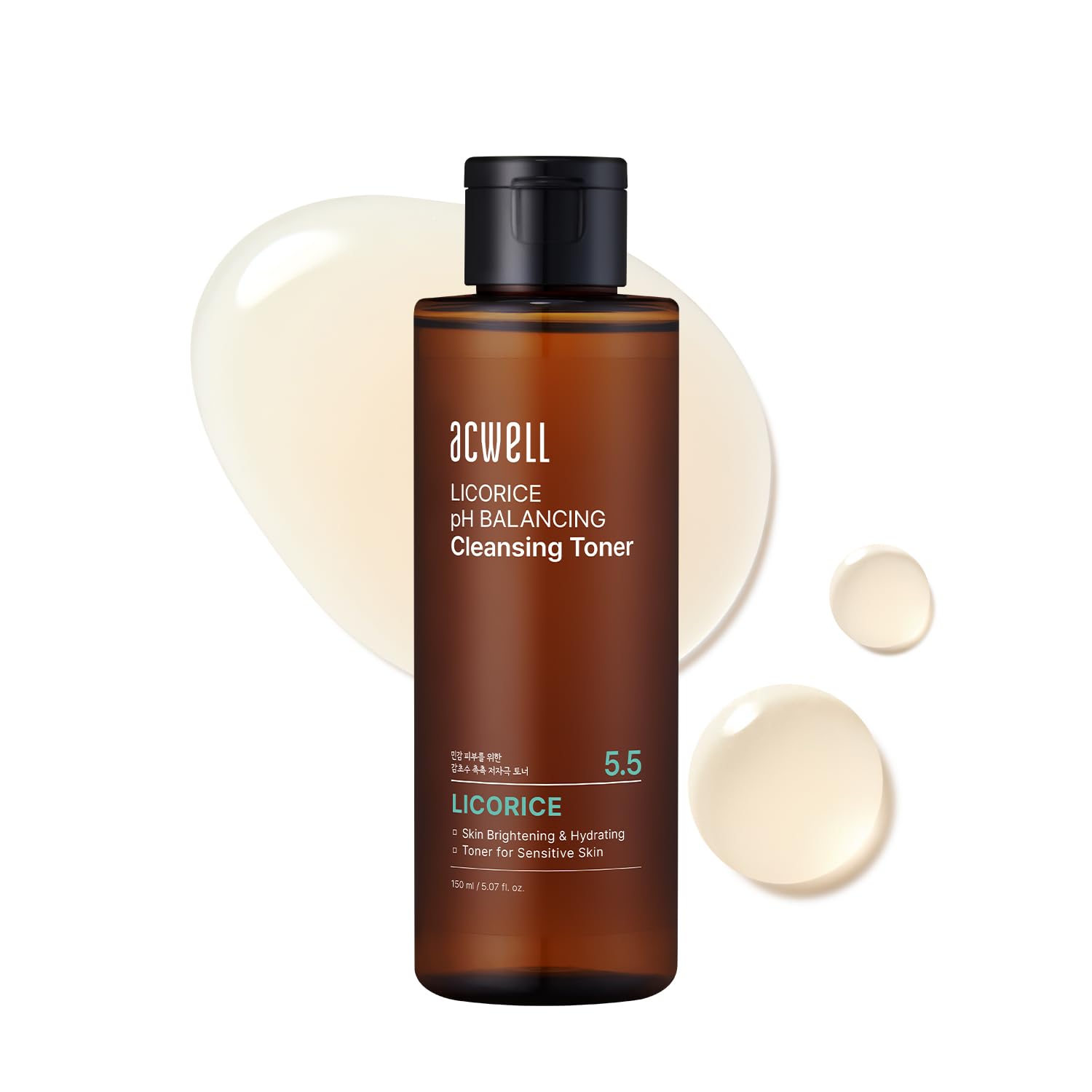
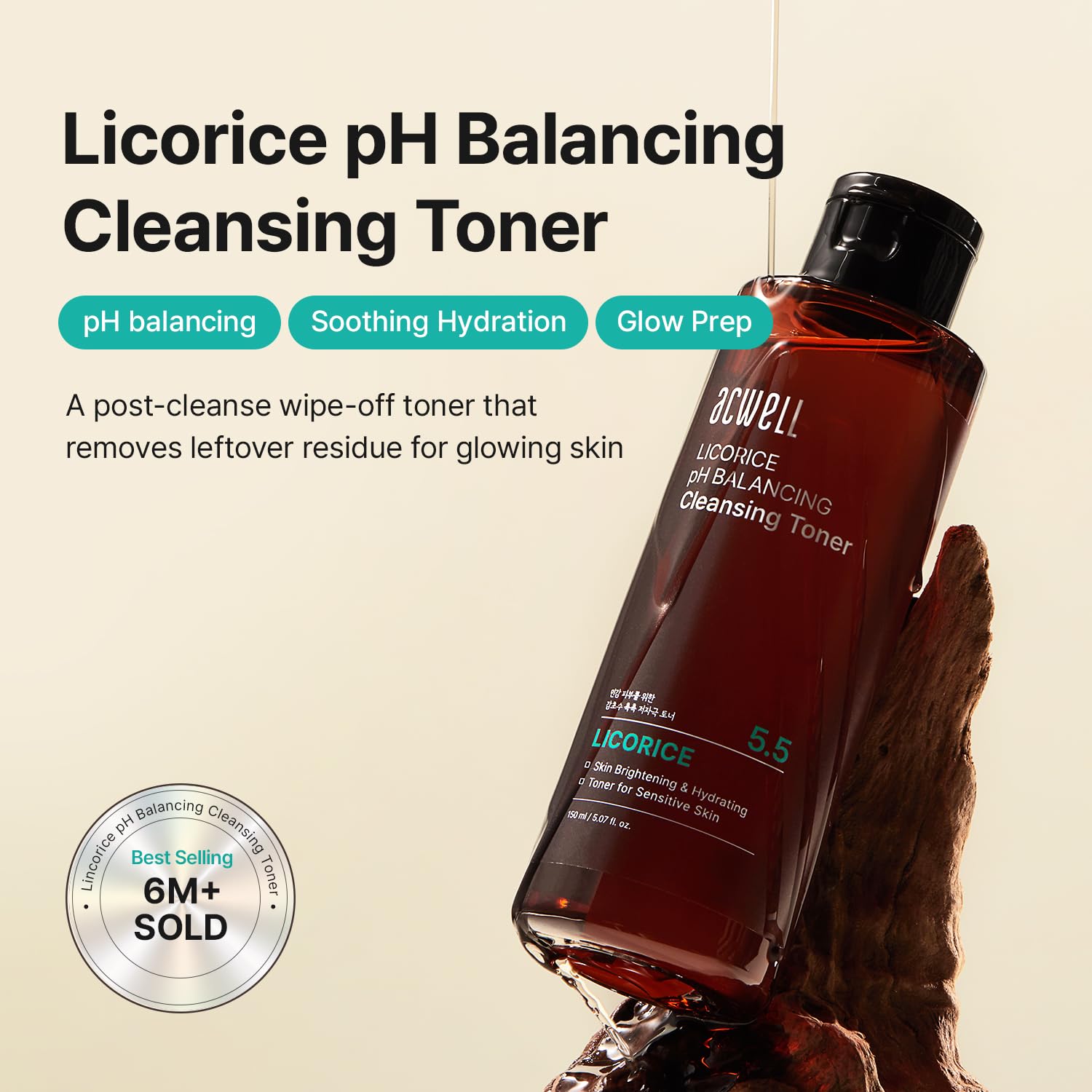
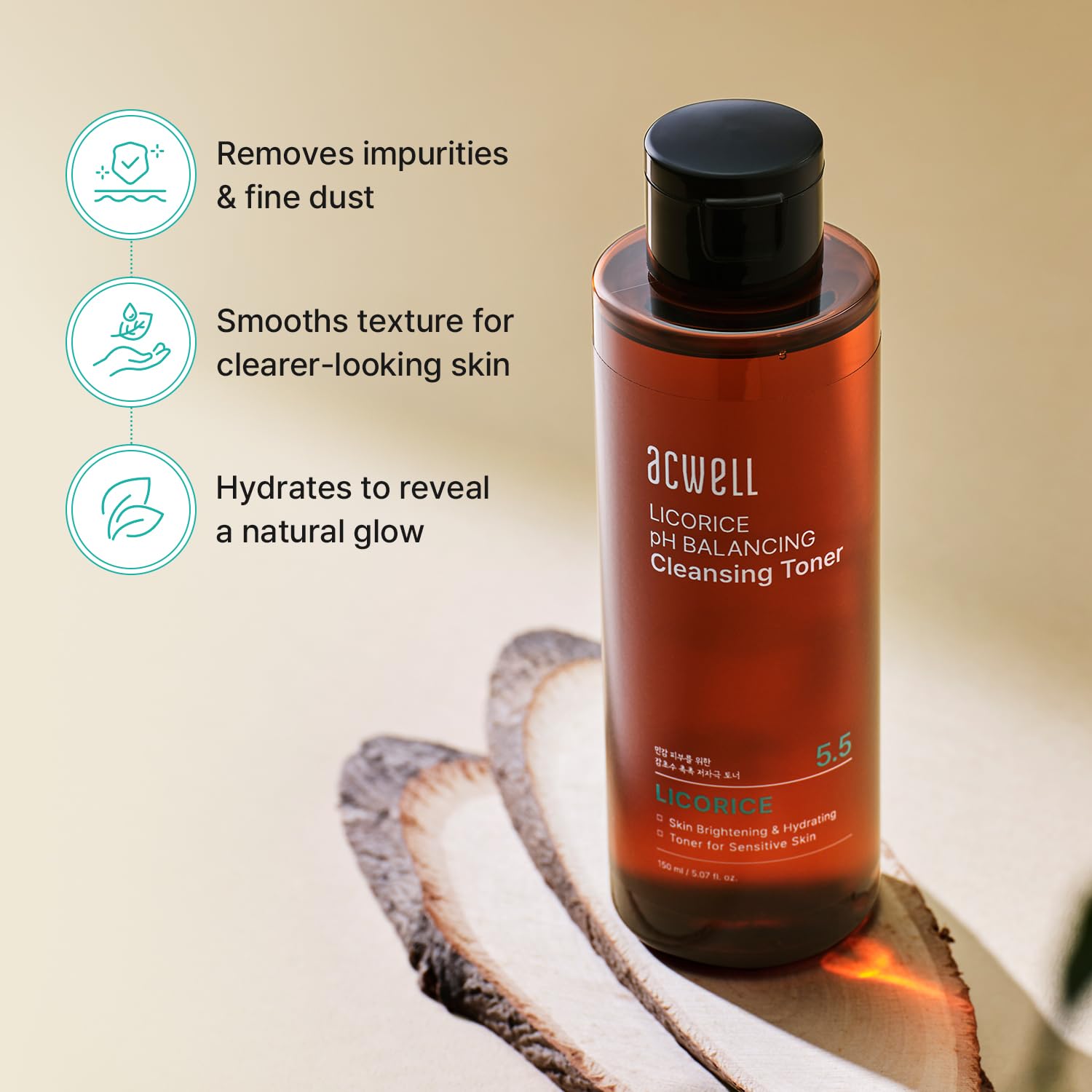
The three listing images, in carousel order. Each frame sells the pH and the licorice; none of them names the fragrance component that the ingredient list declares at position 17.
Declared specification
What the brand claims
- <b>LICORICE-POWERED BRIGHTENING TONER.</b> Formulated with licorice root water and licorice extract to help improve the look of dullness, uneven tone, and post-blemish marks for a clearer-looking complexion.
- <b>pH 5.5 SKIN-BALANCING FORMULA.</b> Designed with a skin-friendly pH level to help support the skin’s natural moisture barrier without leaving the skin feeling stripped or tight.
- <b>HYDRATING & CLARIFYING CLEANSING TONER.</b> Helps remove leftover impurities, oil, sunscreen, and residue after cleansing while adding lightweight hydration to refresh the skin.
- <b>SOOTHING BOTANICAL INGREDIENTS.</b> Enriched with green tea, peony root, and perilla seed extracts to help calm, comfort, and support healthy-looking skin.
- <b>SUITABLE FOR DAILY USE.</b> Lightweight, alcohol-free toner suitable for normal, combination, oily, dull, and mildly sensitive skin types. Use after cleansing and before serum or moisturizer.
Two details in that table are worth pulling out. The rank line - #21 in Facial Toners & Astringents - is a live figure and moves daily; treat it as a position on the capture date, not a settled fact. And the manufacturer of record is BNH cosmetics, which is the contract manufacturer, not the brand: useful if you are matching this bottle against a COSDNA entry, since some entries are filed under the manufacturer.
Product rating and buyer voice
Amazon's own rounded percentage shares. The 84% five-star block is the headline; the 3% one-star block is about 96 ratings, and that is the sample any reading of the weak points has to come from.
A 4.7 from 3,191 ratings is a mature figure - it is not going to move on a handful of reviews, and it is high enough that the interesting information sits in the tail rather than the average. The distribution is steeply top-weighted: 84% five-star, 8% four-star, and then a long thin tail of 4% three-star, 1% two-star and 3% one-star. Roughly one in thirty buyers lands in the bottom two buckets.
The aspect table is where that tail becomes legible. Effectiveness, appearance and moisturising all score in the 90s, which matches how the product is marketed and how it is used. The two aspects that break the pattern are gentleness at 60% and skin compatibility at 81% - the same two aspects that a fragranced formula would be expected to dent, and the same two that the ingredient screen flags.
What the ratings talk about
Amazon's review-summary model counts how many reviews mention each aspect and how many of those mentions are positive. The counts, not the percentages, carry the weight: 365 effectiveness mentions against 73 for gentleness means the gentleness signal is real but small.
Green is positive mentions, red is negative. The bars are counts, so a short bar with a poor ratio (gentleness) can matter more than a long bar with a good one (effectiveness).
| Aspect | Mentions | Positive | Negative | Positive share |
|---|---|---|---|---|
| Effectiveness | 365 | 330 | 35 | 90% |
| Skin Compatibility | 217 | 175 | 42 | 81% |
| Skin Appearance | 91 | 87 | 4 | 96% |
| Moisturizing | 90 | 89 | 1 | 99% |
| Scent | 85 | 78 | 7 | 92% |
| Gentleness | 73 | 44 | 29 | 60% |
| Value For Money | 70 | 57 | 13 | 81% |
| Skin Feel | 68 | 64 | 4 | 94% |
The gap between 99% on moisturising and 60% on gentleness is the whole story of this product in one comparison. People are not describing a product that failed; they are describing one that works and stings. That is a formula characteristic, not a batch defect, and it points at the same three positions the ingredient table flags - phenoxyethanol, bergamot oil and the glycols.
One caution on the aspect counts: they are generated from all reviews on the listing, not from the reviews quoted below (there are none quoted - see the note). Percentages are rounded to whole numbers, so a 99% can be anything from 98.5% up, and small aspects with 68-73 mentions can move several points on a few reviews.
What review text is available
Product ingredients
Two independent ingredient sources were merged for this part: COSDNA, which publishes an acne-risk, irritant and safety grade per ingredient, and Skinsort, which publishes the claim matrix, the concern list and its own comedogenic and irritancy columns. COSDNA lists 29 rows for this product; Skinsort lists 27. The two lists are identical in order and differ only in that Skinsort omits limonene and linalool - which is worth remembering when the fragrance badges are read.
How the levels are assigned
Each ingredient is placed in a level equal to the upper bound of its COSDNA safety band: a printed 1 is level 1, a 1-2 is level 2, a 2-4 is level 4, a 5 is level 5. Ranges are read high on purpose - the lower number understates a grade the database also permits. Two points about the scale: safety is inverse (1 is safest, 5 is most flagged), and a blank cell is unrated, not zero risk. One row in this formula has no grade at all.
| Level | Rows | Share |
|---|---|---|
| Level 1 minimal | 13 | 45% |
| Level 2 low | 7 | 24% |
| Level 3 moderate | 4 | 14% |
| Level 4 elevated | 3 | 10% |
| Level 5 high | 1 | 3% |
| Unrated unrated | 1 | 3% |
Level counts across all 29 rows. The shape is a long low-risk floor with a short stack of flagged rows on top - 20 rows at level 2 or below against 8 at level 3 or above.
Read the distribution as a shape rather than a score. Two-thirds of the formula is unremarkable - water, two PEG esters, three glycols, a buffer pair and six botanical extracts, most of them graded at level 1 or ungraded entirely. The risk that exists is clustered in three places: the preservative system (phenoxyethanol, band 2-4), the fragrance system (bergamot oil 3-4, limonene 3, linalool 3-4) and one glycol at position 28 (propylene glycol, 3). Everything else is a 1 or a 2.
That clustering is the practical finding. It means the formula is not diffusely irritating - it is irritating in a way that can be traced to a short list, and two of those three clusters are there for reasons a formulator could have avoided. The fragrance is a marketing choice; the preservative is a necessity; the propylene glycol at position 28 is a texture decision.
Function groups
Botanical extracts are the largest single group at 11 rows, and they are also the least graded - which is why the level chart is more informative than a count of 'natural' ingredients. The fragrance group is only 3 rows but holds the tightest concentration of level 3 and 4 grades in the formula.
What is inside, claim by claim
Skinsort publishes twelve claim badges for this product, each resolved as holding or not holding. A failing claim arrives with a Not prefix; the prefix is stripped here and the verdict is carried by the badge colour and the note, because reading the label alone inverts the meaning.
Seven claims hold and five fail, and the five that fail are not scattered - they are one story. Fragrance-free fails, EU-allergen-free fails for the same reason, oil-free fails because the fragrance is an oil, and fungal-acne-safe fails on the ester and glycol load. The only outlier is vegan, which Skinsort marks as not holding without a parenthetical explanation; the reason is not published on the page and is not inferred here.
The one that matters is fragrance. Skinsort's own note is 'Contains Fragrance', and unlike the cases where that flag rests on botanical extracts with a fragrance function, here it is backed by an explicitly declared fragrance oil and both of its declarable allergens. If you are avoiding fragrance for sensitisation reasons, this is not the toner for you, whatever the listing copy says about sensitive skin. If you are not, the fragrance is the source of the scent that 92% of scent-mentioning reviewers liked.
Flagged rows
Every row carrying acne risk 3+, irritant 3+ or safety 3+. Eight of 29 rows qualify, and the acne column is empty for all of them - this formula's risk is on the safety and irritation axes, not the comedogenic one.
| Ingredient | Pos. | Function | Acne | Irritant | Safety | Level |
|---|---|---|---|---|---|---|
| Poloxamer 184 | 7 | Surfactant, emulsifier | - | - | 2-3 | Level 3 |
| Phenoxyethanol | 8 | Preservative | - | - | 2-4 | Level 4 |
| Citrus Aurantium Bergamia Fruit Oil | 17 | Fragrance | - | - | 3-4 | Level 4 |
| Limonene | 18 | Solvent, fragrance | - | - | 3 | Level 3 |
| Linalool | 19 | Fragrance | - | - | 3-4 | Level 4 |
| Tocopheryl Acetate | 23 | Skin conditioning, antioxidant | 0 | 0 | 2-3 | Level 3 |
| Glycyrrhiza Glabra Root Extract | 24 | Fragrance, anti-inflammatory, emollient | - | - | 5 | Level 5 |
| Propylene Glycol | 28 | Solvent, moisturiser | 0 | 0 | 3 | Level 3 |
One row in that table needs a caveat rather than a reading. Glycyrrhiza Glabra Root Extract at position 24 carries a grade of 5 - the highest anywhere in this formula, on the plant the product is named after, while the same plant's root water at position 2 is ungraded. Two explanations are possible and this page cannot settle either: the grade may reflect the extract's use as a flavouring and fragrance component, or it may be an entry artefact. It is reported as published and treated as an outlier rather than a verdict, because it is a trace-position botanical and it should not be allowed to dominate a summary of a formula whose load-bearing rows are all graded 2 or lower.
The phenoxyethanol band of 2-4 is the single widest range in the formula, and it is the row most often named when toners sting. That is not a reason to avoid the product - phenoxyethanol is one of the most common cosmetic preservatives in use - but it is the reason the gentleness aspect sits at 60% while everything else sits in the 90s.
What independent screening flags
| Concern | As described |
|---|---|
| May Worsen Dryness | Can strip moisture and worsen dryness. |
| May Worsen Eczema | May worsen itching or irritation for eczema. |
| May Worsen Rosacea | Can trigger flare-ups in rosacea-prone skin. |
Read these as class warnings, not predictions. All three trace to the same pair of facts: a fragranced formula and a product whose job is to wipe across the face. They are the reason a patch test is worth the two minutes, and they are consistent with the 60% gentleness score in the review aspect table.
The formula in order
The declaration order, complete, as published. Position 1 is the largest fraction; position 29 the smallest. The licorice appears twice - as root water at 2 and as root extract at 24 - which is how a brand gets an ingredient into the name at two very different doses.
What the formula is actually good at
Hydration and antioxidant support, honestly earned. Six botanical extracts with astringent and antioxidant functions, glycerin and three glycols for water-binding, and a vitamin E ester at 23. Skinsort's benefit counts agree: hydrating is carried by 6 ingredients, and the antioxidant group by 5. This is a competent hydrating wipe-off step, and the 99% moisturising aspect score is consistent with that.
Where the claims outrun the formula
Brightening, dark spots and radiance all rest on one or three ingredients at trace positions. The named active is at position 24 of 29. This does not make the claims false - licorice root water at position 2 is a real input - but a wipe-off product at trace dosing is not going to fade pigment, and the review language reflects that: buyers describe glow and hydration, not fading.
Who should skip it
Anyone avoiding fragrance for sensitisation reasons, and anyone with a rosacea or eczema diagnosis who reacts to essential-oil components - limonene and linalool are both declared, and Skinsort's concern list names rosacea and eczema explicitly. For everyone else the formula is low-risk with a mild sting risk that a patch test resolves in two minutes.
Full ingredient table
All 29 rows, in declaration order, with both channels side by side. The last column is Skinsort's comedogenic and irritancy pair, which is unrated for 26 of 29 rows - the sparsity is the point, not a gap in the capture.
| # | Ingredient | Function | Acne | Irritant | Safety | Level | Skinsort comed. / irrit. |
|---|---|---|---|---|---|---|---|
| 1 | Water | Solvent | - | - | 1 | Level 1 | - / - |
| 2 | Glycyrrhiza Glabra Root Water | Skin conditioning, Antioxidant | - | - | - | Unrated | - / - |
| 3 | PEG-6 Caprylic/Capric Glycerides | Synthetic ester, Emollient, Emulsifier | - | - | 1-2 | Level 2 | - / - |
| 4 | PEG-7 Glyceryl Cocoate | Surfactant | - | - | 1-2 | Level 2 | - / - |
| 5 | Dipropylene Glycol | Solvent, Moisturizer | - | - | 1 | Level 1 | - / - |
| 6 | 1,2-Hexanediol | Solvent | - | - | 1 | Level 1 | - / - |
| 7 | Poloxamer 184 | Surfactant, Emulsifier | - | - | 2-3 | Level 3 | - / - |
| 8 | Phenoxyethanol | Preservative | - | - | 2-4 | Level 4 | - / - |
| 9 | Glycerin | Solvent, Viscosity Control, Skin conditioning, Moisturizer | 0 | 0 | 1-2 | Level 2 | 0 / 0 |
| 10 | Butylene Glycol | Solvent, Fragrance, Viscosity Control, Skin conditioning, Moisturizer | 1 | 0 | 1 | Level 1 | 1 / 0 |
| 11 | Rheum Palmatum Root Extract | Skin conditioning, Astringent | - | - | 1 | Level 1 | - / - |
| 12 | Psidium Guajava Leaf Extract | Skin conditioning, Astringent | - | - | 1 | Level 1 | - / - |
| 13 | Rosa Centifolia Flower Extract | Skin conditioning, Astringent | - | - | 1 | Level 1 | - / - |
| 14 | Camellia Sinensis Leaf Extract | Skin conditioning, Moisturizer, Antioxidant, Astringent, Sunscreen, Emollient | - | - | 1-2 | Level 2 | - / - |
| 15 | Perilla Ocymoides Seed Extract | Antioxidant, Plant extract | - | - | 1 | Level 1 | - / - |
| 16 | Poncirus Trifoliata Fruit Extract | Skin conditioning | - | - | 1 | Level 1 | - / - |
| 17 | Citrus Aurantium Bergamia Fruit Oil | Fragrance | - | - | 3-4 | Level 4 | - / - |
| 18 | Limonene | Solvent, Fragrance | - | - | 3 | Level 3 | - / - |
| 19 | Linalool | Fragrance | - | - | 3-4 | Level 4 | - / - |
| 20 | Sodium Citrate | pH Adjusters, Antioxidant | - | - | 1 | Level 1 | - / - |
| 21 | Disodium EDTA | Viscosity Control | - | - | 2 | Level 2 | - / - |
| 22 | Citric Acid | pH Adjusters | - | - | 1-2 | Level 2 | - / - |
| 23 | Tocopheryl Acetate | Skin conditioning, Moisturizer, Antioxidant | 0 | 0 | 2-3 | Level 3 | 0 / 0 |
| 24 | Glycyrrhiza Glabra Root Extract | Fragrance, Skin conditioning, Anti-inflammatory, Emollient | - | - | 5 | Level 5 | - / - |
| 25 | Paeonia Lactiflora Root Extract | Skin conditioning | - | - | 1 | Level 1 | - / - |
| 26 | Cimicifuga Dahurica Root Extract | Antioxidant, Plant extract | - | - | 1 | Level 1 | - / - |
| 27 | Pueraria Lobata Root Extract | Moisturizer | - | - | 1 | Level 1 | - / - |
| 28 | Propylene Glycol | Solvent, Viscosity Control, Moisturizer | 0 | 0 | 3 | Level 3 | 0 / 0 |
| 29 | Ethylhexylglycerin | - | - | - | 2 | Level 2 | - / - |
Two scales in one table: the Acne / Irritant / Safety columns are COSDNA's 0-5 grades (safety inverse, 1 safest), and the final column is Skinsort's comedogenic / irritancy pair (0 safest). A dash means unrated on that channel, never zero.
Product price
Price history for this listing is tracked across three channels, and only one of them has ever recorded a price. That is not a capture failure - the product has been sold by the brand and fulfilled by Amazon throughout, so no Amazon-retail price exists to record, and the used market for a sealed cosmetic is empty. Everything below is the third-party new channel.
| Price type | Lowest ever | Highest ever | Current | Average |
|---|---|---|---|---|
| Amazon | - | - | - | - |
| 3rd Party New | $9.00 Mar 11, 2024 | $35.99 Jun 04, 2024 | $15.70 Oct 19, 2026 | $14.89 |
| 3rd Party Used | - | - | - | - |
The summary block as published. Current is a last-observation value dated 19 October 2026, eight days before this capture - the live listing showed the same $15.70, so the record is current in substance. Note the list price conflict: this source publishes $18.00, the Amazon listing displayed $22.00 with a 29% saving on the same day. Both are reported as published; $18.00 is used for every ratio below.
The same table as bars
Four numbers from one channel, side by side. The distance between the $9.00 floor and the $35.99 ceiling is the thing to notice - a 300% spread inside three months is marketplace mechanics, not demand.
Dated observations
Only dated observations exist, five per channel - there is no observation-level change history. This line therefore connects extremes and last-known values; it does not show the path the price took between them.
Position against every benchmark
| Measure | Value | Basis |
|---|---|---|
| Current vs lowest ever | +74.4% | $15.70 against the $9.00 low of 11 Mar 2024 |
| Current vs highest ever | -56.4% | $15.70 against the $35.99 high of 04 Jun 2024 |
| Current vs all-time average | +5.4% | $15.70 against the $14.89 average |
| Current vs list price | -12.8% | $15.70 against the $18.00 list on this source |
| Average vs list price | -17.3% | $14.89 against the $18.00 list |
| All-time spread | $26.99 | 299.9% of the $9.00 low |
| Amazon channel | No data | No Amazon-retail price was ever recorded for this listing |
| Subscribe & Save | $14.13 | 36% below list, as displayed on the listing at capture |
| Unit price | $3.10 / fl oz | As displayed on the listing; derived from the 5.07 fl oz fill |
The honest summary of the current price is that it is ordinary. It sits 5.4% above the product's own all-time average and 12.8% below list, which is where a steady third-party listing lives. The two dramatic numbers in the table - 74.4% above the low and 56.4% below the high - describe two events, not a range anyone actually paid across.
The $35.99 high in June 2024 is the one figure to distrust as a market signal. A licensed toner at twice list, six months after a $9.00 low, is the shape of a stock-out or a reseller offer rather than a demand-driven peak. The same caveat applies to the $9.00 low: half of list is a promotion, not a new normal. Strip both out and the credible operating band for this product is roughly $13 to $18, with the current price at the upper end of it.
With only one channel there is no cross-channel comparison to run - no marketplace premium, no parity test. What replaces it is the Subscribe & Save offer on the listing itself: $14.13, or 36% off list, which is below the all-time average and close to the credible band's floor. If the product suits you, that is the cheaper route, and it is visible on the listing rather than in any price history.
How this was assembled, and how far to trust it
Method
- Listing data - title, breadcrumb, specification table, bullets, price block, rating and star shares, aspect counts - read from the Amazon US product page with the delivery address set to ZIP 10001, so every price is native USD. No currency was converted at any point.
- Product images: the first three carousel frames downloaded from the listing at full size, and the three captions written by looking at each file rather than by paraphrasing the listing copy.
- Ingredient data merged from two channels: COSDNA's acne / irritant / safety grades for 29 rows, and Skinsort's claim matrix, concerns, benefits and its own comedogenic / irritancy pair for 27 rows. The two lists agree on order; Skinsort omits limonene and linalool.
- Levels are computed, not published: the upper bound of each COSDNA safety band, rounded up into five levels, with ungraded rows held separately. The method is stated in part 03 so the classification can be checked.
- Price history read from a third-party price tracker covering Jan 2019 to the capture date. Only the all-time summary block exists on that source - there is no period-specific low, high or average to be had, and none is presented.
- Every quoted figure traces to one of those four sources. Where two sources disagree - the $18.00 and $22.00 list prices - both are shown rather than reconciled.
Confidence
- Listing specification and price - High. Read directly from the rendered listing with a US delivery context; the price was confirmed twice, eight days apart, at $15.70
- Star distribution and aspect counts - High. Published by the listing itself; percentages are Amazon's rounded shares, not computed here
- Individual review text - Not available. The review module returned no review bodies on every attempt; nothing is quoted or paraphrased
- Ingredient identity and order - High. Two independent channels agree on a 27-row common list and on order; the 2-row gap is identified and explained
- Ingredient grades - Medium. COSDNA is a community database with thin acne and irritant coverage; safety grades are near-complete but community-sourced
- Level classification - Medium. A defensible computed mapping, not a published taxonomy - a different banding would move rows between levels 2 and 3
- The grade-5 licorice row - Low. Reported as published, unexplained by either channel, and treated as an outlier rather than a finding
- Price history values - High. Transcribed verbatim with their dates; derived ratios are labelled as arithmetic
- Price-history interpretation - Low. The stock-out reading of the $35.99 high is inference, not a collected fact