A 80 ml barrier cream from AMOREPACIFIC's derm line, built on a ceramide-fatty-acid-cholesterol triad and sold as the go-to moisturiser for compromised, sensitive skin. It is one of the highest-volume Korean moisturisers on the US marketplace, holds an eczema-association acceptance, and has been price-tracked since June 2022. It is also a cream that a specialist skincare community rates far more harshly than the marketplace does - and that gap is the most interesting thing in the data.
1. The Product
1.1 Specification
| Attribute | Detail |
|---|---|
| Product | AESTURA ATOBARRIER365 Cream with Ceramides, 80 ML |
| Brand / manufacturer | AESTURA / AMOREPACIFIC CORPORATION |
| ASIN | B09YDCCJBJ |
| Category | Beauty & Personal Care › Skin Care › Face › Creams & Moisturizers › Face Moisturizers |
| Volume | 80 ml / 2.7 fl oz |
| Dimensions | 1.65 × 2.05 × 5.63 inches; 3.17 ounces |
| Age range | All |
| Special features | Dermatologically tested, non-comedogenic tested, unscented |
| Model number | 150100801 |
| Best Sellers Rank | #550 in Beauty & Personal Care; #21 in Face Moisturizers |
| Availability | In stock |
| Sold by / ships from | AESTURA Official / Amazon |
1.2 The brand's case
- Ceramide capsules. High-density ceramides delivered through capsule technology that the brand says replenishes the moisture barrier in sensitive skin for deep, long-lasting hydration.
- Triple lipid complex. Ceramides, fatty acids and cholesterol together - the same three lipid classes the skin builds its own barrier from.
- Hydration for dry, normal and sensitive skin. Vitamin E and squalane named as the supporting actives, with an immediate-comfort claim.
- Derm-tested and non-comedogenic tested. Allergy-tested, free of fragrance, colourants and mineral oils, accepted by the National Eczema Association, and positioned as usable after microneedling.
- Volume claim. One unit sold every seven seconds in Korea across a five-million-unit period.
1.3 Product images
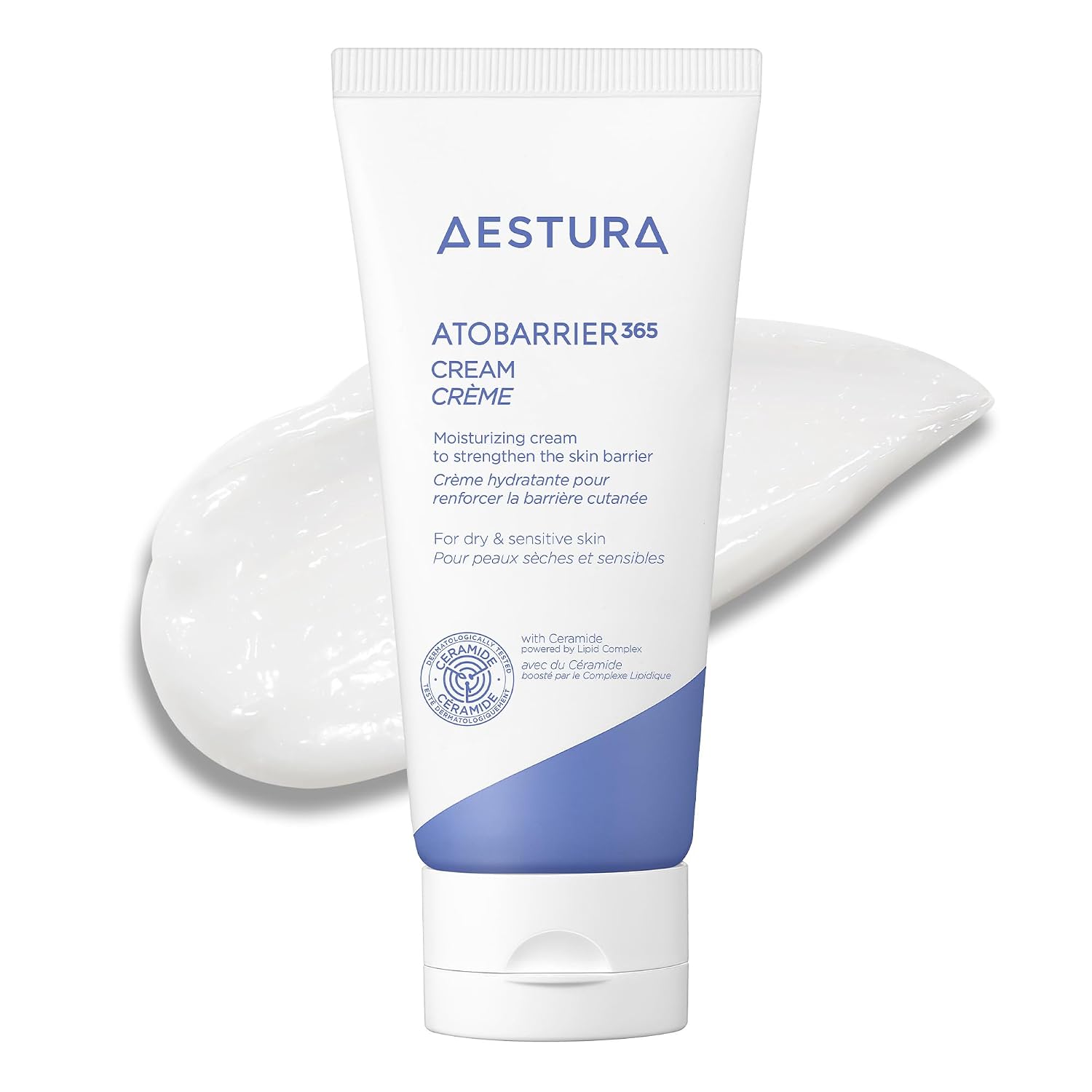
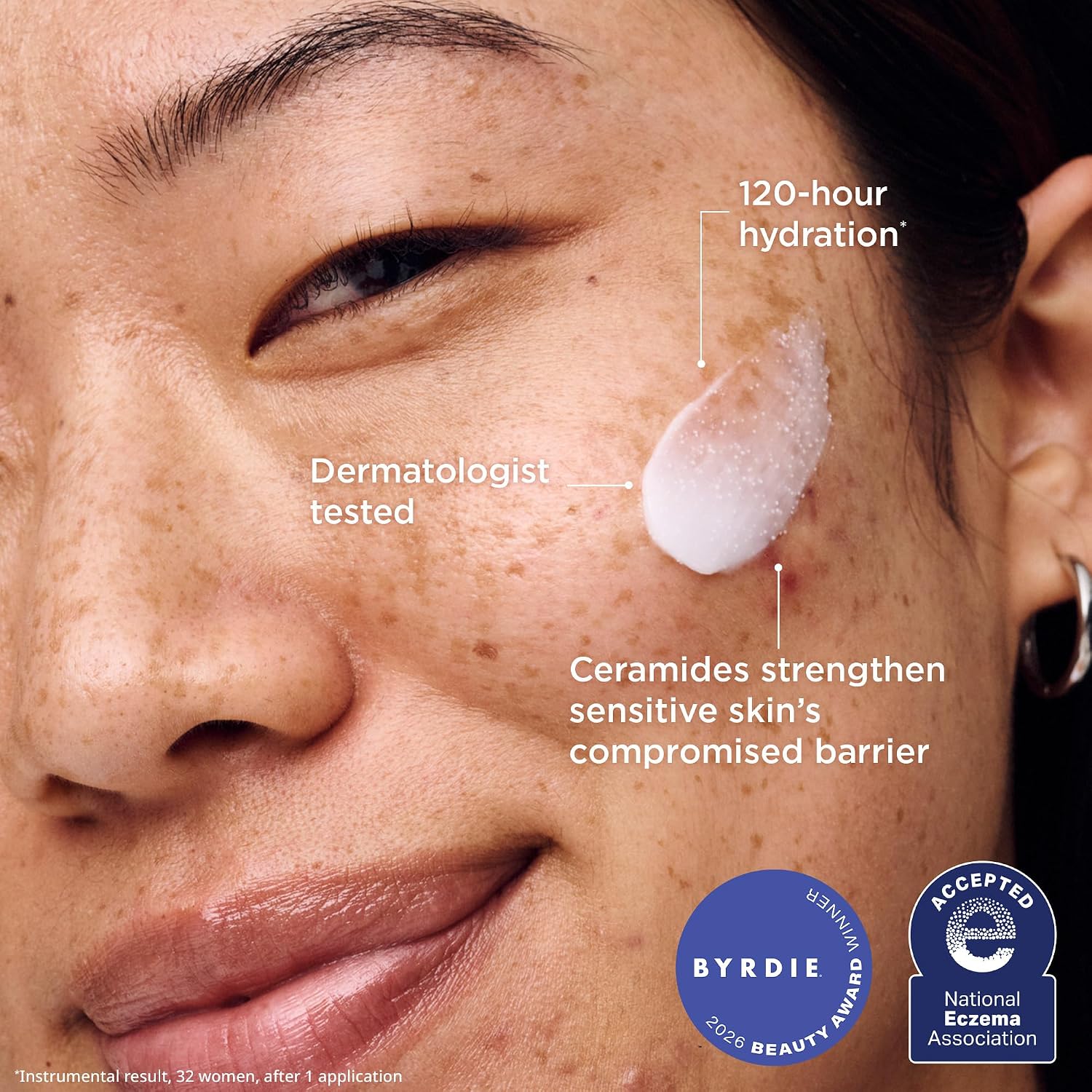
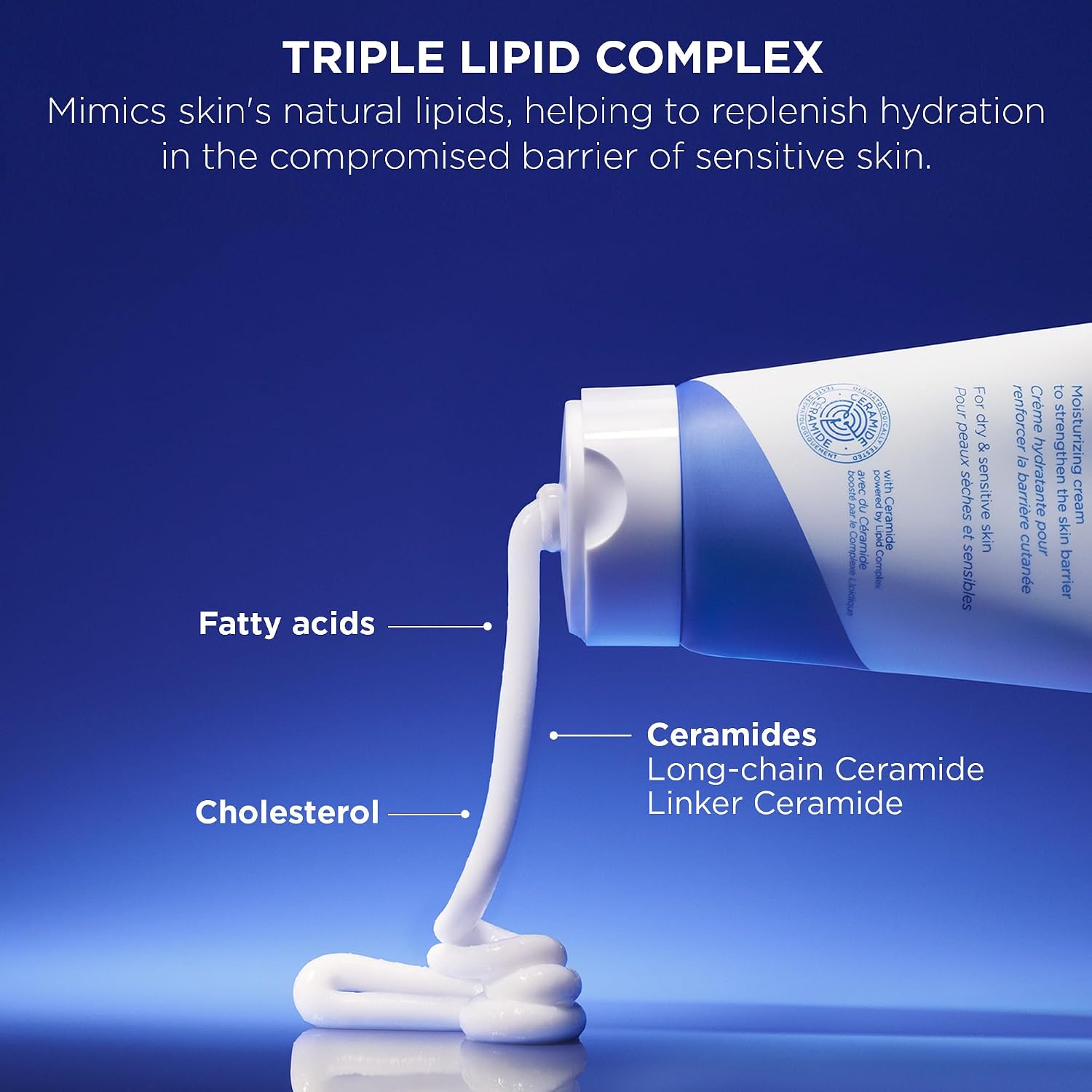
The first frame is the packaging: a white tube with a diagonal blue lower half, the wordmark in blue capitals, and the ceramide seal printed near the crimp. The second is a textural proof shot - a thick white swatch on a bare cheek, annotated with the 120-hour hydration figure, the dermatologist-tested line, and two award badges. The third is the formula diagram: a ribbon of cream leaving the nozzle with three labelled anchors pointing at fatty acids, ceramides and cholesterol.
1.4 Texture and routine position
A cream, so it closes a routine after serum and before sunscreen in the morning, or last at night. Buyers describe it as smooth and non-greasy on application with quick absorption despite a heavy-looking swatch, and the ingredient base explains that combination: squalane esters and dicaprylyl carbonate for slip, dimethicone for the non-greasy finish, and a fatty-acid soap structure for body. It layers over hydrating essences and under sunscreen without pilling in the reports that mention it.
2. What Buyers Report
2.1 Two ratings that disagree
| Source | Rating | Sample | What the gap means |
|---|---|---|---|
| Marketplace ratings | 4.6 / 5 | 5,520 | General buyers judging comfort, hydration and value |
| Specialist community | 3.6 / 5 | 120 | Skincare-engaged users weighting irritation and ingredient profile |
The marketplace distribution is close to a ceiling: 83% five-star against 3% one-star, with only 2% at two stars. That shape is what a product looks like when it reliably does its one job for the majority of buyers. The specialist rating of 3.6 does not contradict it - it measures a different question. A community that reads ingredient lists will mark down a cream for containing oleic acid at comedogenic 5 and for triggering reactions in 58 of 184 sensitivity mentions, even while acknowledging that it hydrates exceptionally well.
2.2 Aspect by aspect
| Aspect | Mentions | Positive | Negative | Positive share |
|---|---|---|---|---|
| Moisturising | 683 | 610 | 73 | 89% |
| Effectiveness | 653 | 606 | 47 | 93% |
| Texture | 202 | 186 | 16 | 92% |
| Skin sensitivity | 184 | 126 | 58 | 68% |
| Non-greasy | 179 | 135 | 44 | 75% |
| Value for money | 173 | 107 | 66 | 62% |
| Lightweight | 142 | 118 | 24 | 83% |
| Skin appearance | 142 | 108 | 34 | 76% |
The two highest-volume aspects - moisturising at 683 mentions and effectiveness at 653 - are also the two highest-scoring, at 89% and 93%. That is the strongest possible version of this pattern: the thing people talk about most is the thing they are happiest with. Texture at 92% over 202 mentions confirms the sensory experience is not contested.
The soft spot is not what a reader might expect. Skin sensitivity is the fourth most-discussed aspect at 184 mentions and sits at 68% - meaning 58 individual complaints about reactions, on a product whose entire positioning is sensitive-skin safety. That is a real signal, not a rounding artefact, and it is exactly the aspect that the specialist community's 3.6 rating is picking up. Value for money at 62% is the lower score but the weaker signal: at $32.00 for 80 ml the per-ounce math is $11.85, which is expensive for a pharmacy-adjacent moisturiser and cheap for a derm-brand ceramide cream, so the split is a positioning argument rather than a product failure.
3. What Is Inside
Two independent ingredient databases were merged for this section. One grades every INCI entry on acne risk, irritation and a safety grade where 1 is safest; the other publishes claim badges, concerns, benefit counts and its own comedogenic ratings. Both list the same 42 ingredients in the same order, which makes this the cleanest cross-check in the report.
3.1 Claim badges
Alcohol freeEU allergen freeFragrance freeOil freeParaben freeSulfate freeReef safeVeganCruelty free (brand claim)
Not silicone freeNot fungal-acne safePotential pore cloggers found
| Claim | Holds | Evidence |
|---|---|---|
| Fragrance free | Yes | No parfum and none of the 26 declarable allergens; the independent screen found no fragrance ingredients at all |
| Oil free | Yes | No triglyceride or plant oil; the emollients are esters, squalane and silicones |
| Alcohol free | Yes | No ethanol; the alcohol entries are fatty alcohols |
| Vegan | Yes | No animal-derived ingredient in the list |
| Paraben / sulfate free | Yes | Neither class present |
| Silicone free | No | Dimethicone at position 10 plus dimethiconol |
| Fungal acne safe | No | Eight flagged ingredients on the fungal-acne screen |
| Pore clogger free | No | Three flagged, led by oleic acid at comedogenic 5 |
3.2 Ingredient levels
Each row was graded from its safety value, reading ranges on the upper bound. The scale is inverted - level 1 is the cleanest grade.
| Level | Safety band | Count | Share | Representative members |
|---|---|---|---|---|
| Level 1 | 1 | 30 | 71% | Water, squalane, cholesterol, allantoin, ceramide NP, phytosphingosine |
| Level 2 | 1-2 | 5 | 12% | Glycerin, C12-20 alkyl glucoside, carbomer, hydrogenated lecithin |
| Level 3 | 1-3 | 2 | 5% | Polyacrylate-13, tromethamine |
| Level 4 | 1-4 | 1 | 2% | Betaine |
| Level 5 | 2 | 1 | 2% | Ethylhexylglycerin |
| Level 6 | 2-3 | 1 | 2% | Arachidyl glucoside |
| Level 7 | 2-5 | 1 | 2% | Dimethicone |
| Unrated | none | 1 | 2% | Silica |
The safety picture is solid: 30 of 41 graded rows sit at the lowest grade, and the only genuinely wide bands belong to a silicone and three emulsifier-or-pH ingredients whose ranges reflect source disagreement. Where this formula is not clean is the acne axis. Thirty-nine percent of the graded rows carry a comedogenic rating and four of those are at 3 or above, all of them in the fatty-acid and ester cluster that forms the oil phase. So the correct reading is narrow: this is a low-irritation, high-comedogenic-potential cream. Those two properties are not in tension - occlusion is the mechanism.
3.3 What is flagged, and why
| Ingredient | Pos. | Acne | Irritant | Safety | Assessment |
|---|---|---|---|---|---|
| Oleic Acid | 42 | 5 | - | 1 | Highest comedogenic grade in the list. Last position limits exposure but does not change the flag |
| Ethylhexyl Palmitate | 34 | 4 | 1 | 1 | Ester emollient with a well-documented pore-clogging reputation; low irritation |
| Palmitic Acid | 16 | 3 | 0 | 1 | Comedogenic 3 with zero irritation - occlusion without sting |
| Tocopherol | 41 | 2-3 | 2 | 1 | Range value, conservative reading 3. Late position |
| Dimethicone | 10 | 1 | 0 | 2-5 | Widest safety band in the formula at meaningful concentration |
| Arachidyl Glucoside | 23 | - | - | 2-3 | Emulsifier; range reflects source disagreement |
| Betaine | 13 | - | - | 1-4 | Humectant; four-point range is about purity grades |
Three things are absent and worth stating because their absence is the formula's main safety argument: no drying alcohol, no fragrance and no parfum allergens, no parabens. For a cream aimed at eczema and post-procedure skin, removing the fragrance allergen set is the single most consequential formulation choice available, and it was made.
3.4 Key ingredient groups
Every headline group holds exactly one ingredient. That is not a weakness in the formula - the ceramide work here is done by one ceramide plus two ceramide-like amides (hydroxypropyl bispalmitamide MEA and hydroxypropyl bislauramide MEA) plus cholesterol plus phytosphingosine and sphingolipids, which is a broader lipid reconstruction than the "one ceramide" count suggests. It is, however, a weakness in the marketing: there is no multi-active story to tell here, which is why the brand sells mechanism (triple lipid complex, capsules) rather than an ingredient list.
3.5 The full 42
Both databases side by side, in INCI order. Safety is inverse: 1 is safest. A dash means unrated, not risk-free.
| # | Ingredient | Function | Acne | Irritant | Safety | Comedo. | Irritancy |
|---|---|---|---|---|---|---|---|
| 1 | Water | Solvent | - | - | 1 | - | - |
| 2 | Butylene Glycol | Solvent, viscosity control, humectant | 1 | 0 | 1 | 1 | 0 |
| 3 | Glycerin | Solvent, viscosity control, humectant | 0 | 0 | 1-2 | 0 | 0 |
| 4 | Butylene Glycol Dicaprylate/Dicaprate | Emollient | - | - | 1 | - | - |
| 5 | Cetyl Ethylhexanoate | Synthetic ester, emollient | - | - | 1 | - | - |
| 6 | Squalane | Skin conditioning, emollient | 1 | 0 | 1 | 1 | 0 |
| 7 | Pentaerythrityl Tetraisostearate | Surfactant, emollient, emulsifier | 2 | 0 | 1 | 2 | 0 |
| 8 | Dicaprylyl Carbonate | Emollient | - | - | 1 | - | - |
| 9 | Behenyl Alcohol | Viscosity control, emollient | - | - | 1 | - | - |
| 10 | Dimethicone | Skin conditioning, emollient | 1 | 0 | 2-5 | 1 | 0 |
| 11 | Hydroxypropyl Bispalmitamide MEA | Emollient (ceramide analogue) | - | - | 1 | - | - |
| 12 | Stearic Acid | Surfactant, viscosity control, emulsifier | 2 | 0 | 1 | 2-3 | 0 |
| 13 | Betaine | Viscosity control, antistatic, humectant | - | - | 1-4 | - | - |
| 14 | Mannitol | Skin conditioning, humectant | - | - | 1 | - | - |
| 15 | C14-22 Alcohols | Emulsion stabilising | - | - | 1 | - | - |
| 16 | Palmitic Acid | Emollient, emulsifier | 3 | 0 | 1 | 2 | 0 |
| 17 | Hydroxypropyl Bislauramide MEA | Emollient (ceramide analogue) | - | - | 1 | - | - |
| 18 | Arachidyl Alcohol | Emollient | - | - | 1 | - | - |
| 19 | Cholesterol | Viscosity control, skin conditioning, emollient, emulsifier | 0 | 0 | 1 | 0 | 0 |
| 20 | Polyacrylate-13 | Film former, thickener | - | - | 1-3 | - | - |
| 21 | C12-20 Alkyl Glucoside | Emulsifier | - | - | 1-2 | - | - |
| 22 | Allantoin | Skin conditioning, anti-inflammatory, anti-allergic | 0 | 0 | 1 | 0 | 0 |
| 23 | Arachidyl Glucoside | Emulsifier | - | - | 2-3 | - | - |
| 24 | Niacinamide | Skin conditioning | - | - | 1 | - | - |
| 25 | Ceramide NP | Moisturiser, skin conditioning | - | - | 1 | - | - |
| 26 | Glyceryl Caprylate | Emollient, emulsifier | - | - | 1 | - | - |
| 27 | Ethylhexylglycerin | Preservative booster | - | - | 2 | - | - |
| 28 | Hydrogenated Polyisobutene | Viscosity control, emollient | 1 | - | 1 | 1 | 2 |
| 29 | Carbomer | Viscosity control | 1 | 1 | 1-2 | 1 | 0 |
| 30 | Tromethamine | pH adjuster | - | - | 1-3 | - | - |
| 31 | Dimethiconol | Moisturiser, emollient | - | - | 1 | - | - |
| 32 | Polyglyceryl-10 Laurate | Emulsifier, skin conditioning | - | - | 1 | - | - |
| 33 | Hydrogenated Lecithin | Emulsifier | - | - | 1-2 | - | - |
| 34 | Ethylhexyl Palmitate | Solvent, synthetic ester, emollient | 4 | 1 | 1 | 2-4 | 0 |
| 35 | Acrylates/Ammonium Methacrylate Copolymer | Antistatic | - | - | 1-2 | - | - |
| 36 | Sorbitan Isostearate | Emulsifier | 2 | - | 1 | 1-2 | 0 |
| 37 | Silica | Viscosity control, absorbent | - | - | - | - | - |
| 38 | Phytosphingosine | Skin conditioning | - | - | 1 | - | - |
| 39 | Sphingolipids | Emollient | - | - | 1 | - | - |
| 40 | Arachidic Acid | Surfactant, emulsifier | 2 | 0 | 1 | 2 | 0 |
| 41 | Tocopherol | Antioxidant | 2-3 | 2 | 1 | 0-3 | 0-3 |
| 42 | Oleic Acid | Emollient, emulsifier | 5 | - | 1 | - | - |
Coverage is 42 of 42 from both databases, in the same order. Four rows carry a range, and the two databases disagree in direction on two of them: stearic acid is 2 in one and 2-3 in the other, tocopherol is 2-3 and 0-3. Both readings are shown rather than reconciled, because picking one would hide the disagreement. Two rows carry no numbers at all in one database and a rating in the other - silica is fully unrated on both axes, and oleic acid's comedogenic 5 has no counterpart in the second database's unrated row. Where the two disagree, treat the rating as directional evidence and not as a measurement.
3.6 Do the benefit claims survive the formula?
| Claim | Ingredients cited | Verdict |
|---|---|---|
| Hydrating | 15 | Supported - glycerin, betaine, mannitol, squalane plus the occlusive film |
| Barrier repair | 12 | Supported, and the strongest structural claim - two ceramide analogues, ceramide NP, cholesterol, phytosphingosine, sphingolipids |
| Redness reducing | 6 | Supported - allantoin and the anti-inflammatory extracts carry this |
| Anti-aging | 5 | Plausible - niacinamide, adenosine-type support, tocopherol |
| Reduces irritation | 5 | Supported by ingredients, but 58 negative sensitivity mentions say it does not work for everyone |
| Acne fighting / good for oily skin | 1 / 2 | Not supported - contradicted by two acne concerns and four comedogenic ratings at 3 or above |
4. What It Costs
4.1 Today's price
There is no discount on this listing. The price equals the reference list price, the subscription price is the standard 10% incentive, and the per-ounce figure of $11.85 is what a buyer is really paying for a derm-brand ceramide cream in a small tube. That number explains the value-for-money aspect sitting at 62%: an 80 ml tube at $32 is not expensive in absolute terms, but it is expensive per ounce relative to the pharmacy brands it competes with, and it is cheap per ounce relative to prestige ceramide creams.
4.2 Four years of tracked prices
A long-run price tracker was read for this listing. Both the Amazon-sold channel and the third-party new channel carry history - unusual for an imported Korean SKU - and there is no used market.
| Channel | Lowest ever | Highest ever | Current | Average |
|---|---|---|---|---|
| Amazon sold | $26.00 (Jun 26, 2025) | $35.94 (Apr 07, 2025) | - | $31.10 |
| 3rd party new | $22.00 (Oct 21, 2024) | $56.99 (Apr 06, 2025) | $32.00 (Jun 27, 2026) | $29.02 |
| 3rd party used | - | - | - | - |
The bars separate two very different pricing regimes. Amazon's own channel is narrow and disciplined: a $9.94 spread over four years and an average within 3% of list. The third-party channel is four times wider in relative terms, with a $56.99 spike and a $22.00 trough bracketing a $29.02 average. What a buyer actually pays is the brand-controlled price, and the third-party noise is mostly a side-show.
Both April 2025 extremes are suspicious. The third-party high of $56.99 is dated 2025-04-06 and the Amazon high of $35.94 is dated 2025-04-07 - one day apart, on both channels, at the top of their ranges. Two channels hitting all-time highs within 24 hours of each other is the signature of a supply event or a data artefact across the listing, not of organic pricing. Neither should anchor a valuation. The $22.00 low in October 2024 is more likely a real promotional moment.
4.3 Where today's price sits
| Measure | Value | Basis |
|---|---|---|
| 3rd-party spread | $34.99 | $56.99 - $22.00 |
| Spread as share of the low | 159.0% | Spread / low |
| Current vs 3rd-party low | +45.5% | ($32.00 - $22.00) / $22.00 |
| Current vs 3rd-party high | -43.8% | ($32.00 - $56.99) / $56.99 |
| Current vs 3rd-party average | +10.3% | ($32.00 - $29.02) / $29.02 |
| Current vs list | 0.0% | Parity, no discount |
| Amazon spread | $9.94 | $35.94 - $26.00 |
| Amazon average vs list | -2.8% | ($31.10 - $32.00) / $32.00 |
| Channel gap at average | $2.08 | $31.10 vs $29.02 |
Today's price is the brand's price, undiscounted, and it is 10.3% above the four-year third-party average. On this record there is no discount to capture by waiting for a normal cycle - the price does not move. The only genuinely cheaper window in four years was Amazon's own $26.00 in June 2025, which is a 19% saving against today and worth waiting for if the purchase is not urgent. The tracked current value is dated June 2026, four months before this capture, so treat it as the brand's standing price rather than as a live quote.
5. Who It Suits
This is a barrier reconstruction cream, not a treatment. Its lipid architecture - ceramide NP, two ceramide analogues, cholesterol, phytosphingosine, sphingolipids and four fatty acids - is a more complete reconstruction of the skin's own lipid mix than most ceramide creams attempt, and that is what the 89% moisturising and 93% effectiveness scores are responding to. It is fragrance-free, alcohol-free and allergen-free, which is exactly right for the population it targets. Against that, it is occlusive by design, contains a silicone at position 10, and carries oleic acid at comedogenic 5 near the end of the list.
| If you are | Fit | Because |
|---|---|---|
| Very dry, tight, flaky or barrier-damaged | Strong | Lipid architecture matches the need; effectiveness at 93% over 653 mentions |
| Eczema-prone or post-procedure | Strong, with a patch test | Fragrance and allergen free, eczema-association accepted, derm-tested - but 58 sensitivity complaints exist |
| Sensitive but also acne-prone | Poor | Four comedogenic ratings at 3 or more and two acne concerns; the occlusivity that helps a barrier feeds clogged pores |
| Oily or combination, looking for a light moisturiser | Poor | Despite the 83% lightweight score, this is a heavy cream with a silicone film; two independent acne concerns apply |
| Buying on price per ounce | Poor | $11.85 per fluid ounce at parity with list, and the price has never meaningfully discounted |
6. How This Was Built
6.1 Sources and sequence
Four channels were read on 2026-10-27. The live retail listing was read under a New York 10001 delivery address so that every price is native USD with no conversion. A long-run price tracker supplied the historical band. Two independent ingredient databases were merged: one grading all 42 INCI entries on acne, irritation and safety, and one publishing claim badges, concerns, benefit counts and its own comedogenic ratings. Both returned 42 of 42 ingredients in the same order, which is the strongest cross-check available across the four channels.
6.2 Confidence
| Element | Confidence | Basis |
|---|---|---|
| Specification | High | Read from the listing's own specification table |
| Current price | High | Native USD under a US address, same-day capture, no discount to infer |
| Marketplace rating and distribution | High | Published aggregates over 5,520 ratings |
| Community rating | Medium | 120 reviews - usable, not large; a specialist sample by construction |
| Review aspect shares | Medium | Listing's own aggregation; individual review bodies did not render |
| Ingredient list and order | High | Two databases agree on all 42 names and their sequence |
| Per-ingredient grades | Medium | Community databases; 26 of 42 rows unrated on acne |
| Price history band | Medium | Five values per channel, newest 3rd-party observation four months stale |
| Cause of the paired April 2025 highs | Low | Inferential; no offer-level detail published |
6.3 What this report cannot tell you
- The price history block is all-time for every chart window. No period-specific low, high or average exists in that source, and none is stated here.
- The 3rd-party current value is four months old and the Amazon channel has no current value at all. The live listing price of $32.00 is the number to buy at.
- Individual review bodies and buyer photographs did not render at capture time. The review analysis rests on published aggregates, and no buyer-photo gallery appears because the listing rendered none.
- Ingredient grades are community assessments. A blank cell is missing data; a low grade is not a safety guarantee; a range is disagreement, not precision.
- Two of the twelve benefit claims are genuinely contradicted by the formula. That judgement is this report's reading of the evidence, not a claim by any source.
- Every figure is a snapshot. Ratings, ranks and prices move between captures.