A 250 millilitre milky toner that has sold itself on rice water, niacinamide and a ceramide barrier blend, ranked third in Amazon's facial toner category and rated 4.6 across 7,086 ratings. It is also the clearest case in this batch of a listing and an ingredient screener disagreeing in public: the product highlights the phrase fragrance free, and independent screening marks that exact claim as failing - not because a perfume was added, but because the rice bran water that opens the formula is a fragrance-functioning material. This dossier sets out the 38-ingredient formula, the 3.4 community score that sits two points below the marketplace score, the aspect table where irritation is the only weak axis, and a price record that has barely moved in two years.
The product, as sold
The product is a texture decision before it is an ingredient decision. Clear watery toners evaporate and leave nothing; this one is an opaque emulsion with an actual lipid phase, which is why it can be described as milky without the word being a metaphor. That lipid phase - diphenyl dimethicone, triethylhexanoin and hydrogenated lecithin at positions 14 to 16 - is what produces both the glow the listing photographs and the film some buyers describe as residue. The same three ingredients are the reason the product is not silicone-free, a claim the listing never made and a screener still checked.
The rice content is delivered in four separate materials rather than one, and the numbers behind the 70% are worth reading carefully. The bran water that opens the list is the bulk of it; the rice extract is recorded at 3,753 ppm and the rice proteins at 3,000 ppb, which are three and four orders of magnitude smaller respectively. That is a normal way to build a botanical story - a water for volume and concentrated fractions for effect - but it means the headline percentage describes the carrier, not the actives.
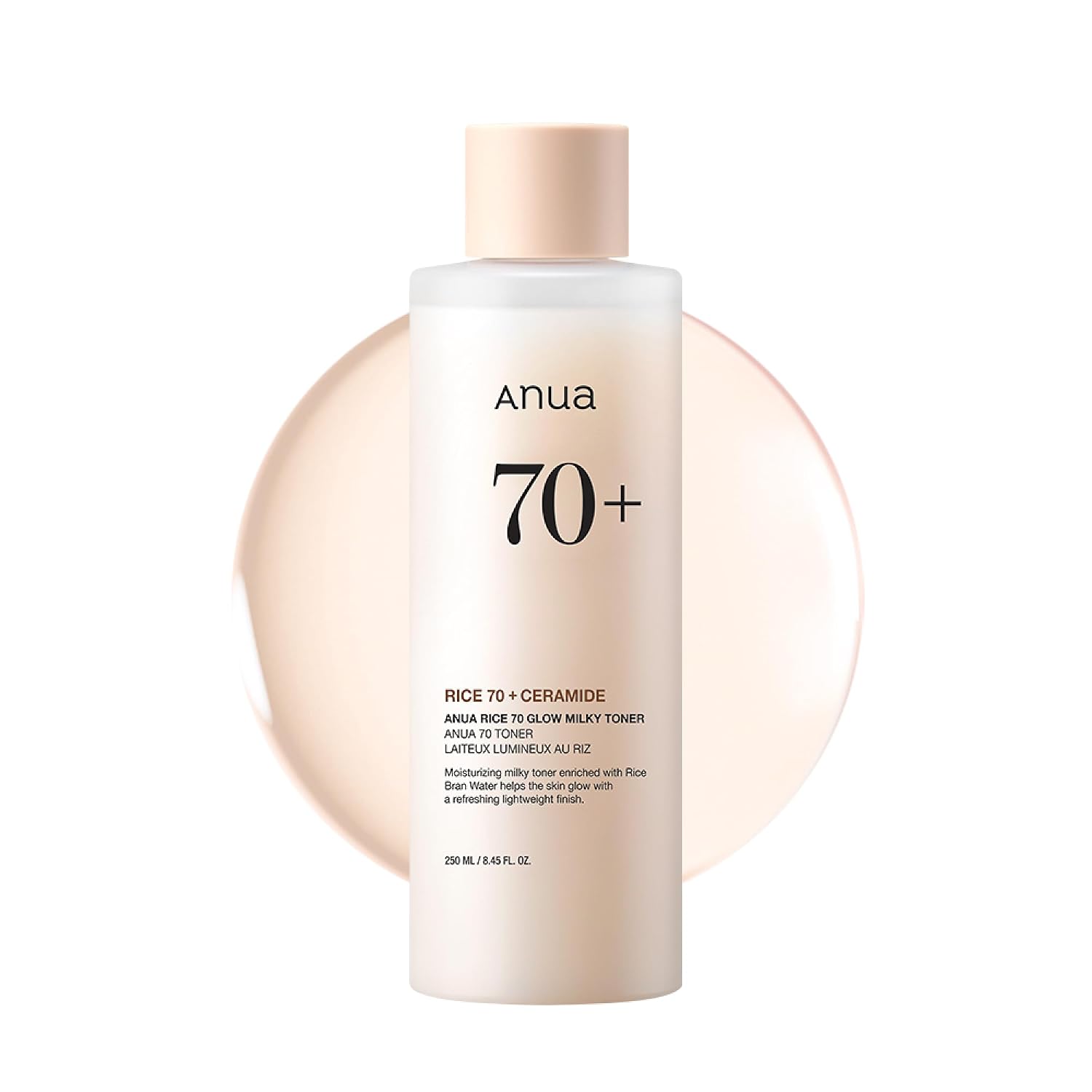
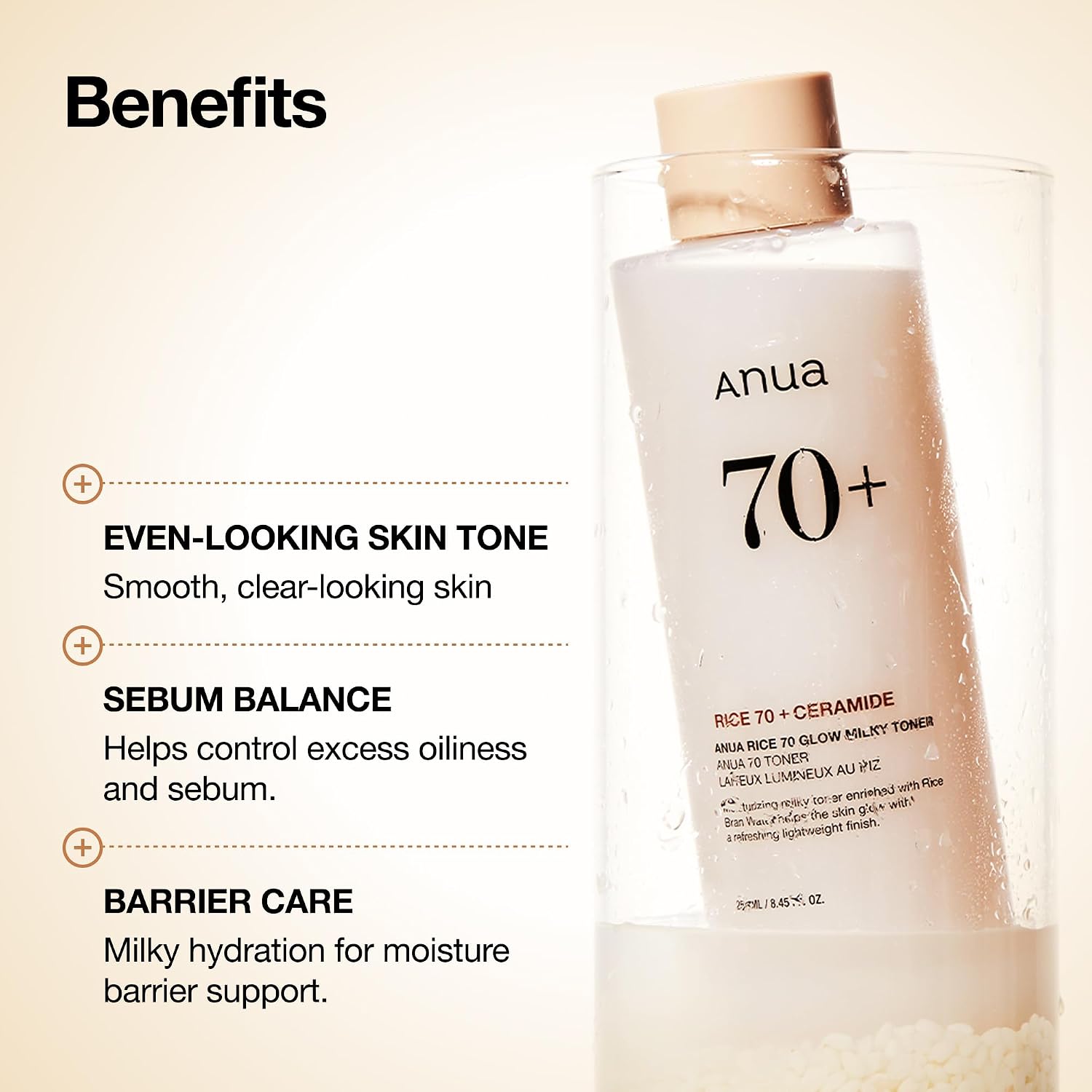
Three listing images at source resolution. Buyer photographs were not retrievable for this ASIN on the capture date - the review gallery rendered empty across every fetch variant - so the gallery contains listing imagery only. No claim is made about what buyers photographed, and none is invented.
Declared specification
What the brand claims
- <b>Lightweight Milk Toner.</b> Provides intense moisture with a blend of Rice Water, Niacinamide and Ceramides, yet leaves a refreshing non-sticky finish to achieve glass skin.
- <b>Skin Barrier Care.</b> Contains Anua RICE CERA-PROTEIN, a blend of Ceramides and Protein that helps support the skin’s natural moisture barrier.
- <b>Radiance-Boosting & Sooting Hydration.</b> 70% Rice Water + Niacinamide for dull skin; Panthenol, Glycerin & Allantoin soothe irritated skin and provide instant(temporary) moisture.
- <b>All Skin Types.</b> Fragrance free milky toner with gentle yet potent ingredients, suitable for sensitive, dry, oily skin types to use everyday, AM & PM.
- <b>Balanced Sebum Care.</b> Designed to balance excess sebum and oiliness, this breakout-prone Korean toner helps keep skin fresh and comfortable without clogging pores.
The listing's A+ block returned as an empty carousel shell on capture, with only the navigation labels readable. No A+ claim is quoted anywhere in this dossier.
How the marketplace rates it
4.6 from 7,086 ratings is a high score on a large sample, and the distribution is 80 / 10 / 5 / 2 / 3. That shape - a heavy top, a thin middle, a small tail - is the marketplace signature of a product that works for most of the people who bought it. The 3% one-star share is larger than the 2% two-star share, which is a subtle but useful detail: users who dislike this product tend to dislike it decisively rather than mildly.
The disagreement with Skinsort's 3.4 is the single most interesting number in the dossier. Both figures are reported here without adjustment. The plausible reading is that they measure different things - 7,086 buyers rating a purchase against 130 community members rating a formula and its long-term behaviour - and that the community sample is both smaller and more critical by construction. It is not a contradiction to resolve, but it is a reason not to treat either number as the truth about the product.
What buyers talk about
Amazon's generated aspect summary for this listing covers eight axes, the widest coverage in this capture batch. Counts are mentions drawn from review text, not ratings, and they are the only review-derived evidence available because no review bodies rendered.
| Aspect | Mentions | Positive | Negative | Positive share |
|---|---|---|---|---|
| Effectiveness | 599 | 505 | 94 | 84% |
| Moisturizing | 368 | 301 | 67 | 82% |
| Glow | 213 | 188 | 25 | 88% |
| Skin Feel | 204 | 180 | 24 | 88% |
| Skin Irritation | 161 | 84 | 77 | 52% |
| Value For Money | 114 | 86 | 28 | 75% |
| Texture | 85 | 66 | 19 | 78% |
| Lightweight | 69 | 65 | 4 | 94% |
Star shares as published. The one-star bucket exceeds the two-star bucket, which usually indicates a discrete failure mode rather than general dissatisfaction - and the aspect table points to irritation as the most likely one.
Individual reviews were not retrievable for this listing. The inline review block rendered empty on the desktop page, the mobile page and the alternate-context page, and three retry passes with fresh sessions produced zero bodies each time. Because the same failure occurred across every product in this batch, it is treated as an environmental block rather than a property of the listing. Nothing in this dossier quotes a review, names a reviewer, or characterises an individual's experience.
The aggregate layer still supports a firm conclusion. Seven axes run between 75% and 94% positive, led by lightweight at 94%, glow at 88% and skin feel at 88%, with effectiveness carrying the largest mention volume at 599 and 84% positive. Irritation is the sole axis below 60%, at 52% across 161 mentions - a near-even split rather than a clear negative, which is exactly what a product built for dry and combination skin should look like among buyers whose skin is neither.
Inside the formula
COSDNA and Skinsort returned 38 ingredients each, in the same order, opening with rice bran water, butylene glycol, glycerin and dipropylene glycol. That agreement is the foundation for everything below, because the two tables are merged: COSDNA supplies the acne, irritant and safety grades, Skinsort supplies the comedogenic and irritancy ratings, the twelve-badge claim matrix and the benefit counts.
Claims, checked one by one
Skinsort screens twelve claims against the list. Nine hold and three fail - and the three failures are of three different kinds, which matters more than the count.
Fragrance-free is the one that matters, because the listing prints it as a product highlight. There is no Parfum in the formula, so the failure is not a hidden perfume - it is a functional classification. Oryza Sativa Bran Water is the first ingredient and COSDNA tags it with a Fragrance function; butylene glycol at position 2 carries Fragrance among its five functions as well. The listing's claim is therefore true in the narrow sense of no added fragrance and false in the sense a fragrance-sensitive shopper means.
The other two failures are easier to dismiss but should not be. Silicone-free fails on diphenyl dimethicone at position 14 - a real phenyl silicone, and the ingredient that gives the toner its slip. Cruelty-free fails because no certification is recorded at all, which is an absence of evidence rather than evidence of testing. Ranking these three as equally serious would be a mistake, and so would ignoring any of them.
Risk levels across the whole formula
Every ingredient was bucketed by COSDNA's safety grade, on the inverted scale where 1 is safest. The result is close to the floor: two thirds of the formula sits at level 1 and nothing reaches level 5.
Counts by safety level across 38 entries. Twenty-five at level 1 and nine at level 2 account for 89% of the formula; the single level 3 and single level 4 rows are a buffer and a betaine, both with wide class ranges rather than findings. Two rows carry no grade at all and are shown separately - unrated is a gap, not a zero.
Where the ingredients cluster by function
Each ingredient counted once under its primary function. Two groups of five - the solvent carrier and the barrier lipid system - plus seven humectants describe the architecture: a water-and-glycol chassis, a hydration block, and a ceramide repair layer bolted onto it.
Flagged ingredients
| Ingredient | Pos. | Acne | Irritant | Safety | Reading |
|---|---|---|---|---|---|
| Betaine | 11 | - | - | 1-4 | The widest safety range in the formula, on a sugar-beet humectant. A class range rather than a finding, and the only row in the list whose upper bound reaches 4. |
| Tromethamine | 20 | - | - | 1-3 | A pH buffer bringing the emulsion to skin pH. Small quantity, wide class range, no acne or irritant grade. |
| Ethylhexylglycerin | 18 | - | - | 2 | Preservative booster paired with hydroxyacetophenone. Rated 2 and nothing else. |
| Carbomer | 19 | 1 | 1 | 1-2 | The only row rated above zero on both risk axes. A gelling polymer; 1 and 1 are as low as a rating gets without being zero. |
| Butylene Glycol | 2 | 1 | 0 | 1 | Comedogenic 1 at position 2 - early enough to be the most plausible culprit if a buyer breaks out, and the only real candidate in the first five entries. |
| Theobroma Cacao Seed Extract | 23 | - | - | - | No safety grade published at all. Recorded as not rated, which is missing data rather than a clean result. |
| Oryza Sativa Seed Protein | 29 | - | - | - | Also unrated on safety. One of the four rice-derived materials and the one carrying the least regulatory-grade information. |
What the formula is for
The rice story, measured
Four rice materials at four different concentration scales: bran water as the base liquid, extract at 3,753 ppm, hydrolyzed rice protein at 3,000 ppb and rice seed protein at 3,000 ppb. The headline 70% belongs to the water. The ppm and ppb entries are the fractionated actives, and their position - 12, 28 and 29 - puts them late enough to be supporting rather than structural. None of this makes the claim false; it makes it a claim about volume, not potency.
The barrier system is the real differentiator
Ceramide NP, AP and EOP at 30, 35 and 38, with cholesterol at 37, phytosphingosine at 36 and sodium lauroyl lactylate at 31, is a complete ceramide-cholesterol-fatty-acid assembly rather than a token ceramide. This is the part of the formula a formulator would call expensive, and it is the part the marketing describes least. For a damaged or winter-dry barrier it is the reason to choose this over a rice-water toner that is otherwise similar.
Where the complaints come from
Nothing here grades above 2 on the risk axes, and Skinsort flags no concerns at all - yet irritation is the listing's weakest aspect at 52% positive. The explanation is architectural rather than toxicological: this is a lipid-bearing emulsion applied twice daily, and for oily or congestion-prone skin that is an extra emollient load a watery toner would not add. Butylene glycol at position 2 adds a small comedogenic signal on top. The product is well matched to dry and combination skin and mismatched to the oily skin its 'balanced sebum' copy also courts.
The honest positioning
This is a barrier toner with a brightening story attached, not a brightening toner with hydration attached - the benefit counts say so, with 19 ingredients behind hydration and 15 behind barrier repair against 3 behind brightening. Anyone buying it for dark spots should expect modest help from niacinamide at position 5 and very little from arbutin and ascorbic acid at 32 and 33. Anyone buying it because their skin is tight and reactive is buying the right product for the right reason.
Full ingredient table
All 38 entries in the order both databases publish them. Acne, irritant and safety are COSDNA grades on the inverted safety scale; the last column is Skinsort's comedogenic and irritancy pair. A dash means unrated - not zero, and not safe.
| # | Ingredient | Function | Acne | Irritant | Safety | Level | Comed. / Irrit. |
|---|---|---|---|---|---|---|---|
| 1 | Oryza Sativa Bran Water | Fragrance | - | - | 1-2 | Level 2 | - / - |
| 2 | Butylene Glycol | Solvent, Fragrance, Viscosity Control, Skin conditioning, Moisturizer | 1 | 0 | 1 | Level 1 | 1 / 0 |
| 3 | Glycerin | Solvent, Viscosity Control, Skin conditioning, Moisturizer | 0 | 0 | 1-2 | Level 2 | 0 / 0 |
| 4 | Dipropylene glycol | Solvent, Moisturizer | - | - | 1 | Level 1 | - / - |
| 5 | Niacinamide | Skin conditioning | - | - | 1 | Level 1 | - / - |
| 6 | Propanediol | Solvent, Viscosity Control | - | - | 1 | Level 1 | - / - |
| 7 | Water | Solvent | - | - | 1 | Level 1 | - / - |
| 8 | 1,2-Hexanediol | Solvent | - | - | 1 | Level 1 | - / - |
| 9 | Methyl Gluceth-20 | Surfactant, Moisturizer | - | - | 1-2 | Level 2 | - / - |
| 10 | Panthenol | Antistatic, Skin conditioning, Moisturizer, Anti-inflammatory | 0 | 0 | 1 | Level 1 | 0 / 0 |
| 11 | Betaine | Viscosity Control, Antistatic, Moisturizer | - | - | 1-4 | Level 4 | - / - |
| 12 | Oryza Sativa Extract 3753ppm | Skin conditioning | - | - | 1-2 | Level 2 | - / - |
| 13 | Hydroxyacetophenone | Antioxidant | - | - | 1 | Level 1 | - / - |
| 14 | DiphenylDimethicone | Emulsifier | - | - | 1-2 | Level 2 | - / - |
| 15 | Triethylhexanoin | Synthetic ester, Emollient | - | - | 1 | Level 1 | - / - |
| 16 | Hydrogenated lecithin | Emulsifier | - | - | 1-2 | Level 2 | - / - |
| 17 | Adenosine | - | - | - | 1 | Level 1 | - / - |
| 18 | Ethylhexylglycerin | - | - | - | 2 | Level 2 | - / - |
| 19 | Carbomer | Viscosity Control | 1 | 1 | 1-2 | Level 2 | 1 / 0 |
| 20 | Tromethamine | pH Adjusters | - | - | 1-3 | Level 3 | - / - |
| 21 | Xanthan Gum | Surfactant, Viscosity Control | - | - | 1 | Level 1 | - / - |
| 22 | Glyceryl acrylate/acrylic acid copolymer | Viscosity Control, Moisturizer | - | - | 1 | Level 1 | - / - |
| 23 | Theobroma Cacao Seed Extract | Antioxidant | - | - | - | Not rated | - / - |
| 24 | Sodium Hyaluronate | Skin conditioning, Moisturizer | 0 | 0 | 1 | Level 1 | 0 / 0 |
| 25 | Hydrolyzed Hyaluronic Acid | Skin conditioning, Moisturizer | - | - | 1 | Level 1 | - / - |
| 26 | Hyaluronic Acid | Moisturizer | - | - | 1 | Level 1 | - / - |
| 27 | Dextrin | Viscosity Control | - | - | 1 | Level 1 | - / - |
| 28 | Hydrolyzed rice protein 3000ppb | Antistatic | - | - | 1-2 | Level 2 | - / - |
| 29 | Oryza Sativa Seed Protein 3000 ppb | Antioxidant | - | - | - | Not rated | - / - |
| 30 | Ceramide NP | Moisturizer | - | - | 1 | Level 1 | - / - |
| 31 | Sodium lauroyl lactylate | Emulsifier | - | - | 1 | Level 1 | - / - |
| 32 | Arbutin | Whitening | - | - | 1 | Level 1 | - / - |
| 33 | Ascorbic Acid | Antioxidant, Whitening | 0 | 0 | 1 | Level 1 | - / - |
| 34 | Allantoin | Skin conditioning, Anti-inflammatory, Anti-allergic | 0 | 0 | 1 | Level 1 | 0 / 0 |
| 35 | Ceramide AP | Skin conditioning | - | - | 1 | Level 1 | - / - |
| 36 | Phytosphingosine | Skin conditioning | - | - | 1 | Level 1 | - / - |
| 37 | Cholesterol | Viscosity Control, Skin conditioning, Emollient, Emulsifier | 0 | 0 | 1 | Level 1 | 0 / 0 |
| 38 | Ceramide EOP | Skin conditioning | - | - | 1 | Level 1 | - / - |
The two tables agree row for row wherever both publish a grade. Skinsort grades five rows and COSDNA eight; butylene glycol, glycerin, panthenol, sodium hyaluronate, ascorbic acid, allantoin, cholesterol and carbomer are the overlap, and every one of them matches. Two rows carry no safety grade on either side.
What it costs, and what it has cost
This listing is the only one in the batch where Amazon itself appears as a seller across the recorded period, which turns the price record into something more useful than a marketplace history - it shows an administered price.
| Price type | Lowest ever | Highest ever | Current | Average |
|---|---|---|---|---|
| Amazon | $20.35 Oct 23, 2026 | $21.00 Oct 23, 2026 | $21.00 Oct 23, 2026 | $20.78 |
| 3rd Party New | $14.40 Nov 21, 2024 | $22.00 Feb 05, 2025 | $20.90 Aug 17, 2026 | $20.66 |
| 3rd Party Used | - | - | - | - |
Values as published by the tracker on 2026-10-27. Amazon's low, high and current all share the date 23 October 2026, so the record shows a recent repricing rather than a long series. The third-party current value is dated in August and is seventy-one days stale.
Every number in that table, side by side
Both live channels side by side, with average drawn as a reference line. The Amazon bars are almost the same height because Amazon's entire recorded range is 65 cents wide - that is the finding, and a chart is the fastest way to see it.
The shape of the record
Dated observations plotted in chronological order. The third-party low of $14.40 in November 2024 and high of $22.00 in February 2025 fall inside the product's first eight months; the 2026 points have settled at list. The dashed line is a guide between published points, not a time series - no observation-level history is published.
Reading the position
| Measure | Value | Basis |
|---|---|---|
| Current vs list price | -0.5% | $20.90 against a $21.00 list |
| Current vs third-party average | +1.2% | $20.90 against $20.66 |
| Current vs third-party record low | +45.1% | $20.90 against the $14.40 low of November 2024 |
| Current vs third-party record high | -5.0% | $20.90 against the $22.00 high of February 2025 |
| Amazon band width | 3.2% | $20.35 to $21.00 across the whole record |
| Third-party band width | 52.8% | $14.40 to $22.00, as a share of the low |
| Cost per fluid ounce | $2.47 | $20.90 over 8.45 fl oz |
| Channel gap at current | $0.10 | Amazon $21.00 against third-party $20.90, dated two months apart |
The most informative number in this record is not a price but a width. Amazon's entire range across more than two years of monitoring is $20.35 to $21.00 - sixty-five cents, or 3.2% of its low. For comparison, the third-party channel on the same listing spans $14.40 to $22.00, a 52.8% band. Two channels on one product, one of them essentially fixed and the other wide open, is the signature of a brand holding its own price while the marketplace does what it likes around it.
The history of that third-party width is also readable. Both extremes - the $14.40 low in November 2024 and the $22.00 high in February 2025 - sit inside the first eight months after the product became available in June 2024. Everything published since has clustered at list: the average is $20.66, which is 1.6% under the $21.00 list. In other words the price found its level during launch and has not moved since, and the current quote of $20.90 is 1.2% above average rather than anywhere near either extreme.
The practical consequence is that this is a bad listing to time. There is no discount cycle to wait for, no seasonal low in the published record after the launch window, and only one episode - late 2024 - in which the product was materially cheaper. At $2.47 per fluid ounce it is priced as a mid-tier K-beauty toner, and the price it asks today is the price it has asked for two years.
How to read this, and how far to trust it
Method
- Product data was read from the US listing with a New York 10001 delivery context; all prices are native USD with no conversion.
- Ingredient grades come from COSDNA's English edition, read through a rendering fetch because direct requests are blocked. Where blank rating cells could not be anchored, the last number on the row was assigned to safety and the other axes left unrated; two rows carried no grade at all and are recorded as unrated.
- Claims, the absent-concerns confirmation, benefit counts and the second ingredient table come from Skinsort, read in full through a reader channel rather than the truncated direct page.
- Price history comes from a third-party tracker and is all-time for every chart window. Amazon's low, high and current values share one date, which is disclosed wherever those values are used.
- Review bodies were unavailable on the capture date across three fetch variants and three retries. The aspect table is Amazon's generated summary and is used as the only review-derived evidence.
- No reviewer name, handle, profile identifier or profile link appears in this document. There are no quoted reviews to redact.
Confidence
- Amazon product data - High. Read in a US context on the capture date; price, spec, rating and eight aspect rows resolved
- Ingredient list - High. Two databases return 38 rows in the same order
- Safety grades - Medium. Community database with small vote counts; alignment recovered by rule
- Claim matrix - High. Twelve badges captured, three failures resolved to their cause
- Review text - Not available. Zero review bodies across three variants and three retries; nothing quoted
- Price history - Medium. Amazon values four days stale, third-party value seventy-one days stale
- Skinsort's 3.4 against Amazon's 4.6 - Medium. Both transcribed; the explanation for the gap is interpretive