A 35 ml Korean face cream that promises three things at once - smaller-looking pores, a more even tone, and enough moisture that no second cream is needed. It carries declared actives rather than trace amounts: 5% niacinamide, 5% tranexamic acid, 1% of the brand's Melazero V2 complex and 0.1% ceramide NP, and it sits on a ceramide-and-cholesterol barrier base. This report reconstructs the product from four angles: what it is, what buyers report, what is actually inside it, and what it has cost over time.
1. Product Information
1.1 Listing specification
| Field | Value |
|---|---|
| Product name | celimax Pore+Dark Spot Brightening Cream, 1.18 fl.oz, TXA cream |
| Brand | celimax |
| Category path | Beauty & Personal Care › Skin Care › Face › Creams & Moisturizers › Face Moisturizers |
| ASIN | B0DHKSF81K |
| Item form | Cream |
| Scent | Unscented |
| Skin type stated | Sensitive |
| Declared actives | 5% Niacinamide, 5% Tranexamic Acid, 1% Melazero V2, 0.1% Ceramide NP |
| Size | 35 ml / 1.18 fl oz, 1 ounce unit count |
| Item weight | 35 g |
| Dimensions | 5.12 × 0.59 × 0.59 inches |
| Manufacturer | Celimax |
| Model number | TYC3ENBN1N172744732549804 |
| GTIN | 08809971484503 |
| Best Sellers Rank | #513 in Beauty & Personal Care; #20 in Face Moisturizers |
| Availability | In stock |
| Sold by / ships from | Miryl / Amazon |
1.2 What the brand claims
- Triple skin care. Pores, dark spots and uneven tone addressed in one step, on the strength of 5% niacinamide plus 5% tranexamic acid plus 1% Melazero V2 for melanin care.
- Deep hydration. Enough moisture that the brand says no additional moisturiser is needed.
- Gentle on skin. Positioned as hypoallergenic and fragrance-free, with Houttuynia Cordata and allantoin named as the soothing pair for reactive skin.
- Ten clinical trials. The brand states improvements in moisture, tone evenness, visible pore size and texture within two weeks.
1.3 Product images
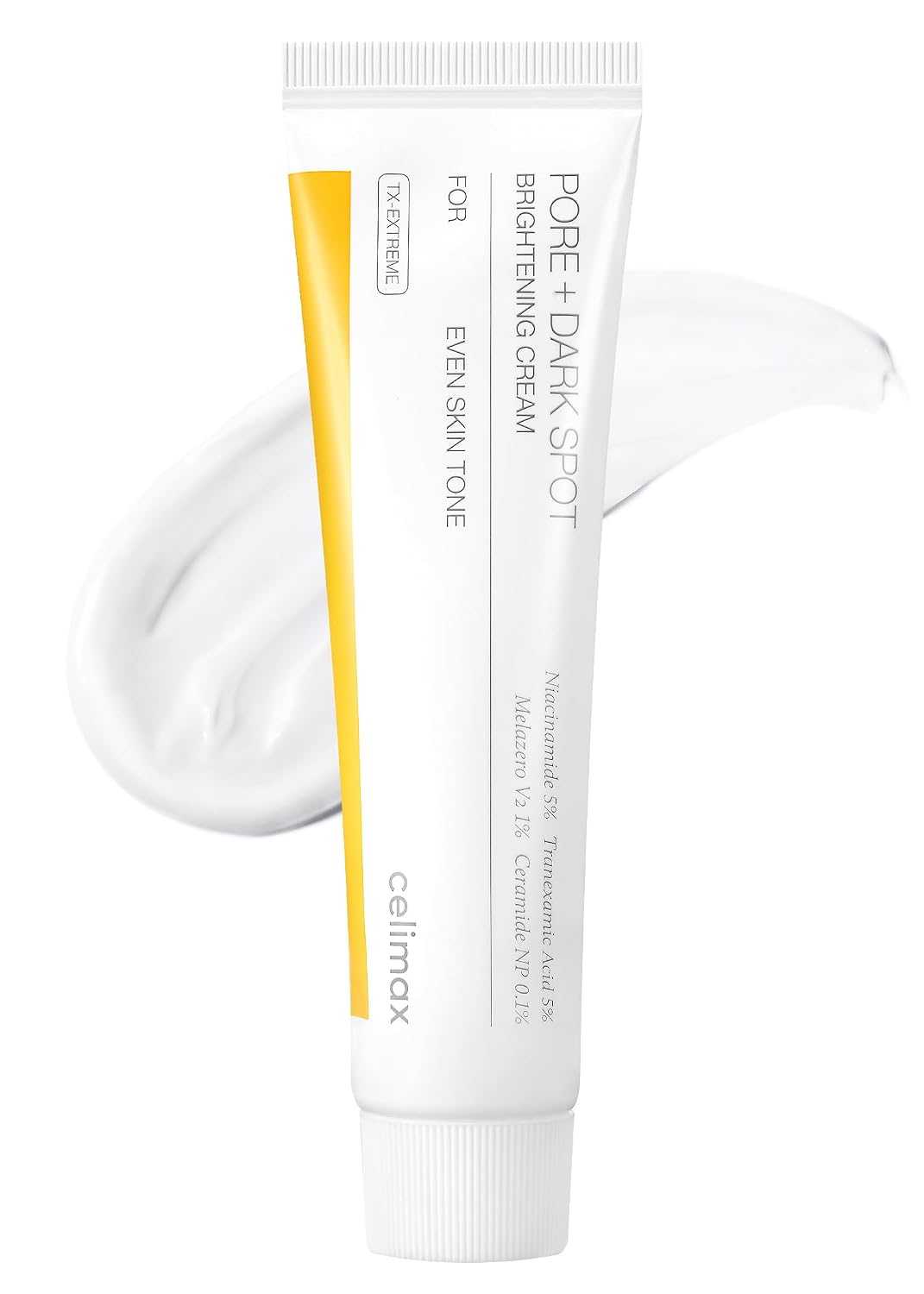
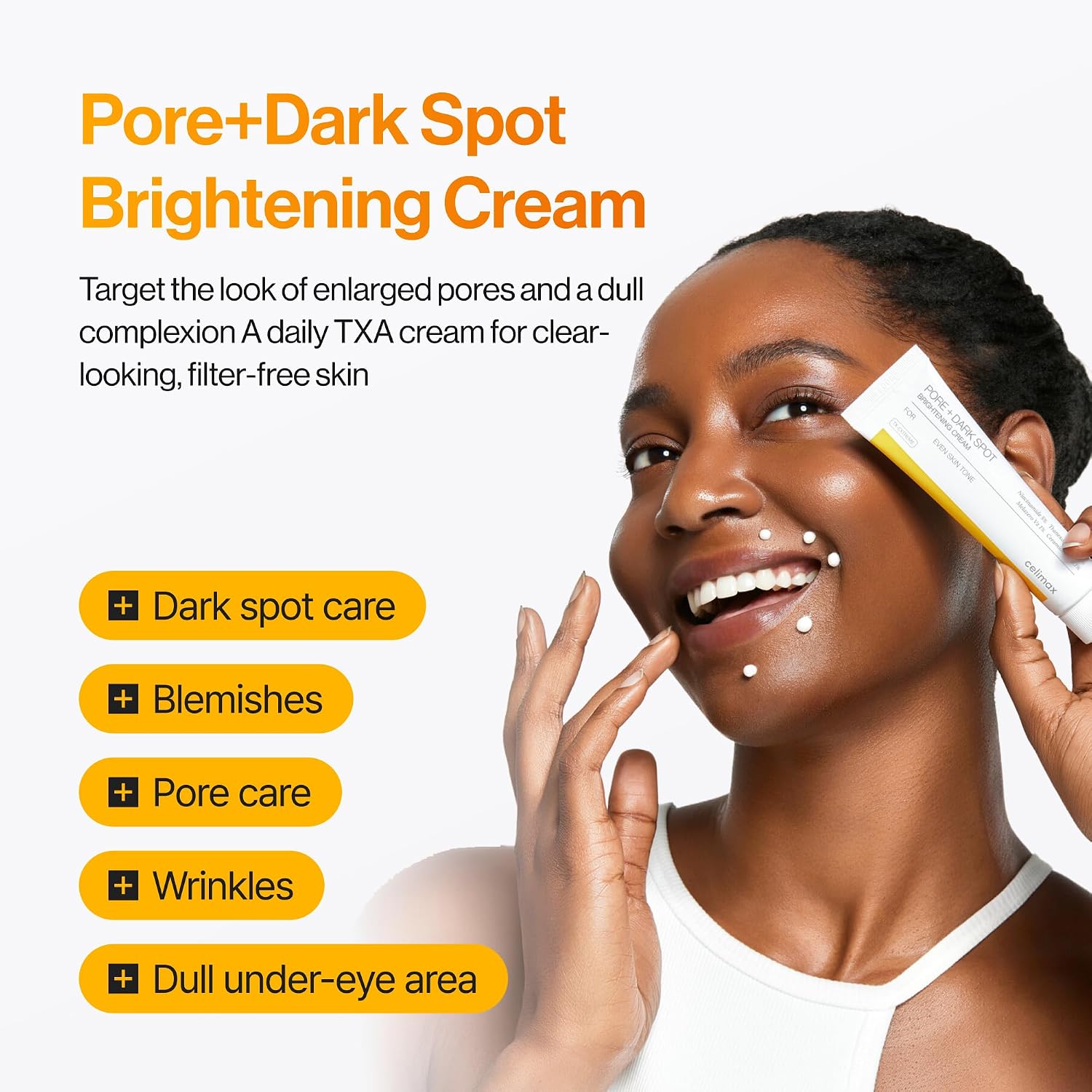
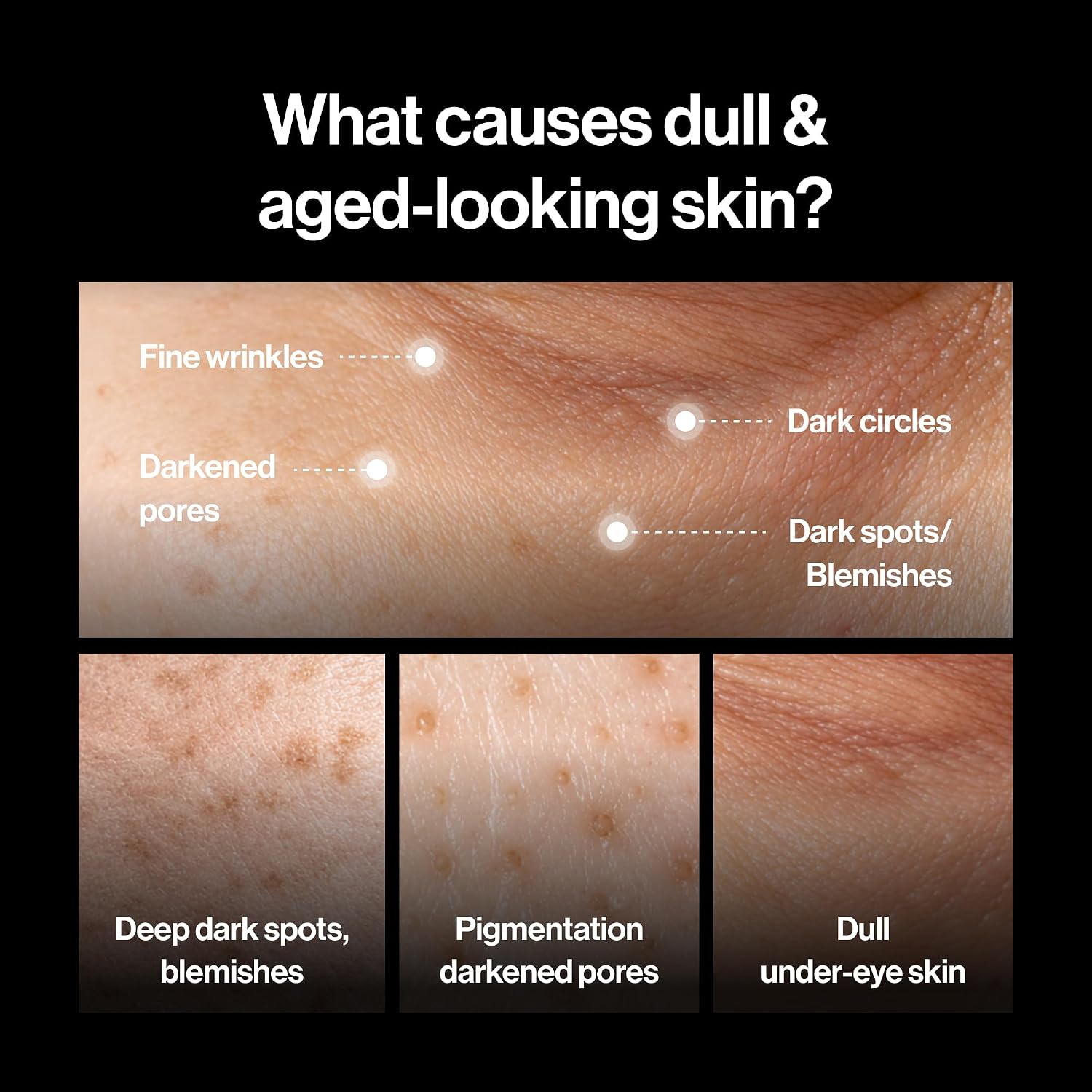
The first frame is the product itself: a plain white squeeze tube with a vertical yellow stripe, the name printed sideways, and the four active percentages listed in small type near the crimp. The second is the brand's benefit board - a model with the cream dotted on her cheekbones and five callouts (dark spot care, blemishes, pore care, wrinkles, dull under-eye area). The third is a diagnostic panel rather than a product shot, mapping four concerns - fine wrinkles, darkened pores, dark circles, dark spots - onto close-up skin.
1.4 How it is meant to be used
A cream, so it goes after serum and before sunscreen in a morning routine, or last at night. The texture described by buyers is creamy but light, absorbing without a greasy film - consistent with a formula built on silicone and ester emollients rather than heavy butters. Because it carries 5% tranexamic acid and 5% niacinamide rather than an exfoliating acid, there is no obvious photosensitivity reason to restrict it to night, though the brand's two-week efficacy claim implies twice-daily use.
2. Product Rating and Reviews
2.1 Rating summary
| Stars | Share | Shape |
|---|---|---|
| 5 star | 73% | Dominant |
| 4 star | 10% | Supporting |
| 3 star | 7% | Neutral minority |
| 2 star | 4% | Small |
| 1 star | 6% | Small but not negligible |
The distribution is top-heavy but not artificially flat. A 73% five-star block with a 10% one-star tail is the shape of a product that works for most buyers and fails for a distinct minority - not the shape of a listing propped up by incentivised reviews. With 4,633 ratings, a 6% one-star share is roughly 280 individual negative ratings, which is enough for the complaints to be a real signal rather than noise. The 7% three-star block matters as much as the tail: it is where "it is fine but not what I expected" lives, and it usually points at texture or value rather than efficacy.
2.2 What buyers say
The listing's own review summary collapses four and a half thousand ratings into seven aspects, each with a mention count and a positive share. That is the most useful view of the review body because it separates "people talk about this a lot" from "people like this a lot".
| Aspect | Mentions | Positive | Negative | Positive share | Reading |
|---|---|---|---|---|---|
| Effectiveness | 305 | 223 | 82 | 73% | Most-discussed and clearly positive, but a quarter of the mentions are complaints |
| Skin appearance | 108 | 81 | 27 | 75% | Visible change in tone is the second-strongest theme |
| Moisturising | 62 | 51 | 11 | 82% | Consistently positive; the hydration claim holds |
| Texture | 57 | 52 | 5 | 91% | The least contested aspect in the whole set |
| Value for money | 47 | 27 | 20 | 57% | Split - the weakest aspect |
| Gentleness | 31 | 19 | 12 | 61% | Split, with a real irritation minority |
| Absorption | 24 | 18 | 6 | 75% | Fast absorption without residue |
Three things stand out. First, the sensory experience is almost universally liked - texture at 91% and absorption at 75% mean very few people object to how the cream feels, which is unusual for a silicone-forward formula. Second, the two split aspects are value and gentleness, and they pull in opposite directions commercially: value is a price-per-millilitre objection at 35 ml, while gentleness is a genuine skin reaction in a minority of users. Third, effectiveness carries the most volume and a solid 73%, which is a credible number rather than a glowing one - one in four people who mention results is disappointed.
The listing's narrative summary adds colour the numbers cannot: buyers report visible change after four to five applications, describe the cream as creamy without being heavy, and several describe it as a repurchase rather than a trial. On the negative side the summary records burning sensations in some users and a price objection in others.
3. Product Ingredients
Two independent ingredient databases were merged for this section. One grades each INCI entry on three axes - acne risk, irritation, and a safety grade where 1 is the safest and higher numbers mean more caution - and one publishes claim badges, concern flags, benefit counts and its own comedogenic and irritancy ratings. Both list the same 46 ingredients. Where they disagree, both readings are shown rather than reconciled into one number.
3.1 The claim matrix
Claims are printed as badges that name a property. A claim that fails is printed with a negation prefix, and that prefix is the verdict - "not oil free" means the product contains oil. Seven of twelve claims hold.
Alcohol freeFragrance freeParaben freeSulfate freeEU allergen freeReef safeCruelty free (brand claim)
Not oil freeNot silicone freeNot fungal-acne safePotential pore cloggers foundNot vegan
| Claim | Holds | Basis |
|---|---|---|
| Alcohol free | Yes | No ethanol or denatured alcohol; the alcohol-family entries are fatty alcohols and glycols |
| Fragrance free | Yes | No parfum entry in the list; the unscented claim is consistent with the INCI |
| Paraben free | Yes | No paraben preservative present |
| Sulfate free | Yes | No sulfate surfactant present |
| EU allergen free | Yes | None of the 26 declarable fragrance allergens appears |
| Reef safe | Yes | No oxybenzone or octinoxate; this is a moisturiser, not a sunscreen |
| Cruelty free | Yes | Brand assertion, not third-party certified |
| Oil free | No | Contains Macadamia Integrifolia Seed Oil |
| Silicone free | No | Contains Phenyl Trimethicone, Vinyldimethicone and Dimethiconol |
| Fungal acne safe | No | Seven flagged ingredients on the fungal-acne screen |
| Pore clogger free | No | Two flagged ingredients, led by Glyceryl Stearate SE |
| Vegan | No | Formula not certified vegan |
3.2 Ingredient levels and counts
Every row was assigned a level from its safety grade. The scale is inverted, so level 1 is the cleanest grade in the database and level 3 is the first that asks for caution. Ranges were read on the upper bound, which is the conservative choice.
| Level | Grade band | Ingredients | Share | What sits here |
|---|---|---|---|---|
| Level 1 | Safety 1 | 36 | 78% | Water, glycols, ceramides, most emulsifiers, all four barrier lipids |
| Level 1-2 | Safety 1-2 | 4 | 9% | Glycerin, Vinyldimethicone, Cetearyl Glucoside, Hydrogenated Lecithin |
| Level 1-4 | Safety 1-4 | 1 | 2% | Betaine, a range reflecting source disagreement rather than a hazard |
| Level 2 | Safety 2 | 1 | 2% | Ethylhexylglycerin, a preservative booster |
| Level 3 | Safety 3 | 1 | 2% | Mentha Viridis Extract, the only grade-3 entry |
| Unrated | No grade | 3 | 7% | Macadamia Seed Oil, Theobroma Cacao Seed Extract, Glyceryl Stearate |
The formula is clean by grade rather than clean by omission. Thirty-six of the forty-three graded rows carry the lowest grade, and the four grade-1-2 rows are ordinary excipients. Only one ingredient - a spearmint extract at position 36 - reaches grade 3, and only one carries a comedogenic rating of 3. That combination is why the formula reads as barrier-first with a brightening top note rather than as an active-heavy treatment.
3.3 Flagged ingredients
| Ingredient | Pos. | Acne | Irritant | Safety | Why it is flagged |
|---|---|---|---|---|---|
| Glyceryl Stearate SE | 16 | 3 | 2 | 1 | The single highest comedogenic rating in the formula and the ingredient behind both "potential pore cloggers" flags |
| Tocopherol | 40 | 2-3 | 2 | 1 | A genuine range disagreement; conservative reading is 3 on both axes. Low position limits exposure |
| Cetearyl Alcohol | 13 | 2 | 2 | 1 | A fatty alcohol, not a drying one. Rated 2 on both axes, typical for the class |
| Mentha Viridis Extract | 36 | - | - | 3 | The only safety grade 3. Spearmint is the most sensitiser-prone botanical in the list |
| Betaine | 26 | - | - | 1-4 | Four-point range on a humectant; usually reflects purity-grade disagreement |
| Ethylhexylglycerin | 27 | - | - | 2 | Preservative booster; grade 2 is normal for the class |
3.4 Key ingredient groups
Five ceramides plus cholesterol plus fatty alcohols is a deliberate reconstruction of the skin's own lipid mix, and it explains why the barrier claim carries the second-highest ingredient count in the benefit table. The brightening story is narrow by contrast: one niacinamide at 5%, one tranexamic acid at 5%, one ascorbic acid polypeptide. Narrow is not weak here - both actives are declared at concentrations that do work - but it does mean the "triple care" framing rests on two molecules and one proprietary complex rather than on a broad brightening cocktail.
3.5 Full ingredient list
Both databases are shown side by side, in INCI order. Safety is an inverse scale where 1 is the safest. A dash means the ingredient is unrated in that column, not that it is risk-free.
| # | Ingredient | Function | Acne | Irritant | Safety | Comedo. | Irritancy |
|---|---|---|---|---|---|---|---|
| 1 | Water | Solvent | - | - | 1 | - | - |
| 2 | Glycerin | Solvent, viscosity control, humectant | 0 | 0 | 1-2 | 0 | 0 |
| 3 | Niacinamide 5% | Skin conditioning | - | - | 1 | - | - |
| 4 | Tranexamic Acid 5% | Whitening | - | - | 1 | - | - |
| 5 | Caprylic/Capric Triglyceride | Emollient, skin conditioning | 1 | - | 1 | - | - |
| 6 | Dipropylene Glycol | Solvent, humectant | - | - | 1 | - | - |
| 7 | 1,2-Hexanediol | Solvent | - | - | 1 | - | - |
| 8 | Macadamia Integrifolia Seed Oil | Skin conditioning, plant extract | - | - | - | - | - |
| 9 | Phenyl Trimethicone | Antistatic, skin conditioning | - | - | 1 | - | - |
| 10 | Hydrogenated Poly(C6-14 Olefin) | Viscosity control, emollient | - | - | 1 | - | - |
| 11 | Dicaprylyl Ether | Solvent, emollient | - | - | 1 | - | - |
| 12 | Vinyldimethicone | Viscosity control | - | - | 1-2 | - | - |
| 13 | Cetearyl Alcohol | Surfactant, viscosity control, emollient | 2 | 2 | 1 | 2 | 1 |
| 14 | Propanediol | Solvent, viscosity control | - | - | 1 | - | - |
| 15 | Cetearyl Olivate | Emulsifier | - | - | 1 | - | - |
| 16 | Glyceryl Stearate SE | Emulsifier | 3 | 2 | 1 | 3 | 2 |
| 17 | Sorbitan Olivate | Emulsifier | - | - | 1 | - | - |
| 18 | Ammonium Acryloyldimethyltaurate/VP Copolymer | Surfactant, viscosity control | - | - | 1 | - | - |
| 19 | Behenyl Alcohol | Viscosity control, emollient | - | - | 1 | - | - |
| 20 | Dimethiconol | Moisturiser, emollient | - | - | 1 | - | - |
| 21 | Cetearyl Glucoside | Viscosity control, moisturiser, emulsifier | - | - | 1-2 | - | - |
| 22 | Laminaria Japonica Extract | Skin protecting | - | - | 1 | - | - |
| 23 | Eclipta Prostrata Leaf Extract | Skin conditioning | - | - | 1 | - | - |
| 24 | Hydrogenated Lecithin | Emulsifier | - | - | 1-2 | - | - |
| 25 | Ceramide NP | Skin conditioning, moisturiser | - | - | 1 | - | - |
| 26 | Betaine | Viscosity control, antistatic, humectant | - | - | 1-4 | - | - |
| 27 | Ethylhexylglycerin | Skin conditioning, preservative booster | - | - | 2 | - | - |
| 28 | Xanthan Gum | Surfactant, viscosity control | - | - | 1 | - | - |
| 29 | Eriobotrya Japonica Leaf Extract | Skin conditioning | - | - | 1 | - | - |
| 30 | Adenosine | Skin conditioning | - | - | 1 | - | - |
| 31 | Fructooligosaccharides | Humectant | - | - | 1 | - | - |
| 32 | Coptis Japonica Root Extract | Skin conditioning | - | - | 1 | - | - |
| 33 | Cholesterol | Viscosity control, skin conditioning, emollient, emulsifier | 0 | 0 | 1 | 0 | 0 |
| 34 | Butylene Glycol | Solvent, viscosity control, humectant | 1 | 0 | 1 | 1 | 0 |
| 35 | Beta-Glucan | Anti-allergic, skin conditioning | - | - | 1 | - | - |
| 36 | Mentha Viridis Extract | Masking | - | - | 3 | - | - |
| 37 | Hydrolyzed Hyaluronic Acid | Skin conditioning, humectant | - | - | 1 | - | - |
| 38 | Theobroma Cacao Seed Extract | Antioxidant | - | - | - | - | - |
| 39 | Dextrin | Viscosity control, absorbent | - | - | 1 | - | - |
| 40 | Tocopherol | Antioxidant | 2-3 | 2 | 1 | 0-3 | 0-3 |
| 41 | Ascorbic Acid Polypeptide | Whitening, antioxidant | - | - | 1 | - | - |
| 42 | Glyceryl Stearate | Emollient, emulsifier | - | - | - | 1 | 0 |
| 43 | Ceramide AS | Skin conditioning | - | - | 1 | - | - |
| 44 | Ceramide AP | Skin conditioning | - | - | 1 | - | - |
| 45 | Ceramide NS | Skin conditioning | - | - | 1 | - | - |
| 46 | Ceramide EOP | Skin conditioning | - | - | 1 | - | - |
Coverage is 46 of 46 from both databases. Only seven rows carry an acne rating and six carry an irritation rating, so no average was computed over them: a mean across six observations out of forty-six describes the database's coverage, not the formula's risk. The two databases disagree in exactly two places worth naming. Glyceryl Stearate carries a comedogenic 1 in one and no rating in the other, and Tranexamic Acid is spelled as one word in one database. Neither changes the reading. The two lists also swap positions 8 and 9, which is an ordering discrepancy rather than a content one.
3.6 Benefit claims against the formula
| Benefit | Ingredients delivering it | Strength of the claim |
|---|---|---|
| Hydrating | 21 | Broad - most of the base is a moisturising system |
| Barrier repair | 15 | Strong - five ceramides plus cholesterol plus fatty alcohols |
| Reduces irritation | 11 | Moderate - beta-glucan, allantoin-class soothing, panthenol-type support |
| Anti-aging | 9 | Moderate - adenosine and peptide support |
| Redness reducing | 9 | Moderate |
| Brightening | 4 | Narrow but potent - niacinamide and tranexamic acid at 5% each |
| Scar healing | 4 | Narrow |
| Dark spots | 4 | Narrow - the headline claim rests on two molecules |
| Acne fighting | 1 | Weak - one ingredient, against a formula flagged as potentially comedogenic |
| Good for oily skin | 1 | Weak |
| Reduces large pores | 1 | Weak on count, though niacinamide at 5% is a credible mechanism |
| Skin texture | 1 | Weak on count |
Two of these rows deserve a flag. "Acne fighting" rests on a single ingredient while the same databases warn the formula may trigger acne and may worsen oily skin - the statements describe different ingredients and are not contradictory, but nobody should read the acne claim as reassurance. And "good for oily skin" sits against an oil-containing, silicone-containing base, which is why that claim carries one ingredient and a competing concern.
4. Product Price
4.1 Current pricing
At $15.99 against a $24.00 list, the discount is a third. The subscription price is $14.72, a further 8% below the on-page price, which is the usual size of a subscribe-and-save incentive. Per ounce that works out to $15.99 - the 35 ml tube is small enough that the per-ounce figure looks high for a drugstore-class cream, and that is exactly the objection the review data picks up under value for money at a 57% positive share.
4.2 Price history
A long-run price tracker was read for this listing. Only one of its three price channels carries any data at all: the product has never been sold by Amazon itself in the tracked record, and no used market has ever formed. Everything below is therefore third-party new.
| Price type | Lowest ever | Highest ever | Current | Average |
|---|---|---|---|---|
| Amazon | - | - | - | - |
| 3rd party new | $14.70 (Apr 12, 2026) | $33.00 (Jul 12, 2025) | $15.20 (Oct 26, 2026) | $17.31 |
| 3rd party used | - | - | - | - |
The bars make the shape obvious: the average sits only slightly above the current price, and the all-time high is more than double the low. That high is dated July 2025, roughly eight months after tracking began, which is the pattern of an early listing or a moment with no competing offer rather than a sustained market level. It should be read as an artefact candidate when judging the average - a single observation at $33.00 lifts the $17.31 mean well above the band the product has actually traded in.
4.3 Price position
| Measure | Value | Basis |
|---|---|---|
| All-time spread | $18.30 | $33.00 - $14.70 |
| Spread as share of the low | 124.5% | Spread / low |
| Current vs all-time low | +3.4% | ($15.20 - $14.70) / $14.70 |
| Current vs all-time high | -53.9% | ($15.20 - $33.00) / $33.00 |
| Current vs average | -12.2% | ($15.20 - $17.31) / $17.31 |
| Current vs tracker list price | -43.7% | ($15.20 - $27.00) / $27.00 |
| Average vs tracker list price | -35.9% | ($17.31 - $27.00) / $27.00 |
The current tracked price is $0.50 above the all-time low and $2.11 below the average. On this record the product is at the floor of its range, not at a mid-cycle level - which is the useful conclusion, because it means waiting for a deeper discount has very little room to work with. The one caveat is that the tracker's last observation is $15.20 while the live listing read on the same day is $15.99, a gap of $0.79. The two systems capture at different moments and publish different list prices ($27.00 against $24.00), so neither corrects the other; treat the live price as the purchase price and the tracked band as the context.
5. Verdict
This is a barrier cream with two serious brightening actives dropped into it, sold at 35 ml, priced to sit permanently on discount. The formula is coherent: five ceramides and cholesterol rebuild the lipid mix, silicone and ester emollients give it the slip that 91% of texture mentions approve of, and 5% niacinamide with 5% tranexamic acid is a real brightening dose rather than a label decoration. Against that, it contains oil, it contains three silicones, one emulsifier carries the highest comedogenic rating in the list, and a spearmint extract at grade 3 is the likeliest culprit behind the burning sensations a minority of reviewers report.
| Buyer profile | Fit | Reason |
|---|---|---|
| Dull tone and post-acne marks, normal to dry skin | Strong fit | Both headline actives are at working concentrations and the barrier base offsets irritation risk |
| Sensitive skin wanting a brightening cream | Qualified fit | Fragrance-free and alcohol-free, but 61% gentleness and one grade-3 botanical mean patch-testing first |
| Oily or fungal-acne-prone skin | Poor fit | Oil-containing, silicone-containing, seven fungal-acne flags, two pore-clogger flags |
| Buying on price per millilitre | Poor fit | 35 ml at $15.99 works out to $15.99 per ounce; the value aspect is the only one under 60% |
What would change this read: a full INCI revision that adds the Houttuynia Cordata and allantoin the marketing copy names, or a formulation change that removes Glyceryl Stearate SE. Neither is visible in the data captured here.
6. Method, Confidence and Limits
6.1 What was measured
Four channels were read on 2026-10-27: the live Amazon US listing under a New York 10001 delivery address so that every price is native USD with no conversion; a long-run price tracker for the historical band; one ingredient database for the acne, irritation and safety grading of all 46 INCI entries; and a second ingredient database for the claim badges, concerns, benefit counts and its own comedogenic ratings. Review text and buyer photographs did not render on this listing at capture time.
6.2 Confidence
| Element | Confidence | Basis |
|---|---|---|
| Product specification | High | Read directly from the listing's specification table |
| Current price and discount | High | Native USD under a US delivery address, captured the same day |
| Rating and star distribution | High | Published aggregates over 4,633 ratings |
| Review aspect shares | Medium | Listing's own aggregation of a subset of reviews; individual bodies were not retrievable |
| Ingredient list and count | High | Two independent databases agree on all 46 names |
| Per-ingredient grades | Medium | Community databases, not regulatory sources; 39 of 46 rows unrated on acne |
| Price history band | Medium | Five values per price type, last observed one day before capture |
| Cause of the $33.00 historical high | Low | Inferential; no offer-level detail is published |
6.3 Limits
- The price history is all-time for every chart window. No period-specific low, high or average can be derived from that source, and none is reported.
- The tracked current price is a dated last observation, one day stale, and differs from the live listing by $0.79. The live figure is the one to buy at.
- Individual review bodies and buyer photographs did not render at capture time. The review analysis therefore rests on the listing's published aggregates, and no real-photo gallery is shown because none was obtainable.
- Ingredient grades are community assessments. A blank cell means no rating, not no risk, and a low grade is not a safety guarantee.
- All ratings, ranks and prices are a snapshot. Two captures a day apart routinely differ.