CeraVe built this lotion around 5% hydro-urea, three ceramides and a natural-moisturizing-factor complex, and priced it at a dollar an ounce. That architecture is real and the ingredient list supports it. What the list also shows is an emollient ester rated 4 for comedogenicity sitting fifth, ahead of every ceramide in the formula - and a badged claim matrix where seven promises hold and five do not.
Amazon US · captured with a New York 10001 delivery address · snapshot 1 November 2026 · all prices native USD · no reviewer identities reproduced
| Live price | Rating | Ratings | Ingredients | Claims held |
|---|---|---|---|---|
| $15.99 | 4.7 / 5 | 4,975 | 45 | 7 / 12 |
Price, rating and volume read from the listing on 1 November 2026. Of the twelve claim badges Skinsort checks, seven hold and five fail - the pore-clogger, fungal-acne, silicone, vegan and cruelty-free badges.
Part one
The product, and the shelf it occupies
This is a body lotion, and the listing is honest about it: 16 fluid ounces, a pump bottle, dry-to-very-dry skin, a dollar an ounce. The formula is built on four ideas held together - 5% hydro-urea as the lead humectant, three ceramides paired with cholesterol and free fatty acids, shea butter for occlusion, and a small amino-acid fraction (glycine, serine, alanine, sodium PCA) that stands in for the skin's own moisturizing factors. It sits 28th in Amazon's Body Lotions chart and 1,065th across Beauty and Personal Care, which is exactly where a mass-market pharmacy lotion at this price should sit.
Source: Amazon
Source: Amazon
Source: Amazon
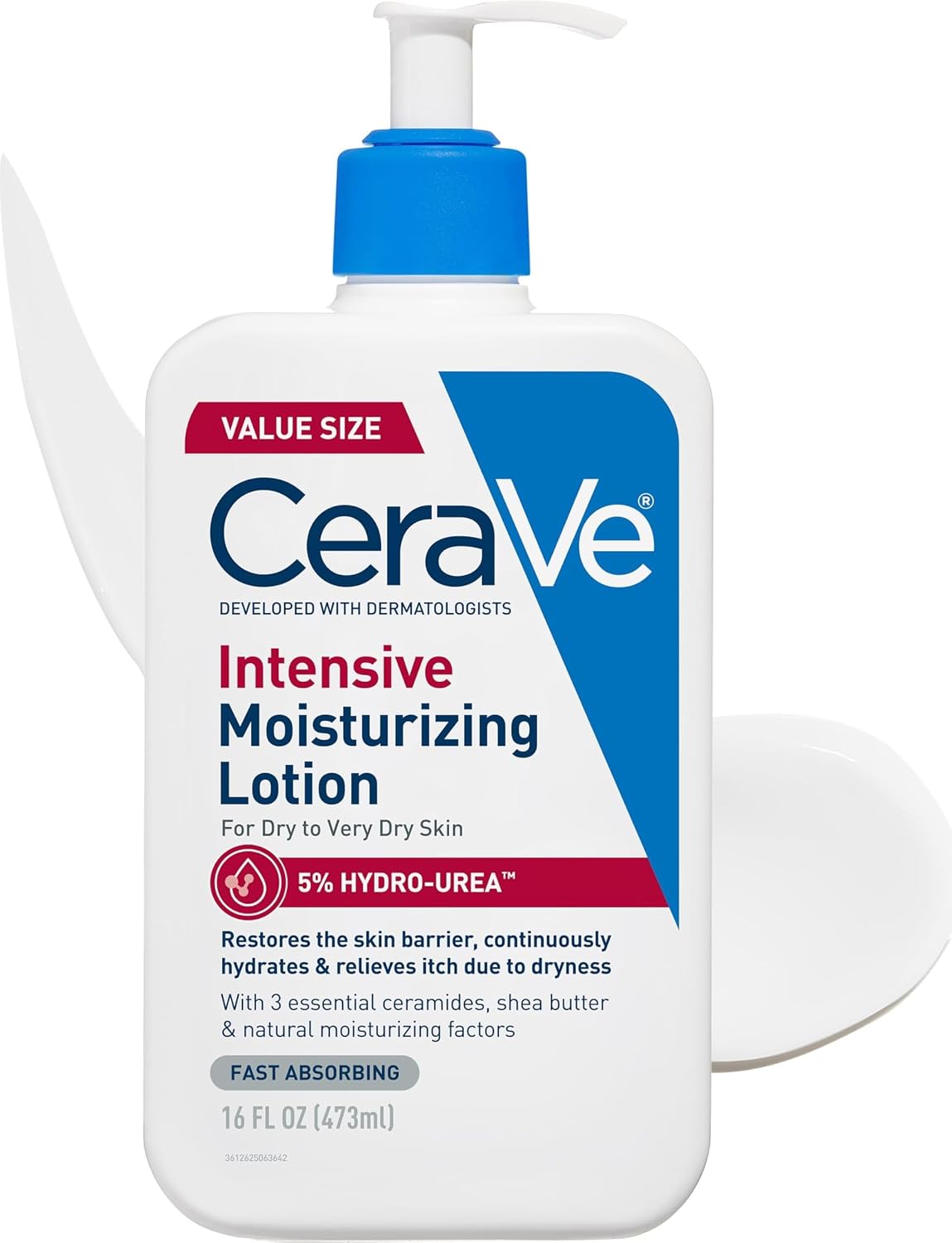
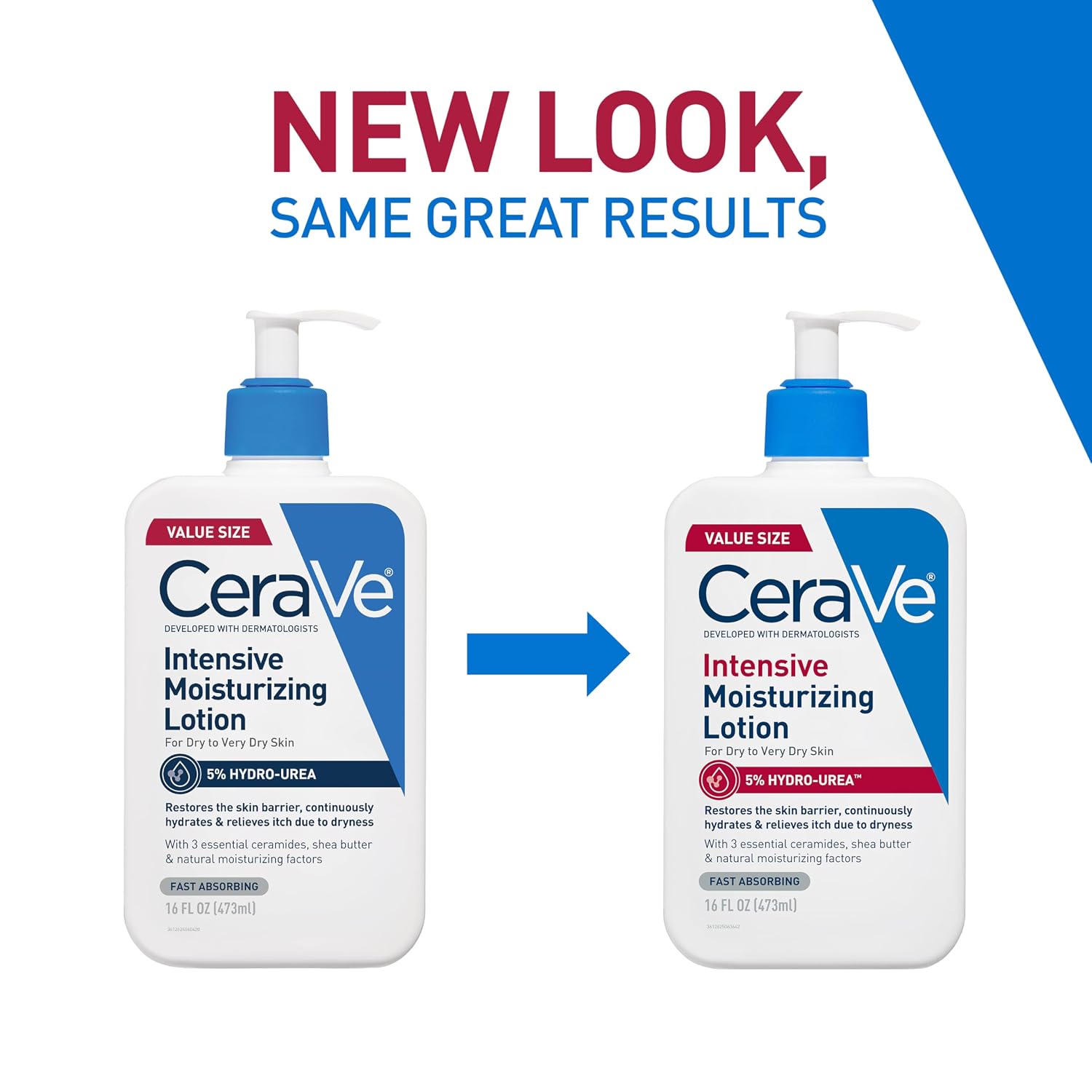
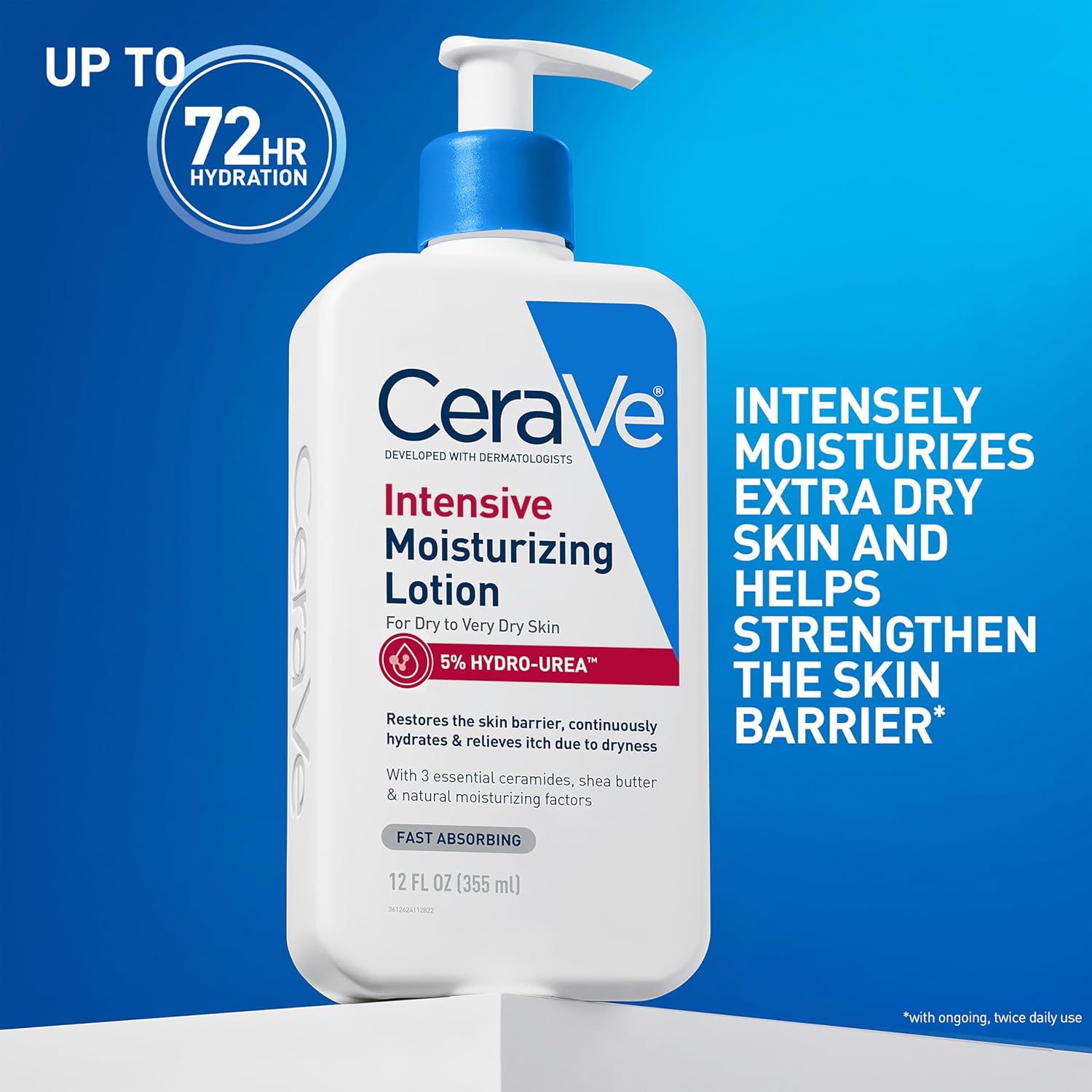
Three listing frames, no buyer photographs. The second frame is the more useful of the two product shots: it is a repackaging notice, which explains why the same formula surfaces under slightly different names across retailers. The third frame carries a size mismatch worth flagging - the bottle photographed is 12 FL OZ, the listing sells 16 FL OZ, and the 72-hour claim printed on it is footnoted with ongoing, twice daily use, which the sealed listing copy does not repeat.
Declared specifications
| Field | Value |
|---|---|
| Brand | CeraVe |
| Item Volume | 51.87 cubic inches |
| Item dimensions L x W x H | 1.81 x 3.46 x 7.48 inches |
| Age Range (Description) | Adult |
| Special Feature | Dermatologist Tested |
| Item Dimensions | 1.81 x 3.46 x 7.48 inches |
| Unit Count | 16 Fluid Ounces |
| Item Weight | 473 g |
| Product Dimensions | 1.81 x 3.46 x 7.48 inches; 1.04 pounds |
| Item model number | F8385200 |
| Manufacturer | CeraVe |
| ASIN | B0D6X6CKBX |
| Best Sellers Rank | #1,065 in Beauty & Personal Care; #28 in Body Lotions |
What the seller promises
- [HYDRO-UREA]: NMF complex to hydrate deep within skin's surface layers to help replenish skin’s natural moisturizing factors. Intensely hydrates, restores & helps strengthen the skin barrier.
- [RICH LOTION, NON-GREASY]: Non greasy body lotion instantly absorbs with no greasy or sticky feel. Body, foot & hand lotion.
- [MVE DELIVERY TECHNOLOGY]: Moisturizing lotion for extra dry skin with controlled release for long lasting hydration. 2X increase in skin’s hydration and 42% increase in skin's moisture barrier function with on-going twice daily use.
- [FAST ACTING & LONG LASTING]: Lotion with hydro-urea helps soothe dry, itchy skin at application
- [RELIEVES & DEFENDS AGAINST 5 SIGNS OF DRYNESS]: Body moisturizer for dry skin helps relieve and defend against itchiness, tightness, roughness, flaking & scaling, and redness
Five bullets, and three of them carry numbers: a 2x increase in skin hydration and a 42% increase in barrier function, both qualified by ongoing twice-daily use, and a list of five signs of dryness the lotion claims to relieve. The MVE delivery claim - controlled release for long-lasting hydration - is the mechanism behind the 72-hour figure in the third image. Nothing here is unusual for the category, but the numbers are unusually specific, and specificity is checkable in a way that silky-smooth language is not.
From the manufacturer
The manufacturer block adds what the bullets leave out: a usage instruction (apply liberally as often as needed, on the body including hands, elbows, knees, heels and feet), a dermatologist-development statement, and a routine table that places this bottle as the last step after a hydrating cleanser, a hyaluronic acid serum and a facial moisturizer. The internal comparison is the telling part - the same table lists this lotion at $15.99 against $14.19 and $13.62 for two of the products it is being sold alongside, so the brand is not positioning it as the cheap option in its own line.
Part two
4.7 from 4,975 buyers, and 1.6 from ten votes somewhere else
The listing carries 4.7 out of 5 across 4,975 ratings - a volume large enough that the average is stable, and high enough that the interesting information is in the shape of the distribution rather than the mean. The same product is scored 1.6 out of 5 from ten reviews on Skinsort, the ingredient-side database. Both numbers are real. They are measuring different populations, and the gap between them is the first thing worth understanding about this product.
Share of ratings by star bucket, as published on the listing.
84% five-star, 10% four-star, 4% three-star, 0% two-star, 2% one-star. The distribution is almost binary: buyers either find it excellent or reject it outright, with very little middle ground. The 0% in the two-star bucket is a rounded share, not proof that no one gave two stars - at this volume one percent is roughly fifty ratings, so anything under about 0.5% rounds to zero. The more informative asymmetry is that the three-star bucket (4%) is larger than the two-star bucket: dissatisfaction here tends to arrive as a flat rejection rather than as mild disappointment, which is what a product that either soothes dry skin or stings it would produce.
What buyers actually argue about
Eight themes are counted across 1,416 total mentions, and the spread between the best and worst theme is 31 points. That gap is the most useful signal on the page, because it separates what the product is reliably good at from what it is merely acceptable at.
Share of positive mentions per theme, with mention volume.
| Theme | Mentions | Positive | Negative | Positive share |
|---|---|---|---|---|
| effectiveness | 394 | 368 | 26 | 93% |
| moisturizing | 383 | 367 | 16 | 96% |
| non-greasy | 200 | 162 | 38 | 81% |
| skin irritation | 115 | 75 | 40 | 65% |
| texture | 97 | 88 | 9 | 91% |
| value for money | 91 | 61 | 30 | 67% |
| fragrance-free | 69 | 57 | 12 | 83% |
| absorption | 67 | 53 | 14 | 79% |
Moisturizing at 96% on 383 mentions and effectiveness at 93% on 394 are the two pillars, and they are what the formula is designed to deliver. Non-greasy at 81% on 200 mentions is weaker than the positioning implies, with 38 negative mentions - the second-largest complaint count of any theme. The real fault line is skin irritation at 65% on 115 mentions, where 40 buyers report a negative experience. Value for money at 67% on 91 mentions is the other soft spot, which is notable for a lotion priced at a dollar an ounce: the complaint is not that it costs too much in absolute terms but that it does not do enough for the money.
Customers find this moisturizer highly effective, particularly for dry skin, noting it hydrates well and lasts all day. They appreciate its non-greasy formula, silky texture, and lack of scent, while also praising its quick absorption. Regarding skin irritation, while some customers report it calms itchy skin, others experienced burning sensations. The value for money receives mixed feedback, with some finding it worth the price while others disagree.
Amazon's own synthesis is candid about the split - it says customers find the lotion highly effective for dry skin and praise its texture and lack of scent, then states plainly that some report burning sensations. The mechanism is plausible and worth naming: 5% urea is an osmotic humectant, and on cracked or compromised skin an osmotic load of that size can sting on application before it helps. That reading is inferential - the listing publishes no irritation testing - but it fits both the 65% irritation score and the concentration the label leads with.
The review text layer
No review body rendered. The desktop page, the mobile fallback and a second unswitched session were each fetched, with three timed retries on the last, and none returned review text or buyer-uploaded photographs. The fourteen sections of review analytics above are Amazon's own aggregates - the star histogram, the aspect counters and the Customers say summary - which are published independently of the review bodies. Nothing in this report quotes a buyer, and no individual review is paraphrased, because none was readable at capture time.
Part three
Forty-five rows, and only sixteen of them carry a rating
Two ingredient channels were queried. Skinsort returned the complete 45-row declaration with its comedogenic and irritancy columns intact. COSDNA returned nothing - both the desktop and mobile search endpoints served a Cloudflare interstitial rather than results, twice each, and the channel was abandoned rather than retried indefinitely. So this section rests on a single database, and the level column below is Skinsort's rating scale, not a merged score. That limitation is carried through every count on this page.
Level by level
Ingredient rows by level, after merging the two ingredient channels.
| Level | Rule | Rows | Share of formula |
|---|---|---|---|
| Level 1 | 0-1 rated | 9 | 20% |
| Level 2 | 2-3 rated | 6 | 13% |
| Level 3 | 4-5 rated | 1 | 2% |
| Unrated | no numeric rating | 29 | 64% |
| Total | 45 | 100% |
Nine rows sit at Level 1 - water, glycerin, the humectants, the silicone, the polyols - and six at Level 2: cetearyl alcohol, stearic acid, sorbitan oleate, myristic acid, palmitic acid and tocopherol, all rated 2 or 3. Exactly one row reaches Level 3: isopropyl palmitate, rated 3-4 for comedogenicity and 1 for irritancy. The number that matters more is the fourth slice - 29 of 45 rows, 64% of the formula, carry no numeric rating at all, because Skinsort's scale is drawn from patch-test literature that only covers a minority of INCI names. The three ceramides, the cholesterol, the amino acids and the entire emulsifier system are unrated, not safe-by-default. Read the level table as a map of where ratings exist, not as a verdict on the formula.
The same list by function
Ingredient rows grouped by the job they do in this formula.
| Function group | Rows | Share |
|---|---|---|
| Emulsifiers & surfactants | 8 | 18% |
| Ceramides & cholesterol | 5 | 11% |
| Fatty alcohols & fatty acids | 4 | 9% |
| Humectants & NMF | 4 | 9% |
| Rheology & stabilisers | 4 | 9% |
| Solvents & carriers | 4 | 9% |
| Amino acids & NMF | 3 | 7% |
| Antioxidants | 3 | 7% |
| Emollients & esters | 3 | 7% |
| Preservation & chelation | 3 | 7% |
| pH & buffering | 2 | 4% |
| Emollients & plant butters | 1 | 2% |
| Silicones & occlusives | 1 | 2% |
Eight rows are emulsifiers and surfactants - the largest single group, and the reason a 16-ounce lotion holds together as an emulsion rather than separating on the shelf. Five are the ceramide-and-cholesterol cluster, the part the label advertises. Four are humectants, four are free fatty acids, four are rheology modifiers, four are solvents, and the remainder is thin: three emollient esters, three amino acids, three antioxidants, three preservation and chelation agents, two pH buffers, one plant butter and one silicone. The structural point is positional: the three ceramides sit at rows 12, 13 and 14, behind water, glycerin, shea butter, hydroxyethyl urea and isopropyl palmitate. They are in the formula, and they are not in the top of it.
What is inside: the claim matrix
Skinsort checks twelve claim badges against the declared list. Seven hold, five fail, and the failures are more instructive than the passes because each one is traceable to a specific row.
| Claim | Verdict | Evidence |
|---|---|---|
| Alcohol-free | YES | no denatured alcohol or drying alcohol in the list |
| EU-allergen-free | YES | none of the 26 fragrance allergens of Regulation 1223/2009 |
| Fragrance-free | YES | no fragrance or masking fragrance declared as perfume |
| Oil-free | YES | the lipid phase is esters and fatty alcohols, not triglyceride oils |
| Paraben-free | YES | no methyl, ethyl, propyl or butyl paraben |
| Sulfate-free | YES | behentrimonium methosulfate is a cationic conditioner, not an anionic sulfate |
| Reef-safe | YES | no UV filter or ingredient restricted under the Guam reef rules |
| Silicone-free | NO | dimethicone, position 19 |
| Cruelty-free | NO | brand-levelled status, not a formula fact |
| Fungal-acne-safe | NO | eight potential triggers, esters and free fatty acids |
| Pore-clogger-free | NO | six rows flagged, the highest at 4 |
| Vegan | NO | cholesterol and the ceramides are traditionally animal-derived |
Sulfate-free survives on a technicality worth knowing - the formula contains behentrimonium methosulfate, a cationic conditioning surfactant whose name contains the word but whose chemistry is not that of an anionic sulfate cleanser. Vegan fails on cholesterol at row 29, which is traditionally lanolin-derived, and on the ceramides that share that supply chain. Silicone-free fails on dimethicone at row 19. Pore-clogger-free fails on six flagged rows, and fungal-acne-safe fails on eight potential triggers - six esters, three free fatty acids, one triglyceride and one fatty alcohol - which is what a barrier-repair formula built on esters and fatty acids will always look like. Cruelty-free is a brand-level status rather than a formula fact, and is listed for completeness rather than as a finding about this bottle.
The complete ingredient list
Every row below is a declared ingredient in INCI order. The two rating columns are transcribed from Skinsort exactly as published, including its ranges; a dash means no value is carried for that row, not that the row scored zero. Level is derived from the higher of the two ratings, which is why the method section states the rule rather than assuming it.
| # | Ingredient | Function (CosIng) | Group | Comedogenic | Irritancy | Level |
|---|---|---|---|---|---|---|
| 1 | Water | Skin conditioning | Solvents & carriers | - | - | Unrated |
| 2 | Glycerin | Humectant, skin conditioning | Humectants & NMF | 0 | 0 | Level 1 |
| 3 | Butyrospermum Parkii Butter | Skin conditioning | Emollients & plant butters | - | - | Unrated |
| 4 | Hydroxyethyl Urea | Humectant, skin conditioning | Humectants & NMF | - | - | Unrated |
| 5 | Isopropyl Palmitate | Emollient, masking | Emollients & esters | 3-4 | 1 | Level 3 |
| 6 | Propanediol | Solvent | Solvents & carriers | - | - | Unrated |
| 7 | Cetearyl Alcohol | Emollient, emulsifying, stabilising | Fatty alcohols & fatty acids | 2 | 1 | Level 2 |
| 8 | Octyldodecanol | Emollient, masking | Emollients & esters | - | - | Unrated |
| 9 | C15-19 Alkane | Solvent | Solvents & carriers | - | - | Unrated |
| 10 | Glycine | Buffering, skin conditioning | Amino acids & NMF | - | - | Unrated |
| 11 | Stearic Acid | Cleansing, emulsifying, stabilising | Fatty alcohols & fatty acids | 2-3 | 0 | Level 2 |
| 12 | Ceramide NP | Skin conditioning | Ceramides & cholesterol | - | - | Unrated |
| 13 | Ceramide AP | Skin conditioning | Ceramides & cholesterol | - | - | Unrated |
| 14 | Ceramide EOP | Skin conditioning | Ceramides & cholesterol | - | - | Unrated |
| 15 | Sorbitan Tristearate | Emulsifying | Emulsifiers & surfactants | - | - | Unrated |
| 16 | Sorbitan Oleate | Emulsifying | Emulsifiers & surfactants | 3 | 0 | Level 2 |
| 17 | Carbomer | Emulsion stabilising, gel forming | Rheology & stabilisers | 1 | 0 | Level 1 |
| 18 | Glyceryl Stearate | Emollient, emulsifying | Emulsifiers & surfactants | 1 | 0 | Level 1 |
| 19 | Dimethicone | Emollient, skin conditioning | Silicones & occlusives | 1 | 0 | Level 1 |
| 20 | Behentrimonium Methosulfate | Surfactant (cationic) | Emulsifiers & surfactants | - | - | Unrated |
| 21 | Triethyl Citrate | Masking, perfuming | Solvents & carriers | - | - | Unrated |
| 22 | Isohexadecane | Emollient, solvent | Emollients & esters | - | - | Unrated |
| 23 | Sodium PCA | Humectant, skin conditioning | Humectants & NMF | 0 | 0 | Level 1 |
| 24 | Serine | Masking, skin conditioning | Amino acids & NMF | - | - | Unrated |
| 25 | Sodium Lauroyl Lactylate | Emulsifying | Emulsifiers & surfactants | - | - | Unrated |
| 26 | Sodium Hydroxide | Buffering | pH & buffering | - | - | Unrated |
| 27 | Myristic Acid | Cleansing, emulsifying | Fatty alcohols & fatty acids | 3 | 0 | Level 2 |
| 28 | Sodium Hyaluronate | Humectant, skin conditioning | Humectants & NMF | 0 | 0 | Level 1 |
| 29 | Cholesterol | Emollient, emulsifying, conditioning | Ceramides & cholesterol | 0 | 0 | Level 1 |
| 30 | Palmitic Acid | Emollient, emulsifying | Fatty alcohols & fatty acids | 2 | 0 | Level 2 |
| 31 | Alanine | Masking, skin conditioning | Amino acids & NMF | - | - | Unrated |
| 32 | Tocopherol | Antioxidant | Antioxidants | 0-3 | 0-3 | Level 2 |
| 33 | Hydroxyacetophenone | Antioxidant | Antioxidants | - | - | Unrated |
| 34 | Caprylyl Glycol | Emollient | Preservation & chelation | - | - | Unrated |
| 35 | Hydroxyethylpiperazine Ethane Sulfonic Acid | Buffering | pH & buffering | - | - | Unrated |
| 36 | Trisodium Ethylenediamine Disuccinate | Chelating | Preservation & chelation | - | - | Unrated |
| 37 | Xanthan Gum | Emulsifying | Rheology & stabilisers | - | - | Unrated |
| 38 | Pentaerythrityl Tetra-Di-T-Butyl Hydroxyhydrocinnamate | Antioxidant | Antioxidants | - | - | Unrated |
| 39 | Phytosphingosine | Skin conditioning | Ceramides & cholesterol | - | - | Unrated |
| 40 | Acrylamide/Sodium Acryloyldimethyltaurate Copolymer | Emulsion stabilising | Rheology & stabilisers | - | - | Unrated |
| 41 | Acrylates/C10-30 Alkyl Acrylate Crosspolymer | Emulsion stabilising | Rheology & stabilisers | - | - | Unrated |
| 42 | Polysorbate 80 | Emulsifying | Emulsifiers & surfactants | 0 | 0 | Level 1 |
| 43 | Benzoic Acid | Preservative, masking | Preservation & chelation | - | - | Unrated |
| 44 | PEG-100 Stearate | Surfactant | Emulsifiers & surfactants | 0 | 0 | Level 1 |
| 45 | PEG-20 Methyl Glucose Sesquistearate | Emulsifying | Emulsifiers & surfactants | - | - | Unrated |
Declared order, unbroken
Water, Glycerin, Butyrospermum Parkii Butter, Hydroxyethyl Urea, Isopropyl Palmitate, Propanediol, Cetearyl Alcohol, Octyldodecanol, C15-19 Alkane, Glycine, Stearic Acid, Ceramide NP, Ceramide AP, Ceramide EOP, Sorbitan Tristearate, Sorbitan Oleate, Carbomer, Glyceryl Stearate, Dimethicone, Behentrimonium Methosulfate, Triethyl Citrate, Isohexadecane, Sodium PCA, Serine, Sodium Lauroyl Lactylate, Sodium Hydroxide, Myristic Acid, Sodium Hyaluronate, Cholesterol, Palmitic Acid, Alanine, Tocopherol, Hydroxyacetophenone, Caprylyl Glycol, Hydroxyethylpiperazine Ethane Sulfonic Acid, Trisodium Ethylenediamine Disuccinate, Xanthan Gum, Pentaerythrityl Tetra-Di-T-Butyl Hydroxyhydrocinnamate, Phytosphingosine, Acrylamide/Sodium Acryloyldimethyltaurate Copolymer, Acrylates/C10-30 Alkyl Acrylate Crosspolymer, Polysorbate 80, Benzoic Acid, PEG-100 Stearate, PEG-20 Methyl Glucose Sesquistearate
Readings that matter more than the list
- The one Level 3 row outranks every active in the formula. Isopropyl palmitate sits at position 5, ahead of all three ceramides, the cholesterol and the phytosphingosine. Whatever concentration the ceramide blend uses, the flagged emollient ester is present at a higher one.
- Shea butter is flagged preventively, not on evidence. Skinsort marks Butyrospermum Parkii Butter as a concern for acne and oily skin on user reports alone, with no patch-test rating attached - which is why it appears in the concerns list but carries no number in the table.
- The barrier architecture is textbook. Ceramides NP, AP and EOP alongside cholesterol and stearic, palmitic and myristic acids is the three-lipid ratio the literature describes; it is the strongest technical argument the product has, and it is made by rows 11 to 30 rather than by the marketing.
- The NMF fraction is real but small. Glycine, serine, alanine, sodium PCA and hydroxyethyl urea are five separate humectant strategies in one formula, and four of the five are unrated because the database has no comedogenicity data for amino acids.
- Two preservative-adjacent rows carry the only eczema flag. Benzoic acid is listed by Skinsort as a potential eczema trigger, and caprylyl glycol plus benzoic acid form the preservation system in place of parabens - a trade the Paraben-free badge makes explicit.
- The urea is not in the INCI list under that name. Hydroxyethyl urea at row 4 is the declared form, and the label's 5% HYDRO-UREA refers to the blend, not to a single 5% row. Anyone reading the list for the word urea will not find it.
Part four
Thirty-three percent off a list price that is also the all-time high
The buy box reads $15.99, down from a $23.99 list, which is a 33% saving and a dollar per fluid ounce. That is the headline. The price record behind it is short, one channel deep, and says something more interesting than the discount does: this product does not really trade in a band.
| Field | Value |
|---|---|
| Live buy-box price | $15.99 |
| List price | $23.99 |
| Discount vs list | 33% |
| Unit price | $1.00 per fluid ounce |
| Subscribe & Save | $14.39 (40% off) |
| Monitoring start | Jul 09, 2024 |
| Last tracked | 1 month ago |
The price history table, as published
| Price type | Lowest ever | Highest ever | Current | Average |
|---|---|---|---|---|
| Amazon | $15.74 (Dec 01, 2024) | $23.99 (Sep 30, 2024) | $15.99 (May 19, 2026) | $18.11 |
| 3rd Party New | - | - | - | - |
| 3rd Party Used | - | - | - | - |
The four numbers, side by side
Lowest ever, highest ever, current and average for each channel that carries data.
Dated observations
The tracker has been watching this ASIN since 9 July 2024. Because only the Amazon channel carries data, the record reduces to three dated observations - a high, a low and a current - rather than the five per channel a two-channel product would give. Three points is enough to describe a range and not enough to describe a shape, which is stated plainly rather than papered over.
Every dated observation the free record exposes, plotted in order.
$23.99 on 30 September 2024, $15.74 on 1 December 2024, $15.99 on 19 May 2026. Read in order, that is a two-month slide of $8.25, or 34%, followed by roughly eighteen months of standing still within 25 cents. The highest-ever price of $23.99 is not a market high in any meaningful sense - it is the list price itself, recorded during the first weeks of monitoring. The genuine trading range for this product, as far as the free record shows, is about $15.74 to $15.99.
The 33% is arithmetic against list, not a promotion. The list price of $23.99 is identical to the all-time high recorded on 30 September 2024, three months into monitoring. A product whose ceiling equals its own suggested retail is a product that has been discounted since it launched, and calling the gap a saving is technically correct and commercially meaningless.
The $18.11 average is a legacy artefact. Both of the recent extremes - $15.74 and $15.99 - sit below it, which means the average is being carried by the early weeks at list price. Against a $15.74 floor, today's $15.99 is 1.6% higher, or sixteen cents. Against the average it is 11.7% lower, and that number is the less honest of the two.
The tracker's current value is 166 days old and still exact. The recorded current of $15.99 is dated 19 May 2026; the live buy box on 1 November 2026 reads $15.99. Half a year of staleness with no drift is the strongest available evidence that this price is a standing price rather than a momentary one - and it is also why the tracker's average is the only figure on the page that should not be trusted at face value.
Subscribe and Save is the real floor. At $14.39, forty percent off list, the subscription price is $1.60 below the buy box and 35 cents below the lowest price ever recorded on the one-time channel. For a lotion bought repeatedly and used twice daily by design, the subscription route is cheaper than any historical one-time price in the record.
A single channel is itself a finding. No third-party new or used offer has ever been tracked on this ASIN. The buy box is Amazon's own, the marketplace never undercuts it, and there is therefore no secondary price signal to cross-check the primary one against - which is why the confidence table treats the price layer as high on the live figure and medium on everything derived from it.
Part five
Method, confidence, and the four things this report cannot settle
Every figure here is a single reading taken on 1 November 2026 from two sources: the Amazon listing in a New York delivery context, and the camelcamelcamel record for the same ASIN. Nothing is estimated, nothing is converted, and every derived percentage is labelled as a derivation. Where a channel failed, the failure is stated in the section it affects rather than smoothed over.
| Element | Confidence | Basis |
|---|---|---|
| Live price, list price, discount | High | Read from the rendered buy box with a US ZIP applied and the Deliver to line verified |
| Rating, histogram, aspect counters | High | Amazon's own aggregates, published independently of the review bodies |
| Review text | None | No review body rendered on any of three fetches with three timed retries |
| Ingredient list, 45 rows | High | Skinsort returns the complete declaration in INCI order |
| Comedogenic and irritancy ratings | Medium | Skinsort's scale, drawn from patch-test literature, covering 16 of 45 rows |
| Level classification | Medium | Derived: higher of the two ratings, bucketed 0-1 / 2-3 / 4-5, unrated held separately |
| Price history extremes | High | Transcribed verbatim, including their dates |
| Current price recency | Medium | The tracker's current is 166 days old; it matches the live buy box exactly |
What this report cannot settle
- No review text was readable, so nothing in this report reflects what an individual buyer wrote. The aspect counters are Amazon's counts of mentions, not quotations.
- One ingredient channel was blocked. COSDNA served a Cloudflare interstitial on both endpoints, twice each, so there is no second opinion on any rating and no cross-check on the 45-row count.
- The all-time table is all-time only. The tracker's free page does not expose period-specific lows or highs, and changing the chart window does not change the summary. A six-month low cannot be derived from this record and is not claimed here.
- The rating split is unexplained. Two populations score the same formula 4.7 and 1.6. This report records both and attributes the gap to sample size and audience, not to a defect - the data does not support a stronger claim than that.
Snapshot, 1 November 2026. A barrier lotion with a defensible formula, one flagged emollient ester sitting above its own actives, a claim matrix that holds seven of twelve badges, and a price that has not moved in eighteen months. The 33% is a comparison to a list price nobody has paid since 2024.