A 20 fluid ounce pump bottle of the most widely sold sensitive-skin lotion in the United States, priced at 80 cents an ounce, holding a 4.7 rating across almost nineteen thousand marketplace reviews. It is also a product whose marketing says "free of parabens and fragrance" while its ingredient list contains benzyl alcohol - a preservative that is simultaneously a fragrance ingredient and a declarable EU allergen. This report works through that contradiction, the full sixteen-ingredient formula, the two ratings that disagree by nearly two points, and five years of price history in which the price has never really moved.
1. The Product
1.1 Specification
| Attribute | Detail |
|---|---|
| Product | Cetaphil Moisturizing Face & Body Lotion, Sensitive Skin, 20oz |
| Brand / manufacturer | Cetaphil / Galderma |
| ASIN | B099N2SLT9 |
| Category | Beauty & Personal Care › Skin Care › Body › Moisturizers › Lotions |
| Volume | 20 fluid ounces / 591 ml |
| Dimensions | 3.54 × 1.18 × 7.87 inches; 1.25 pounds |
| Age range | Adult |
| Special feature stated | Non-comedogenic |
| Model number | 0299.011141 |
| UPC | 302990111415 |
| Best Sellers Rank | #437 in Beauty & Personal Care; #14 in Body Lotions |
| Availability | In stock |
| Sold by | Amazon.com |
1.2 What the brand claims
- Face and body, all skin types. A lightweight, fast-absorbing, non-greasy lotion intended for the entire body including hands, feet, elbows and knees.
- 48-hour hydration. An immediate hydration boost plus continued barrier strengthening through the day.
- Dermatologist-backed blend. Glycerin, vitamin B5 (panthenol) and vitamin B3 (niacinamide) named as the functional core.
- For the most sensitive skin. Hypoallergenic and non-comedogenic, and explicitly "free of parabens and fragrance".
- Five signs of sensitivity. Dryness, irritation, roughness, tightness and a weakened skin barrier.
Parfum, so the brand's statement is defensible in the narrow sense of "no perfume was added". But benzyl alcohol, at position 14, is classified by ingredient databases as a fragrance component and is one of the 26 fragrances that EU rules require to be declared on the label precisely because it is a sensitiser. For a buyer avoiding fragrance for reactivity reasons, this is a fragrance-containing product. The distinction between "no perfume added" and "fragrance-free" is the single most important thing to understand about this listing.1.3 Product images
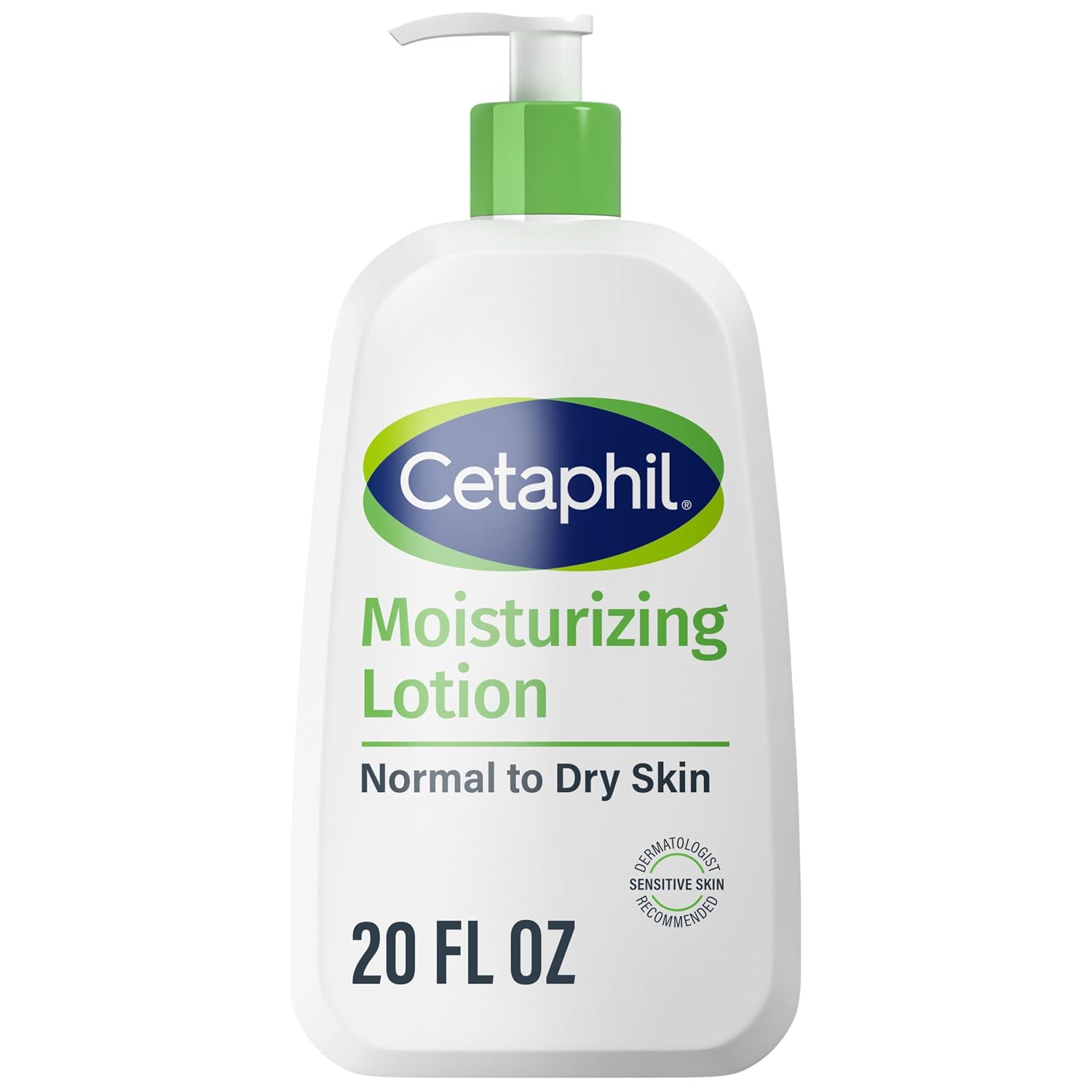
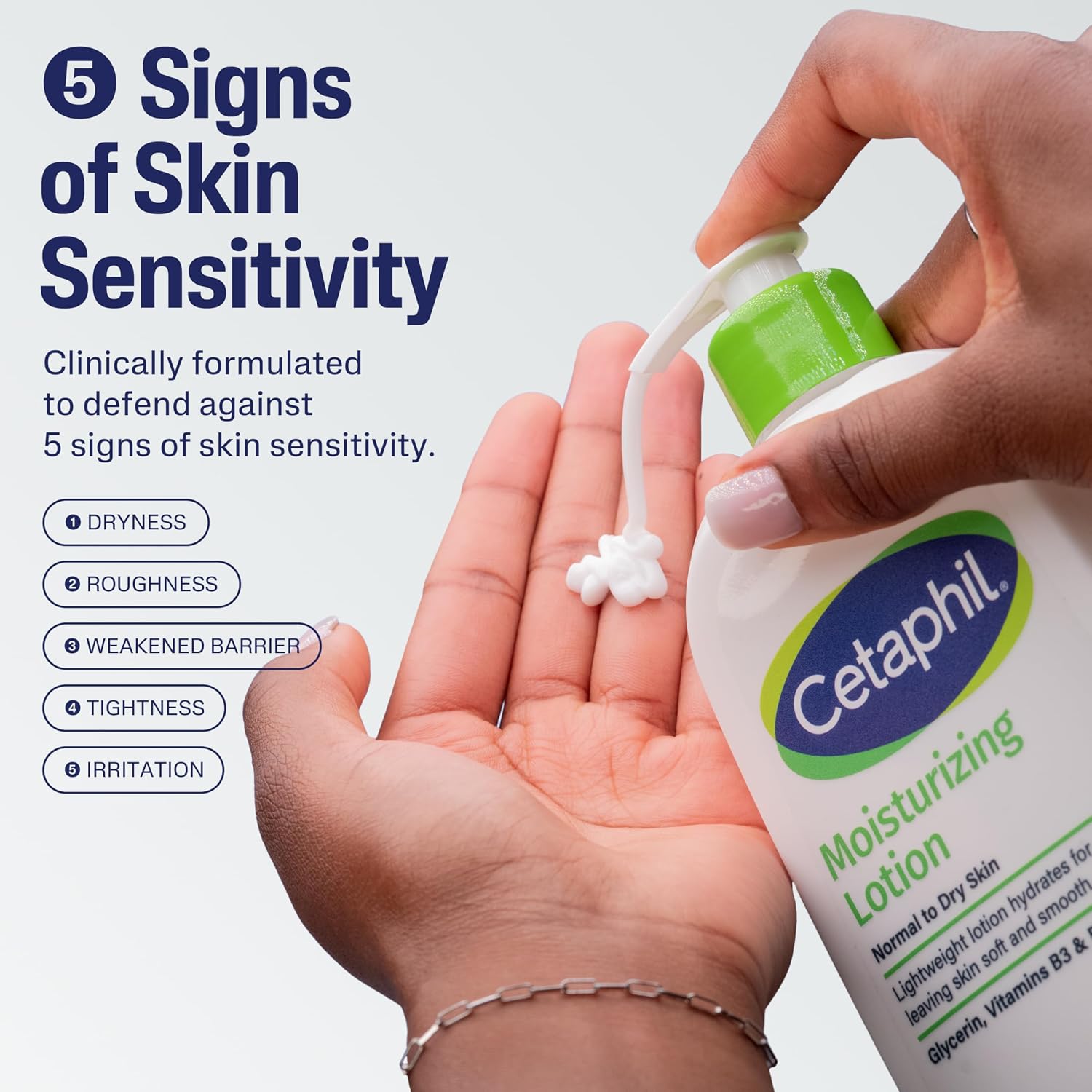
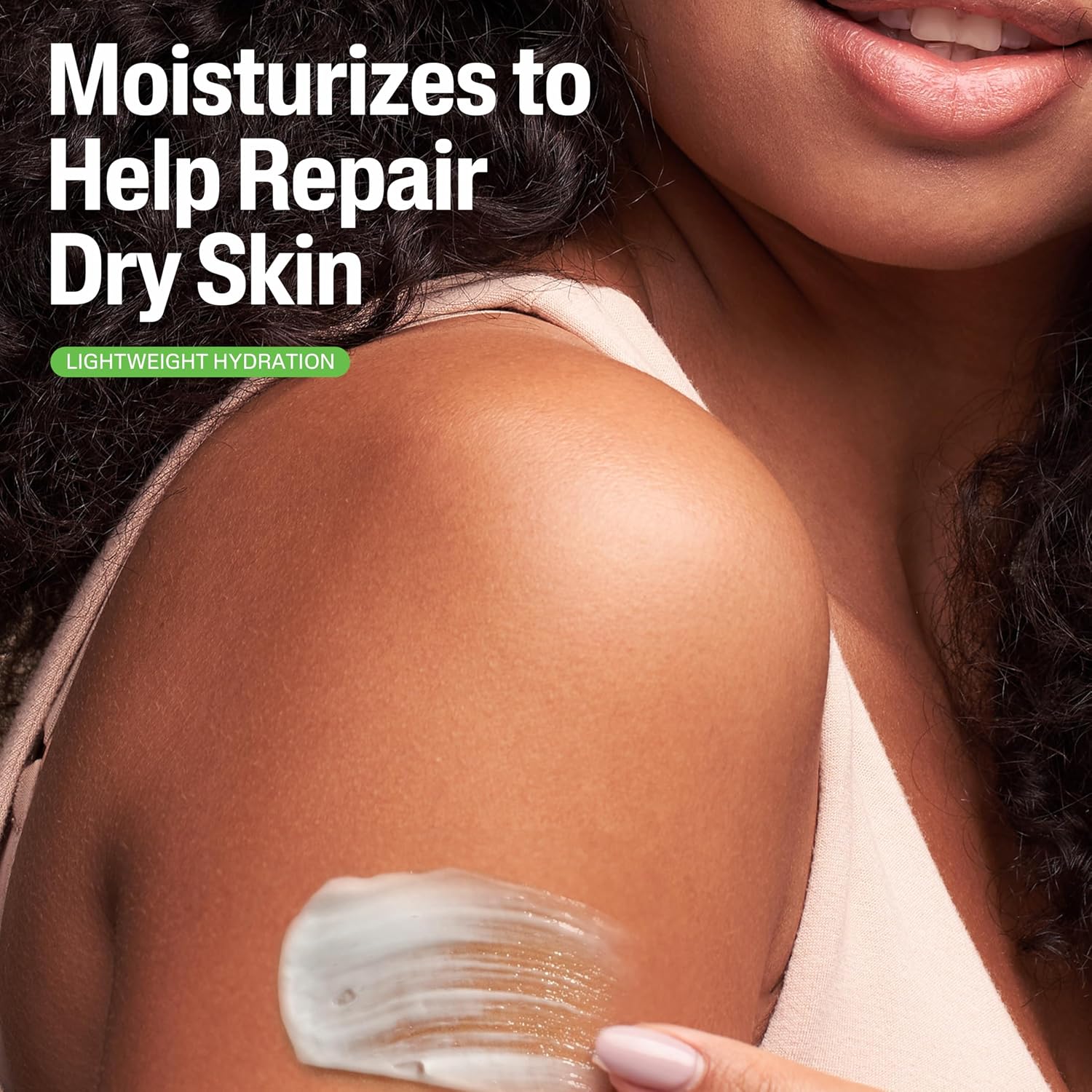
The packaging is the most recognisable in mass skincare: a white bottle, the navy-and-green oval, green lowercase product name, and a green pump collar. The second frame is the brand's positioning board - a hand catching the lotion with the five sensitivity signs listed as numbered pills. The third is a texture proof shot, a sheer white smear on a shoulder, which is a fair representation of how thin this formula actually is at 20 ounces.
1.4 How it is used
A lotion rather than a cream, so it is thin enough to pump and to spread over large areas. It goes on after showering on damp skin for the body, and after serum on the face. Because the functional core is glycerin, panthenol and niacinamide with no occlusive butter, it works as a daily all-over product rather than a treatment for cracked heels - the brand's own 48-hour claim rests on barrier strengthening rather than on occlusion. The 20-ounce pump is the volume play: this is a product bought to be used liberally and replaced, not a 50 ml tube to be rationed.
2. What Buyers Report
2.1 The two ratings
| Source | Rating | Sample size | What it is measuring |
|---|---|---|---|
| Marketplace ratings | 4.7 / 5 | 18,969 | Whether the product does its job at its price |
| Specialist community | 2.8 / 5 | 56 | Whether the formula survives ingredient-level scrutiny |
A 1.9-point gap is not a data error; it is two different tests. The marketplace distribution is almost a straight decline from a dominant five-star block: 86% five stars, 9% four, 3% three, 2% one and a rounded 0% at two stars. With 18,969 ratings, 2% one-star is roughly 380 individual complaints, which is enough to be a signal rather than noise - but at 86% satisfaction the product is clearly doing what most buyers want.
The specialist platform sits at 2.8 over 56 reviews and flags four separate concerns, including eczema worsening and irritation. Both readings are consistent with the same formula: a short, cheap, effective moisturiser that contains one fragrance-classified preservative and one strongly comedogenic ester. A buyer who reads labels will weight those two ingredients heavily; a buyer who wants soft skin for eight dollars a bottle will never notice them.
2.2 Aspect by aspect
| Aspect | Mentions | Positive | Negative | Positive share |
|---|---|---|---|---|
| Effectiveness | 1,001 | 940 | 61 | 94% |
| Moisturising | 399 | 387 | 12 | 97% |
| Value for money | 216 | 178 | 38 | 82% |
| Non-greasy | 215 | 165 | 50 | 77% |
| Skin compatibility | 215 | 172 | 43 | 80% |
| Fragrance-free | 180 | 160 | 20 | 89% |
| Skin feel | 159 | 153 | 6 | 96% |
| Absorption | 104 | 91 | 13 | 88% |
This is the most positive aspect table in the series and it is dominated by volume: effectiveness at 1,001 mentions and 94%, moisturising at 399 and 97%. Both numbers are large enough that the sentiment is stable rather than anecdotal. Skin feel at 96% over 159 mentions says almost nobody objects to how it feels, and absorption at 88% backs up the fast-absorbing claim.
Two aspects deserve more than a passing look. Non-greasy is the lowest at 77%, which is a real split on a product whose central claim is that it is non-greasy - 50 people found it greasy. And the fragrance-free aspect at 89% is interesting precisely because the ingredient list is not fragrance-free by the allergen standard: 180 people volunteered an opinion on fragrance and 160 were positive, which suggests most buyers read "no perfume" as fragrance-free and are satisfied with that reading. They are not wrong about the experience; they are simply not measuring the same thing the databases measure.
3. What Is Inside
Two independent ingredient databases were merged. Both return 16 ingredients over the same INCI set for the current formula, which makes this the cleanest cross-check in the series - and the more interesting finding is that an older 17-ingredient version of this same product is still widely indexed, with a materially different composition.
3.1 Claim scorecard
Three of twelve claims hold. That is the weakest matrix in this series, and the failures cluster around one ingredient.
Paraben-freeSulfate-freeReef-safe
Not alcohol-freeNot EU-allergen-freeNot fragrance-freeNot oil-freeNot silicone-freeNot cruelty-freeNot fungal-acne-safeNot pore-clogger-freeNot vegan
| Claim | Holds | Evidence |
|---|---|---|
| Paraben-free | Yes | Preserved with sodium benzoate and benzyl alcohol |
| Sulfate-free | Yes | No sulfate surfactant present |
| Reef-safe | Yes | No UV filters of concern; not a sunscreen |
| Alcohol-free | No | Benzyl alcohol at position 14 |
| EU-allergen-free | No | Benzyl alcohol is one of the 26 declarable allergens |
| Fragrance-free | No | Benzyl alcohol carries a fragrance function in the ingredient databases |
| Oil-free | No | Avocado oil and sunflower seed oil |
| Silicone-free | No | Dimethicone at position 9 |
| Cruelty-free | No | Not certified |
| Fungal-acne-safe | No | Five flagged ingredients: two esters, two triglycerides, one fatty alcohol |
| Pore-clogger-free | No | Four flagged, led by isopropyl palmitate at comedogenic 3-4 |
| Vegan | No | Not certified |
3.2 Ingredient levels
Sixteen ingredients is short enough to reason about one by one, which is what makes the level table meaningful here rather than statistical.
| Level | Safety band | Count | Which ones |
|---|---|---|---|
| Level 1 | 1 | 7 | Water, isopropyl palmitate, cetearyl alcohol, panthenol, niacinamide, avocado oil, sunflower oil |
| Level 2 | 1-2 | 4 | Glycerin, ceteareth-20, sodium benzoate, citric acid |
| Level 3 | 2-3 | 1 | Tocopheryl acetate |
| Level 4 | 2-5 | 1 | Dimethicone |
| Level 5 | 4 | 1 | Benzyl alcohol - the only grade-4 row |
| Unrated | none | 2 | Glyceryl stearate, pantolactone |
The safety axis is essentially binary: fourteen of sixteen rows sit at grade 1 or 1-2, and the formula's entire risk profile is concentrated in a single preservative at grade 4. The acne axis is more evenly spread and more consequential - nine of sixteen rows are rated, and one of them, isopropyl palmitate, sits at position 3 with a comedogenic grade of 4. Position 3 in a sixteen-ingredient list means real concentration. That single row is why the product carries a pore-clogger flag despite being labelled non-comedogenic.
3.3 Flagged ingredients
| Ingredient | Pos. | Acne | Irritant | Safety | Assessment |
|---|---|---|---|---|---|
| Benzyl Alcohol | 14 | - | - | 4 | Worst grade in the formula, and the ingredient behind three failed claims: alcohol-free, allergen-free, fragrance-free |
| Isopropyl Palmitate | 3 | 4 | 1 | 1 | Highest comedogenic grade, at a position early enough to matter; the pore-clogger flag traces here |
| Dimethicone | 9 | 1 | 0 | 2-5 | Widest safety band; a silicone at functional concentration |
| Tocopheryl Acetate | 8 | 0 | 0 | 2-3 | Zero on both risk axes; the range is source disagreement |
| Cetearyl Alcohol | 4 | 2 | 2 | 1 | Fatty alcohol, not drying; grade 2 is typical for the class |
| Ceteareth-20 | 5 | 2 | - | 1-2 | Ethoxylated emulsifier, comedogenic 2 - the usual class rating |
| Persea Gratissima Oil | 10 | 2 | 0 | 1 | Avocado oil; one of the two oils that breaks the oil-free claim |
3.4 A formula that changed, and an ingredient list that did not keep up
An older 17-ingredient entry for this same product, sourced from packaging in 2018 and still widely retrievable, lists macadamia seed oil, farnesol and sodium hydroxide, and does not list niacinamide, panthenol or pantolactone. The current formula has 16 ingredients and a different core. This is genuine reformulation, not a database error - and it matters, because the two versions have different allergen profiles: the 2018 version contains farnesol, itself a declarable allergen, while the current version contains benzyl alcohol instead.
Anyone who checked a Cetaphil ingredient list before roughly 2022 and concluded the product was fragrance-allergen-free was reading a different formula. That is worth stating plainly in a category where "it has always been the same" is a common assumption.
3.5 The full 16
Both databases side by side, in INCI order. Safety is inverse: 1 is safest. A dash is missing data, not absence of risk.
| # | Ingredient | Function | Acne | Irritant | Safety | Comedo. | Irritancy |
|---|---|---|---|---|---|---|---|
| 1 | Water / Aqua | Solvent, skin conditioning | - | - | 1 | - | - |
| 2 | Glycerin | Solvent, viscosity control, humectant | 0 | 0 | 1-2 | 0 | 0 |
| 3 | Isopropyl Palmitate | Solvent, synthetic ester, emollient | 4 | 1 | 1 | 3-4 | 1 |
| 4 | Cetearyl Alcohol | Surfactant, viscosity control, emulsifier | 2 | 2 | 1 | 2 | 1 |
| 5 | Ceteareth-20 | Surfactant, emulsifier | 2 | - | 1-2 | 2 | 3 |
| 6 | Panthenol | Antistatic, skin conditioning, humectant, anti-inflammatory | 0 | 0 | 1 | 0 | 0 |
| 7 | Niacinamide | Skin conditioning, smoothing | - | - | 1 | - | - |
| 8 | Tocopheryl Acetate | Skin conditioning, antioxidant | 0 | 0 | 2-3 | 0 | 0 |
| 9 | Dimethicone | Skin conditioning, emollient | 1 | 0 | 2-5 | 1 | 0 |
| 10 | Persea Gratissima Oil | Skin conditioning, moisturiser, emollient | 2 | 0 | 1 | 0-3 | 0 |
| 11 | Helianthus Annuus Seed Oil | Skin conditioning, antioxidant, emollient | 0 | 0 | 1 | 0 | 0 |
| 12 | Glyceryl Stearate | Emollient, emulsifier | - | - | - | 1 | 0 |
| 13 | Sodium Benzoate | Preservative | - | - | 1-2 | - | - |
| 14 | Benzyl Alcohol | Preservative, solvent, fragrance | - | - | 4 | - | - |
| 15 | Citric Acid | pH adjuster, buffering | - | - | 1-2 | - | - |
| 16 | Pantolactone | Humectant, skin conditioning | - | - | - | - | - |
Coverage is 16 of 16 from both databases, with two caveats worth naming. The two lists order three items differently - one places glyceryl stearate at 12 and pantolactone at 16, the other reverses the pair - and they disagree on two severity values: ceteareth-20 is irritancy 3 in one and unrated in the other, and avocado oil is 0-3 in one and a flat 2 in the other. Neither discrepancy changes a conclusion. Pantolactone is not indexed as an ingredient page in one of the databases at all, which is why its function cell is empty there and came from the second source here.
3.6 Benefits against a short formula
Twelve benefit claims on sixteen ingredients means six of them rest on a single molecule. Hydrating (5 ingredients) and scar healing (4) are the only claims with depth, and barrier repair at 3 is coherent with panthenol, niacinamide and glycerin. Everything below that - acne fighting, good for oily skin, large pores, dark spots, texture, anti-aging - is one ingredient carrying a category, and each of the first two is directly contradicted by a matching concern about acne and oiliness. On a formula this short, the benefit counts are a fair map of how thin those claims are.
4. What It Costs
4.1 Today's price
Fifteen dollars ninety-seven for twenty ounces works out to eighty cents an ounce, which is the reason this product occupies a permanent slot in the top twenty of its category. The subscription discount is an unusually generous 15% rather than the usual 5%, taking it to $13.57, and there is a further $1.98 coupon on first subscription orders. Stacked, the entry price for a subscriber is about $11.59 - roughly 42% below the on-page price and the cheapest this product has been offered in the tracked record outside a single promotional window.
4.2 Five years of tracked prices
Unusually for this category, both the Amazon-sold channel and the third-party new channel carry full history, and both report the same current price on the same date.
| Channel | Lowest ever | Highest ever | Current | Average |
|---|---|---|---|---|
| Amazon sold | $9.00 (Sep 05, 2024) | $16.84 (Feb 06, 2023) | $15.97 (Oct 14, 2026) | $14.93 |
| 3rd party new | $11.00 (Mar 24, 2022) | $33.90 (Jul 14, 2024) | $15.97 (Oct 14, 2026) | $16.14 |
| 3rd party used | - | - | - | - |
The two channels tell different stories and the chart makes it visible. Amazon's band is disciplined: $9.00 to $16.84, an 87% spread, with an average 6.5% below list. The third-party band is 208% wide, inflated by a $33.90 spike in July 2024 that Amazon has never come close to matching. That spike is a marketplace artefact - no brand-controlled channel has ever charged anything like it - and it should not anchor any judgement about the product's value.
The parity finding is the useful one: both channels report $15.97 on 2026-10-14. Identical current prices on identical dates is what brand-controlled pricing looks like. At the average level the marketplace runs a $1.21 premium over Amazon's own price, so the parity is a recent convergence rather than a structural feature.
4.3 Where today's price sits
| Measure | Value | Basis |
|---|---|---|
| Current vs Amazon low | +77.4% | ($15.97 - $9.00) / $9.00 |
| Current vs Amazon high | -5.2% | ($15.97 - $16.84) / $16.84 |
| Current vs Amazon average | +7.0% | ($15.97 - $14.93) / $14.93 |
| Current vs list | 0.0% | Parity, no discount |
| Current vs 3rd-party low | +45.2% | ($15.97 - $11.00) / $11.00 |
| Current vs 3rd-party average | -1.1% | ($15.97 - $16.14) / $16.14 |
| Amazon spread | $7.84 | 87.1% of the low |
| 3rd-party spread | $22.90 | 208.2% of the low |
| Marketplace premium at average | $1.21 | $16.14 vs $14.93 |
| Channel parity at current | Yes | Both $15.97 on 2026-10-14 |
Today's price is list parity, 7.0% above the five-year Amazon average and only 5.2% below the highest price Amazon has ever charged for it. That is not a discount; it is the top of the normal band. The two genuinely cheap moments in the record are Amazon's $9.00 in September 2024, a 43.7% saving against today, and the $11.00 third-party low in March 2022. Both are historical rather than current. The one live route to a lower price is the subscription stack at roughly $11.59, which beats every historical observation except the $9.00 window.
5. Who It Suits
This is a cheap, effective, short-formula moisturiser with one meaningful formulation problem. Sixteen ingredients is a genuine asset for most people - there is very little to react to, and the functional core of glycerin, panthenol and niacinamide is well chosen and well documented. The problem is concentrated and specific: benzyl alcohol at grade 4 breaks three separate clean-label claims, and isopropyl palmitate at position 3 carries a comedogenic grade of 4 on a product labelled non-comedogenic.
| If you are | Fit | Because |
|---|---|---|
| Dry body skin wanting cheap, daily, all-over moisture | Strong | Effectiveness 94% over 1,001 mentions, moisturising 97%, at 80 cents an ounce |
| Sensitive but not fragrance-allergen sensitive | Good | No added perfume, short formula, panthenol and niacinamide - but benzyl alcohol is a declarable allergen |
| Diagnosed fragrance allergy or contact sensitisation | Poor | Benzyl alcohol is one of the 26 EU declarable fragrance allergens, regardless of the marketing line |
| Acne-prone or fungal-acne-prone on body or face | Poor | Isopropyl palmitate at comedogenic 4 in position 3; five fungal-acne flags; four pore-clogger flags |
| Buying for the lowest possible price per ounce | Strong, via subscription | $11.59 stacked against a $15.97 on-page price; no cheaper than the $9.00 window of 2024 |
6. How This Was Built
6.1 Sources and sequence
Four channels were read on 2026-10-27. The live retail listing was read under a New York 10001 delivery address so every price is native USD with no conversion. A long-run price tracker supplied five years of history across two channels. One ingredient database supplied acne, irritation and safety grades for all 16 INCI entries from an entry labelled Official Site and dated January 2026; a second supplied the claim matrix, four concerns, benefit counts and its own comedogenic ratings. Both returned 16 of 16 ingredients over the same INCI set, and an older 17-ingredient entry was identified and rejected as a pre-reformulation version.
6.2 Confidence
| Element | Confidence | Basis |
|---|---|---|
| Specification | High | Read from the listing's specification table, including UPC and model |
| Current price and coupon stack | High | Native USD under a US address, captured the same day |
| Marketplace rating and distribution | High | Published aggregates over 18,969 ratings |
| Community rating | Low to medium | 56 reviews - small sample, self-selected and ingredient-literate |
| Review aspect shares | Medium | Listing's own aggregation; individual review bodies did not render |
| Ingredient list and count | High | Both databases return the same 16 names for the current formula |
| Formula-change finding | High | Two entries with materially different compositions, one labelled 2018 packaging and one 2026 Official Site |
| Per-ingredient grades | Medium | Community databases; 7 of 16 rows unrated on acne |
| Price history band | Medium | Five values per channel, current observation 13 days stale |
| Cause of the $33.90 third-party high | Low | Inferential; no offer-level detail published |
6.3 What this report cannot tell you
- The price history block is all-time for every chart window. No period-specific statistic exists in that source, and none is stated here.
- The tracked current price is thirteen days stale. It matches the live listing exactly, which is consistent with a brand-held price but is not proof of freshness.
- Individual review bodies and buyer photographs did not render at capture time. The review analysis rests on published aggregates, and no buyer-photo gallery appears because the listing rendered none.
- The community rating rests on 56 reviews and should be weighted well below the 18,969-rating marketplace average.
- Ingredient grades are community assessments. A blank cell is missing data; a low grade is not a guarantee; a range is disagreement, not precision.
- The claim-matrix reading - that benzyl alcohol makes this product not fragrance-free - is the databases' classification. The brand's narrower statement that no perfume was added is also true. Both are reported rather than resolved into one verdict.
- Every figure is a snapshot; ratings, ranks and prices move between captures.