Brand: DRMTLGY | Format: 1.7 fl oz / 50 mL pump | Category: Facial Tinted Moisturizers | Marketplace: Amazon US | Snapshot: 27 October 2026
The one-line summary. A genuinely well-executed hybrid sunscreen with a clean, non-comedogenic base, undone by two things it cannot fix: a chemical UV filter that several jurisdictions have legislated against, and a smell that roughly 1,100 buyers have written about. It is the number one product in its Amazon subcategory. It is also priced 7% above its own list price.
1. Product Information
1.1 Product imagery
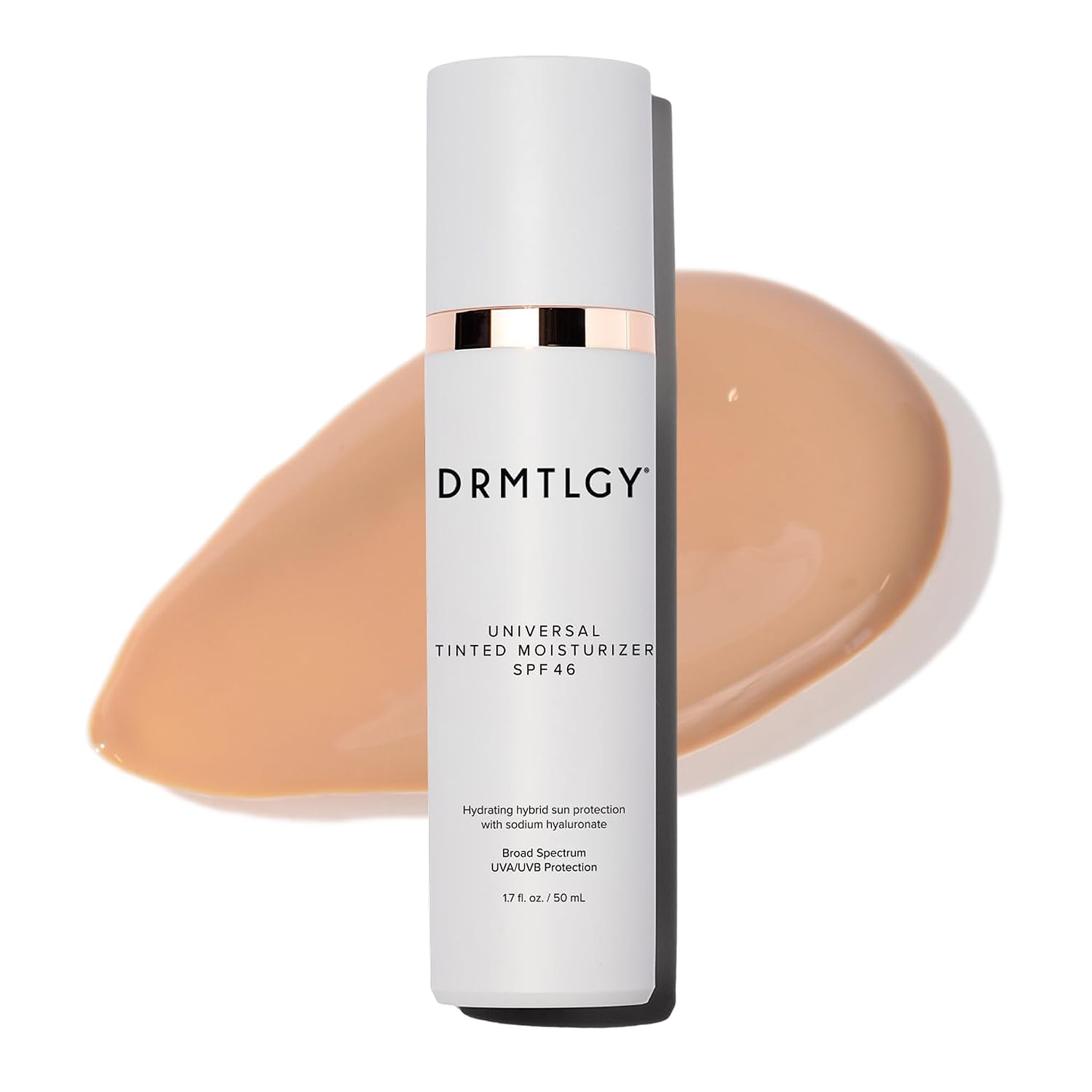 Source: Amazon - the 1.7 fl oz pump bottle with a broad dewy swatch behind it, showing the actual tint. |
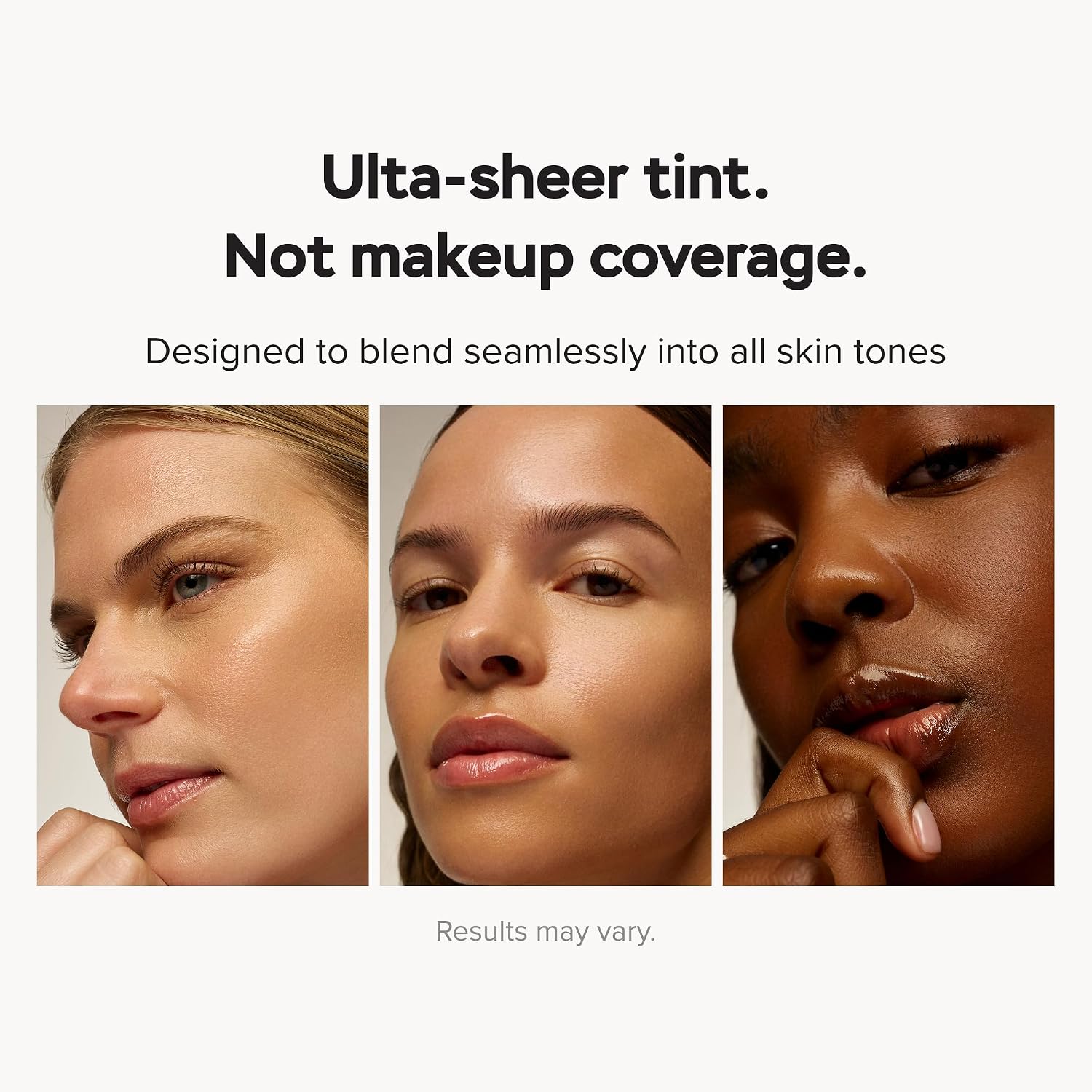 Source: Amazon - the brand's central claim, Ultra-sheer tint. Not makeup coverage., shown on three skin tones. |
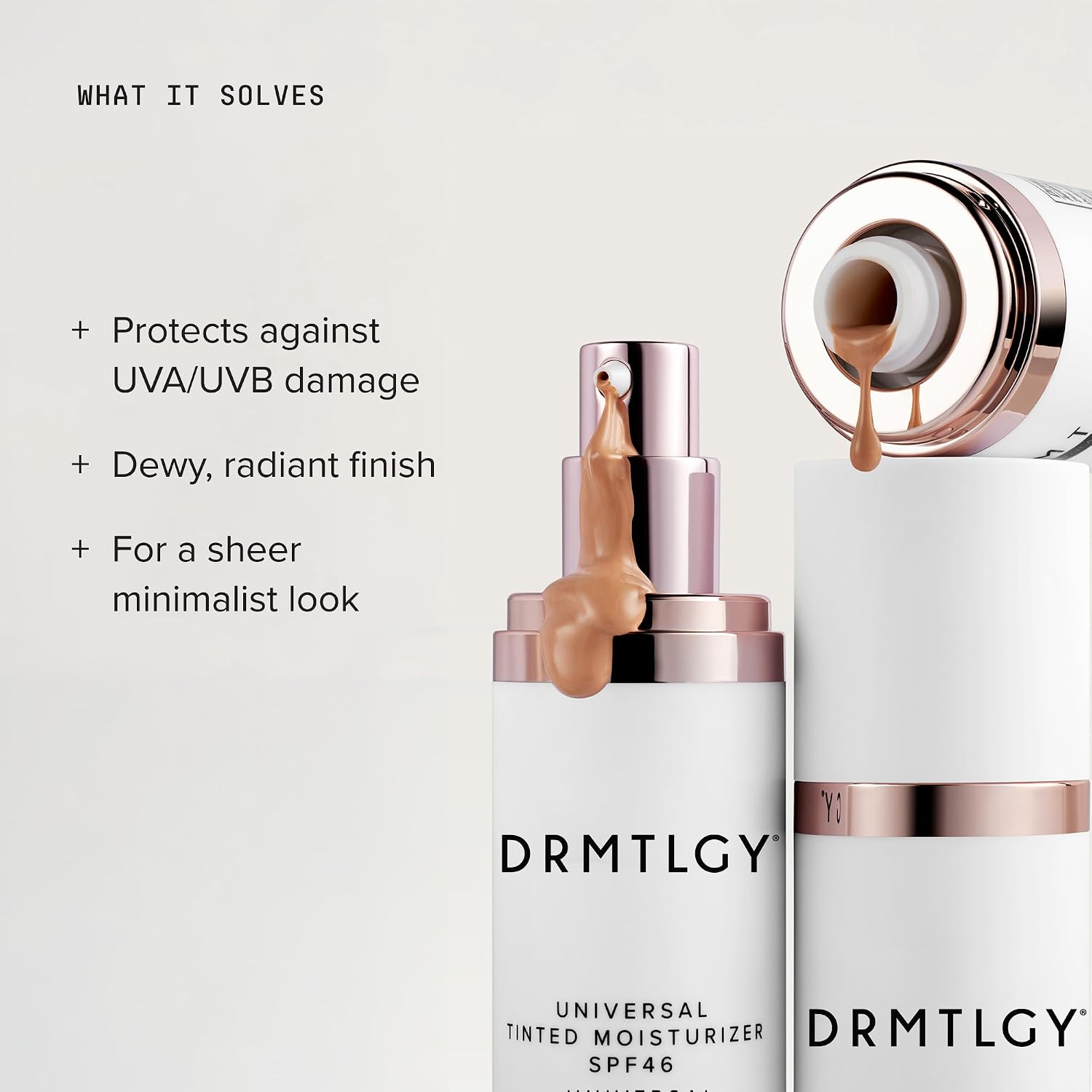 Source: Amazon - the What It Solves panel: UVA/UVB protection, dewy finish, sheer minimalist look. |
1.2 At a glance
| Field | Value |
|---|---|
| Full listing title | DRMTLGY Universal Tinted Moisturizer SPF 46, Dewy Tinted Sunscreen |
| Brand | DRMTLGY |
| Sold by | DRMTLGY (brand-direct) |
| Category path | Beauty & Personal Care › Makeup › Face › Tinted Moisturizers |
| Best Sellers Rank | #548 in Beauty & Personal Care; #1 in Facial Tinted Moisturizers |
| SPF | 46, broad spectrum |
| Active filters | Zinc Oxide 12% (mineral) + Octinoxate 7.5% (chemical) |
| Size | 1.7 fl oz / 50 mL |
| Unit price | $18.24 per fluid ounce |
| Availability | In Stock - quoted to a New York 10001 address |
| Current price | $31.00 - no list price shown on the listing |
| Rating | 4.1 out of 5, from 39,563 ratings |
The rank is the headline fact in this table: #1 in Facial Tinted Moisturizers. This is not a niche product fighting for visibility - it leads its subcategory outright, and it does so at a price point that sits above its own list. Everything else in this report has to be read against that: this is what the market has chosen, not what a formula review might have predicted.
1.3 Specification table
| Specification | Value |
|---|---|
| Scent | Unscented |
| Sun Protection Factor | 46 |
| Product Benefits | Broad Spectrum SPF 46 Protection, Even Toning, Fine Line Treatment, Hydrates and Smooths Skin, Lightweight, Breathable Feel, Sheer, Natural-Looking Coverage |
| Item Volume | 50 ml |
| Unit Count | 1.7 Fluid Ounces |
| Item Weight | 1.7 ounces |
| Item Dimensions | 6 x 1.5 x 1.5 inches |
| Package Size Name | Regular |
| Number of Items | 1 |
| Item model number | N-4541 |
| UPC | 850006649044 |
| Manufacturer | DRMTLGY |
| ASIN | B07RW4CHC3 |
1.4 How the brand argues it
- Dewy, radiant tinted sunscreen. A lightweight tinted sunscreen that blends seamlessly into skin and delivers a healthy dewy glow "without feeling heavy, greasy, or cakey".
- Hybrid broad spectrum SPF 46. Formulated with Zinc Oxide and Octinoxate - one mineral, one chemical - to protect against UVA/UVB while supporting skin against visible signs of premature ageing.
- Hydrates, brightens, smooths. Niacinamide for uneven tone, Hyaluronic Acid for lasting hydration, antioxidant Vitamin E against environmental stress.
- Lightweight daily face SPF. Fast-absorbing and breathable; layers under makeup or worn alone for natural coverage.
- FSA/HSA eligible. Qualifies for health savings account reimbursement - a genuine differentiator in the US market and one that effectively lowers the real cost for eligible buyers.
The A+ content adds nothing beyond a section heading reading "Product description", with no FAQ, no comparison module, and no separated body copy. The five bullets and the specification table are the entirety of the brand's argument, which is unusually lean for a category leader.
1.5 What's Inside - claim matrix
An independent product database audits twelve cosmetic claims against the formula. Nine hold, three do not - and the three failures are all structural rather than accidental.
| Claim | Verdict | Basis |
|---|---|---|
| Alcohol-free | Holds | No volatile drying alcohol in the formula. |
| EU-allergen-free | Holds | None of the 26 declarable fragrance allergens present. |
| Fragrance-free | Holds | No Parfum entry. But see 3.7 - this is literally true and practically misleading. |
| Oil-free | Holds | No oil-phase emollient; the base is silicone and water. |
| Paraben-free | Holds | Preservation is phenoxyethanol with ethylhexylglycerin. |
| Sulfate-free | Holds | No sulfate surfactant. |
| Cruelty-free | Holds | Brand assertion. |
| Fungal-acne-safe | Holds | No fatty acids, fatty alcohols, or triglyceride esters - the materials that feed malassezia. Unusual and genuinely earned for a tinted SPF. |
| Pore-clogger-free | Holds | No ingredient rated comedogenic above 2, and only one at 2 (an emulsifier). |
| Silicone-free | Does not hold | Three silicones: Cyclopentasiloxane plus two silicone emulsifiers. They produce the slip and the dewy finish. |
| Reef-safe | Does not hold | Octinoxate 7.5% - banned in Hawaii and Key West for coral-reef damage. |
| Vegan | Does not hold | Not flagged as vegan. No obvious animal-derived material in the list; the basis is not visible in the table and is not guessed at here. |
2. Product Rating & Reviews
2.1 Two ratings, and how much each is worth
| Source | Score | Sample | Weight |
|---|---|---|---|
| Amazon US | 4.1 / 5 | 39,563 ratings | Statistically decisive. This is the verdict of the buying market. |
| Independent product database | 3.0 / 5 | 9 reviews | Effectively no weight. Nine reviews is an anecdote, not a measurement. |
The gap between the two looks dramatic - 1.1 points - but it should not be read as signal. A nine-review average has a confidence interval wide enough to contain almost any true value. It is reported because it is on the page and discarded because of its sample size, which is the opposite of how most report summaries treat a low score.
2.2 Star distribution
| Stars | Share | Approx. ratings (derived) | Reading |
|---|---|---|---|
| 5 star | 61% | ~24,133 | Modal verdict |
| 4 star | 14% | ~5,539 | Qualified approval |
| 3 star | 11% | ~4,352 | Unusually fat |
| 2 star | 5% | ~1,978 | Disappointed |
| 1 star | 9% | ~3,561 | Rejected |
The shape is the finding, not the 4.1. A 4.1 average can come from a product everyone mildly likes or from a product half the market loves and a tenth hates - and those are not the same product. Here it is clearly the second: 61% five-star alongside 9% one-star, which is roughly 3,500 rejections. And the 11% three-star share is the diagnostic detail. Three-star is where buyers land when a product technically worked but missed the expectation they brought to it. A fat three-star bucket next to a fat one-star bucket is the signature of a product that is being bought for the wrong reason.
The sections below identify what that wrong reason is: two separate expectation gaps, one about coverage and one about smell.
2.3 What buyers mention
| Aspect | Mentions | Positive | Negative | Positive share |
|---|---|---|---|---|
| Effectiveness | 5,328 | 3,988 | 1,340 | 75% |
| Tint | 2,704 | 1,700 | 1,004 | 63% |
| Coverage | 1,977 | 938 | 1,039 | 47% |
| Skin irritation | 1,964 | 964 | 1,000 | 49% |
| Moisturizing | 1,603 | 1,170 | 433 | 73% |
| Scent | 1,418 | 289 | 1,129 | 20% |
| Texture | 1,020 | 876 | 144 | 86% |
| Application | 1,006 | 932 | 74 | 93% |
Four aspects work well. Application at 93% and texture at 86% mean the physical experience of putting it on is close to universally liked - buyers describe it as "smooth as silk". Effectiveness at 75% across 5,328 mentions is the largest volume in the set and is solid. Moisturising at 73% is respectable but unremarkable for a product positioning itself as a moisturiser.
Four aspects do not. Three of them are the same problem wearing different clothes:
- Scent at 20% is the worst result anywhere in this dataset. 1,129 negative mentions against 289 positive. The marketplace summary uses the phrase "awful smell" without hedging.
- Coverage at 47% and tint at 63% describe one expectation gap. Buyers who expected foundation found a sheer wash; buyers who wanted a sheer wash mostly got what they wanted. The brand says this explicitly - Ultra-sheer tint. Not makeup coverage. - but roughly a thousand people either did not read it or did not believe it.
- Skin irritation at 49% is a straight coin flip across nearly 2,000 mentions, with 1,000 negative against 964 positive.
2.4 Why a fragrance-free product smells bad
This is the most instructive finding in the report, and it is a genuine cross-channel contradiction that resolves cleanly.
Three separate sources agree the product is unscented: the listing says Scent: Unscented, the ingredient database marks it Fragrance-free: Yes, and the 21-ingredient list contains no Parfum, no Fragrance, no limonene, and no linalool. All three are correct.
And yet 1,129 buyers have complained about the smell. The resolution is the filter system: Octinoxate is present at 7.5%, and it has its own smell. Chemical UV filters are not odourless, and at 7.5% in a base with no fragrance to mask them, the product smells of its own actives. Cyclopentasiloxane, the volatile silicone at position 4, adds a characteristic solvent note as it evaporates off the skin.
So the claim is literally true - no fragrance has been added - and the inference a buyer draws from it is wrong. Unscented is read as smells of nothing, and for a 7.5% Octinoxate formula the honest expectation is smells faintly of sunscreen. About 1,100 people have recorded that gap. A buyer who is sensitive to the smell of chemical sunscreen should treat this product as unsuitable regardless of the fragrance-free badge.
2.5 What the marketplace summary concludes
The aggregated summary states that customers find the sunscreen effective, moisturising, and easy to apply, describing it as smooth as silk. It records the tint as genuinely mixed - some saying it matches their skin tone perfectly, others that it is not very tinted. It records coverage and irritation as mixed, with some finding sheer coverage and others that it covers nothing, and some reporting no irritation while others report breakouts. It records negative feedback for the smell.
That summary maps cleanly onto the numbers above and contains no surprises, which is itself a useful check: the platform's own synthesis and the underlying aspect counts agree on where the problems are.
2.6 Independent reviewer sentiment
The ingredient database's community votes lean negative: 12 ingredients disliked against 8 liked, with one mixed. This is a vote on individual ingredients, not on the product, and carries no explanatory detail. It is directionally consistent with the low product score on that channel, and it is a weak signal only - not a safety finding.
3. Product Ingredients
3.1 The formula in one paragraph
This is two formulations stacked in one bottle, and the ingredient list makes the seam visible. The vehicle is a volatile-silicone-and-water emulsion: Cyclopentasiloxane for slip, three silicone emulsifiers for texture, Glycerin and Sodium Hyaluronate for water-binding, Niacinamide for tone, Tocopheryl Acetate as an antioxidant, Iron Oxides for the tint. Almost every one of those sits at safety grade 1 or 2, with no irritant rating above 0 anywhere. The filter system is where every high number in the formula lives: Zinc Oxide at 12% for the UVA end, Octinoxate at 7.5% for the UVB end, and a safety grade of 7 on the latter.
The total is 21 ingredients. That is short for a tinted sunscreen, and it is short by design - there is no room in this formula for a long botanical list, and the brand has not pretended otherwise.
| Functional group | Ingredients | Count |
|---|---|---|
| UV filters | Zinc Oxide 12%, Octinoxate 7.5% | 2 |
| Silicone vehicle | Cyclopentasiloxane, Triethoxysilylethyl PDMS, Polyglyceryl-3 PDMS, Triethoxycaprylylsilane | 4 |
| Humectants | Glycerin, Sodium Hyaluronate | 2 |
| Actives (tone / antioxidant) | Niacinamide, Tocopheryl Acetate, Polygonum Aviculare Extract | 3 |
| Emollients | Octyldodecyl Neopentanoate, Polyisobutene | 2 |
| Emulsifiers and rheology | Oleth-3 Phosphate, HEA/SA Copolymer, PEG-7 Trimethylolpropane Coconut Ether | 3 |
| Pigment | Iron Oxides | 1 |
| Preservation and chelation | Phenoxyethanol, Ethylhexylglycerin, Disodium EDTA | 3 |
| Carrier | Water | 1 |
3.2 Ingredient risk tiers
Two independent databases were merged. Each ingredient was tiered using the highest single reading across the clogging and irritation axes - comedogenic and irritancy ratings from one, acne risk and irritant rating from the other - with ranges judged at their upper bound. Safety grades are reported separately in 3.4 because they measure something different.
| Tier | Highest reading | Count | Share of 21 | Ingredients |
|---|---|---|---|---|
| Tier 0 - No known risk | 0 | 5 | 23.8% | Octinoxate, Glycerin, Sodium Hyaluronate, Tocopheryl Acetate, Iron Oxides |
| Tier 1 - Very low | 1 | 1 | 4.8% | Zinc Oxide |
| Tier 2 - Moderate | 2 | 1 | 4.8% | Oleth-3 Phosphate |
| Tier 3 - Elevated | 3 or higher | 0 | 0% | None |
| Unrated | no reading on either axis | 14 | 66.7% | Water, Cyclopentasiloxane, Niacinamide, Octyldodecyl Neopentanoate, HEA/SA Copolymer, Polygonum Aviculare Extract, Ethylhexylglycerin, Triethoxysilylethyl PDMS, Polyglyceryl-3 PDMS, PEG-7, Polyisobutene, Triethoxycaprylylsilane, Disodium EDTA, Phenoxyethanol |
Zero ingredients reach tier 3. On the clogging and irritation axes this is the cleanest formula in the comparison set - there is nothing at comedogenic 3, nothing at irritancy 3, and only one emulsifier at 2 on either scale. For a tinted sunscreen that will be worn all day over a full face, that is a real and slightly unusual achievement, and it is the substance behind the passed Pore-clogger-free and Fungal-acne-safe badges.
But 14 of 21 are unrated, and two of the unrated ones are named Cyclopentasiloxane and Octinoxate. Their absence from this chart is not an absence of concern - it is an absence of ratings on these two particular axes. Section 3.4 is where both of them reappear with the highest scores in the report.
3.3 Comedogenic distribution
Both axes read low is safer. Fifteen of 21 rows carry no comedogenic rating. Of the six that do, five are at 1 or below - and the single 2 belongs to an emulsifier present at a fraction of a percent, not to an emollient. No average has been computed over six rated rows out of twenty-one; a figure derived from 29% of the list would be meaningless.
3.4 Safety grades - where the risk actually is
The ingredient database also publishes an overall safety grade per ingredient on an inverse 1-to-5-plus scale: 1 is safest, and higher means more caution. This formula reaches 7, the maximum this database issues anywhere.
| Safety grade (upper bound) | Count | Share | Ingredient(s) |
|---|---|---|---|
| 1 | 9 | 42.9% | Water, Niacinamide, Octyldodecyl Neopentanoate, HEA/SA Copolymer, Polygonum Aviculare Extract, Sodium Hyaluronate, PEG-7, Polyisobutene, Triethoxycaprylylsilane |
| 2 | 9 | 42.9% | Oleth-3 Phosphate, Glycerin, Tocopheryl Acetate, Ethylhexylglycerin, Triethoxysilylethyl PDMS, Polyglyceryl-3 PDMS, Disodium EDTA, Iron Oxides, Phenoxyethanol |
| 5 | 1 | 4.8% | Zinc Oxide (range 1-5) |
| 6 | 1 | 4.8% | Cyclopentasiloxane |
| 7 | 1 | 4.8% | Octinoxate |
Eighteen of twenty-one sit at grade 2 or better. The three that do not are the three ingredients that define the product. That is not a coincidence - it is the entire analytical point of this section.
| Ingredient | Grade | What the grade is about |
|---|---|---|
| Octinoxate 7.5% | 7 | Endocrine-activity and environmental concerns, not skin irritation. Its own acne and irritant ratings are both 0. Restricted to 10% in the EU, where 7.5% is compliant. Banned in Hawaii and Key West for coral-reef damage. |
| Cyclopentasiloxane | 6 | Environmental persistence and bioaccumulation of a volatile cyclic silicone. Not a skin-risk grade. |
| Zinc Oxide 12% | 1-5 | Wide range because the database aggregates a benign topical assessment with an inhalation concern that applies only to respirable powders. In a cream, the low end applies. |
Reading this correctly matters more than the numbers themselves. A grade of 7 on Octinoxate does not mean it will sting. Its acne rating is 0 and its irritant rating is 0. It means the filter carries regulatory and environmental baggage that a buyer may or may not care about - and for a beach holiday, the reef question is the one that should drive the decision. Conflating an environmental grade with a dermatological one is the most common way this table gets misread.
3.5 Concerns flagged
| Concern | Description | Basis in the formula |
|---|---|---|
| May worsen irritation | May cause stinging, redness, or sensitivity. | Most plausibly the Octinoxate and the volatile silicone. Supported by the review data: irritation splits 49% across 1,964 mentions. |
One concern, and a notable absence. There is no acne concern and no oiliness concern - unusual for a tinted product, and consistent with the passed pore-clogger-free and fungal-acne-safe badges. Whatever else is true of this formula, it is not a formula that clogs.
Note the tension between this concern and the ingredient table: every rated ingredient has an irritant rating of 0, yet irritation splits evenly in real use. Ingredient-level irritancy ratings do not capture the experience of a 7.5% chemical filter worn all day, which is precisely the gap a class-level concern is there to flag.
3.6 Complete ingredient table
All 21 ingredients with readings from both databases - click to expand
| # | INCI name | Function | Comedogenic | Irritancy | Acne | Safety | Tier |
|---|---|---|---|---|---|---|---|
| 1 | Zinc Oxide 12% | Mineral UV filter, colourant | 1 | 0 | 1 | 1-5 | Tier 1 |
| 2 | Octinoxate (Ethylhexyl Methoxycinnamate) 7.5% | Chemical UVB filter | 0 | 0 | 0 | 7 | Tier 0 |
| 3 | Water | Solvent | not rated | not rated | not rated | 1 | Unrated |
| 4 | Cyclopentasiloxane | Solvent, emollient | not rated | not rated | not rated | 6 | Unrated |
| 5 | Niacinamide | Skin conditioning | not rated | not rated | not rated | 1 | Unrated |
| 6 | Oleth-3 Phosphate | Surfactant, emulsifier | 2 | 2 | 2 | 1-2 | Tier 2 |
| 7 | Octyldodecyl Neopentanoate | Emollient | not rated | not rated | not rated | 1 | Unrated |
| 8 | Hydroxyethyl Acrylate/Sodium Acryloyldimethyl Taurate Copolymer | Emulsion stabiliser | not rated | not rated | not rated | 1 | Unrated |
| 9 | Glycerin | Humectant, solvent | 0 | 0 | 0 | 1-2 | Tier 0 |
| 10 | Polygonum Aviculare Extract | Emollient | not rated | not rated | not rated | 1 | Unrated |
| 11 | Sodium Hyaluronate | Humectant | 0 | 0 | 0 | 1 | Tier 0 |
| 12 | Tocopheryl Acetate | Antioxidant | 0 | 0 | 0 | 2-3 | Tier 0 |
| 13 | Ethylhexylglycerin | Skin conditioning, preservative booster | not rated | not rated | not rated | 2 | Unrated |
| 14 | Triethoxysilylethyl Polydimethylsiloxyethyl Hexyl Dimethicone | Silicone emulsifier | not rated | not rated | not rated | 1-2 | Unrated |
| 15 | Polyglyceryl-3 Polydimethylsiloxyethyl Dimethicone | Silicone emulsifier | not rated | not rated | not rated | 1-2 | Unrated |
| 16 | PEG-7 Trimethylolpropane Coconut Ether | Surfactant, emulsifier | not rated | not rated | not rated | 1 | Unrated |
| 17 | Polyisobutene | Viscosity control | not rated | not rated | not rated | 1 | Unrated |
| 18 | Triethoxycaprylylsilane | Surface modifier | not rated | not rated | not rated | 1 | Unrated |
| 19 | Disodium EDTA | Chelating agent | not rated | not rated | not rated | 2 | Unrated |
| 20 | Iron Oxides | Pigment | 0 | 0 | 0 | 2 | Tier 0 |
| 21 | Phenoxyethanol | Preservative | not rated | not rated | not rated | 2-4 | Unrated |
Coverage: 21 of 21, complete. A dash or "not rated" is missing data, never a zero. The two sunscreen actives carry their declared percentages as part of the name because that is how the declaration lists them.
3.7 Where the two databases agree and disagree
| Measure | Database A | Database B | Effect |
|---|---|---|---|
| Row count | 21 | 21 | Exact match. No formula-version gap - the cleanest cross-check in this comparison set. |
| Highest comedogenic | 2 (Oleth-3 Phosphate) | 2 (Oleth-3 Phosphate) | Agreement |
| Highest irritancy | 2 (Oleth-3 Phosphate) | 0 (none above zero) | Minor disagreement on the same ingredient; both are low |
| Zinc Oxide | 1 / 0 | 1 / 0 | Agreement |
| Glycerin, Sodium Hyaluronate, Tocopheryl Acetate | 0 / 0 | 0 / 0 | Agreement on all three |
| Silicones | Three present | Silicone-free: No | Agreement |
| Safety grade | Published, reaches 7 | Not published | The scale difference that matters. |
The one real divergence is the scale, not the data. Database B's maximum reading anywhere is 2, which makes the formula look uniformly benign. Database A reaches 7. Both are right about what they measure. Database B measures clogging and irritancy, where this formula is genuinely excellent. Database A's safety column also incorporates endocrine and environmental assessments, where Octinoxate is not clean at all.
A buyer reading only the comedogenic and irritancy columns would conclude this is one of the safest formulas available - and on those axes, it is. A buyer reading only the safety column would conclude it contains a red-flagged filter. Both conclusions are simultaneously true, and neither is complete on its own. That is why the two tables are kept separate in this report rather than merged into one score.
3.8 Benefit claims and how well they are supported
| Benefit | Ingredients delivering it | Assessment |
|---|---|---|
| Barrier Repair | 3 | Best supported - the niacinamide / hyaluronate / glycerin triangle |
| Anti-Aging | 2 | Weak; rests on Vitamin E and an extract |
| Hydrating | 2 | Genuine but thin |
| Brightening | 2 | Niacinamide-carried; plausible at this percentage |
| Good For Oily Skin | 2 | Consistent with oil-free and pore-clogger-free badges |
| Redness Reducing | 2 | Weak |
| Scar Healing | 2 | Weak - no scar-healing active in the formula |
| Acne Fighting | 1 | Read sceptically - this is a tint with a UV filter, not a treatment |
| Reduces Irritation | 1 | Contradicted by the irritation data in 2.3 |
| Reduces Large Pores | 1 | Weak |
| Dark Spots | 1 | Niacinamide, plausible over months |
| Skin Texture | 1 | Weak |
Twelve benefits, eight of them carried by a single ingredient. A single-ingredient claim means nothing in the formula supports it synergistically - it is the weakest form of evidence in this framework. Only Barrier Repair, at three ingredients, is a claim the formula actually substantiates. The list should be read as marketing surface area, not as a specification.
4. Price Analysis
4.1 Current price position
| Field | Value |
|---|---|
| Current price | $31.00 |
| List price on the listing | None published |
| List price in the tracking record | $28.95 |
| Current vs list | +7.1% - above list |
| Unit price | $18.24 per fluid ounce |
| Subscribe & Save | $26.35 (15% off), plus a 15% coupon for first S&S orders |
| Currency | USD, native. No conversion applied. |
The listing shows no list price at all, and that is itself the finding. When a product is discounted, the platform displays a struck-through list price next to the current one. Here there is nothing to strike through, because the current price is above the $28.95 list price recorded in the tracking history. A 7.1% premium over list with no comparison price on the page is a pricing posture, not a promotion.
The effective floor is the Subscribe & Save path: $26.35, which is 15% below the one-time price and - unlike the headline price - actually below list.
4.2 Seven-year price history
| Price type | Lowest ever | Highest ever | Current | Average |
|---|---|---|---|---|
| Amazon (first-party) | $20.05 (12 Feb 2025) | $65.40 (01 Nov 2025) | Not published | $54.75 |
| 3rd Party New | $14.95 (20 Jul 2020) | $52.00 (27 Jan 2024) | $31.00 (27 Jun 2026) | $32.97 |
| 3rd Party Used | - | - | - | - |
Three things stand out. There is no used market - every cell empty across seven years, which for a sealed cosmetic is expected and is a finding rather than a gap. There is no current first-party price. And the Amazon row is internally implausible: an average of $54.75 against a $28.95 list price is 89.1% above list, and a 2025 range running from $20.05 to $65.40 is a 226% swing inside nine months. Neither is credible as single-unit retail pricing. See 4.6.
4.3 Price comparison across the history table
Grouped by measurement, the two channels behave very differently. The marketplace channel is coherent: a $14.95 floor, a $52.00 ceiling, a $32.97 average, and a current price of $31.00 sitting slightly below its own average. The first-party channel is not coherent - its average of $54.75 sits above the marketplace channel's ceiling of $52.00, and is nearly double the product's own list price.
4.4 Where the current price sits in the range
Against the marketplace channel's seven-year range, $31.00 sits at the 43.3% position - in the lower-middle of the historical band. That is the most favourable thing that can be said about the price: it is not near the ceiling. But the band itself is extraordinarily wide ($14.95 to $52.00, a 248% spread), so "lower middle of a very wide band" is weaker comfort than it sounds.
4.5 Dated extremes over time
This chart plots the six dated observations that exist and joins them for legibility. It is not a continuous series, and the lines between points are not observed prices.
The pattern is the reverse of the usual one. This product's all-time low came early and its all-time high came late, which is what a product gaining popularity looks like: cheap while it was establishing itself, expensive once it had won its subcategory. The two first-party extremes are compressed into a single nine-month window in 2025 - a low of $20.05 in February and a high of $65.40 in November - which is the strongest evidence that the first-party series is capturing something other than single-unit retail.
4.6 Derived analysis
| Measure | Amazon | 3rd Party New | Derivation |
|---|---|---|---|
| Spread (high - low) | $45.35 | $37.05 | high minus low |
| Spread as share of low | 226.2% | 247.8% | spread / low |
| Average vs list price | +89.1% | +13.9% | (avg - list) / list |
| Current vs lowest ever | n/a | +107.4% | (current - low) / low |
| Current vs highest ever | n/a | -40.4% | (current - high) / high |
| Current vs average | n/a | -6.0% | (current - avg) / avg |
| Current vs list price | n/a | +7.1% | (current - list) / list |
| Position within all-time range | n/a | 43.3% | (current - low) / (high - low) |
Neither channel has ever averaged at or below list. The marketplace average sits 13.9% above the $28.95 list; the first-party average sits 89.1% above it. This is the defining feature of this product's price record and it is the opposite of the pattern on most mass-market cosmetics, where the list price is a reference point that no one pays. Here the list price is a reference point that no one pays because the real price is higher.
The first-party row should not be used as a benchmark. A permanent 89% premium over list, combined with a 226% intra-year swing in 2025, is not explicable as single-unit retail pricing for a stable consumer product. The most likely explanation is that the tracker's Amazon series is contaminated by multi-pack, bundle, or reseller-fulfilled offers being captured under the first-party price type. That interpretation is inferential and is flagged as such - but it is the only reading that makes the row internally consistent. The marketplace row is coherent and is what this analysis relies on.
4.7 Price verdict
$31.00 is not a good price, and there is no list-price comparison on the page to disguise that. It is 7.1% above the product's own list price, 107.4% above its all-time low, and only 6.0% below its seven-year average - which is small comfort when the average itself sits 13.9% above list. The single defensible entry point is Subscribe & Save at $26.35, which is below list, below the current price, and, with the 15% first-order coupon, lower still. Anyone paying the $31.00 headline is paying the highest price this product has commanded outside its 2024-2025 spike.
5. Verdict
5.1 The case for
- It leads its subcategory. #1 in Facial Tinted Moisturizers, #548 overall in Beauty. The market has already vetted it.
- The clogging profile is genuinely excellent. Zero ingredients at tier 3, only one emulsifier at comedogenic 2, and both the pore-clogger-free and fungal-acne-safe badges passed. For an all-day tinted product, that is uncommon.
- The physical experience is close to universally liked. Application 93% positive, texture 86%. "Smooth as silk" is the recurring description.
- Real SPF 46 in a wearable format. A hybrid filter system at meaningful percentages - 12% zinc, 7.5% octinoxate - in something people will actually wear every day, which is the only sunscreen property that matters.
- Credible supporting actives. Niacinamide, hyaluronic acid and vitamin E in a formula where all three rate 0 on both clogging axes.
- FSA/HSA eligible, which materially lowers the effective cost for eligible US buyers.
5.2 The case against
- The smell is a documented failure. Scent at 20% positive across 1,418 mentions - the worst aspect in the dataset - and it is caused by the Octinoxate the formula cannot remove. "Unscented" is true and misleading at the same time.
- It contains a filter several jurisdictions have banned. Reef-safe: No, and the cause is specifically Octinoxate. For beach or snorkelling use this is disqualifying.
- Coverage expectations are mismatched. Coverage splits at 47%. The brand says "not makeup coverage" clearly, but ~1,000 buyers disagree about what they got.
- Irritation is a coin flip at 49% across nearly 2,000 mentions, and the one flagged concern is irritation.
- The three-star bucket is fat at 11% - the signature of unmet expectations rather than simple dissatisfaction.
- Priced above list, with a first-party history that is 89% above list and therefore unusable as a reference.
- Twelve benefit claims, eight carried by one ingredient each - including "Acne Fighting" for a tint with no acne active.
5.3 Who it is for
| Profile | Assessment | Basis |
|---|---|---|
| Wants sheer daily SPF over a moisturiser | Excellent fit | Application 93%, texture 86%, SPF 46, no white cast reported |
| Acne-prone, clogging-averse | Strong fit | Pore-clogger-free and fungal-acne-safe both passed; nothing at comedogenic 3 |
| Oily or combination | Good fit | Oil-free, silicone base, an explicit "Good For Oily Skin" benefit |
| Wants foundation-level coverage | Poor fit | Coverage splits at 47%; the brand says "not makeup coverage" |
| Sensitive to sunscreen smell | Avoid | Scent 20% positive - the worst aspect measured; caused by Octinoxate |
| Silicone-averse | Not suitable | Three silicones including volatile Cyclopentasiloxane |
| Reef-conscious / swimming in the ocean | Avoid | Octinoxate 7.5% - banned in Hawaii and Key West |
| Reacts easily to chemical filters | Caution | Irritation 49%; the only flagged concern is irritation |
5.4 Bottom line
This is a well-built product that wins on the two axes that matter most for daily sunscreen - it is pleasant enough to actually wear, and it will not clog you - and it loses on two that no reformulation can fix without becoming a different product. The smell is the Octinoxate. The reef problem is the Octinoxate. Remove it and you no longer have SPF 46 in this texture.
For the right buyer - someone who wants sheer, weightless, non-comedogenic daily protection and does not mind the smell of chemical sunscreen - this justifies its number-one rank. For the wrong buyer, the two failure modes are both predictable in advance from the label, which is more than can be said for most products: if you are shopping for coverage, or you are going in the sea, this is the wrong product and the page tells you so.
6. Method, Confidence and Limitations
6.1 Coverage
| Channel | What it supplied | Coverage |
|---|---|---|
| Amazon US listing | Title, breadcrumb, 13 specifications, 5 bullets, 3 main images, price, coupon, rating and star distribution, aggregated review-aspect analysis | Complete for everything listed |
| Price tracking record | Identifiers, list price, seven-year all-time low/high/current/average for three price types | Complete; no observation-level history exists |
| Ingredient database A | 21 ingredients with acne, irritant, and inverse safety grades | 21 of 21 - full match with the current declaration |
| Ingredient database B | 21 ingredients with comedogenic and irritancy ratings, 12 benefits, 1 concern, 12 claim badges, community votes, product rating | 21 of 21, 12 of 12, 12 of 12 - complete |
6.2 Stated gaps
- Individual review bodies did not render. No verbatim buyer review text is quoted anywhere in this report. Section 2 relies on the marketplace's aggregated aspect analysis - derived summary data, not buyer testimony. The 39,563-rating aggregate is complete and unaffected.
- No buyer-uploaded photos. The listing exposed no customer image tiles for this capture, so only the three main listing images appear. Listing imagery has not been substituted for buyer photos.
- No list price on the listing. The current price is above the tracked list price, so no discount comparison exists on the page. The $28.95 list figure comes from the tracking record and is labelled as such throughout.
- The current tracked price is 122 days old. Dated 27 Jun 2026 against a 27 Oct 2026 snapshot. The $31.00 listing price was read directly on the snapshot date, but the historical comparison rests on a stale observation.
- The first-party price series is unusable. See 4.6.
6.3 Confidence
| Element | Confidence | Basis |
|---|---|---|
| Product identity, specs, rank | High | Read directly from the listing |
| Current price and coupon | High | Native USD at a US delivery address |
| Rating and star distribution | High | 39,563 ratings; stable shape |
| Review aspect percentages | High | Marketplace-published aggregate with mention volumes |
| Individual review text | Not available | Did not render; not reconstructed |
| Complete 21-row ingredient list | High | Both channels agree at 21 |
| Clogging and irritancy ratings | Medium | Good agreement where both rate; 14 of 21 unrated |
| Safety grades | Medium | Single database, inverse scale reaching 7 |
| Marketplace price history | High | Transcribed verbatim, internally coherent |
| First-party price history | Low | Internally implausible; likely contaminated |
| Current price freshness | Low | Tracked observation 122 days stale |
| Community rating (3.0) | Very low | Nine reviews |
| Derived percentages | High | Arithmetic on transcribed values |
6.4 Limitations
- Snapshot, not a trend. Rank, price, and review counts move daily.
- Price history is all-time only. No period-specific statistics exist in this source, and none has been estimated.
- No observation-level price series. The timeline in 4.5 joins six points and does not represent a continuous series.
- An unrated ingredient is not a safe ingredient. Fourteen of 21 rows, including both Cyclopentasiloxane and Octinoxate on the clogging axes, carry no rating there.
- Ingredient ratings describe ingredients, not this product. A filter at 7.5% in a full-face daily wear behaves differently from the same material at a trace.
- Ratings are community aggregates, not clinical findings. Neither database is a regulatory or dermatological authority, and the Octinoxate grade in particular reflects regulatory and environmental assessments that vary by jurisdiction.
- The 3.0 community score rests on nine reviews and should not be used to qualify or contradict the 4.1 Amazon score.
- No reviewer identities appear anywhere in this report, by design. No handle, name, profile reference, or identifier has been reproduced.
6.5 Currency and language
All amounts are US dollars, read natively at a United States delivery address. No currency has been converted, estimated, or presented as a range. This report is entirely in English.