Brand: medicube | Format: 70 pre-soaked pads / 160 ml | Category: Facial Toners & Astringents | Marketplace: Amazon US | Snapshot: 27 October 2026
In one line. A buffered 3% glycolic pad with a genuinely deep soothing stack behind it, ranked #2 in all of Beauty on Amazon, sold below its own list price, and cleaner on the twelve standard cosmetic claims than either of the other products in this set - with one honest catch: kojic acid, the ingredient it is named after, is the single highest-graded ingredient in the formula.
1. Product Information
1.1 Product imagery
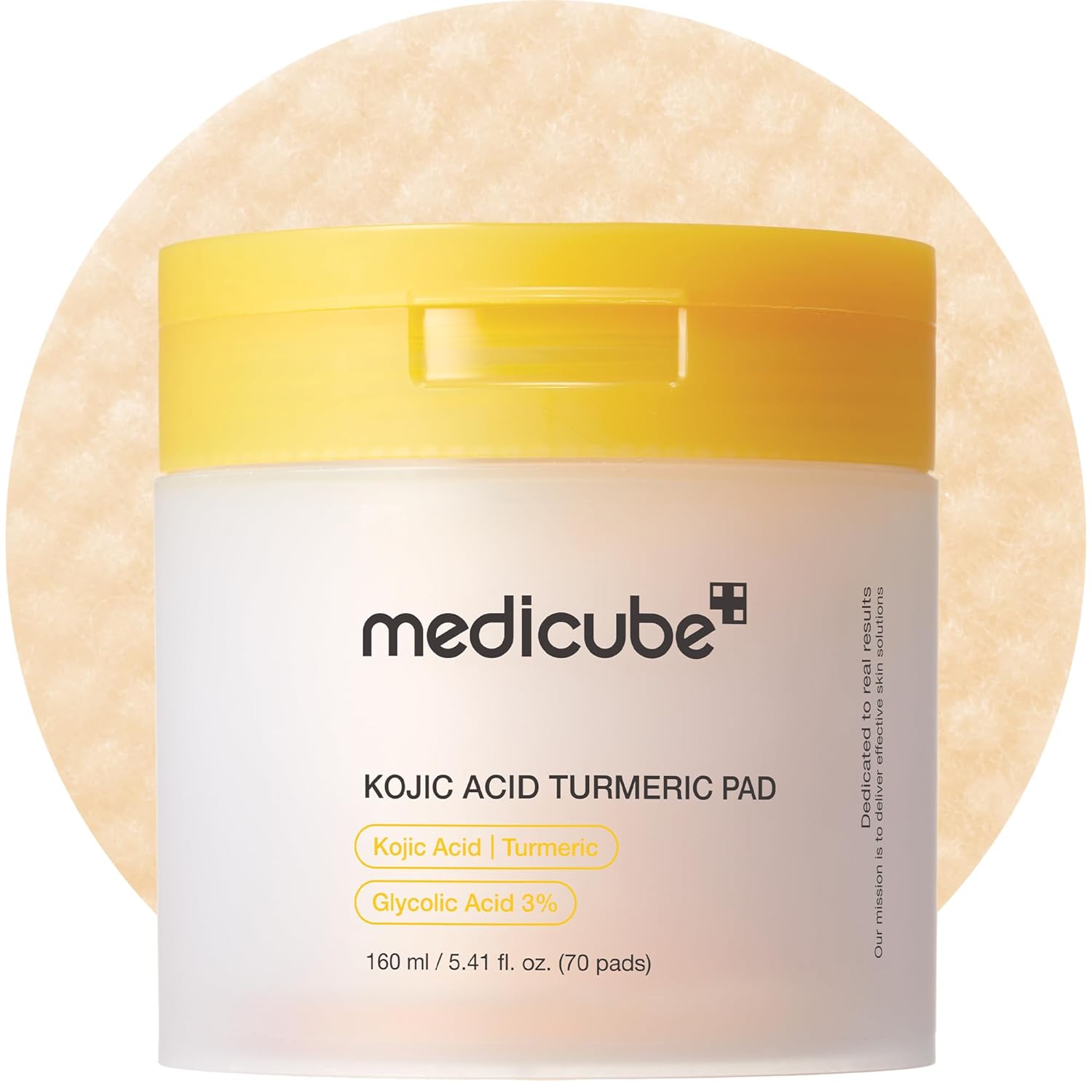 Source: Amazon - the 70-pad jar with yellow flip lid; label reads Glycolic Acid 3% and 160 ml / 5.41 fl. oz. |
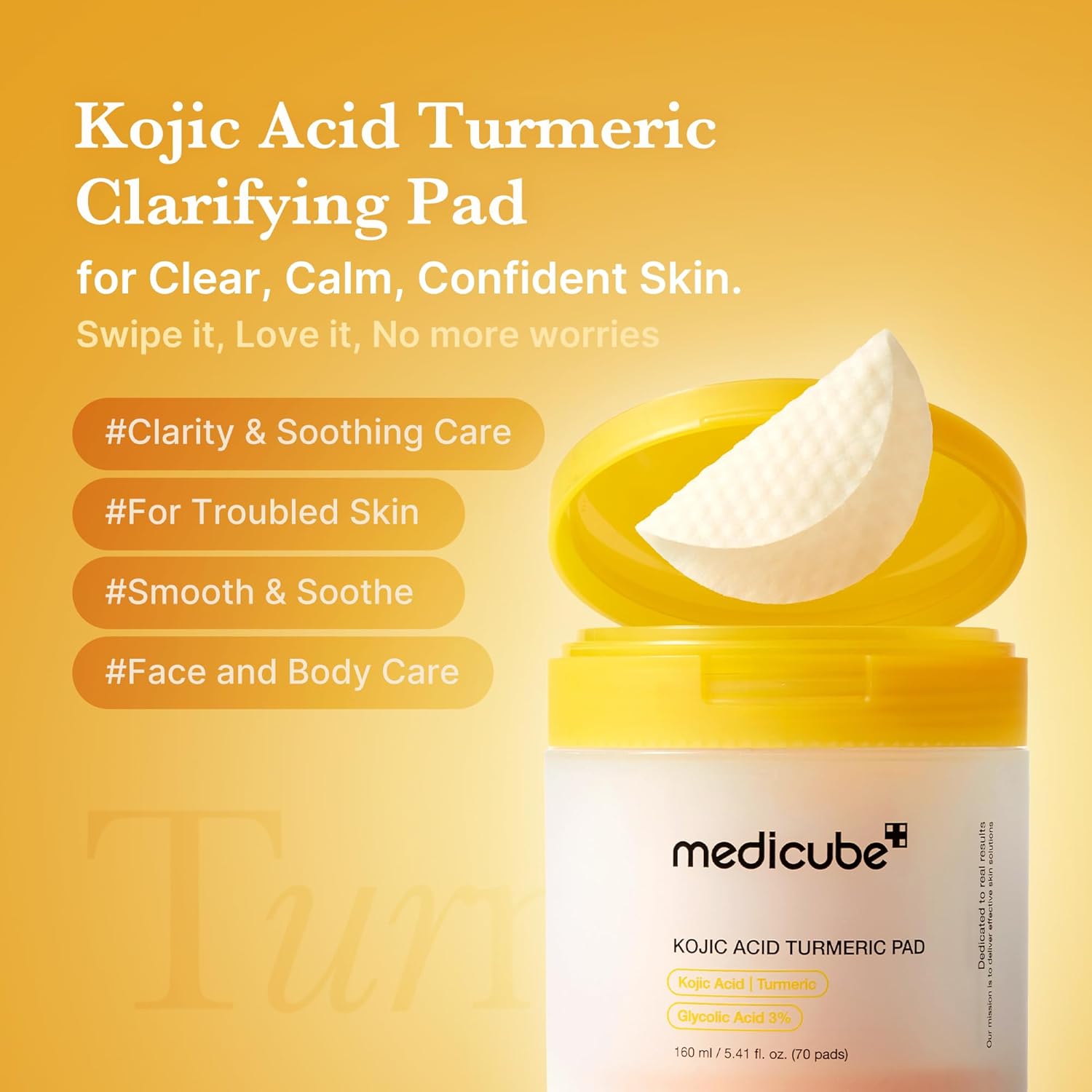 Source: Amazon - the brand's promise, Clear, Calm, Confident Skin, with one textured pad pulled from the jar. |
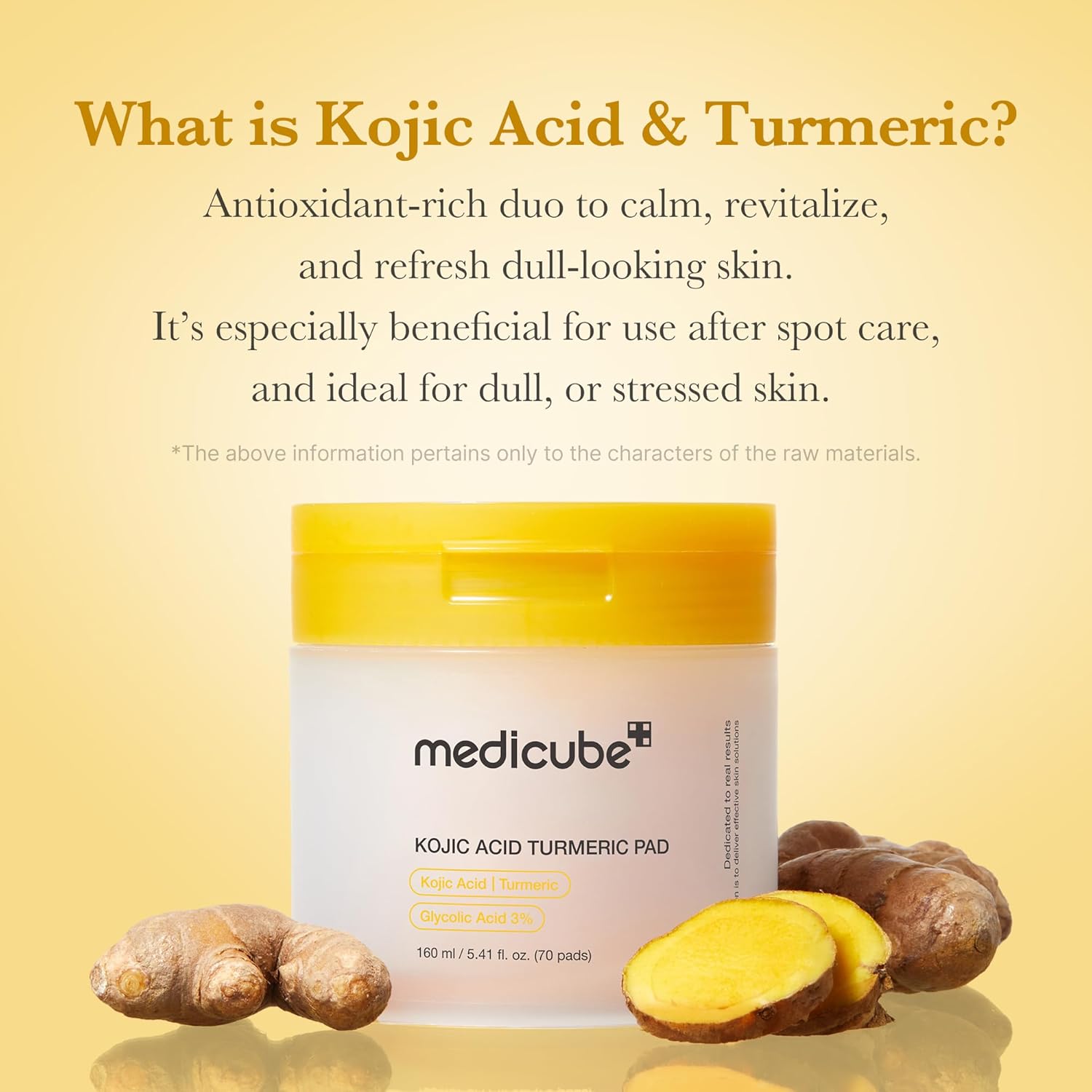 Source: Amazon - the ingredient explainer, framed by raw turmeric rhizomes and a halved root. |
1.2 At a glance
| Field | Value |
|---|---|
| Full listing title | medicube Toner Pads Kojic Acid Turmeric Clarifying Pad for Troubled Skin |
| Brand | medicube |
| Sold by | Medicube & Aprilskin (brand-operated seller, marketplace channel) |
| Category path | Beauty & Personal Care › Skin Care › Face › Toners & Astringents |
| Best Sellers Rank | #2 in Beauty & Personal Care; #1 in Facial Toners & Astringents |
| Format | Pre-saturated toner pad, 70 count |
| Volume | 160 ml / 5.41 fl oz |
| Key actives | Glycolic Acid 3%, Salicylic Acid, Kojic Acid, Niacinamide |
| Unit price | $0.27 per pad |
| Availability | In Stock - quoted to a New York 10001 address |
| Current price | $18.90 - no list price displayed on the listing |
| Rating | 4.5 out of 5, from 4,576 ratings |
Rank #2 in all of Beauty & Personal Care. That is not a subcategory position - it is second across the entire category on Amazon US, and #1 among facial toners and astringents. Of the three products analysed here, this is the one the market has moved on fastest, and it has done so in a little over a year.
1.3 Specification table
| Specification | Value |
|---|---|
| Item Form | Pad |
| Skin Type | All |
| Product Benefits | Soothing |
| Active Ingredients | Glycolic Acid, Salicylic Acid, Hyaluronic Acid, Vitamin C, Vitamin E |
| Item Volume | 160 ml |
| Unit Count | 70 Count |
| Size | 70 Count (Pack of 1) |
| Item Weight | 290 g |
| Product Dimensions | 3.58 x 3.66 x 3.82 inches; 10.23 ounces |
| Number of Items | 1 |
| Item model number | BM-FVVK-QVK1 |
| Manufacturer | medicube |
| ASIN | B0FJ21Z6BW |
One omission worth catching in the specification table. The "Active Ingredients" field names Glycolic Acid, Salicylic Acid, Hyaluronic Acid, Vitamin C and Vitamin E - and lists neither Kojic Acid nor Turmeric, which are the two ingredients in the product's name. Both are present in the formula, at positions 21 and 11 of 37 respectively. The field is incomplete rather than the product being mislabelled, but a buyer reading only the specification would not learn that kojic acid is in it.
1.4 How the brand positions it
- Kojic Acid & Turmeric for troubled skin. An "antioxidant-rich duo" to brighten and protect troubled skin and improve uneven tone and texture, positioned for use after spot care.
- Face and body smoothing care. Glycolic acid and niacinamide refine pores and smooth texture, gentle enough for daily use, and the listing explicitly names shoulders and upper back as valid targets.
- Easy and effective. Pre-soaked pads delivering "high-potency calming care" - after cleansing, after workouts, after sun exposure, or whenever skin feels stressed.
- Synergy up-sell. The brand recommends pairing with its Kojic Acid Turmeric Gel Mask or Wrapping Mask. This is the only one of the four bullets that is a sales prompt rather than a product claim.
The A+ content is two empty carousel headings reading "Product description" with no body copy under either. There is no FAQ, no comparison module, and no ingredient science beyond the third main image - which itself carries the disclaimer that its claims "pertain only to the characteristics of the raw materials". That disclaimer is unusually candid for the category and is worth crediting.
1.5 What's Inside - claim matrix
An independent product database audits twelve standard cosmetic claims. Eleven hold and one fails - the strongest pass rate of the three products in this comparison set, and not an accident.
| Claim | Verdict | Basis |
|---|---|---|
| Alcohol-free | Holds | No volatile drying alcohol. The glycols present are humectant solvents, not drying alcohols. |
| EU-allergen-free | Holds | None of the 26 declarable fragrance allergens present. |
| Oil-free | Holds | No oil-phase material; the pad is a water-and-glycol serum. |
| Paraben-free | Holds | Preservation is hydroxyacetophenone plus 1,2-hexanediol and ethylhexylglycerin. |
| Silicone-free | Holds | No silicone of any kind. Meaningful for a pad, which often uses silicones for slip. |
| Sulfate-free | Holds | No sulfate surfactant. |
| Cruelty-free | Holds | Brand claim. |
| Fungal-acne-safe | Holds | No fatty acids, fatty alcohols, triglycerides, or oils - nothing that feeds malassezia. |
| Pore-clogger-free | Holds | Only one comedogenic reading anywhere in 37 ingredients, and it is a trace antioxidant. |
| Reef-safe | Holds | No organic UV filter and no microplastic. Unusually, this is a genuine pass. |
| Vegan | Holds | No animal-derived material in the 37-ingredient list. |
| Fragrance-free | Does not hold | Contains fragrance - and the cause is the turmeric. See 3.6. |
Eleven claims, eleven absences. No silicone, no sulfate, no paraben, no drying alcohol, no essential oil, no added dye, no animal material. That is the kind of pass rate that comes from formulation discipline rather than from a forgiving database.
2. Product Rating & Reviews
2.1 The two ratings
| Source | Score | Sample | Weight |
|---|---|---|---|
| Amazon US | 4.5 / 5 | 4,576 ratings | Solid. Enough volume to be stable, small enough that a single month can move it. |
| Independent product database | 4.2 / 5 | 6 reviews | No statistical weight. Reported for completeness only. |
The two scores agree closely - 4.5 against 4.2 - and that agreement is itself notable, because ingredient-literate reviewers normally score more harshly than the mass market. Here they did not, which is the first sign that this formula holds up to informed scrutiny. But six reviews cannot establish anything, so the agreement is a curiosity rather than evidence.
2.2 Star distribution
| Stars | Share | Approx. ratings (derived) | Reading |
|---|---|---|---|
| 5 star | 78% | ~3,569 | Dominant verdict |
| 4 star | 10% | ~458 | Qualified approval |
| 3 star | 6% | ~275 | Mixed |
| 2 star | 2% | ~92 | Disappointed |
| 1 star | 4% | ~183 | Rejected |
88% at four stars or above, with a thin tail. Roughly 180 one-star ratings is small in absolute terms - far smaller than on the two mass-market products in this set - and the three-star bucket at 6% is half the size of the worst performer's. That shape says the product is delivering what buyers expect, and it is the distribution you would want to see for an acid pad: a formula the tolerant majority like, with a modest minority who find it too much.
The base of 4,576 is modest enough that a rounded bucket can move. The 2% two-star share should not be read as a precise count.
2.3 What buyers mention
| Aspect | Mentions | Positive | Negative | Positive share |
|---|---|---|---|---|
| Effectiveness | 507 | 401 | 106 | 79% |
| Skin brightening | 185 | 157 | 28 | 85% |
| Moisturizing | 141 | 103 | 38 | 73% |
| Skin irritation | 101 | 36 | 65 | 36% |
| Value for money | 95 | 70 | 25 | 74% |
| Duration | 37 | 20 | 17 | 54% |
The last complaint cluster is a single item, and it is the expected one. Skin irritation at 36% positive - 65 negative against 36 positive - is the only aspect that leans negative, and the marketplace summary reports buyers describing burning sensations. For a 3% glycolic plus salicylic acid leave-on, that is the honest cost of the format. It is also a small absolute exposure: 101 mentions out of 4,576 ratings, versus more than a thousand on the mass-market products in this set.
Everything else works. Skin brightening at 85% is the strongest aspect and the one most directly tied to the product's name and its kojic acid claim. Effectiveness at 79% across the largest volume in the set is solid. Value for money at 74% at $0.27 per pad is credible. Moisturising at 73% is a genuine surprise for an acid product and reflects the eight hyaluronic species in the formula.
Duration at 54% is the odd one. The marketplace summary records that some buyers say they will keep using it while one had to throw it away after a week. That is a two-sided signal about how long a 70-pad jar lasts in real use, not about the product's effect, and with 37 mentions it is too thin to draw anything from.
2.4 What the marketplace summary concludes
The aggregated summary states that customers find the pads effective and appreciate their skin-brightening properties, particularly for fading dark spots; that the product leaves skin feeling refreshed and is considered worth the price; and that on irritation, some report no issues while others experienced burning. It records durability feedback in both directions.
That is a clean match for the numbers and notably free of the coverage or expectation-gap complaints that dominate a tinted product. The one recurring negative is a physical sensation, and it is caused by the actives doing their job. A product whose only consistent complaint is "it stings a bit" is in a structurally better position than one whose complaint is "it does not do what it says".
2.5 Independent sentiment
The ingredient database's community votes are decisively positive: 28 ingredients liked against 4 disliked, with 5 mixed. That is the only clearly positive ingredient-level sentiment in this comparison set, and it is the opposite of the pattern on a mass-market tinted SPF. It is still only a vote count - not a safety finding, not an efficacy claim - but the margin is worth reporting.
3. Product Ingredients
3.1 The formula in one paragraph
This is a buffered acid serum carried on a pad, and every architectural decision in it is aimed at making 3% glycolic acid tolerable on a daily basis. Three actives do three jobs: Glycolic Acid at 3% exfoliates the surface, Salicylic Acid works into the pore, and Kojic Acid inhibits tyrosinase for the brightening claim - supported by Niacinamide and Ascorbic Acid from two other mechanisms. Sodium Hydroxide at position 7 is the tell: a strong base in an acid formula is there to set the pH, and it is the main reason a glycolic pad can be sold for daily use.
The soothing stack behind it is unusually deep - Panthenol, Allantoin, Dipotassium Glycyrrhizate (a licorice derivative with a documented anti-inflammatory function), Adenosine, and eight distinct hyaluronic species. Thirty-seven ingredients in total, of which six are actives and the rest is vehicle, buffer, and humectant.
| Functional group | Ingredients | Count |
|---|---|---|
| Exfoliating acids | Glycolic Acid 3%, Salicylic Acid | 2 |
| Brightening actives | Kojic Acid, Niacinamide, Ascorbic Acid | 3 |
| Soothing and anti-inflammatory | Panthenol, Allantoin, Dipotassium Glycyrrhizate, Adenosine, Tocopherol | 5 |
| Hyaluronic series | Sodium Hyaluronate, Hydroxypropyltrimonium Hyaluronate, Hydrolyzed Hyaluronic Acid, Sodium Acetylated Hyaluronate, Hyaluronic Acid, Hydrolyzed Sodium Hyaluronate, Sodium Hyaluronate Crosspolymer, Potassium Hyaluronate | 8 |
| Humectant solvents | Methylpropanediol, Dipropylene Glycol, Glycerin, Butylene Glycol, Glycereth-26 | 5 |
| Botanical extracts | Curcuma Longa Root Extract, Gardenia Florida Fruit Extract, Citrus Junos Peel Extract, Castanea Crenata Shell Extract, Fragaria Ananassa Fruit Extract | 5 |
| pH adjustment | Sodium Hydroxide | 1 |
| Preservation, chelation, texture | Hydroxyacetophenone, 1,2-Hexanediol, Ethylhexylglycerin, Disodium EDTA, Dextrin, C12-14 Alketh-12, Cyanocobalamin | 7 |
| Carrier | Water | 1 |
3.2 Ingredient risk tiers
Two independent databases were merged. Each ingredient was tiered on the highest single reading across the clogging and irritation axes - comedogenic and irritancy from one channel, acne risk and irritant from the other - with ranges judged at the upper bound. Safety grades are reported separately in 3.4, because they measure something different and here the difference is the whole story.
| Tier | Highest reading | Count | Share of 37 | Ingredients |
|---|---|---|---|---|
| Tier 0 - No known risk | 0 | 6 | 16.2% | Glycerin, Glycereth-26, Allantoin, Ascorbic Acid, Panthenol, Sodium Hyaluronate |
| Tier 1 - Very low | 1 | 1 | 2.7% | Butylene Glycol |
| Tier 2 - Moderate | 2 | 0 | 0% | None |
| Tier 3 - Elevated | 3 or higher | 1 | 2.7% | Tocopherol (Vitamin E, 2-3 upper bound) |
| Unrated | no reading on either axis | 29 | 78.4% | Remainder, including both exfoliating acids and Kojic Acid |
Twenty-nine of thirty-seven ingredients are unrated on both axes - and that group includes Glycolic Acid at position 2, Kojic Acid at position 21, and Salicylic Acid at position 26. So the chart above, read literally, says the most active ingredients in the product carry no clogging or irritation rating at all.
And the one ingredient that does get flagged is Vitamin E, a trace antioxidant at position 27, rated 2-3 comedogenic on the upper bound. That is almost certainly over-cautious for a trace material, but it is the printed reading. The result is a genuine irony: the only "risk" this chart surfaces is the least consequential ingredient in the formula, while the acid that does the work shows blank. That is a limitation of the rating framework, not a property of the product - and it is why section 3.4 exists.
3.3 Comedogenic distribution
Thirty of thirty-seven rows carry no comedogenic rating. Of the seven that do, five are at 0 and one at 1; the single range (Tocopherol 0-3) is the only reading above 1. No average has been computed over seven rated rows out of thirty-seven.
3.4 Safety grades - where the risk actually is
The second database publishes an overall safety grade per ingredient on an inverse scale where 1 is safest. This is the column that tells the truth about this product.
| Safety grade (upper bound) | Count | Share | Ingredient(s) |
|---|---|---|---|
| 1 | 29 | 78.4% | The entire vehicle, humectant stack, hyaluronic series and botanical list |
| 2 | 5 | 13.5% | Glycerin (1-2), Glycereth-26 (1-2), C12-14 Alketh-12 (1-2), Ethylhexylglycerin, Disodium EDTA |
| 4 | 1 | 2.7% | Sodium Hydroxide (1-4) |
| 6 | 1 | 2.7% | Glycolic Acid (3-6) |
| 7 | 1 | 2.7% | Kojic Acid |
Thirty-five of thirty-seven ingredients sit at grade 2 or below. The three that do not are the two acids and the base used to buffer them - and between those three they explain the entire risk profile of the product.
| Ingredient | Grade | What the grade is about |
|---|---|---|
| Kojic Acid | 7 | The maximum this database issues. A tyrosinase inhibitor; the grade reflects sensitisation potential, and contact dermatitis is a recognised reaction. Note its acne and irritant ratings are both blank - this is not a sting grade. |
| Glycolic Acid 3% | 3-6 | Concentration- and pH-dependent. Declared at 3%, the low end for a leave-on AHA. The "burning" buyers report is this ingredient doing its job. |
| Sodium Hydroxide | 1-4 | A strong base. Present only to neutralise the acid and set pH, so the low end applies here. Its presence is evidence of a buffered formula, not of hazard. |
The distinction that matters most. Kojic acid's grade of 7 is not a sting grade. Its acne and irritant ratings are both blank, and the acid that stings is the glycolic. Grade 7 here is about sensitisation - the risk of developing an allergic response over repeated use - which is a different hazard from irritation and requires a different precaution. Patching testing this product tests for kojic acid sensitisation, not for whether the acids will tingle. Those are two separate questions and the product poses both.
3.5 Concerns flagged
| Concern | Description | Basis in the formula |
|---|---|---|
| May worsen rosacea | Can trigger flare-ups in rosacea-prone skin. | 3% glycolic plus salicylic acid on a reactive barrier |
| May worsen dryness | Can strip moisture and worsen dryness. | AHA exfoliation increases transepidermal water loss despite the humectant stack |
| May worsen eczema | May worsen itching or irritation for eczema. | Same mechanism; compromised barrier plus acid |
Three concerns, all pointing at one thing. Rosacea, eczema, and dryness are precisely the three conditions where an AHA/BHA leave-on is most likely to do harm, and all three describe the same mechanism: an exfoliating acid on a barrier that is already compromised. The database has not scattered its warnings - it has identified the product's single structural weakness three times in three clinical vocabularies.
Notably absent: no acne concern and no oiliness concern. For an acid pad marketed at "troubled skin" that is a meaningful pass, and it is consistent with the pore-clogger-free and fungal-acne-safe badges. On the clogging axis this is a clean product; the risk is exfoliation, not congestion.
3.6 Complete ingredient table
All 37 ingredients with readings from both databases - click to expand
| # | INCI name | Function | Comedogenic | Irritancy | Acne | Safety | Tier |
|---|---|---|---|---|---|---|---|
| 1 | Water | Solvent | not rated | not rated | not rated | 1 | Unrated |
| 2 | Glycolic Acid 3% | Exfoliator, brightening | not rated | not rated | not rated | 3-6 | Unrated |
| 3 | Methylpropanediol | Solvent | not rated | not rated | not rated | 1 | Unrated |
| 4 | Niacinamide | Smoothing, brightening | not rated | not rated | not rated | 1 | Unrated |
| 5 | Glycerin | Humectant, solvent | 0 | 0 | 0 | 1-2 | Tier 0 |
| 6 | Dipropylene Glycol | Solvent, humectant | not rated | not rated | not rated | 1 | Unrated |
| 7 | Sodium Hydroxide | pH adjuster | not rated | not rated | not rated | 1-4 | Unrated |
| 8 | Curcuma Longa Root Extract | Fragrance (turmeric) | not rated | not rated | not rated | 1 | Unrated |
| 9 | Butylene Glycol | Humectant, solvent | 1 | 0 | 1 | 1 | Tier 1 |
| 10 | 1,2-Hexanediol | Solvent | not rated | not rated | not rated | 1 | Unrated |
| 11 | Hydroxyacetophenone | Antioxidant | not rated | not rated | not rated | 1 | Unrated |
| 12 | Glycereth-26 | Humectant | 0 | 0 | 0 | 1-2 | Tier 0 |
| 13 | Gardenia Florida Fruit Extract | Skin conditioning | not rated | not rated | not rated | 1 | Unrated |
| 14 | Dextrin | Absorbent, viscosity control | not rated | not rated | not rated | 1 | Unrated |
| 15 | C12-14 Alketh-12 | Emulsifier | not rated | not rated | not rated | 1-2 | Unrated |
| 16 | Ethylhexylglycerin | Preservative booster | not rated | not rated | not rated | 2 | Unrated |
| 17 | Allantoin | Soothing, anti-inflammatory | 0 | 0 | 0 | 1 | Tier 0 |
| 18 | Adenosine | Skin conditioning | not rated | not rated | not rated | 1 | Unrated |
| 19 | Dipotassium Glycyrrhizate | Anti-inflammatory | not rated | not rated | not rated | 1 | Unrated |
| 20 | Disodium EDTA | Chelating agent | not rated | not rated | not rated | 2 | Unrated |
| 21 | Kojic Acid | Brightening | not rated | not rated | not rated | 7 | Unrated |
| 22 | Cyanocobalamin | Skin conditioning (vitamin B12) | not rated | not rated | not rated | 1 | Unrated |
| 23 | Citrus Junos Peel Extract | Skin conditioning | not rated | not rated | not rated | 1 | Unrated |
| 24 | Castanea Crenata Shell Extract | Skin conditioning, plant extract | not rated | not rated | not rated | 1 | Unrated |
| 25 | Ascorbic Acid | Antioxidant, brightening | 0 | 0 | 0 | 1 | Tier 0 |
| 26 | Salicylic Acid | Exfoliator, brightening | not rated | not rated | not rated | 1 | Unrated |
| 27 | Tocopherol | Antioxidant | 0-3 | 0-3 | 2-3 | 1 | Tier 3 |
| 28 | Fragaria Ananassa Fruit Extract | Skin conditioning | not rated | not rated | not rated | 1 | Unrated |
| 29 | Panthenol | Soothing, anti-inflammatory | 0 | 0 | 0 | 1 | Tier 0 |
| 30 | Sodium Hyaluronate | Humectant | 0 | 0 | 0 | 1 | Tier 0 |
| 31 | Hydroxypropyltrimonium Hyaluronate | Humectant | not rated | not rated | not rated | 1 | Unrated |
| 32 | Hydrolyzed Hyaluronic Acid | Humectant | not rated | not rated | not rated | 1 | Unrated |
| 33 | Sodium Acetylated Hyaluronate | Humectant | not rated | not rated | not rated | 1 | Unrated |
| 34 | Hyaluronic Acid | Humectant | not rated | not rated | not rated | 1 | Unrated |
| 35 | Hydrolyzed Sodium Hyaluronate | Humectant | not rated | not rated | not rated | 1 | Unrated |
| 36 | Sodium Hyaluronate Crosspolymer | Humectant | not rated | not rated | not rated | 1 | Unrated |
| 37 | Potassium Hyaluronate | Humectant | not rated | not rated | not rated | 1 | Unrated |
Coverage: 37 of 37, complete. "Not rated" is missing data, never a zero.
3.7 Where the two databases agree and disagree
| Measure | Database A | Database B | Effect |
|---|---|---|---|
| Row count | 37 | 37 | Exact match - no formula version gap |
| Highest comedogenic | 0-3 (Tocopherol) | 2-3 (Tocopherol) | Same ingredient, same conclusion |
| Highest irritancy | 0-3 (Tocopherol) | 2 (Tocopherol) | Agreement |
| Glycolic Acid | not rated on either axis | not rated on either axis | Agreement by omission - neither rates it for clogging |
| Kojic Acid | not rated on either axis | not rated on either axis | Both silent; only the safety column catches it |
| Fragrance verdict | Fragrance-free: No | Two fragrance-function hits | Both correct - see 3.7.1 |
| Safety grade | Not published | Published, reaches 7 | The scale difference that decides everything |
The two channels agree on all 37 ingredients and still tell contradictory stories about risk. Database A's maximum reading anywhere is 3; Database B's reaches 7. Neither is wrong. Database A measures clogging and irritancy, where this formula is genuinely excellent - 11 of 12 claims pass, nothing is pore-clogging, and the vehicle is silicone-free and oil-free. Database B's safety column also captures sensitisation potential, where kojic acid is a recognised concern.
The single most decision-relevant fact about this product is invisible in the table that looks most complete. A 37-row ingredient list with 30 blanks reads as thorough; it is in fact silent on the two ingredients doing the work. That is why the two tables are kept separate here rather than merged into one score.
3.7.1 The fragrance verdict resolves cleanly
The two channels appear to contradict each other on fragrance and do not. Database A says Contains Fragrance. Database B shows no Parfum entry. The Amazon listing names no scent.
The resolution is in the function labels: Database B classifies Curcuma Longa Root Extract under the single function Fragrance, and Butylene Glycol carries Fragrance among its five labels. So the verdict is correct, the evidence is in the taxonomy rather than the INCI names, and the fragrance source is the turmeric itself - the ingredient the product is named after and photographed beside on the packaging.
That makes this the most interesting claim failure here, because it is structural rather than incidental: the brand cannot make this product fragrance-free without removing turmeric, and removing turmeric removes the product's identity. A buyer avoiding fragrance for sensitisation reasons should treat it as a real flag. A buyer avoiding added perfume can disregard it. Those are different questions and this report does not collapse them.
3.8 Benefit claims and support
| Benefit | Ingredients delivering it | Assessment |
|---|---|---|
| Hydrating | 15 | Strongest claim in the formula - eight hyaluronic species plus five humectant solvents |
| Scar Healing | 11 | Well supported by the actives; the second-highest count measured |
| Anti-Aging | 9 | Good - acids plus adenosine plus antioxidants |
| Barrier Repair | 8 | Good, and consistent with the soothing stack |
| Brightening | 6 | Well matched to the named actives |
| Reduces Irritation | 6 | Credible - the buffering and licorice derivative earn this |
| Redness Reducing | 6 | Same basis as above |
| Dark Spots | 5 | Well matched - kojic, niacinamide, ascorbic, glycolic, salicylic |
| Skin Texture | 4 | Core claim, adequately supported |
| Acne Fighting | 3 | Moderate - salicylic acid is the real basis |
| Good For Oily Skin | 3 | Moderate |
| Reduces Large Pores | 3 | Weakest claim - no ingredient in the formula is a pore-size active |
Twelve benefits averaging six ingredients each - far broader support than the other products in this comparison set, where eight of twelve claims rested on a single ingredient. But the ranking is revealing: Hydrating is the top claim on an exfoliating acid pad, and Scar Healing is second. The product's name promises brightening and clarification; those rank fifth and ninth. The formula is measurably better at calming and hydrating than at clarifying, which is consistent with its buffered pH and its eight-species humectant stack - and it is the most useful thing this framework tells you about the product.
4. Price Analysis
4.1 Current price position
| Field | Value |
|---|---|
| Current price | $18.90 |
| List price on the listing | None displayed |
| List price in the tracking record | $21.80 |
| Current vs list | -13.3% - genuinely below list |
| Unit price | $0.27 per pad |
| Subscribe & Save | $17.01 (10% off) |
| Currency | USD, native. No conversion applied. |
This is the only product in the comparison set actually selling below its own list price, and the only one whose list price functions the way a list price normally does. $18.90 against $21.80 is a real 13.3% discount, and the average across the whole record has been 19.9% below list.
4.2 Fourteen-month price history
| Price type | Lowest ever | Highest ever | Current | Average |
|---|---|---|---|---|
| Amazon (first-party) | - | - | - | - |
| 3rd Party New | $14.90 (25 Mar 2026) | $52.99 (18 Nov 2025) | $18.90 (12 Oct 2026) | $17.47 |
| 3rd Party Used | - | - | - | - |
The Amazon row is empty across all four cells. In fourteen months of tracking, no first-party Amazon offer has ever been recorded. The product is sold by the brand through a marketplace arrangement, so it sits under 3rd Party New rather than under Amazon - this is a structural fact about how it is sold, not a data gap. The used row is empty for the ordinary reason: a sealed cosmetic has no secondary market.
Two limits on this record should be stated before any figure is quoted. It is fourteen months long, not a decade - monitoring began 21 Aug 2025 - so every "all-time" value means "since launch". And the $52.99 high is not credible as a single-unit price: 2.4 times list for a 70-pad jar, recorded three months after launch. See 4.5.
4.3 Price comparison across the history table
With one channel and no first-party series, the useful comparison is against the list price rather than between channels. Set against $21.80, the current $18.90 sits below list and far below the $52.99 outlier - though it is 8.2% above the $17.47 average rather than below it, and that average is itself inflated by the outlier. The list-price bar is the anchor: this is the only product in the set whose current price is lower than that anchor.
4.4 Where the current price sits in the range
At the 10.5% position of its fourteen-month range, $18.90 is close to the historical floor of $14.90. That is a materially different reading from the other two products, both of which sit mid-range or above. It also means the downside is limited: the product has only been cheaper than this once, in March 2026, and only by $4.
4.5 Dated extremes over time
Six dated observations, joined for legibility. This is not a continuous price series and the lines between points are not observed prices.
The trajectory is a launch curve. The record starts in August 2025, peaks at $52.99 in November 2025 - three months in - then falls to its floor of $14.90 by March 2026 and has settled in the high teens since. A launch-window high followed by a settling low is the classic signature of a new listing: early scarcity or bundled offers produce an outlier, then the price finds its level once supply normalises.
Two readings of the $52.99 figure are possible and the data cannot separate them: a genuine launch scarcity spike, or a multi-pack or reseller offer captured as a single-unit price. The second is more likely at that multiple of list. The high should be excluded from any estimate of normal price, and it inflates the $17.47 average upward - which means the average slightly overstates how expensive the product usually is.
4.6 Derived analysis
| Measure | Value | Derivation |
|---|---|---|
| Spread (high - low) | $38.09 | high minus low |
| Spread as share of low | 255.6% | spread / low |
| Average vs list price | -19.9% | (avg - list) / list |
| Current vs lowest ever | +26.8% | (current - low) / low |
| Current vs highest ever | -64.3% | (current - high) / high |
| Current vs average | +8.2% | (current - avg) / avg |
| Current vs list price | -13.3% | (current - list) / list |
| Position within all-time range | 10.5% | (current - low) / (high - low) |
| Cost per pad | $0.27 | current / 70 |
| Subscribe & Save vs current | -10.0% | (S&S - current) / current |
A 255.6% low-to-high spread is not credible as ordinary retail movement. Over fourteen months with a stable SKU, the plausible range for a single 70-pad jar is roughly $14 to $25. The $52.99 observation sits far outside that, and excluding it leaves a much tighter and more believable band. That exclusion is inferential and flagged as such, but it is the only reading that makes the series internally consistent.
4.7 Price verdict
$18.90 is a fair price, and the best-justified of the three products analysed here. It is 13.3% below the product's own list, 10.5% of the way up its recorded range, and $0.27 per pad for a 70-pad jar. The record is short and rests on one channel, so it describes a product still settling rather than one with an established level - but within that short record, the price is near the floor rather than the ceiling. The current price sits 8.2% above the fourteen-month average only because the average is dragged up by a $52.99 launch-period outlier. Subscribe & Save at $17.01 takes it below every point in the record except the March 2026 floor.
5. Verdict
5.1 The case for
- Rank #2 in all of Beauty & Personal Care, #1 in Facial Toners & Astringents. The market has settled this question.
- The cleanest claim matrix in the set: 11 of 12 passed. No silicone, sulfate, paraben, drying alcohol, essential oil, added dye, or animal material - eleven absences by design rather than by luck.
- Genuinely buffered for a daily acid. Sodium Hydroxide at position 7 is the evidence, and it is why a 3% glycolic pad can be sold for everyday use.
- The soothing stack is real, not decorative. Panthenol, Allantoin, Dipotassium Glycyrrhizate, Adenosine and eight hyaluronic species - which is why Hydrating at 15 ingredients is the top-supported claim and moisturising runs 73% positive.
- Four actives, four mechanisms. Glycolic for surface, salicylic for pore, kojic for tyrosinase, niacinamide for tone - a coherent brightening formula rather than a list of trending names.
- Priced below list, near the floor of its own range, at $0.27 per pad.
- Strong sentiment from the hardest audience. 28 ingredients liked against 4 disliked, and a 4.2 community score that matches the 4.5 market score rather than undercutting it.
5.2 The case against
- Kojic Acid carries the maximum safety grade this database issues. Grade 7, and it is a sensitisation risk rather than a sting - which means patch testing is testing for the right thing, and repeated use is the exposure that matters.
- Three concerns, all barrier-related. Rosacea, eczema, and dryness. Predictable for a 3% AHA plus BHA, and disqualifying for anyone in those groups.
- It stings. Skin irritation at 36% positive - the only aspect that leans negative - with buyers reporting burning. That is the honest cost of the format.
- Contains fragrance, and the source is the hero ingredient. The turmeric that gives it its name is filed under a fragrance function. Structural, not fixable.
- The specification table omits both kojic acid and turmeric from its active-ingredient field, so the page undersells its own formula.
- The price record is fourteen months and one channel. No long-run history, no first-party series, and an outlier that distorts the average.
- Hydrating and Scar Healing rank above Brightening and Dark Spots in the support counts - the formula is stronger at calming than the name suggests.
5.3 Who it is for
| Profile | Assessment | Basis |
|---|---|---|
| Dull, uneven tone, post-blemish marks | Excellent fit | Four brightening mechanisms; skin brightening 85% positive |
| Tolerant skin wanting daily chemical exfoliation | Strong fit | Buffered 3% AHA, humectant stack, 79% effectiveness |
| Body use - shoulders, upper back | Good fit | Explicitly supported by the brand; pad format suits the area |
| Acne-prone, clogging-averse | Good fit | Pore-clogger-free and fungal-acne-safe both passed; salicylic acid as the basis |
| Silicone-averse or vegan | Excellent fit | Both badges passed - rare for a pad |
| Rosacea | Avoid | Specifically flagged concern |
| Eczema or compromised barrier | Avoid | Specifically flagged concern |
| Dry or dehydrated | Avoid or use sparingly | Specifically flagged concern; the humectants do not offset daily AHA for this group |
| Sensitive to fragrance | Caution | Contains fragrance - turmeric root extract |
| Fragrance-sensitive, kojic-acid-naive | Patch test first | Grade 7 sensitisation risk on the namesake active |
5.4 Bottom line
This is the best-built formula of the three products analysed, and it is the only one whose price is genuinely below its own list. Thirty-five of thirty-seven ingredients sit at safety grade 2 or better; eleven of twelve cosmetic claims pass; the buffering is deliberate; the soothing stack is deep enough that hydration - not exfoliation - is the best-supported benefit. A 3% glycolic pad that people describe as calming is a formulation achievement.
The two things a buyer needs to know are both printed on the label and both easy to underweight. Kojic acid is the highest-graded ingredient here, and its risk is sensitisation, not sting - which is a slow, repeated-exposure hazard, not an immediate one, and it is why patch testing this product is not a formality. And this is an acid: the three flagged concerns are rosacea, eczema, and dryness, and the one negative review aspect is burning. For skin that tolerates acids, it does what it says at a fair price. For skin that does not, no amount of humectant stack will change that.
6. Method, Confidence and Limitations
6.1 Coverage
| Channel | What it supplied | Coverage |
|---|---|---|
| Amazon US listing | Title, breadcrumb, 13 specifications, 4 bullets, 3 main images, price, rating and star distribution, aggregated review-aspect analysis | Complete for everything listed |
| Price tracking record | Identifiers, list price, fourteen-month all-time low/high/current/average | Complete; only one of three price types carries data |
| Ingredient database A | 37 ingredients with acne, irritant, and inverse safety grades | 37 of 37 - full match |
| Ingredient database B | 37 ingredients with comedogenic and irritancy ratings, 12 benefits, 3 concerns, 12 claim badges, community votes, product rating | 37 of 37, 12 of 12, 12 of 12 - complete |
6.2 Stated gaps
- Individual review bodies did not render. No verbatim buyer review is quoted anywhere in this report. Section 2 relies on the marketplace's aggregated aspect analysis - derived summary data, not testimony. The 4,576-rating aggregate is complete and unaffected.
- No buyer-uploaded photos. The listing exposed no customer image tiles, so only the three main listing images appear. Listing imagery has not been substituted for buyer photos.
- No list price on the listing. The $21.80 figure comes from the tracking record and is labelled as such throughout; the current price being below it is a comparison across two sources, not a discount displayed on the page.
- The record is fourteen months long. Every "all-time" statement means "since 21 Aug 2025".
- No first-party price series at all. The product has never been sold by Amazon directly in the tracked period.
- The $52.99 high is treated as an artefact. Inferential, and flagged wherever it affects a conclusion.
6.3 Confidence
| Element | Confidence | Basis |
|---|---|---|
| Product identity, specs, rank | High | Read directly from the listing |
| Current price and unit price | High | Native USD at a US delivery address |
| Rating and star distribution | High | 4,576 ratings; stable shape |
| Review aspect percentages | High | Marketplace-published aggregate with mention volumes |
| Individual review text | Not available | Did not render; not reconstructed |
| Complete 37-row ingredient list | High | Both channels agree at 37 |
| Clogging and irritancy ratings | Medium | Good agreement; 30 of 37 unrated on both axes |
| Safety grades | Medium | Single database, inverse scale reaching 7 |
| Price history figures | High | Transcribed verbatim; single channel |
| Current price freshness | Medium | Tracked observation 15 days stale; listing price read on the snapshot date |
| The $52.99 high being an outlier | Low | Inferential; no observation-level data |
| Community rating (4.2) | Very low | Six reviews |
| Derived percentages | High | Arithmetic on transcribed values |
6.4 Limitations
- Snapshot, not a trend. Rank, price, and review counts move daily.
- Price history is all-time only within a fourteen-month window. No period-specific statistics exist in this source.
- No observation-level price series. The timeline in 4.5 joins four dated points and does not represent a continuous series.
- An unrated ingredient is not a safe ingredient. Thirty of thirty-seven rows carry no rating on the clogging axes, including both exfoliating acids and kojic acid.
- Ingredient ratings describe ingredients, not this product. A 3% buffered AHA on a pad behaves differently from the same acid at 10% at low pH.
- Ratings are community aggregates, not clinical findings. Neither database is a regulatory or dermatological authority, and the kojic acid grade in particular varies by jurisdiction and concentration.
- The 4.2 community score rests on six reviews and should not be used to rank this product.
- No reviewer identities appear anywhere in this report, by design. No handle, name, profile reference, or identifier has been reproduced.
6.5 Currency and language
All amounts are US dollars, read natively at a United States delivery address. No currency has been converted, estimated, or presented as a range. This report is entirely in English.